Software
Houzz Logo Print
waneright

Pro Mix?

8 years ago

I made the great mistake of using this stuff and then wondered why I was not having any success. And I recently learned, it contains no nutrients. I can only guess that all I did was starve my plants to death.

Whar purpose can this stuff possibly serve?


Comments (24)

  • 8 years ago

    What did you use it for? How did you use it?

  • 8 years ago

    What rgreen said..love Pro mix.

  • 8 years ago

    Like all good quality potting soil mixes (not the doctored up MG stuff). ProMix is a soil-less mix. It will not contain nutrients. The focus of any container planting mix should be durablity, fast drainage and good aeration. ProMix is quite satisfactory in addressing these concerns. Providing nutrients or the need for fertilization should always be the responsibility of the grower/gardener, never of the potting mix.

    btw, I assume this was being used for containerized plants. It is not intended for inground gardening, even as an amendment, and is excessively expense to use in that manner.

    If you don't know already, growing plants in containers is very different from growing plants in the ground and a whole different set of methods and "rules" apply :-)) You may want to post any further questions on the Container Gardening forum where these issues are discussed in detail. This forum is more focused on inground soils and how to improve them.

    Jim Waneright thanked gardengal48 (PNW Z8/9)
  • 8 years ago

    In containers, I added nothing and little grew.

    As a starter medium, it seems to be a good idea. I wonder if it would have helped if the packaging said "contains no nutrients" with maybe some guidelines. For example: Hollytone offers a list of plants that would benefit from its use.

    Still, hard lesson learned....


  • 8 years ago

    Potting soil is potting soil........HollyTone is a fertilizer. They are two entirely different products used for two entirely different purposes.

    And I do not mean to be disparaging, but most container gardeners with any experience under their belts are well aware that potting soil will need to be augmented with fertilizer.

    btw, let me just add another complicating factor to this issue. A dry organic fertilizer - like HollyTone - is not a good choice for fertilizing containers. Organic fertilizers require the processing and digesting by soil organisms to convert them into plant usable forms. And since the vast majority of commercial potting soils contain minimal to NO populations of these organisms (and there is nothing in the mix to support their lives anyway), dry organic ferts are pretty much useless in these conditions and just wasted, with the plants recognizing no benefits from their application. You are better served using a fully water soluble or liquid fertilizer, typically of synthetic derivation.

  • 8 years ago

    I will add on to the very good advice that GardenGal48 and others have given.

    Even gardeners that are religiously organic in their garden beds, when it comes to containers, will use a well draining neutral potting medium in containers and then feed the plants with a carefully selected synthetic fertilizer. As GardenGal said, organic gardening assumes a living soil ecosystem which requires diversity. Containers are just too small to develop all the bacteria, fungal, and insect populations that make organic gardening possible.

    So, I wouldn't ditch the ProMix. Just pick up some synthetic fertilizer that matches the needs of the plants you are growing and you will be good to go. That's all that was missing.

  • 8 years ago

    Keep in mind that, if one wishes to remain completely organic, there are also many types of soluble organic ferts that can be used in containers at any stage of growth.

  • 8 years ago

    Well, I'm not sure I would say there are 'many'......but the choices are growing. Unfortunately, few of them offer a full range of nutes, the exception being seaweed emulsion. And even the emulsions are not fully water soluble

  • 8 years ago

    "A dry organic fertilizer - like HollyTone - is not a good choice for fertilizing containers."

    Yes, I am fully aware that they are not interchangeable and was not planning ot use it in a container. I only made reference to reflect the fact that some products offer insights on how to use their product.

    I am not sure if these insights of what I should have known will rekindle my interest in container plants. I am struggling with my gardens in general and may let a lot go to seed this year....


  • 8 years ago

    Container gardening - successful container gardening - does require more specific knowledge than does inground gardening. By that I mean, you can go outside and toss a bunch of seeds on the ground and chances are pretty darn good a few, if not most, will germinate and grow. But you will not get those same sort of results doing it in a container unless you monitor all the input - media, water, fertilizers, etc. and provide ongoing attention. An inground garden can survive with a fair amount of neglect.......a container garden will just wither away and die with a similar amount of neglect :-)

  • 8 years ago

    I read, probably here, that someone had problems with sprouting tomato seed. It would root and produce the primary leaves but when the secondary leaves grew the plant would die. Apparently this was consistent for over 30 attempts (20 at a time).

    Could the problem happen if the growing medium was strictly promix? Such a small seed would not have much in the way of nutrients and would have exhausted its source quickly since promix, according to the responses, has no nutrient value?

    Just wondering....

  • 8 years ago

    NO potting soil has any nutrient value......unless it is an added product like a Miracle Gro soil. Generally, seeds and seedlings require no supplemental fertilization until after their second set of true leaves develops. And even then, not very much. If there were problems before that point it was likely due to something like damping off.

  • 8 years ago
    last modified: 8 years ago

    I think the short answer to your question is... yes, a seedling could die if planted in such mediums - if it had no further access to nutrients. The long answer is that there may be some other issue that is also acting to weaken or kill the plant, However, the first lesson on this subject is to understand the qualities, characteristics, and capabilities of whichever medium you choose. You'll want to choose the one that best fits your needs, and then learn how to use it to achieve the particular goals you have in mind.

  • 8 years ago

    "NO potting soil has any nutrient value......unless it is an added product like a Miracle Gro soil. "

    Yet all the talk shows seem to leave it at "Use potting mix" with no addressing fertilizer and nutrients.

    Generally, seeds and seedlings require no supplemental fertilization until after their second set of true leaves develops. And even then, not very much. If there were problems before that point it was likely due to something like damping off.

    I am not sure what "damping off" is. I just purchased something called "Seed Starter" Can I expect some success here?


  • 8 years ago

    Gardening talk shows are not your friends :-)) Information provided there is sketchy at best, lacks any detail and may very well be totally inaccurate. Or they may assume you already have that knowledge. But you can do a little research on your own - the Container Gardening forum will have oodles of info about various potting soils and how and when to fertilize container plants. Or the Winter Sowing forum should have info on how and when to fertilize new starts.

    Google search on 'damping off'. And a sterile seed starting mix should help but may not prevent it entirely.

  • 8 years ago

    Jim, what's your light situation for these seedlings?

  • 8 years ago
    last modified: 8 years ago

    'Damping off' is actually the name for a mold/fungi attack on new seedlings. It causes the stem to weaken, rot, and the seedling will fall over. It almost always attacks the stem where it meets the soil, and it happens most often when the medium is too wet, and the air is humid. There's a lot of advice out there to use humidity domes, but the most experienced seed starting gardeners don't use them except for specific circumstances where extra humidity is needed. Those domes are the top cause of a newbies having their seedlings fail due to damping off.

    I use a seed starter for many seeds. the one I have used a long time is Jiffy Mix - otherwise known as Jiffy Seed Starter. It's been a very consistent formula for many years, and works well for me. I don't use much of it. In fact, these days I just fill my trays with my own transplant mix and top them off with 1/2 inch of the Jiffy. If you do have a lot of damping off, you can use a fan to keep the air moving. Fungi like that which causes damping off prefer static air.

  • 8 years ago

    Maybe just luck but I have never had "damping off" as described.

    Lighting: My front hall has Northeast morning light through frosted windows so that is of no help. My other location is bright southwest windows that almost bake the plants.

    As for artificial light, I can supply dual 4' fluorescent lamp fixtures and/or 40w - 60w CFLs. I hear that CFLs offer no beneficial light. All within 3" of the pot surface and raised when the plants grow.

  • 8 years ago

    I ask because people will often proudly display seedlings with 2 leaves and 3 inch stems. Plants that start out light starved like that usually don't recover well.

  • 8 years ago

    Over the years, I have potted and seeded up many a plant with scarcely a modicum of success. I am not sure what drives me. Gardener's optimism?

    As I get older any my arms get shorter, it looks as if I should change over to cultivating weeds.

    I take it that what I mentioned for lighting is adequate, yes? I do keep them on a timer but oft don't know how much they want/need. If nothing else, the set up looks as if I really know what I am doing. (:

    What took me quite a while to learn is that tomato plants really cannot be forced into a longer season if started in January. They develop slower and weaker than if started in March. So much work and electrical expense. If set out too early, they will get stunted anyway. Too many lessons learned.

    The later to the seed's natural germination time the better the result. Yes, indoor to protect from the cold is a benefit but that is about all.

    Now I learn that most of my draw backs were caused by a serious problem believing that Promix was an end-all cure-all that only exacerbated the struggle.

    I just started 4th-of-July and Eros tomatoes along with two other specialty ones. I also read recently that Artichokes can be grown so that is in the experimental mix too. From there, any seed goes into the soil outside in raised beds,

    No, all that time wasted not knowing how to use Promix really took a toll on my interest for any early season jump start.

    In the past, I was using 8 dual-fluorescent lamp fixtures and 16 trays of pots but now down to one fixture and two trays. I will probably sell/give-away a lot of stuff this year.


  • 8 years ago

    Will you be able to quit? I’m more driven to plant seeds than I am anything else in March. I may quit gardening some time, but I’ll never quit planting seeds or composting.

    I use Pro mix with success for seedling starting. I agree with you that starting seeds too early is not in the plant’s best interest. I don’t know if lighting is your problem. If they’re really long-legged, it is.

  • 8 years ago

    I'm beginning to think the problems you've been experiencing are what I'd call nearly universal. And I don't know where to start to try to help you.

    Easy answers for where to start are light and bottom heat. The books I'd recommend are the book of Garden Secrets by Hinshaw-Patent and Bilderback and park's success with seeds.

    I'm really not sure where to start. Change one thing, you can change everything. Change everything, you don't know what was right and what was luck and what was wrong. you may think you're on the right track...but you may be chasing blind alleys thinking you have accomplished something.

    A simple question: Do you know what seeds need light to germinate and what seeds need dark? Does particle size of your germination mix ever play a part in your decisions?

    You say you've been doing this for a while, but have never met damping off? Yet have near catastrophic failure every time? On the first, you're very lucky or quite good. which makes the latter extremely peculiar.

    There has to be a gardening club near you...someplace where you can find someone who can put their eyeballs on what you're doing and provide answers based on that rather than just descriptions.

  • 8 years ago

    "Change one thing, you can change everything. Change everything, you
    don't know what was right and what was luck and what was wrong. you may
    think you're on the right track...but you may be chasing blind alleys
    thinking you have accomplished something."

    Got got that right. I
    teach programming and one-change-at-a-time is the order of the day.
    Unfortunately in gardening, change one thing and you have to wait an
    entire growth cycle to see if it made any difference.

    It has not been all that catastrophic, just increasingly frustrating. I spent a lot of time learning about Promix. If only it had said something on the package....

    "Will you be able to quit?" You got that right there too, Annpat (: This may be my problem over all. Many tiny little packages of seed are all talking to me. Seeds collected from the garden, Seeds that fell into my cart at the store. Shall we talk about seed catalogs and on-line shops? Hey a package of seed costs only about $2 and look, it is 40% off. Sometimes you get 10,000 seeds in a package. It even has an excellent picture of the flower on the cover. It doesn't say that the flower is only 1/8" wide.

    Add to that 300-400 4" pots, dozens of trays, holders, humidity domes that I so optimistically purchased not to mention the four 4-shelf wire racks purchased on sale.

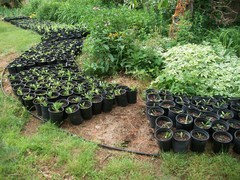
    My biggest issue one year (6/4/12) was sprouting seeds and repotting them into 6" flower pots that I got free from a "friend" and used only promix. The medium may not have been the only reason for 100% failure. A lot of the seedlings were biennial I learned later. Pots need a lot of watering and winter care. I was so optimistic:


    Every plant in the garden is just another heart waiting to be broken.....

    I just set up 36 4" pots of Artichoke, and three types of tomatoes......

    I just received 6 types of Onion sprouts and have seed potatoes (mostly fingerlings and russets) that I put up last year.

    Unfortunately, my arms are another inch shorter this year.

    The beat goes on.