Software
Houzz Logo Print
cleonard45

Dekton Countertops

8 years ago
Has anyone used Dekton Countertops or have any Intel on them? we are doing a high-end renovation of a kitchen that includes a 13-foot island that doesn't have anything on it- no sink, no cooktop. we are either going to have to order a custom slab or have a seam. Dekton claims to be the best material for a seamless look, but the fact that it is Home Depot's main material for countertops seems to be a red flag. any thoughts?

Comments (36)

  • PRO
    8 years ago

    It's all about the fabricators, and this type of countertop is notoriously difficult to install. Use Glacier White Corian - it will all look totally seamless. You may not think of it as "high end", but in the UK and Europe it is used in VERY high end houses.

  • 8 years ago

    Why is it being offered by Home Depot a "red flag"?

  • PRO
    8 years ago

    I am a fabricator. 13' long means either a special order slab (expensive and long lead time) or a seam. I would not say a well done seam in Dekton is any more or less conspicuous that one in quartz. A granite seam might be problematic as the granite slabs are not perfectly flat and you might have lippage at the seam. The best way I know to make a perfect 13' island is to use bookmatched slabs, make a shop joint (epoxy the seam in the fab shop) and then repolish the seamed pieces if there is objectionable lippage. This approach requires a better than average fab shop. With a well done seam the primary reason the seam will be noticeable will be the grain transition. if you select a homogeneous color (little or no grain) it's a lot easier to make a barely noticeable seam.

  • PRO
    8 years ago

    oldryder yes you are correct but did not imply a seam in dekton is any better than the same seam that is done correctly in any other stone would be better.

    Would have to totally disagree with your comment of seam and lippiness. A seam should not be lippy if it is set correctly and with the right gear. The better seam setter have the ability to take out twists in the stone if you know what you are doing with them.

    Bookmatching is good if you are after the butterfly effect, but any good fabricator should be able to pattern match the perfection, especially Cosentino products as they put alot of R&D into their products for this reason.

    The problem of repolishing the join, is that you will void the warranty and really there is no need to do this if set correctly. Beside you will never get the original finish unless you put it back on an inline polisher or a Jenny Lind which we assume you are doing, if this is your process of doing joins.

    Any colour, pattern etc should be a barely noticeable seam if you know what you are doing etc.

  • 8 years ago

    Depending on your style and budget, it would be worth the time to look for quartzite slabs to bookmatch. With a 13’ long run, there is an opportunity to create something truly beautiful. Good luck!!

  • PRO
    8 years ago

    "Would have to totally disagree with your comment of seam and lippiness. A seam should not be lippy if it is set correctly and with the right gear." Not entirely accurate. Since standard granite slabs are not perfectly flat you can easily have areas where the thickness of the 2 pieces of stone are different at the seam which generates the lippage. (Think of the top surface of the slabs as having a slight wave to them.) The longer the seam the more likely it is that there will be an area where the thickness of the seamed pieces is different enough to produce lippage even tho the surfaces are flush everywhere else. On shorter seams (like 25" deep countertops) the seam setting tools can usually provide enough mechanical leverage to bend or twist the stone enough to make the top surfaces of the stone flush. However, even there it's possible to have minor lippage that can only be eliminated by grinding the joint. Of course the shop seam and repolish option takes a fabricator that can repolish granite to a factory finish which is not a common capability. However, given this approach it is possible to make what appear to be giant one piece islands. (Then you have to figure out how to get them installed which is often another big challenge.)

    This is less of an issue with materials like quartz and Dekton type products because they are manufactured as slabs instead of sawn from giant blocks of raw material and are "flatter". I am not suggesting repolishing manufactured materials.

  • PRO
    8 years ago

    "Dekton will not stain, lose it polish, scratch etc even remotely as much as corian will if at all. "

    ALL totally untrue! Corian will not stain - it is a solid surface and most stains can be wiped off - it something is left for weeks, it can have a light sanding with a ScotchBrite pad. It develops a patina, but can be republished if a high shine is what is wanted. Scratches are surface scratches - even porcelain can get those. Just avoid using a dark color.

    I've had the same Corian Glacier White countertops now for 33 years. I re-used them when I re-did my kitchen almost 2 years ago, as they were still in perfect condition. Seams are invisible, it is a very durable material and it looks great.

    Dekton and other brands of porcelain are lovely, but can be a bear to fabricate/install, and many people have had major problems with chipping.

  • PRO
    8 years ago

    oldryder the thickness variation associated with any material should be addressed in the factory by dry fitting the pieces together as you would with any seam. This enables you to thickness the exposed edge to the correct thickness so both pieces are flush top and bottom. A pretty standard practice.

    Yes the longer the seam the more deviation that could be seen if it is not seam set correctly. But again if you use the right equipment and methods this is not an issue as we never have had a lippy join. It may mean you need to use more than one seam setter even on 2' feet wide pieces or 25" as you have put it. Block clamping the front ensures the front is perfectly level and true.

    Again all pieces should be dry fitted and check in the factory as it make life so much easier on site. As you know everything fits to the templates, and fit together correctly.

    Granite is no different to quartz or porcelain like dekton. It just requires sometime a little more prep work in the factory.

  • PRO
    8 years ago
    last modified: 8 years ago

    Anglophilia We are not sure where you got your information from about Corian not staining but it does.. Wendy's icecream use to use it an it would stain from the pink packets being handed across the counter. Your personal experience would an an exception to the rule

    Just a quick google search will show you that. Plus we have do numerous repair from corian that has stained, been heat damage or cracked.

  • 8 years ago
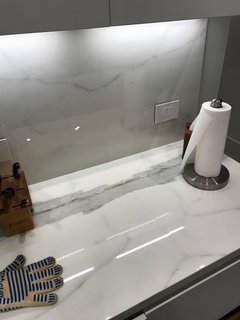
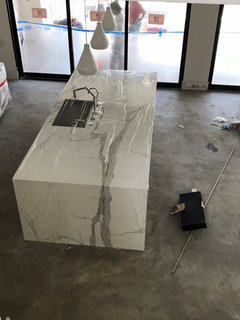
    I haven’t used Dekton, but it was one of the options I looked at for my kitchen. I ultimately ended up using Neolith, a competitor, because they had the most realistic marble look of all the man made materials I was able to see in person. My island was only 10 ft so I was able to use a single slab, but I do have a seam on one of my perimeter counters and adjacent backsplash. You can see them if you’re looking for them but they’re not noticeable.

    Pic 1 is the counter and backsplash with the two seams. Pic 2 is the island during construction with plastic covering it.
  • PRO
    8 years ago

    good to see that your fabricator pattern matched it makes for a much nicer job

  • PRO
    8 years ago

    "Yes the longer the seam the more deviation that could be seen if it is not seam set correctly. But again if you use the right equipment and methods this is not an issue as we never have had a lippy join. " This is still wrong. Imagine mating 2 pieces with non flat surfaces over a seam of 36 or 48". You can clamp the outside edges so the surfaces are flush at the edges but the "wave" in the non flat surfaces can create lippage at the seam in certain area away from the edge. Seam setters will not flex the stone enough to remove an offset at the joint in the middle of the stone if the offset is large. Hence the follow-up of repolishing which grinds and polishes the top surface thereby removing the lippage. We are not really disagreeing; minor lippage can be removed with seam setters even on long seams. However, I have seen lippage due to wavy stone surface that no combination of seam setters was ever going to fix. If you still believe this is wrong we can just agree to disagree. I will confirm that a shop seam followed by a repolish makes a beautifu,l apparently seamless island as we have done it multiple times over the years.

  • PRO
    8 years ago

    I "get my information" from having had Corian countertops for 33 years!!! It is also used extensively in hospital settings, and I think it would be unlikely they would choose a material that would stain. Pink packets passed over a countertop could not possibly permanently stain Corian. I think it's YOU who has the incorrect information as you want to see other types of countertops!

  • 8 years ago

    Where are you from Cara? If you are near my fabrication facility i would love to show you some options and much smaller our seams are.

  • 8 years ago

    So ... no-one has actually commented who actually has actual Dekton in their actual house??? Hmmm ...

    I have an acquaintance who has a large slab of Dekton as the island countertop in her extremely hard-working semi-commercial kitchen, and she loves it. They use and abuse it, dance on it in their high heels, chop on it, shove pastry around on it, and it's taken a beating for a few years now and is still going strong. It's the Makai pattern.

    I looked into it for our kitchen, but because I wanted it cut out around an under-mounted apron-front sink and I was concerned about the infamous chipping on non-factory edges, I walked away. Plus, there aren't any experienced fabricators in our area, which is an issue.

  • PRO
    8 years ago

    We have seen stone fabricators do this method with disastrous results. OBviously you are not doing that to any quartz products, just natural. Get to see someone with some skill at refinishing the polish

  • PRO
    8 years ago
    last modified: 8 years ago

    Unlike natural stone or engineered stone, no one has ever had to use a poultice to remove a "stain" from Corian. Maybe a little 400 abrasives, but that's about it.

    Seams in engineered stone and sintered (Dekton) can be inconspicuous, but compared side by side, Glacier White Corian seams would be nearly invisible. If a "seamless" 13-foot island is the priority, there is no question as to the material choice.

    This solid surface top has a seam running its length. Nothing seams like solid surface.

  • 8 years ago

    oldryder 100% correct. I spent the first 10 years of my carrer managing primary sawing via gangsaws and wire saws. both methods can cut "banana" to a certain extent. This is the reason seam setters were created, how ever you can bend all you want but if you end up with 5" left of lippage your not bending that no matter how many tools you throw at it. If I cant dry fit a level seam in shop with just shims I will level it as far towards the back wall as I can then resurface the rest of the way. No special tools just a grinder with some line polisher bricks on it then finish off with some tenoxide buffing compound.

  • PRO
    8 years ago
    last modified: 8 years ago

    granite guru Yes I understand the shot or wire cut gang saws etc and even block saws, like you we use to process our our slabs from blocks. But a inline polisher will take out most the rippes or as you put it banana effect. But this is only on usually hard granites like calca red etc. Plus everything now that is of decent quality is block sawn or at least thickness and then inline polished.

    My suggestion it is not the stone, but the quality of the stone being supplied as you are aware you pay more for "A" grade product but most the cheaper stuff would not even rate a "D"

    So yes agree, but most stone fabricators do not know how to face polish or even what acids should be used to polish granite etc. let alone what tin oxide powder was. The secret here is you guys are using polishing stones not diamond pads as you are aware of the secrets of face polishing. This is why there are so many different "off the shelf Polishing Products etc" as you are aware most the old skills are lost in the advance of not Stonemasons being able to process materials like Dekton aka porcelain which does take some skill.. but quartz is where the real problems lay. Because you can get away with abusing it in a fabrication and installation way, where if you did the same to any natural it would be on the floor in a million pieces. Also why guys can not edge polish black granite to a high shine or without the graying lines or patches.

    But again if you are playing with inferior grades of granites, you will have the lipping issues, but again you can eliminate this in the factory ... rather than the job site.

  • 8 years ago
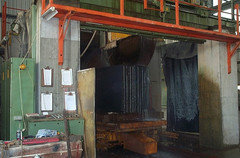
    The banana I’m talking about is not removed by line polishers they will de-rough the inconsistencies of the cut but not a banana over the height of a slab. The heads are adjusted by air pressure therefore over a gradual banana they will only follow the shape not straighten it out. This is also why the thickness of slabs vary from corner to corner and centre, the line polishers will not calibrate it will only polish what it is given. To calibrate it out it you need to have a fixed hight like a z axis on a cnc with a gauging wheel. Primary sawing for thin materiel for countertops and construction paneling is typically cut with wire saws or the older method of steel shot in a gang saw. A block saw is the work horse of the monument and landscape industry where they typically cut smaller blocks into thick slabs. The fact that the block saw works on a bridge with a cross travel makes it less than practical to saw thin slabs. When it gets down the the last foot of the block the accuracy goes out the window and when it comes time to do your maximum downs the last 3-4 slabs are extremely dangerous to go get. I used to work with 2 gang saws and a 12’ blade block saws. The thinnest we would cut was 2” and even 2” I’ve seen some diamonds hit the wall!
  • PRO
    8 years ago

    granite guru when i first started my apprenticeship we were using the shot gang saws for processing blocks that where 50" long, 7-8" height and about the same in width.

    Then they moved to Block Saws and the blade was 3 metres or 12" odd Million dollar machines back in the 80's. Yes I too have seen segments come off and hit the wall but only when they hit a plug and feather left in the core holes for splitting the blocks from the quarry. But like anything the right equipment in the hands of the right people anything is almost possible.

    You are right the best you can get on granite and especially anything super hard is 20mm thickness so is still way less an 2" or 50mm on a block saw. Yes a gang saw would be quicker as it has 10-20 blades cutting at once. But a block saw is not far being it and much better for stone that needs to be used a facias or countertops. But like you said, most the time cutting under 2" is difficult and on some stones impossible.

    The inline polishers we where using were not air but hydraulic and most of the older and better inline polishers are. This means that what you are saying that the banana can not be taken out... actually can. Yes you are correct may not be 100% a true plan but is pretty close.


  • 8 years ago

    VH have you had any issues with chipping and cracks with your Neolith? I agree that Neolith's marble looks way more realistic than Dekton but I have seen way more complaints on Neolith as a product and a company. Dekton seems to have a much better reputation.

  • 5 years ago

    VH, your Neolith is beautiful! Thanks for taking the time to share pix! I am leaning towards Dekton Olimpo-going through HD & they partner with Cosentino, thus for sintered we must choose a Dekton. I hope you could share your loved experience with the sintered product. So much concern with splitting and chipping.

  • 5 years ago

    VH- can you please update on your Neolith and if it has chipped etc. Thank you

  • 4 years ago

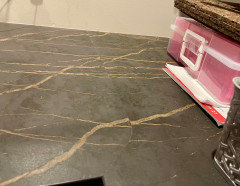
    I just had Dekton installed as a countertop. It does have seams and they look terrible! Can anyone tell me if they have experiences this same thing? Can you also tell me if this is normal, or if it was caused by a poor installer??


  • 4 years ago

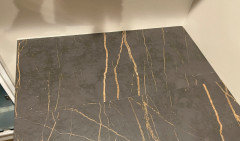
    Gosh, I am so sorry. I think this is a result of poor templating. Our fabricator said when planning the surface they ”print” the veins to align. I will snap a close up

    of our Dekton Olimpo. Your colour is bold and striking. I encourage you to complain.


  • 4 years ago


  • 4 years ago

    Wow, that really looks nice. I think ours is probably an installion issue. Our design team is Novare Renovation and Design, and they have been a remodel nightmare! They used Innovative Surfaces for our countertops and the granite they installed all turned out fine, but the Dekton was a disaster! Thank you so miuch for your quick response and the photo!

  • 4 years ago

    Oh thank you so much for your kind comment. I love your colour and wish you a successful resolution.

  • 4 years ago

    I'm considering Dekton countertops. Any updates on durability? Is cracking and scratching an issue for those of you who have had it installed? Anyone with input on the installation?

  • 4 years ago

    We have had ours for 3 months and no issues, We do baby it though.

  • 4 years ago

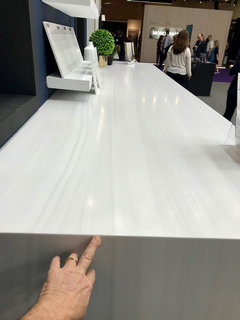
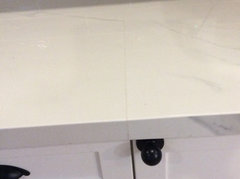
    Sd1962 - glad to hear that you are happy with your Dekton! Did you start with 2cm slabs and do mitred edges? They look thicker in your photo above. I’m curious what you asked your fabricator to do to achieve this result (and have the design show on the edges, vs plain white)…

  • 4 years ago

    Hi DMAC3620, thank you very much. the edges are mitred to the max thickness. They said it is now standard to have the pattern show on the edge. I think they just take a strip and somehow attach it. We are very happy with Dekton’s gleaming surface.

  • 4 years ago

    I am remodeling my kitchen and trying to decide on countertops for indoors, so I was looking at discussions. I thought I would comment on Dekton too.

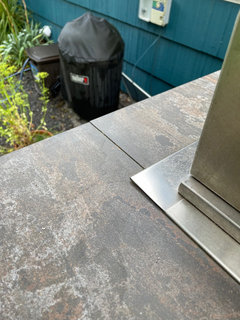
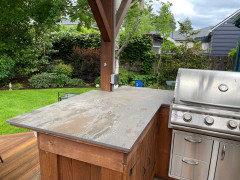
    I currently have corian (or something similar) in my kitchen. I like the corian and have little complaints other than I don’t love the color/pattern options. I have Dekton outside. I put it out there about ten years ago, when people here had no idea how to install it nor had even heard of it. They installed it incorrectly (the company had insisted they install, luckily). It cracked from the corner and they came out and put a brand new piece in. It has lasted outside in all weather ever since and been great! I have one tiny seam behind the grill, so not noticeable to me, but would be if it wasn’t hidden. This picture is unwashed and unused for the winter. The thing to know is the edges don’t carry any pattern that is on top. But, it handles heat fresh off the grill as well as direct sunlight, snow and rain. If you don’t live somewhere who can fix it if it cracks, I may hesitate. My hesitation now is cost and feel. It is a bit rough (very little bit, but present) and, inside, I like the smoothness of corian or quartz. The funny thing is the roughness may just be that it has not been washed for 8 months!

  • 4 years ago

    I am glad to read more experiences with this relatively unknown material. It was hard to find authentic consumer feedback when we were remodelling. They were able to put pattern on our mitred edge.