Software
Houzz Logo Print
abqconiglio

Should I give up on my Ashmead's Kernel?

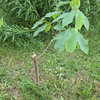
I've had this tree for five years now, and last year was the biggest harvest, of two apples. Which were wormy. Come to think of it, all my apples are wormy. I've read that if you don't spray (and I did spray last year, but not at the right time I suppose), that you get some wormy apples, but it is very rare for me to get a worm free apple, maybe one in 50. Maybe I should get rid of all of them.

Comments (6)

  • 8 years ago

    Yes...if you're not willing for regular sprays.. or more work bagging then get rid of them and plant something else...I'm thinking of berries.

  • 8 years ago

    Thanks, that helps me with my decision. Out it comes! Maybe I'll put in flowering crabapples instead, or a flowering cherry. I've always had a soft spot in my heart for those.

  • 8 years ago

    Duh !

    If all you wanted was flowers than why did you bother with fruiting trees?


  • 8 years ago

    LOL! Well, the whole point was to have fruiting trees, but after...hmm...I just checked, it's actually 6 years... and only two apples last year, I'm thinking that it is not worth it. It's not that I started out only wanting flowers. I wanted fruit! I wanted to make tart tatin, and apple pie, and have apples that you couldn't buy anywhere to make those things or eat fresh. Now, given the choice, I'd rather have flowers and easy care than a lot of work and neither flowers nor apples (it's not that the trees don't have flowers, but they certainly don't look like much, compared to the flowering versions). I was kind-of hoping someone would say "yeah, I had Ashmead's for 5 years and in the 6th year it was fabulous" or "Just do xxxx, and presto, the worms will be gone without much work!" Nope, those dreams are gone. Time for reality.

  • 8 years ago
    last modified: 8 years ago

    noseometer,

    I have Ashmead's Kernel now going into its 5th year. I have had fruit the last three.

    There is a minimal spray regimen that will give you fruit. The flavor of the Kernel will blow your socks off.

    There are some old posts here by Aalan Haigh (Harvestman) that set out the minimalist spray that will give you fruit.

    For Ashmead's Kernel it is well worth the effort.


    See below - looks long but it is really not

    Posted by harvestman 6
    (My Page) on Fri, May 11, 12 at 18:27

    Here's my spray schedule for the scores of
    orchards I manage around SE NY. It has
    functioned

    well for me for over 2 decades, although J.
    Beetles and brown rot of stone fruit increases the

    number of sprays some years some sites.

    I commonly mix those three chemicals with
    the exception of triazide, but I've mixed other

    pyrethroids with Cap and Immunox (myclobutanil).

    The main issue you are likely to encounter
    is captan anywhere near oil. You can't mix the two and

    shouldn't even
    spray them within about 14 days of each other.

    If your problem with CAR requires control, myclobutanil
    is your best option. One spray of myc. at petal fall and one more 10-14 days
    later should control it. I use
    myclobutanil with the brand name Immunox .

    =======

    Dormant oil (this is optional if there were no mites or
    scale issues the previous season).

    Do oil spray somewhere between the point where emerging
    shoots are 1/2" and the flower

    clusters begin to show a lot of pink. Mix Rally or
    Immunox (myclobutinol) at highest legal rate

    with 1 to 2% oil. If it's closer to pink use 1%.

    Don't spray again until petal fall when petals have
    mostly gone from latest flowering varieties and

    bees have lost interest. Than spray Imidan (or triazide
    or something equally affective) + Nova +

    Captan mixed together at highest legal rates (you may
    want to drop the Captan because of

    increasing concerns about health risks). Repeat in 10
    to 14 days.

    Where I manage orchards, the space between earliest
    flowering Japanese plums and latest

    flowering apples is only 2 weeks or so (not this year)
    which usually allows me to wait until the

    latest flowering trees are ready to begin spraying
    anything. Plum curculio seems to time its

    appearance conveniently to the rhythm of the last
    flowering apple varieties. This may not be true

    where you are.

    If plums or peaches need oil they may need application
    before apples. I�ve only had mites on

    European plums here and never need oil for other stone
    fruit.

    All this is based on plum curculio being the primary
    insect problem which is the case most areas

    east of the Mis. River. These sprays will also
    absolutely control scab, CAR and Mildew as well

    as most of the crop fatal insects. Apple fly maggot is
    an exception, but I haven't had much of a

    problem with this pest in the orchards I manage. This
    pest can be controlled with a lot of fake

    apples smeared with tangle trap.

    If you don't want to use synthetic chemicals try 4
    applications of Surround about a week apart

    starting at petal fall. You may need to start on
    earlier flowering varieties as soon as they drop

    petals. When weather isn't too hot you can mix hort oil
    at 1% once or twice.

    Other problems may occur later in the season and you
    will in time learn to monitor and react to

    the pitfalls.


    Mike

    noseometer...(7A, SZ10, Albuquerque) thanked mes111