Software
Houzz Logo Print
mc510

Diagnose boron or sodium toxicity?

8 years ago

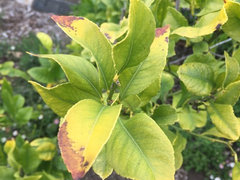
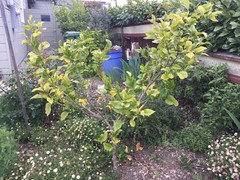
My young dwarf Eureka lemon tree shows symptoms that are exactly like those of boron toxicity and sodium toxicity. Local water supply has boron below 100 ppb and sodium below 26 ppm, so I don't think that the water is the problem. My nearby lime tree (15' away) does not have similar symptoms. Are there other things that can cause leaf damage that looks like boron/sodium toxicity? Advice on what to do? The tree has suffered ever since I planted it five years ago; I think I need to either address the problem or give up and remove the tree.

Comments (14)

  • 8 years ago
    last modified: 8 years ago

    Both these toxicities can result from improper soil or improper fertilisation. Also salt damage (not necessarily from sodium) can present similar symptoms. Use of too much fertiliser containing chlorine (for example potassium chloride) can result in this also. Boron toxicity is rare if water is OK, but can result from applying improper fertiliser. I have a friend who managed to poison his citrus with boron by applying too much compound fert formulated for olive trees.

    mc510 thanked nikthegreek
  • 8 years ago
    last modified: 8 years ago

    Kelley, I’ve picked off all of the really affected leaves, but here’s an example of moderate damage. Seems to be more prevalent near the top, less down low.

    I dont fertilize much, just a couple of light applications of citrus fertilizer in the summer. After five years, it’s less than five feet tall and somewhat sparse.

    Possibly relevant that there is a concrete storm sewer culvert below? I'd guess maybe eight feet down, should be well below any roots from this sad specimen.

  • 8 years ago

    It might be salt build up from minerals in the water. I have hard water and my Meyer had burns on its leaf tips and eventually defoliated, but I grow in a container where that is more likely to happen. I water only with rain water now. Hopefully some of the in grown growers will chime in.

  • 8 years ago
    last modified: 8 years ago

    Do you know your soil and water pH? This looks like extreme nutrient deficiency to me. You can try fertilising repeatedly with an N rich compound fertiliser but without knowing if conditions are alkaline or acidic (and the rootstock) I cannot provide more advice. Maybe a couple of foliage applications of N plus nutrients and micros can provide a quick temporary fix but the issue is within the soil (be that soil or root)... Flying dragon trifoliate, which is a common dwarfing rootstock, is no good in alkaline and calcareous conditions, and lemons are particularly susceptible.

    mc510 thanked nikthegreek
  • 8 years ago
    last modified: 8 years ago

    Good question, Nik; ag extension in California no longer does soil tests, so I don't know. Tho I guess pH is something that I can test myself; I'll look into that. We've had good rain past two years so I haven't had to irrigate that much, but our local water supply is somewhat alkaline (8.2-8.9 according to the utility's own report).

    Not sure about the rootstock, I'll look into that.

    Thanks all!

  • 8 years ago
    last modified: 8 years ago

    If your soil is alkaline (not to mention calcareous) it will be easy to explain the issue. I'm pretty sure that if a planted my few potted dwarf citrus in the ground this is more or less the look I would get after some time... That's why I take budeyes and bud them on other rootstock if I want to plant this variety in my garden. You need tolerant rootstock for these conditions. If your conditions are alkaline but borderline (and certainly not calcareous), then you can try fertilising with ammonium sulphate as the primary source of N for a quick fix and enrich your soil with sulphur for more permanent results. On the other hand, if your conditions are not like mine then either you will need to fertilise properly for a citrus tree (which you currently are not) or there's something very wrong with the root and/or the planting hole.

    mc510 thanked nikthegreek
  • 8 years ago

    mc510 - 8.2 - 8.9 is on the higher side of alkaline in terms of citrus requirements, which prefer more in the 5.5 - 6.5 range. You may need to consider adding some type of acidifier to the soil if you irrigate with your tap water more than what the rains naturally provide (and I know California has had inconsistent rainy seasons in the past but I have been glad you guys finally got some kind of rainy season these past 2 years). It could be that there was a buildup down in the soil that happened during those lean years when you had to manually water. Finally, you may want to clear the area under the tree canopy so the tree is not competing for nutrients.

    mc510 thanked jenny_in_se_pa
  • 8 years ago
    last modified: 8 years ago

    At least my soil is not calcareous, if that means chalky ... it's actually nice loam and clay in layers. I've ordered a pH test kit and will get to the bottom of the soil pH question!

  • 8 years ago

    "relevant that there is a concrete storm sewer culvert below"....That fact right there could be your whole problem. You would be surprised how far from concrete the soil can become calcareous. I would move the tree.

    mc510 thanked johnmerr
  • 8 years ago
    last modified: 8 years ago

    !!!!

    Okay, let’s see how the soil pH test goes. I’ll post back when I have results.

    BTW, I have heard from the grower that the rootstock should be either C35 or Cuban Shaddock. For what that is worth.

  • 8 years ago

    The lime in concrete will move horizontally or down vertically but wll not travel upwards in the soil. Its leaching is a factor of water movement and unless you periodically have a very high water table - which would be rare in CA - the culvert is NOT an issue!

    mc510 thanked gardengal48 (PNW Z8/9)
  • 8 years ago
    last modified: 8 years ago

    AFAIK C35 does not tolerate high pH well. No idea about the Shaddock.

    Over here Sour Orange had been used for ages as a rootstock (non dwarfing) for lemons until CTV was traced in one commercially productive region. I believe Volckameriana is mainly used now. Even on Sour Orange, lemons are the first of the common citrus to exhibit nutritional issues on high pH and calcareous soils. One can grow a lemon and a sweet orange tree side by side and see real difference. We have no need for concrete to make our soils basic, our native limestone does that.....

    Calcareous includes 'chalky' but is not limited to that and has nothing to do with the soil's mechanical properties (sandy, loam, clay). The chemistry is complex. Suffice to say that what matters is the percentage of free ('active') calcium in the soil (in the form of CaCO3) not the total amount of it.

  • 8 years ago

    The presence of concrete, brick, etc. at the surface or deeper, where any taproot reaches it is always deleterious to citrus. I would move the tree; better, I would never have planted it there.