Software
Houzz Logo Print
meubank1

fiddle leaf fig advise

8 years ago

Hi,

My husband purchased the fiddle leaf fig for my birthday about 2 weeks ago. He bought a moderately large one. I have heard the are difficult to care for so my anxiety about it is already high. I have been testing the soil and only watering when first 1" of soil is dry. In otherwords i've only watered twice since getting it (about 1x per week). I have also been misting it daily, but after doing some reading am thinking i need to stop that. It is currently sitting next to a southern facing window about 9 feet from a huge forced air heat vent in the floor. I know this is not the ideal location for it, and am planning to move it to an eastern facing window that is further away from the heat vent.

Anyway my fig is showing some brown spots on the underside of its leaves and a new grown crack has formed at the tip of one of the leaves. I also noticed one scale that i plucked off with my finger nail. and some sort of small gnat -like bug hovering above the soil. There is a root exposed at the top of the soil as well. and a white powdery appearance to the surface of some of the leaves, which i wiped off with a damp cloth

I'm thinking that the answer is to repot? but wondering what would be the best medium, is there a recipe out there for a well aerated soil for a fig? and any step by step tutorials of how to repot and trim the root ball would be helpful.

Any reccomendations for fertilizer?

Thanks!

Comments (11)

  • 8 years ago

    Happy Birthday two weeks ago! The best place to get information would be the House Plants forum on here. This section is for edible figs and your plant is a house plant. They are very knowledgeable over there and should be able to help you. Good luck.

  • 8 years ago

    Dirtguy,

    you must be in the wrong section. This is container gardening, not the fig section.

    Op, you’re overwatering if you’re watering when only the first inch of soil is dry. The lower portions could be still very moist.

    Misting is not needed.

    South facing window would be best.

    Photos would also help.

  • 8 years ago

    Ooops, my bad. My apology to meubank1. Must have missed my meds last night.

  • 8 years ago

    There are specifications you should follow when fertilizing a Fiddle Leaf Fig Tree. You may find this post helpful. I'd love to hear your feedback! How Often Should You Fertilize Your Fiddle Leaf Fig?

  • 8 years ago
    last modified: 8 years ago

    My feedback:

    I submit that no one should offer advice so specific as 'to fertilize at each watering' w/o a good understanding of the grower's soil choice and watering habits; or unless the advisor offers instruction enough that the grower ends up understanding how to prevent serious issues associated with high TDS/EC levels and the limitations imposed by badly skewed nutrient ratios in the soil. The limitations I speak of are exactly those that spawned the commonly repeated myth that plants shouldn't be fertilized during the winter months, from the reasoning it's better to withhold fertilizer than to force the plant to suffer from high salinity because 'the soil' won't allow the grower to flush salts from the soil at will, w/o the plant being forced to suffer from an extended interval during which a large fraction of the soil mass remains saturated.

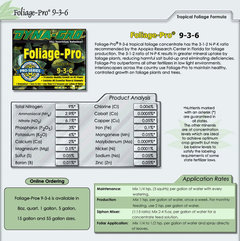
    I also noticed that the fertilizer linked to is said to have a favorable 3:1:2 ratio, but nowhere in the details does it mention the NPK %s. Because of the very small volume of water a teaspoon of the FLF fertilizer is mixed with to make a solution of appropriate strength, NPK %s must necessarily be extremely low. For comparison, if fertilizing at every watering with Foliage-Pro 9-3-6 (another 3:1:2 ratio fertilizer), the suggested rate is 1/4 tsp per gallon, or 1 teaspoon for every 4 gallons. So 1 tsp of the FLF fertilizer Claire links to makes 16 oz of maintenance strength solution, where 1 tsp of the Foliage-Pro 9-3-6 makes 512 ounces. If I divide 512 by 16, I come up with the embarrassing fact that your FLF fertilizer is in the neighborhood of being only 1/32 the strength of 9-3-6. Note where the decimal points are in the NPK %s of the FLF "fertilizer" suggested in the link in post above mine - NPK %s = 0.28 : 0.09 : 0.06. I don't know how others feel, but I think this is dishonest, and because there is no apparent way to know what we're buying - deceitful. No wonder we can't readily find the NPK % or even what's IN the product. Micro-nutrients? Magnesium? What's the source of the N?......

    I put that FLF "fertilizer" in the same 'scam' category as Eleanor's VF-11, which has NPK %s of 0.15 : 0.85 : 0.55 and actually delivers far more "fertilizer" than the FLF product. I'll make it a point to warn others any time I see this product touted.

    Al

  • 8 years ago

    Thanks for your comment Dave.

    t's very interesting - we actually tested a 9-3-6 fertilizer in our trials. We tested 6 formulas originally. Al is right; that one performed almost exactly as well as the formula we ended up using. The reason we chose the 3-1-2 formula is that there's virtually no risk of over feeding and they can use it at every watering. Since 70% of FLF owners are first time houseplant owners, they are not necessarily going to be able to remember to fertilize every few weeks, once a month, etc. I tested both ways of feeding - every month with the 9-3-6 and every week with the 3-1-2. The plants both looked amazing - but we chose the 3-1-2 to reduce the risk of overfeeding and make the product simpler to use for our novice clients. FLFs can do very well with lots of fertilizers, they do not have specific requirements, which I am open and honest about. I make my products to provide something easy to use, but you could certainly use another formula.

    Claire


  • 8 years ago
    last modified: 8 years ago

    You're confused. 3:1:2 is a RATIO, and your fertilizer contains NPK somewhere near the shamefully low %s of 0.28 : 0.09 : 0.06, which is nowhere near 9-3-6. 9-3-6, 12-4-8, and 24-8-16 are all commonly used examples of 3:1:2 ratios. It's absurd to try to convince people that your product somehow makes it easier to fertilize. Both products need to be mixed in water. 8 oz of your product makes 384 oz of maintenance dose solution. The same volume of FP 9-3-6 costs less than 1/3 the amount of your "fertilizer", and makes 24,576 ounces of solution with the same NPK %s. So it makes 64X as much at 1/3 the cost, which means you're asking people to pay 192X as much for their fertilizer; this, w/o knowing what's in it or the source from which it derives it's nitrogen.

    BTW, I fertilize every time I irrigate during the winter (but not summer), and I use FP 9-3-6. I can't speak for others, but I would NEVER purchase a product that claims to be "fertilizer" but doesn't list the NPK %s OR inform the customer what, aside from NPK, is in it. Caveat emptor!

    Dyna-Gro provides a detailed ingredient mix for everything it contains above trace amounts, and provides its N source. I'd be very interested in exactly what is in your "fertilizer"?

    Al

  • 8 years ago
    hello to all! I also have film on leavesof 2 FLF plants from time it was bought at big box garden store. the film is mostly white, but a few areas seem light turquoise aqua , I wondered if this was results of Miracle-Gro or similar. I have wiped them with a damp cloth and they seem to disappear but then reappear when dry. New growth is not affected, and I don't suspect mealybugs

    Any recommendation for cleaning agent? repeat wiping with warm water and drop of dish soap? some type of oil such as coconut or Olive as I've seen in other posts?

    thanks!!
  • 8 years ago

    Hi Al,

    Our NPK percentage is 3-1-2. I'm not sure where you are getting your information from.

    If you'd like to develop your own fertilizer for ficus lyrata, you are welcome to use whichever formula you'd like.

    I've spent three years testing my formula, and it's what I've decided to go with. Thanks,

    Claire

  • 5 years ago
    last modified: 5 years ago

    Our NPK percentage is 3-1-2. That's NOT what your advertising says. From amazon: """"""Fiddle Leaf Fig Tree Plant Food for Ficus Lyrata – Calcium Fortified, Urea-Free and with NPK RATIO of 3-1-2 [my emphasis - your words] for Healthy Roots, Stems and Leaves (8 Ounces)."""""" When you tout a 3:1:2 RATIO, the actual NPK % could be minuscule, which in your product they most certainly are. There is a very big difference between a fertilizer's RATIO and its NPK %s.

    I'm not sure where you are getting your information from. This doesn't take a rocket scientist to figure out. Witness that 1 teaspoon of your product makes 2 cups of maintenance strength solution (use every time you water). 1 teaspoon of Foliage-Pro 9-3-6, a legit 3:1:2 RATIO fertilizer, makes 4 gallons of maintenance strength solution at a tiny, tiny fraction of the price you charge for your product.

    If you'd like to develop your own fertilizer for ficus lyrata, you are welcome to use whichever formula you'd like. There is no need for anyone to formulate their own fertilizer. They can buy better than you offer at a tiny fraction of the price. In fact, I'd bet large you don't "formulate" or manufacture your own product unless you consider buying a product like Foliage-Pro 9-3-6, then diluting it to minuscule NPK %s and selling it as a fertilizer "created specifically for Ficus lyrata" (which is prima facie absurdity in itself).

    Folks - a 3:1:2 NPK ratio fertilizer (like Foliage-Pro 9-3-6) is indeed great for almost any commonly grown houseplant and all Ficus species, but please beware of what you buy. It's almost always wise to be wary of products that make absurd claims, but don't even tell you what's in the product.

    Al

Sponsored
Buckeye Restoration & Remodeling Inc.
Average rating: 5 out of 5 stars7 Reviews
Central Ohio's Premier Home Remodelers Since 1996