Software
Houzz Logo Print
lucky_cloud

Two lemon trees, two cases of chlorosis

8 years ago
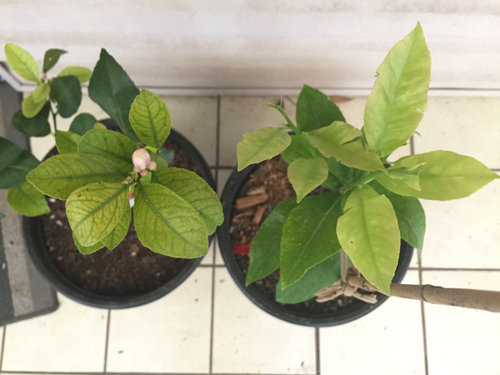
Hey all,


I recently got two new lemon trees and both came with some chlorosis:


Guessing the one on the left is iron deficiency, the one on the right nitrogen? Anyway, question is - how long will these take to show signs of recovery? I have repotted them into new well-draining mix, added FP, iron chelate, a little sulfur, azomite. I've heard mixed advice about whether foliar sprays are worth it but tried that anyway. I've also heard mixed advice about whether iron deficiency ever recovers on existing leaves. I don't want to overdo it, but don't know how long to wait before stepping up my efforts. They've been out in the sun for several days (I've had them for just under a week).

Comments (17)

  • 8 years ago

    I may be wrong, the one on the right looks like it just has new leaves.

  • 8 years ago

    Oh hmm, could be. I certainly have noticed new leaves being lighter green, but these seemed just a bit lighter than what I've experienced.

  • 8 years ago

    Though, that whole plant has leaves that are a bit lighter than all my other citrus.

  • 8 years ago

    The damaged leaves will not improved but they still function. The new leaves should come in pail and darken as they age. Give them time and warmer weather outside.

  • 8 years ago

    Be patient. In my experience lemons are the first of the common citrus to exhibit chlorosis. Lemon leaves also do appear somewhat lighter than many other citrus. That is normal. If you care for them well they will grow fine. Do not over do it in feeding them expecting them to change from one day to the next.

  • PRO
    8 years ago

    Hi, I suspect it's likely a result of your soil pH, which may be too alkaline. I'd suggest picking up a fertiliser for acid loving plants, and feed it according to the directions for a couple weeks. The leaves should darken up.

  • 8 years ago

    I wondered that, and added a bit of sulfur just in case. I also tested the soil in the one on the left with an inexpensive kit (the kind where you add a capsule and water, then compare to a chart), and that read about 6.0-6.5. Hopefully consistently warmer soil temps we'll see this week will get the nutrients moving a little better.

  • 8 years ago
    last modified: 8 years ago

    The soil in the mix in the pot is not what you test but it's the water solution, that is why I suggest you use vinegar every time you fertilize. Those will green right up in no time and in record time if they are actively growing under lots of sunlight and warm temps)

    If it has been fed a good fertilizer either by you or the garden center, then it is always most likely the pH of the water solution or the roots not doing their job do to being in poor condition..

  • 8 years ago

    yes, that looks like interveinal chlorosis on the left. Iron deficiency, and maybe other micros. I was told (by a PhD in the industry) that foliar spray is effective in this case (iron). Soil drench is OK too. I was told the damaged leaves would drop - mine did, but I also had partial WLD. This is on my meiwa kumquat (discount rack purchase not always worth it!)

    Does your iron spray have micros?

    Look into the pour-through method for soil pH testing. You will need distilled water.

    Did you find any specific dosing info for the sulfur? I need to know for mine. I was told 'a handful' for my 5 gallon pot.

    What kind of lemons are they?

  • 8 years ago
    last modified: 8 years ago

    I am telling her to make sure her water pH is correct and others are still saying to check the pH of the soil?

    Testing the pH of the soil should be done for ground use and pH testing should be done with the fertilizer solution for potted plants.

    It's been said lately that many have been getting confused around here lately when the answer is so simple)

    I'm a believer of getting to the root of the problem, and to me foliage spraying is just a bandied and a quick fix that does not get to the heart of the problem. How do you think I have been keeping my trees so green and healthy for over 15 years here?

    Mike

  • 8 years ago
    last modified: 8 years ago

    I agree with Mike. Foliage spraying will take care of the symptoms (if the diagnosis is correct) but it will not eliminate the cause.

  • 8 years ago

    I just got these plants, so I'm guessing the cause is that nursery conditions were not optimal - too cold or too much rain. I've since repotted them and have started a fertilizer regimen, so I believe the root causes are probably addressed. The question was how long should I expect to wait to see results.

    The chelated iron solution does have a few other micros in it - zinc, manganese, copper. I think you're probably right that the iron-deficient leaves will eventually drop, so I'm prepared for that. Hopefully the warmer spring temps and plentiful sun will keep the new growth coming. I forget what the dosing info is for sulfur but it's mostly directions for turning hydrangeas blue, so I just added a small amount. I'll try a little vinegar too, maybe.

    On the left, New Zealand lemonade, on the right, Santa Teresa.

  • 8 years ago

    2 different trees may be on 2 different roots. That can make a difference

  • 8 years ago

    Two different nurseries too - way different. Stan McK vs. Four Winds.

  • 8 years ago

    They both use C35 roots

  • 8 years ago

    As dumb as this is going to sound, I’m will to admit that in all the times I’ve read about iron deficiency, it never once occurred to me to figure out why it was happening. I use foligaepro and I spray a foliar spray of chelated iron. I thought that was fixing the problem and never that of that as a bandaid. Clearly, there is an underlying problem where my roots are not taking up nutrients properly. Seriously, a lightbulb went off when I read this thread...