

What To Do With Shiso
Ever have something interesting come up in your yard that you didn't know what it was, but knew it was not just your ordinary weed? That happened to me with Shiso.
My mother had the purple variety in her garden. She called it "Purple Basil", and I liked the color, so she gave me a start of it for my garden. Mind you, this was two changes of residence ago, and to the best of my memory, I didn't bring anything from the garden during the first move.
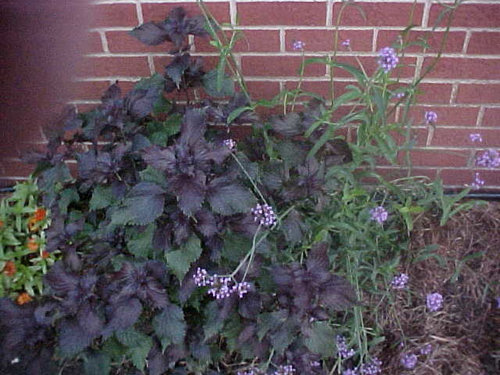
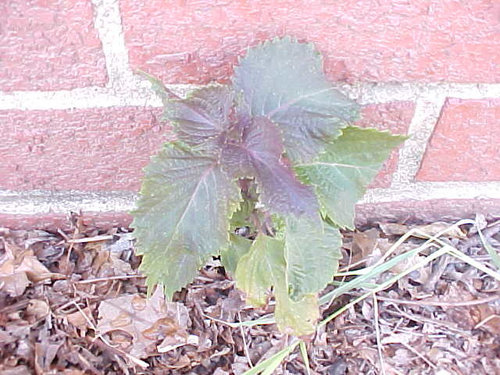
A few years ago, after we moved where we live now, I found the green variety, going strong, in the middle of my iris bed. I loved the way it smelled, but I didn't realize it was related to the purple stuff. Something looked familiar about it though....
It seems like, we Americans have lost our appreciation for greens. I know that my dad's German grandmother was in the habit of going out into the places where things grew wild in the spring, to harvest "herbs and yarbs", as they called it in our family. But when I was growing up she had long since passed away and we didn't have much exposure to what she would've considered to be "herbs and yarbs". We ate spinach out of a can, bought at the grocery store.
I owe a lot of who I am to that German great-grandmother of mine. When I had to raise my grandsons, the experience completed my full appreciation of her and how she was such a big part of my dad's life after his daddy died when he was five years old and the eldest of four children. The least that I can do, in her memory, is to become more aware of the things she considered important. I think Perilla is an import from Japan and so probably is not something she would've harvested during her day. But I can't help but think that if she had found it growing in her yard, and smelled the complex herby scent of it when the leaves were brushed, she would've known it was something useful. So I looked up ways in which to use Perilla and found these interesting sites:
https://cnz.to/ingredients-fine-foods/43-things-to-do-with-fresh-shiso/
http://www.urbancultivator.net/learn-about-shiso/
Shiso also has medicinal properties, as you will learn here:
http://naturalmedicinalherbs.net/herbs/p/perilla-frutescens=shiso.php
The purple variety, by the way, makes a deep maroon liquid when it's boiled. I've never tried to use it as a dye and so I don't know how permanent the color would be. I have incorporated some of the green variety in my recipe for liniment, and I do not use the purple variety because of the concern about turning everything pink.
Comments (12)
 8 years ago
I use fresh shiso as an edible garnish and also add to salad throughout the summer. At the end of the season I harvest it all and make pesto and freeze in cubes, which I use in pasta, on meat and fish, and on pizza. The purple shiso is used more as a coloring agent, but I'm open to new ideas as I have lots of that as well.
- 8 years ago
Really neat green I've never seen or heard of before. Is it supposed to be native here, considering it's sprouting in your flower bed? Foraging for wild edibles has always interested me, especially recently. What a great skill it would be to learn, and a real asset in a survival, situation, or even a food shortage, which is very well possible, as it has happened many times before.
What all did your great grandmother forage for?
Related Professionals
Burlington Landscape Architects & Landscape Designers · Magog Landscape Architects & Landscape Designers · Dothan Landscape Contractors · Newport News Landscape Contractors · Portland Landscape Contractors · Bakersfield Landscape Contractors · San Angelo Landscape Contractors · Palm Bay Home Additions · Vidalia Home Additions · Des Moines Home Additions · Toledo Home Additions · Stockton Home Additions · Billings Home Additions · Kennewick Home Additions · Toronto Home AdditionsUser
Original Author8 years agoKit, that's kinda what I thought I might try. I've been making hummus lately and I was wondering how it would taste in that, rather than the basil. It hasn't come up this year and I didn't harvest any last summer so I'll have to wait. Then I think I'll make that pesto. They say the darker the color, the better for you, so I'm thinking the purple might be healthier than the green. Not sure.
Jacob, my dad was just a little boy then so I'm not sure what all she foraged for. But I think wild onions, dandilion greens, poke. Maybe young cat-tails. I understand people gather something they call "ramps", I don't know what that is but saw somewhere that it was what we call "stick-tight"?? Do you know? My mom once told me dad's grandmother knew how to cook possum so that it wasn't greasy, and she and my grandmother would pressure can some kind of fish the men would catch in the river that was just mostly bone and so they'd just give them to anyone that wanted them. I don't remember what kind of fish it was, but I would recognize it if someone said it... Shiso is native to Japan, I'm told, and brought over here at some point. I think it's naturalized by now, at least mine has.
- 8 years ago
Aren't ramps wild leeks? That's really fascinating. I pick wild onions and garlic all the time but have yet to try many on that list!!
User
Original Author8 years agoOh, is that what ramps are? I don't know if I'd know the difference between wild leeks and wild onions. Maybe they are same. We used to have wild garlic growing in the tall grass along the fence line, two houses ago. We wouldn't notice till we or our neighbors mowed. Then....phew! Do you know what Lambs-quarter is? It's a tall rangy plant with kind of triangular leaves, if I remember right. I think it's related to Amaranth. My parents used to gather that and cook it like spinach. I bet Dad's grandmother did too, as it's native to this area.
I mis-spoke with the "herbs and yarbs" thing. Pretty sure, now that I think about it, it was "roots and yarbs" -- "yarbs" being a mispronunciation of "herbs", maybe. So very long ago.....
If you harvest poke, do your homework and know what you can eat and what you can't, and when and when not to harvest it, and how it should be prepared. Poke can be very dangerous if you don't know what you're doing. In fact, all foraged food can be. There's a certain kind of acorn that people gather, and they grind the nut inside the acorn shell and use it as a kind of flour. Has to be from the right kind of oak tree or it's bitter. Of course wild blackberry was pretty common in Kansas back then, too. I had forgotten about that, purslane and curly dock.
Here's a YouTube I found:
https://www.youtube.com/watch?v=XkoZDkGI6RQ
I do gather dandelion and I make tea out of the flowers. I saved and dried some of the root and vacuum packed it in a jar, but I've never used any of it. I love rose-hip tea. Just be sure to clean out the little hairy inner cavity and the seeds, or you might get a pretty thorough cleanse, like I did. I wouldn't ever do THAT again.
Some people grow and gather stinging nettle. I won't do that, Hubs is the one who mows and weed-wacks and stinging nettle can give a painful blistering rash if you don't pay attention to what you're doing around it -- and Hubs wouldn't be careful. They say the only thing that stops the stinging is to pee on the point of contact. Not willing to do that, either.
Then of course there are mushrooms, something else you REALLY have to be careful with. My neighbors and I were just talking about mushrooms the other day and the husband said his dad, who kept his family fed by hunting, would find mushrooms and berries, etc. while he was hunting, that he would bring home, but that he, (my neighbor), would not be able to do that because he never learned how to tell which kinds were safe and which were not. There are lots of YouTubes on how to identify mushrooms, and Amazon has several books on how to identify them, too, if you do a search on "Identify Wild Mushrooms".
User
Original Author8 years agoOh, and let's not forget Elderberry, which grows wild at the edges of creeks and sometimes along fencelines. Very medicinal.
User
Original Author8 years agoJacob, I found what it was that I had been thinking about the weed we used to call "stick-tight" when I was a kid. It was not ramps. I think it's "cleavers". Here's a website that describes it: https://altnature.com/gallery/cleavers.htm Do you think this is right?
In fact, this is a good site for identifying and finding out more about a lot of weeds that you and I might find right out on our land, so click on the "Medicinal Plant Articles List" link that's upper right on the page and see what's there.
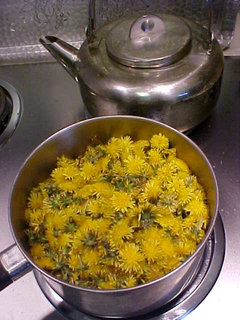
I was out gathering dandelion flowers today. Bring them to a boil as soon as you get inside as they deteriorate rapidly. Do not rinse first as a lot of the yellow color and the pollen goes down the drain. Just pick where they look clean. You'll be straining the spent flowers after they've simmered a little while. Add lemon and honey and drink as a tea, hot or cold. It's a spring tonic. Here's that page for you: https://altnature.com/gallery/dandelion.htm But don't try to dry the yellow flowers. They turn to fuzz in the dehydrator. Ask me how I know. LOL
I make the tea right away, in a concentrated form so I can freeze it in ice-cube trays for later use. I haven't tried popping them right into a zip bag and putting in the freezer, so not sure what would happen. Maybe it would work.
- 8 years ago
Lol dehydrating dandelions! Thanks for the headsup before I try that!!!
There are so many popping up in our yard now. You know, I've never eaten a dandelion before. What do they taste like?
Isn't it amazing how much food is growing in our yards, without even anyone's help, and it's neglected? I've often thought myself, that even if somebody is starving, there is so much food around the corner for them, in the grass!! It may not be roast beef, but it's food, and we ought to be thankful to have it at all.
User
Original Author8 years agoWell, for the most part, it's bitter. Our ancestors knew "bitters" were good for them and they ate them to aid the digestion, seems like I remember reading that it was before a meal, but not sure. The flower tea is palatable with lemon and honey. Some people with allergies might need to be careful, as there's pollen in those flowers (and also in honey!). The first time you use something you've never used before, don't overdo. BTW, be careful if you buy honey in the grocery store. Sometimes it's combined with corn syrup. I buy my honey at the farmer's market in the summer, it's from TuckerBees in Kansas.
I read that some of our early pioneers ate leaves, from trees, to keep from starving to death. That's got to be pretty harsh on the digestive system! There are also poisons in many plants so don't put anything in your mouth or on your skin without knowing for sure what it is and how it can be used. There are also several plants that look very much like something else that can be bad for you, so make sure you check for that information and know how to tell the good from the bad.
- 8 years ago
Ilene, I think you might have got that shiso from me in seed form in some of the plants I have sent you. I got it from a woman in Clever many years ago and she said I would never be without it again because it self-seeds every where. She was right! I let some of it grow in flower beds but have never cooked with it. I have to chop it out or it would take over my entire farm so be careful with it.
We eat lambs quarter like spinach and like it better. I also freeze poke when it gets big enough. Mom collected wild greens and I know she picked dock, lambs-quarter, just a few dandelion greens because they are quite bitter, purslane, and maybe wild lettuce. User
Original Author8 years agoOh, Glenda! I need lessons from you on Poke. I've been afraid to try to use any of it. Susun Weed, a herbalist that has videos on YouTube, says the berries can be used as a woman's tonic IF you swallow them like pills and do not chew them, as the seeds will make you sick. I've not had the courage to try it, however.
If you're the source of that shiso, then thank you very much. I really love how it smells. Hugs, ilene


gldno1