Software
Houzz Logo Print
nhbabs

Hummingbird plants and attractions

8 years ago
last modified: 8 years ago

Rather than sidetrack the Hummingbird migration thread any further, I am starting a thread on hummingbird plants. I'd love notes on any particular needs of the plants or experience with them in your garden, but just a list of which ones you have seen them visiting is fine also. I don't do feeders since they attract animals I don't want near the house, but I try to keep something in bloom all summer for the hummers. If you have other attractions (other than feeders which are a given), please add them as well.

Cardinal flower/Lobelia cardinalis blooms in summer and needs consistently moist soil, but given enough water, I've seen in growing in spots ranging from full sun to dense shade.

Salvia guaranitica 'Black and Blue' is always one of the most popular with the hummers here even if it is blue. It isn't hardy for me but is a great pot plant with a long bloom season from some time in June through frost. Likes sun.

My longest blooming hummingbird plant is trumpet honeysuckle/Lonicera sempervirens which starts in late May with a really full bloom and then continues to throw out blooms on new growth until some time in November when we get a hard freeze, long after the hummingbirds have left here. Mine is the cultivar 'Major Wheeler'.

I have a deep red (AKA black) hollyhock/Alcea that gets frequent visits. It's a biennial or short lived perennial that reseeds prolifically. It needs good air circulation to dry foliage, otherwise it can be prone to rust, a foliar fungus. When that has happened to mine, I have removed affected plants and done a good cleanup in the fall and it hasn't been a problem the following year.

Native columbine/Aquilegia canadensis blooms in spring and I've seen in growing in spots ranging from full sun to dense shade. Another easy reseeder, one which plays well with other plants, so I mostly let it do its thing.

I have some old-fashioned red-flowered, green leafed coral bells/Heuchera that I've been dividing and replanting for at least 25 years. The flowers are on stalks that are almost 2' high and it blooms late spring into early summer. The flowers are tiny, so I was surprised that they were attractive to the hummers. Mine are in morning sun, afternoon bright shade.

Monkshood/Actonitum is fine in shade or sun if it stays moist and the ones I grow are fall bloomers, though there may be some late spring bloomers also. Be aware that it is highly toxic to people though that doesn't bother the hummers, so wear gloves when handling.

They often visit my Kniphofia, AKA red hot poker plant or torch lily which blooms in summer.

I grow Delphinium 'Blue Butterfly', a short statured, short-lived perennial variety, and it gets a lot of visits during its summer bloom.

What plants do hummingbirds visit in your garden?

Comments (24)

  • 8 years ago

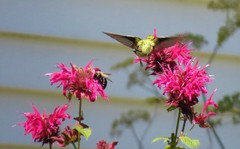
    I'll second the Lonicera -- they seem perfectly designed for hummingbirds to polinate them. Same for Aquilegia. One genus you didn't mention, that hummingbirds frequent in our garden, is Monarda. Both M. didyma and M. fistulosa get a fair amount of attention. I have a hunch that most of the native flowers in that range of reds -- from the deep saturated Lobelia or Monarda didyma blooms to the slightly more orange/translucent Aquilegia -- are going to be popular with the hummers.

    NHBabs z4b-5a NH thanked nekobus
  • 8 years ago

    Believe it or not, the one time I planted Monarda in this garden, it died after a couple of years. I didn't replant because it always got powdery mildew, but I should try again with one of the mildew-resistent types. Thanks for the reminder.

  • 8 years ago

    Babs, I tried growing Lobelia cardinalis when I first started gardening here and I lost them all. My garden is just not moist enough. I tried a lot of Astilbe and the same problem.


    I’ve tried the Salvias, the Black and Blue and a couple more I forget the name of, and they do okay but they don’t thrive in my clay soil. They just seem to sit there and do very little growing.


    I added Honeysuckles in 3 different varieties and last spring two of them were dead as a doornail.


    I’ve always enjoyed Hollyhocks but not the rust that goes along with them. When you say you removed affected plants, do you mean what you have the next season are seedlings from the original?


    I have Columbine but not the native, does it make a difference?


    I’ve tried Monkshood and it never got going at all. It came back two seasons, never flowered and then stopped coming back.


    I’ve rarely seen hummingbirds in my garden and I’ve been here 30+ years. Two summers in the past five, I saw a hummer flit thru the garden, late in the summer, stopped at the Scarlet Runner Bean on the vegetable trellis once and off he went. That was it.


    Last season, I happened to see a 'Vermillionaire' Cuphea at the nursery and bought them for my outdoor pots. I was pretty surprised one day as I was kneeling down next to the pot, deadheading petunias that were in the pot with the Cuphea, to hear something above my head and looked up and there was a humming bird. What a treat! Over the summer I must have seen the one solo hummingbird come back to the Cuphea about a dozen times. So that one plant had more success than anything else I have tried. And once they visit your garden, you just want to keep them coming back.


    Spedigrees - I love your Jewelweed. I just looked it up and apparently it won't keep growing for you if you have dry conditions, which I have. It's very pretty. BTW, I sent you a GW message. :-)


    NHBabs z4b-5a NH thanked prairiemoon2 z6b MA
  • 8 years ago
    last modified: 8 years ago

    Sped, I've not grown nastursiums for eons, so thanks for that suggestion. And believe it or not, I don't have any wild impatiens here. I think the growing conditions must not be good for them because there's certainly enough water, just not damp areas with organic soil.

    Thanks for reminding me of Cuphea and scarlet runner beans, PM2. Scarlet runner beans were one of the first plants I planted at this house for the hummers since I couldn't plant anything permanent until all the needed rebuilding was done. I will need to find a spot for them this summer. I tried Cuphea in a pot a couple of summers ago, and it just didn't thrive. I think our nights are too cool here in general for a plant that likes hot weather.

  • 8 years ago
    last modified: 8 years ago

    The Cuphea in pots here, kept dropping leaves, but managed to keep blooming. And of course, it didn't come back after the winter, but it was worth it enough to try it again this year. I might try putting them in the ground this year and see how they do. They're an expensive annual. I think they root in water, so I may try to buy one early and root some cuttings for more plants.

    NHBabs z4b-5a NH thanked prairiemoon2 z6b MA
  • 8 years ago

    Nhbabs, I've had better luck with Monarda fistulosa than with M. didyma with regard to mildew, for what that's worth. And I forgot how much the hummingbirds love scarlet runner beans! Good reminder to get my seeds in the ground soon.

    I believe my in laws have had good luck with Buddleia too, though I can't personally vouch for it since I don't grow a lot of non-natives.

    NHBabs z4b-5a NH thanked nekobus
  • 8 years ago
    last modified: 8 years ago

    Nasturtiums in a hanging pot is a great idea!!
    And I have jewelweed I transplanted from a neighbor who was "tidying" away "weeds" :( to a boggy low spot in my yard. They come back most summers, sometimes growing huge. I love them for their color and for the poison ivy soothing sap/gel in their stems.

    NHBabs z4b-5a NH thanked barrett001
  • 8 years ago
    last modified: 8 years ago

    Aside from the columbines and salvias, monardas, etc, last year the hummers were attracted to tall zinnias!

    Columbines are late this year. Hummers are usually here when they open, the last week in April. Plants are slow this year due to weather. I'd better get out the feeder.

    I stopped feeding seed this winter due to rodents feasting on them on the ground and bringing ticks in. It made a big difference in the number of rodent holes this year (near zero). Hummer feeder is up on my deck. I haven't seen any ticks on me yet.

    NHBabs z4b-5a NH thanked susanzone5 (NY)
  • 8 years ago

    Sped, I didn't find out until I had pulled nearly all of my jewelweed, which is an annual, that it was a hummingbird magnet. Now I'm wondering if some will show up anyway. I hope I missed a few, or that seeds from nearby areas blow in, or get "dropped" in. If not I'll get some seeds and sow them.

    I'd love a breakdown of plants by season to ensure season-long plants. I have several charts for bees, but not for hummingbirds. Full confession: I haven't looked that hard.

    What is the earliest plant for hummingbirds? If they are supposed to be heading our way now, there is nothing for them here.

    I am growing Nicotiana for hummingbirds, as well as some listed above. Will see this season how it does.

    NHBabs z4b-5a NH thanked deanna in ME Barely zone 6a, more like 5b
  • 8 years ago
    last modified: 8 years ago

    Generally I don't see hummers during this first wave of migration, but I have been looking since they rely on the sapsucker wells for early food and we do have sapsuckers. It is sometimes theorized that this first wave is migrants moving through towards Canada. My memory (hope it is accurate) is that Claire has commented that she sees her first hummers around the time of the PJM rhodies, but I don't remember if she said that she sees them actually feeding on the PJMs or just show up around then. So that might be the first flower they like. I see them first at the native columbine, then the trumpet honeysuckle (and they continue to visit all summer), and my Heuchera are late spring bloomers. The hollyhocks start blooming in early to mid-summer along with the butterfly blue delphinium and continue all summer, and the Lobelia cardinalis blooms in August. The red hot poker plant blooms in midsummer also, but not for as long. My Salvia Black and Blue is greenhouse grown, but blooms all summer.

    Deanna, I grow Nicotiana (it selfseeds but is easy to pull where not wanted) and I don't remember ever seeing hummers visiting them. Let me know if they visit yours.

    Susan, thanks for the zinnia suggestion. Looks like I will be adding a few annuals from this list.

  • 8 years ago

    I do see the hummers when the PJM rhodies are blooming but I don't know if they feed on them or on something else blooming at the same time, maybe some non-native honeysuckles. The PJMs are everywhere around here and they may just be a flashy trail marker for the birds. Or they may use them and other rhododendrons or azaleas. There are some huge Roseum Elegans rhododendrons nearby which I think are Catawba rhodies and supposedly attractive to hummers (ref: Operation Ruby Throat).

    I'm conflicted about jewelweed. When it first showed up in small numbers I loved it - pretty orange flowers and native. The next year there were about a hundred jewelweed plants here and I left them although a bit concerned, and the year after that there were so many I started pulling them out. I may go back to just leaving a few here and there.

    Claire

    NHBabs z4b-5a NH thanked claireplymouth z6b coastal MA
  • 8 years ago

    Yes, I worry about my little patch of jewelweed getting out of control. My husband thought that happened last summer, when some of them grew very tall and scraggly. In the dry (drought-y) years they seem OK, but this has been such a wet spring I fear I may regret planting mine....

    NHBabs z4b-5a NH thanked barrett001
  • 8 years ago

    They don't bother me so much because they are so easy to pull out. The roots are so shallow that I can pull several dozen in a couple of minutes, grabbing multiple stems in one hand at each pull. If they were tenacious I would have second thoughts.

    NHBabs z4b-5a NH thanked deanna in ME Barely zone 6a, more like 5b
  • 8 years ago

    One of my favorite things about jewelweed besides the attraction to hummingbirds is the way the seeds disburse, flinging out the seeds via a spring-like action of the pods. So they do disburse fairly far.

  • 8 years ago
    last modified: 8 years ago

    The zinnia I mentioned that was a hummer attractant is Art Deco by Botanical Interests. The picture on the pak also shows a lot of butterflies on them.


    Also, I don't know if it's a myth or not, but they say jewelweed and poison ivy grow in the same place. Just FYI.

  • 8 years ago

    I put up feeders because we haven't had an animal problem (fingers crossed), but the hummingbirds definitely love the flowers too.

    Monarda "Raspberry Wine" beautiful, and does not seem to mildew like another variety I had in the past.

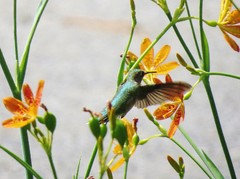
    Iris Domestica "Blackberry lily"

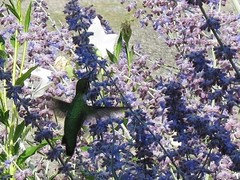
    Russian Sage

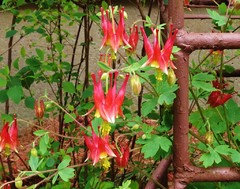
    No pics of birds on these, but Native columbine as others have mentioned

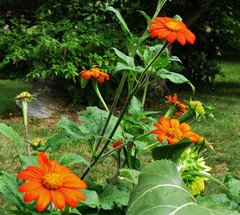
    Some annuals they love: Tithonia " Mexican torch sunflower"

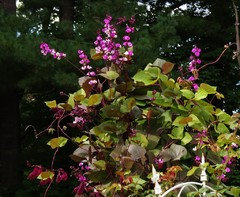
    Hyacynth Bean Vine "Moonshadow"

    From the latter 2, lots of size and beauty from a few seeds each year...even if the hummingbirds didn't love them!

    Susan


    NHBabs z4b-5a NH thanked homegrowninthe603
  • 8 years ago

    Susan, do you grow your Tithonia from seed? If so, when do you start it?

  • 8 years ago

    Yes, from seed. I plant them directly in a row of my vegetable garden with other sunflowers (although I may do them separately this year). I do this around the beginning of June when I plant tender veggies. They seem to germinate and grow fairly quickly.

    NHBabs z4b-5a NH thanked homegrowninthe603
  • 8 years ago

    So...any updates on plants? We are dry, and perennials are waiting on rain to grow and bloom. It will be a while before my annual seedlings grow and are ready to bloom. Would love to hear an update from others.

    Per my earlier comment about wishing I had not pulled up the Jewelweed/Impatiens. I have seen a few seedlings. Yea! They grow in a large woodland area where they will not detract so much, so this year NO PULLING! Now that I know they are hummingbird food they suddenly look oh-so-nice!

  • 8 years ago

    My native Lonicera sempervirens/honeysuckle Major Wheeler is blooming up a storm as is the native red and yellow columbine/Aquilegia canadensis. Salvia guaranitica Black and Blue is not hardy here, so is in pots. I also found a Cuphea locally for a pot and hopefully it will do better this year than the last one I tried. A Heuchera/coral bells with pinkish red flowers is blooming as well. I have lots of other things blooming, but these are the ones I see the hummingbirds visiting.

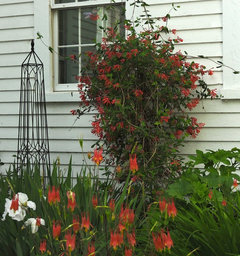
    I haven’t yet taken a photo this year and it’s pouring rain right now, but the garden next to the front door looks almost exactly like this photo from a couple of years ago except that Major W is more full. I started giving him a bit of a haircut yesterday because the newest twigs didn’t harden off well last fall when we went from warm to cold too suddenly, so there are a bunch of little dead twigs.

  • 8 years ago

    Major Wheeler is high on my list of desirables because of your reports. Just need to find a place to put it! My seedlings of Aquilegia canadensis went out yesterday, so I'm looking forward to next year's bloom. Do you always buy black and blue new from a nursery every year? It seems to be such a great plant, but I honestly don't remember seeing it much at nurseries. I must just be missing it because of its popularity. Is it expensive?

  • 8 years ago

    I can overwinter Salvia B&B in a large pot in my enclosed entry which gets heat from the sun and from the leaky interior door to the house. There is one local nursery that sells it here, way up a back road, though well known to local gardeners. They sell almost entirely plants for pots and annuals, though they always have a few veggies and perennials. My memory is that they sell it for $10-$12 per two quart pot, already good sized. It gets to the size of a small shrub relatively quickly, and might winter over for you well mulched in a sheltered spot. I am planning to put one of my two in the ground along our uninsulated foundation and give it a heap of mulch in the fall to see if it will over winter here.

    Major W is a large plant and mine took about 4 years to get to where it is in the photo. It really should have a bigger space and bigger trellis than I have given it.

  • 8 years ago
    last modified: 8 years ago

    I'm not surprised that your jewelweed is surviving, Deanna. It's a prolific re-seeder! I have no qualms about pulling up clumps of it that are growing where I don't want them to grow. I know they'll be back! On edit: You have small children, if I remember correctly. When jewelweed goes to seed, it's an unending amusement to little kids to squeeze the swollen seed pods and watch them explode! (Hahaha, and I must admit I still get a kick out of it!) Hence jewelweed's second name "touch-me-not."

    I should mention that invasive honeysuckle bushes are great pollinator attractions, hummingbirds among them. Most people wouldn't willingly allow it to grow, and I have battled it in a few places where I don't want it. But I welcome it in the unmowed areas that I am re-foresting because I know that eventually the trees will take over. In the meantime it is a fast growing provider of cover/privacy/screening and a boon to the wildlife.