Software
Houzz Logo Print
horizonx

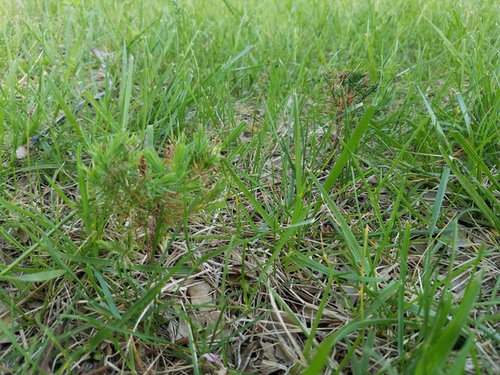
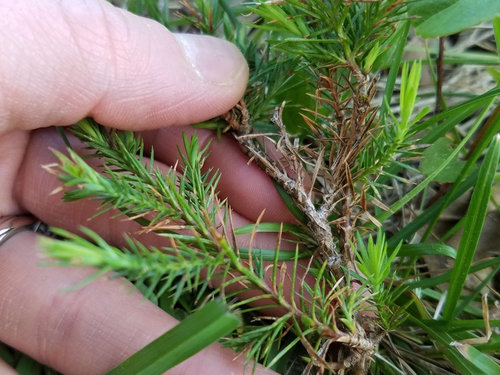
Tiny cedar/spruce like trees growing in grass like weeds

8 years ago
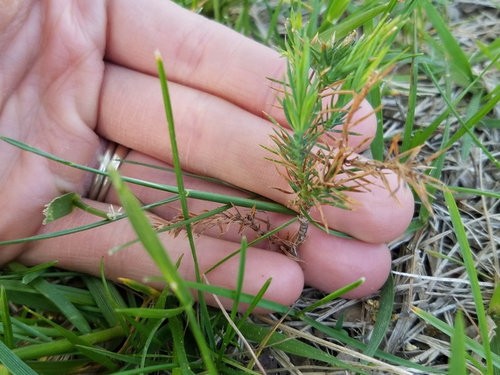
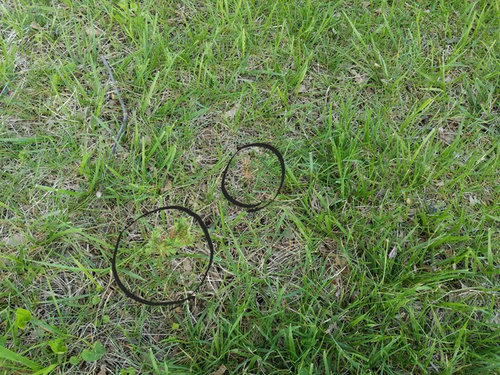
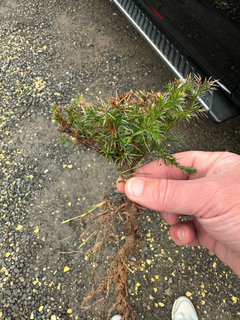
Hi there. Please help me ID this plant/weed/tree. I live in the DC area, and I have dozens of these extremely small, prickly cedar/spruce plants/trees/weeds growing in my shady front yard. I've owned my home for 3 years, and I spotted only one or two the first year. Each subsequent year, I have found more and more of them, often in groups but overall, they are spread out in the front. I have no idea how they are seeding or spreading since we keep the grass cut short and I've never seen a bloom.


They tend to break when I try to pull them, and are so small, it is hard to find the roots without tearing up the grass. What the heck are they?

Comments (32)

  • 8 years ago

    Looks like juniper.

    horizonx thanked carol23_gw
  • 8 years ago

    Any idea what kind?

  • 8 years ago

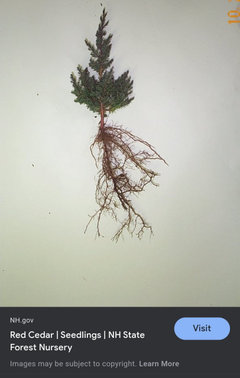
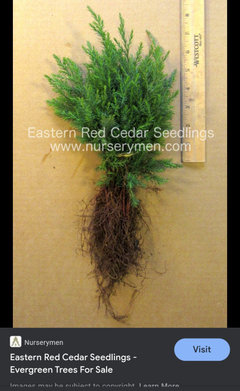
    I don't know what junipers are growing near you. Juniperus virginiana is a common one. Eastern Red Cedar is the common name. The wood is used in cedar closets.

    horizonx thanked carol23_gw
  • 8 years ago

    And often coming up weedily in its native area.

  • 8 years ago

    welcome to the forums.. if you are going to hang around.. plz add your location on your members page.. so it shows in every post ...


    where are you ... it will help with the ID ...


    J viginiana is an aggressive seeder in my MI ... you can see them lining the roads for miles ....


    as such.. they are weeds in my garden.. regardless of how cute they might be ...


    if you cut them off at ground level.. they will most likely not resprout ... or at this size.. they might pull out easily.. in spring ...


    ken


  • 8 years ago

    "And often coming up weedily in its native area." An excellent way to refer to a native's exuberant tendencies w/o maligning it to the point of calling it a weed.

  • 5 years ago

    I also have them sprouting in my lawn, and each season there's more, can't pull them up, how do I eliminate them finally?

  • 5 years ago

    Since birds eat the berries and then deposit them anywhere they like, pretty difficult to eliminate completely, Hard to get any sort of permanent fix without removing all the neighboring trees. But mowing them frequently will kill off the existing seedlings/shoots. Just keep at it :-)

  • 5 years ago

    I've been in my house now in Michigan for 11 years and this is the first time I have had them growing in my yard. There are literally hundreds of them, so I started pulling them out since the yard is a little soggy from the snow melting. Is there anything I can put on my yard to stop them from growing as I do not want them to continue to spread. Thanks for any help with this and what exactly are they called?

  • 5 years ago

    did you note my answer above.. from adrian mi ...


    there is nothing you can do to stop the birds from planting pre-fertilized air borne seed.. wherever they may fly...


    mowing of grass .. will take care of them in the lawn ... it garden beds where they can become problematic ...


    and when you drive down any highway in lower MI you will spot millions of them ... especially in non-mowed areas.. m50.. m52... 127 ... rural I94 ... i havent been downtown detroit in a long time.. but they might not be there ...


    ken

  • 4 years ago

    We have them in St. Louis Louis. they seem invasive to me. lil buggers.

  • 4 years ago

    A little update from me, the OP. When I wrote this post, we had a huge (100+ year old) old tree that was right in the center of our front yard. Most of these plants were sprouting close to this specific tree's canopy. It makes sense that birds were perched on this huge tree and thus dropping seeds periodically.


    A few years ago, our beautiful big tree had to be taken down. It was diseased and became a fall risk. Afterwards, these little spikey plants stopped showing up. The tree/plant lover in me still would love to know what this plant is..

  • 4 years ago

    Juniperus virginiana, as noted by carol.

    tj

  • 4 years ago

    Eastern red cedar seems to be likely. Thank you for everyone that responded and weighed in with their best guesses. I wasn't expecting anyone to know for sure, but was hoping someone would have educated ideas of what it could be. The curiousity was killing me. Eastern red cedar saplings look very similar.

  • 4 years ago

    I'm not sure why you were confused by the ID. It was correctly ID'd by @carol23_gw in her 1st and second posts 4 years ago!

  • 4 years ago

    You're right. Time fogged my memory. I had to reread the comments and jog my memory.

  • 3 years ago

    i have the same problem in zone 7b. hundreds of these little buggers. I've been mowing them for 3 years and their roots just keep getting deeper. I bought Grandpa's weeder but it doesn't go deep enough. Help me try to figure out how to get rid of them


  • 3 years ago

    Is the mower on the lowest setting?

  • 3 years ago

    Thank you, I will try that but they are so well established i'm pretty sure they will just grow back.


  • 3 years ago

    Consistently removing any top growth by mowing will weaken the seedlings, as you are removing any ability to photosynthesize. If they can't photosynthesize, they cannot survive and will die off. Pretty much the same way chopping down a tree will prevent photosynthesis and eventually cause death.

    Should just happen easier and faster with seedlings.

  • 3 years ago

    i just low mowed and crossing fingers. thanks

  • 2 years ago

    I have same exact thing in northern VA and took to the local nursery today. As everyone stated the horticulturalists said it was juniper aka cedar and most likely the squirrels (which are very active around my home) “planted” them there. She told me to simply weed and feed grass fertilizer would do the trick and if not I can hit them with Roundup.

  • 2 years ago

    Okay great, thanks Gardengal48. Since the original poster and the other individual haven’t responded with a positive response to your recommendation I will assume your advice did not work. My yard is similar to the HU-868171717) person with hundreds growing and many deeply rooted at this point despite constant mowing.

    Can you elaborate on how frequent to mow or how low the mower should be set? I have a Torro push mower with settings we will say are 1-5 and the lowest I’ve ever gone is 3. I have zoysia grass and even at level three it’s difficult to mow that low. If I went to a 1 I would basically got to the dirt and assume kill the grass as well.

    So a professional recommended weed and feed and spot kill with roundup if that didn’t work. This lady (in her late 50’s early 60’s) seemed to be quite experienced and said she went to college for horticulture.

    Would you elaborate on how mowing would be effective or how often at what level? Otherwise I will post my results using the chemicals you deem harmful once the issue is contained. Thanks!

  • 2 years ago
    last modified: 2 years ago

    "Since the original poster and the other individual haven’t responded with a positive response to your recommendation I will assume your advice did not work."

    I would not make that assumption. People often fail to report back after they have received help. Some even post a question and then don't bother to respond at all.

    Fwiw consistently mowing woody subjects, such as these Juniper seedlings, will work. What it won't do is destroy perennials with creeping rootstocks or deep tap roots.

    Btw GG is an experienced, qualified professional too.

  • 2 years ago

    Another northern VA resident here. Cedars are spread by birds not squirrels BTW. Mowing absolutely works.

  • 2 years ago

    " Would you elaborate on how mowing would be effective or how often at what level? "

    The explanation for how this works was also provided previously. If you consistently remove any top growth by mowing, the seedling is unable to photosynthesize. If it cannot photosynthesize, it cannot feed it itself and the plant will die...not necessarily immediately but inevitably. And you do not need to scalp your lawn to achieve this effect. Just mow it routinely - like once a week - in season. However, more seeds can be deposited so the problem may not be eliminated until/unless you can remove the source.

    " the chemicals you deem harmful "

    I don't 'deem' them harmful - they are widely acknowledged to be harmful!! Just look up the risks involved for kids, pets and yourself when using these products unnecessarily or incorrectly.

  • 2 years ago

    for European meadows/ grassland 2-3 cuts /year are considered sufficent to keep away shrubs, trees and even blackberries, so mowing those seedlings almost weekly should absolutely work

  • 2 years ago

    “The explanation for how this works was also provided previously.”

    I don’t think the snappy and snarky response insinuating “I’m right and you’re wrong” is necessarily the best way to “sell” your explanation particularly since how often and at what level wasn’t addressed you simply pointed out (argumentatively I might add) how this was already addressed. Maybe take a different tone and others will take your word a little more seriously. I appreciate linaria explanation.

    I’ll make a point to follow up with results. I mow at least once a week, FYI

  • 2 years ago

    When I do use fertilizers and pesticides I follow recommendations and think of my pet follow guidelines so I guess it’s only harmful if you don’t follow directions. Thanks for emphasizing that the chemicals we use aren’t dangerous unless you are irresponsible.

  • last year

    Mowing does not help.

  • last year

    A good healthy turf should out-compete them. My neighbor whose yard looks horrible (80% weeds) has a ton of these. My yard has none. Improve your turf and that should solve the problem.