Software
Houzz Logo Print
bluebonty

What citrus rootstock is this?

8 years ago
last modified: 8 years ago
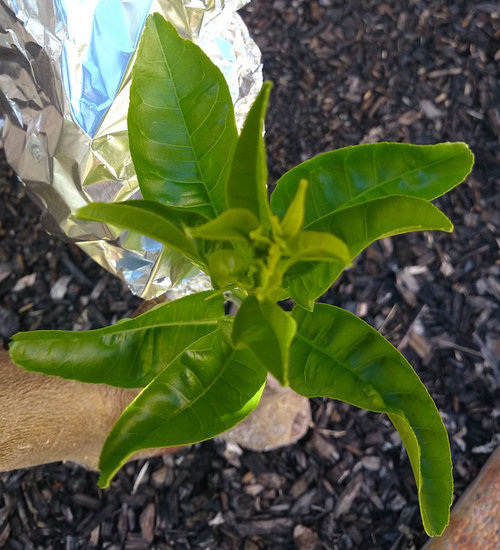
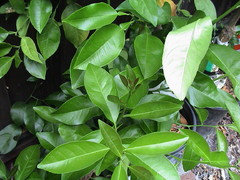
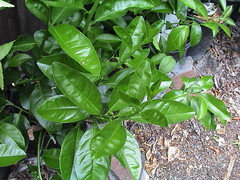
Can someone help me with the ID of this unknown rootstock? I go crazy when I don't know the name of something.

Originally (when the young plant was bought), it was supposed to be an orange tree, but the aggressive, very big long spiky rootstock overtook it, and the orange part was accidentally/unknowingly hacked off. Also, I noticed that when I re-graft a(ny) particular citrus onto THIS rootstock, the new leaves of my scion tend to be bigger than normal - like they're on steroids.

Example: when I grafted Frost Lisbon lemon onto it once, I noticed the leaves were HUGE, a lot bigger than the mother/source Lisbon plant I took the scion from. About 50% of my Lisbon lemons looked like they're on steroids. LOL. Furthermore, the Lisbon lemon rinds were thicker - too thick in my opinion (when compared to the Lisbon citrus pictures I see online). Of course I hacked most of the Lisbon branches off this, and is now using the last one main Lisbon branch as an interstock for my other grafts (Improved Meyer lemon and Mexican Key lime). Again, I noticed that the Improved Meyer's leaves are bigger than normal when compared to the source Meyer plant (in ground, not dwarf).

Anyone want to venture a guess what this rootstock may be?


Comments (11)

  • 8 years ago
    last modified: 8 years ago
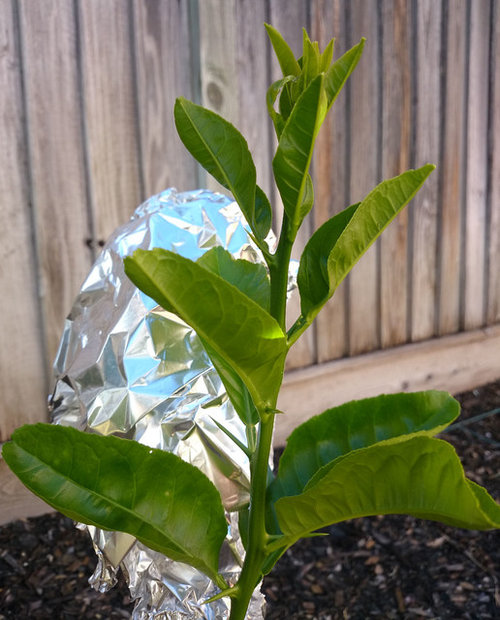
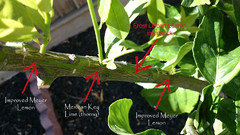
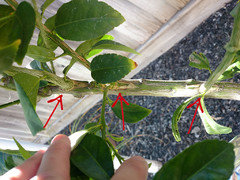
    My Improved Meyer lemon and Mexican Key lime grafts on the Frost Lisbon lemon interstock, which was grafted on the UNKNOWN rootstock years ago:


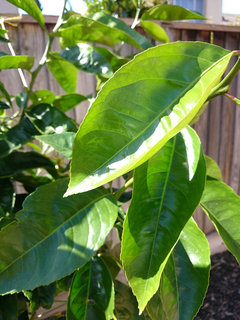
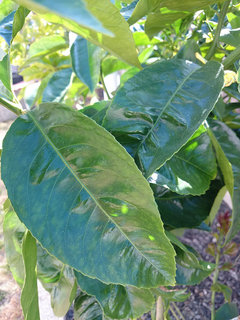
    The leaves on my improved meyer lemon graft look kinda huge when compared to the source meyer plant where I got the buds from. Source meyer plant (@ my sister's house nearby) is also planted in ground and not on a dwarf rootstock. The leaves just don't look normal for an improved meyer, but I am POSITIVE I took the buds off my sister's improved meyer lemon plant.


  • 8 years ago

    If you remember where you bought the original plant, you might be able to contact the nursery to find out, or at least narrow it down.

    I have a few inherited citrus that are unknown rootstocks with dead scions. Interestingly, they are all non-trifoliate, like yours. That narrows it down quite a bit. I spent a long time looking up commonly used rootstocks and cross-referencing with the descriptions on http://idtools.org/id/citrus/citrusid/factsheet_index.php, but couldn't get close enough to ID. But you at least know what the scion was, so you should be able to narrow down to rootstocks commonly used with orange. Good luck! I love a good mystery but not one that never gets solved...

  • 8 years ago
    last modified: 8 years ago

    with the aggressive rootstocks comes bigger liaves on the scion. That is normal.

    I am going to guess Cuban Shaddock. Easy to graft, Grows well, addapts to container very well, cheap to produce, but produceses poor quality fruit.

  • 8 years ago
    last modified: 8 years ago

    Echo Steve's guess. BTW It does not look like Volk.

  • 8 years ago

    Is the tree partly shaded? That could also cause larger leaves (besides rootstock).

  • 8 years ago

    I was hoping it would not be a Cuban Shaddock. But the more I google CS and read about its characteristics, the more I believe you may be right. Thanks for all the responses.

    I spent the last few years getting rid of all my dwarf trees - basically all from Four Winds Growers. My older trees developed cracked trunk, peeled bark, some gummy/jelly oozing thingie (sp?), and.....well, they just grow agonizingly slooow.

    Didn't someone here say 4WG stop using their mysterious rootstock (supposedly Cuban Shaddock) and are on C-35 now? When did they make the switch? I noticed that their trees at Home Depot now say "Semi-Dwarf" next to the price...but the hanging info picture card still says dwarf or true dwarf? So which is which? I will NEVER buy their dwarf or any Cuban Shaddock tree again.

    Anyway, this particular unknown rootstock (first post) is in ground and has full sun all day long. It had been my project tree a.k.a. Franken-citrus/practice tree for years (maybe I'll do a post to share my project). When I first grafted the Frost Lisbon lemon onto it, I noticed huge, and I mean HUGE leaves-not slightly bigger, compared to other Lisbon tree grown in ground. And the Lisbon rinds were way too thick - not normal. Some lemons looked like they were on steroids. Now I grafted Improved Meyer onto it, and I noticed again - huge leaves compared to other Meyer lemon trees grown in ground. There's no Meyer fruit yet, but I hope the Meyer lemons don't develop way thicker than normal rinds. It's the reason why I got rid of the Lisbon branches.

    Weird,..on the other hand, I also grafted oranges and mandarins onto this same unknown rootstock and the leaves and rinds seem normal. Just the lemons get crazy huge with too thick of a rind. All fruits are okay, not great.

    Oh well, I'll play with this unknown rootstock for a few more years...

  • 8 years ago

    Cracked trunks, peeling bark, oozing gum are telltale signs of Phytophthora gummosis. That is a cultural problem, likely from constantly moist soil, or sprinklers keeping the trunks too wet. More info here:


    http://ipm.ucanr.edu/PMG/r107100411.html


    C-35 looks totally different with trifoliate type leaves. I did a quick search of common rootstocks and it does look like Cuban Shaddock / Yuma Ponderosa, which happens to be susceptible to Phytopthora gummosis. This rootstock is recommended for lemons so maybe they just like each other and the combo is super vigorous.


  • 8 years ago
    last modified: 8 years ago

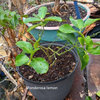
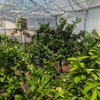
    Just a couple of pics from my yard for comparison:

    Volk Rootstock - (note the purple tinged new growth) (Volk leaves towards bottom of pic)

    And the (dreaded) Cuban Shaddock:


    I am awaiting grafts to succeed on these...…. !

  • 8 years ago

    Are the leaves with the broad petioles from the Volk as well?

  • 8 years ago
    last modified: 8 years ago

    judging only from the leaves, it is probably not Cuban Shaddock; anyway, when planted in the ground CS seems to be a normal size producing stock; not semi-dwarf as previously promoted by 4WG (that is only the result when planted in containers).

Sponsored
Peabody Landscape Group
Average rating: 3.5 out of 5 stars8 Reviews
Columbus' Reliable Landscape Design & Contracting