Software
Houzz Logo Print
tropicofcancer

Costco 60W grow light for $60

Looks pretty good and they provide PAR ratings which is not all that bad for the price. I am very tempted to buy a couple and stock up. I posted this on House Plants too: https://www.gardenweb.com/discussions/5308500/costco-60w-grow-light

Since it is quite new I did not find any relevant reviews yet.

Comments (33)

  • 8 years ago

    Is this it? https://www.costco.com/Feit-Electric-LED-2'-Grow-Light.product.100393562.html

    Intersting. I am going to need some for this coming winter.

    tropicofcancer (6b SW-PA) thanked lucky_cloud
  • 8 years ago
    last modified: 8 years ago

    Yes that is the one. The good thing is that it is ready to plug in and can be daisy chained up to 3 units. Problem with Costco is that their products sometimes just disappear. So I am also thinking of buying a couple. Just have to figure how I am going to use my diy lights that I have rigged.

    And thanks for finding the correct link.

  • 8 years ago

    Saw your earlier comment in my inbox that you may have deleted. It is also available in our local store. That is where I saw it. My wife pulled me away from that section. All I managed was to buy a pack of gardening gloves :(

  • 8 years ago

    Yes, I was wondering if it was in-store too, but then that seemed redundant somehow. Was it the same price in-store? I'll have a look at my local store this week or next. I'll probably get at least one. I have 4 taotronics bulbs on pendant sockets, but have acquired several new trees since last winter.

  • 8 years ago
    last modified: 8 years ago

    At least it's a good brand of diode. Seems to be the 'red/blue' spectrum mix. More modern research is reducing the credence of that, there are better spectrums available, but then again, I never bothered to load up the Feit Electric website (just the Costco description) so what can I tell.

    60W seems a little low for 2ft... but I'm comparing the recommendation against 75-100W HPS/sq ft.

  • 8 years ago
    last modified: 8 years ago

    lucky: same price in store.

    funkyhat: definitely not sufficient if you want summer like growth. But good enough to get by in winter. For tall plants, supplemental lights from sides will be needed to. This is not the best of LEDs, you can do far better than these. What I liked was that the box label is pretty upfront with spectrum data and actually states the PAR value. It is 1.27 micro-moles per Joule. Not too bad. One can do at least twice that for same power consumption. But will cost more too.

    Agreed that red/blue spectrum is somewhat out of favor these days. I have couple of red/blue light and they do pretty good for some tropical plants (eg ficus). Some others do not seem to like it as much. My limited citrus plants seem to be OK under it. No beautiful new growth but the plants did not stress out. In my case, my target is to sort of get by through the winter without stressing the plants too much.

  • 8 years ago

    So...for $60 is one of these better than two TaoTronics 36W full spectrum bulbs? I'm not sure of the PAR rating for those. I like mine but they seem to be so limited in their coverage.

  • 8 years ago

    The big question is what do you want to grow, different parts of the spectrum promote different types of growth.

  • 8 years ago

    I bet your Tao led is running at around 18W each. I could not find any specs on that but most led grow light companies employ false advertisement claims. 12 leds at 3W each results in 36W but you cannot operate those leds at that spec. Usually it is about half for efficiency purposes. Feit claims 60 actual consumption on their label. So it would be better than 3 of those Tao's unless Feit is using very poor leds.

    The downside of the feit led is that it is spread over 2 square feet. So it is good for short plants - may be 12 inches or a bit more. For taller plants you would still need some additional lighting especially from the sides.

  • 8 years ago

    This is a better option if you want more focused intense lighting with deeper reach - consumes 100W: https://www.amazon.com/MarsHydro-Spectrum-Hydroponic-Indoor-Growing/dp/B0773M18R6/

    I have an older version of the above Mars Hydro 300 but the specs for the new one looks better than mine.

  • 8 years ago

    There is a commenter on the Amazon page for the Tao saying it only consumes around 20W, so I think you are right.

  • 8 years ago

    I found another forum where they say it is 14.4 watts.

  • PRO
    8 years ago
    last modified: 8 years ago

    By far the most impressive grow lights right now are produced by Horticultural Lighting Group. They sell 4000K (white LED) grow lights that outperform the burple lights commonly used. You can get 65W or 100W panels off amazon.com. They cost as little as $99. There are the real deal, and are leading the market in terms of cost/efficiency and overall quality.

    The benefits of full spectrum lights cannot be understated. Green light is important, especially for deep canopy penetration.

    https://www.amazon.com/gp/product/B076QDKVDZ/ref=oh_aui_detailpage_o02_s00?ie=UTF8&psc=1

  • PRO
    8 years ago

    Also, if you do not want to look at the so called quantum lights I linked to above, check out COB LED grow lights. Stay away from the burple, there are better options out there now.

  • 8 years ago

    I have two of the QB120 65W from HLG, rigged to a Meanwell driver and they are certainly impressive. I like the footprint and the fact that it does not need any extra cooling. But then one will have to be comfortable with a bit of wiring, mounting, etc.

  • 8 years ago

    I have a couple of Marshydro 300 (140W each) from several years back and they are pretty good for some plants. For a change by bonsai tabasco actually grew under those. But the color is certainly hideous.

    The Costco burple I posted should be suitable for short plants. What I liked is that they are open with specs unlike many others that sell gimmicks with no specs. And the specs are not bad. Quantum efficiency of 1.27micromole/J is not bad compared with 1.6 or so for QB120 at max output.

  • 8 years ago

    Without knowing the details: they're probably okay (assuming the setup was successful!). T8/T5 flourescents or reasonably high wattage LEDs are both just fine.

  • 8 years ago

    lucky please feel free to post your findings. Very good opportunity for you to acquire perhaps a decent set of lights and may be even other supplies.

  • 8 years ago

    Yes, please post!

  • 8 years ago
    last modified: 8 years ago

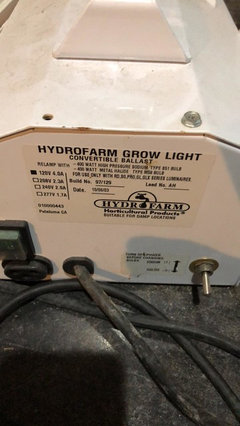
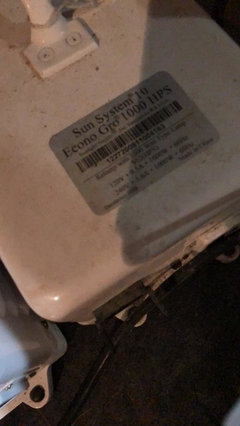
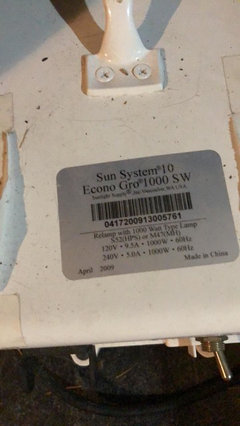
    Okay - turns out what she is getting rid of are mostly HPS lights, plus some reflectors and such. Here are the pics she sent me. She basically said I can just have the stuff so I'm just hoping they aren't going to be too expensive or hot to run in my basement w/very little natural light. It looks like some might be the remote ballast type, but I"m not familiar with those. Would love to hear what you all think,


  • 8 years ago

    400W and 1100W HPS lights are great. Very energy efficient, but they run hot because of the amount of power they're putting in such a small area.

  • 8 years ago
    last modified: 8 years ago

    Both of your ballasts can handle HPS or Metal Halide.

    The 1000W will run quite hot and very very bright (as in daylight). If your grow area is not heated then it might be an advantage. You will need good air circulation. It will cover a large area and can be (should be) hung high. I would keep it 3ft off the top of the plants. So you would need a good bit of clearance in your grow area. A 400W will be more convenient from a placement perspective. In fact I would say two or three 400W is more convenient than one 1000W but it would not put out as much light. A 1000W is more efficient per watt than a 400W though.

    Usually a reflector for 1000W will have side holes for air intake and exhaust. When I had one I did not use an exhaust fan but had a small fan blowing at the bulb.

    Google for height clearance and coverage of HID bulbs. There is ton of info on that.

    What would bother me more is that both ballasts are quite old. From the pics one is 2003 and the other is 2009. Well made ballasts can last quite a while but these are quite old and may not be as efficient any more. Hard to tell.

    Cost wise - this is the formula for a month (30 days for convenience):

    cost_per_month = (wattage_of_lights x unit_cost x hrs_per_day x 30)/1000

    eg:

    wattage_of_lights = 1000W

    hrs_per_day = 12

    unit_cost = $0.12 per killowatt-hr (get the actual number from your bill - I am using national average)

    cost_per_month = $43

  • 8 years ago

    Thanks, great info! I wonder if just getting some LED panels might be easier.

  • 8 years ago

    Easier? Perhaps, but you'll spend easily $500+ to replicate those two lights using LEDs.

  • 8 years ago
    last modified: 8 years ago

    The problem is, they would be going in my basement, with standard low basement ceilings with exposed wood rafters. Would there even be enough vertical space to use them safely? None of my trees are super tall, but I also have two curious kids who would try to touch the lights if they were not high enough.

  • 8 years ago

    It depends on how tall your trees are and how high your basement ceiling is. Without knowing specifics it's impossible to answer.

  • 8 years ago

    Basement ceilings are 7.5ft, minus a little for pipes, conduits, and other fixtures. Tallest tree is maybe 4' with most around 3'. I will need to read up on the HID requirements.

  • 8 years ago

    I have a similar basement like yours and for several years I used a 1000W HID light there. Since then I have my plant area moved to a covered porch. Although, it throws out the most magnificent light, it is hard to manage the grow space. Especially, when you have different types of plants with different light requirements and growth habit. With a 7.5ft clearance you do not have much of a freedom to adjust the distance of the light. Most recommendations for coverage and height assumes you have sort of uniform plant canopy. I put shorter plants and in the center and taller plants near the edges and rotated the plants so that they got somewhat uniform light. I pruned the plants in fall to make this easier. But you still have to contend with the fact that some will grow taller/bigger under those lights. At the end some plants will grow bigger and shade out the other ones.

    Since then, I have decided that I want my plants to just get by in the winter and grow a bit may be but not vigorously. This allows to keep such intense lights a bit farther away and cover a bot more area. I have a 600W now and keep it no less than 3 ft away from the plants. But my porch has a 10 feet clearance and so it is easier to play around. And I rotate the plants around.

    All in all, I think in a basement situation with limited clearance and different plants heights a 1000W source is a pain. You are better off with two 600W or three 400W lights. It gives you a lot more freedom to adjust.

    How many plants you have? If you have say a dozen or so plants and you are OK with a single 1000W light then it can work.

  • 8 years ago
    last modified: 8 years ago

    Thanks for the thoughtful responses, it's super helpful! A dozen or so plants would need to go in the basement space, yes. I have about 10 citruses (plus a bunch of small seedlings), 2 bananas, 2 avocados, 2 mangos. And a couple pineapples, a curry leaf, black pepper, several small coffee plants...I guess I like tropical edibles. Maybe overwinter some peppers too, although those seemed to be bug vectors. At least 4-6 of the plants, more depending on size, can go in our upstairs room with a 3-direction-facing bank of windows and Tao lights on pendants.

  • 8 years ago
    last modified: 8 years ago

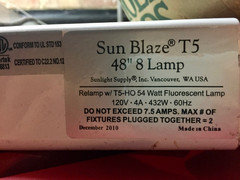
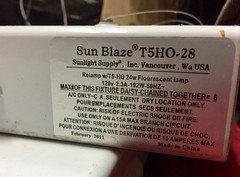
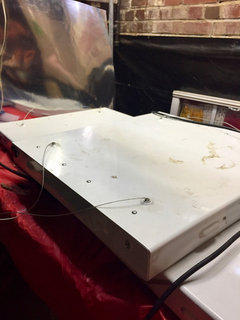
    Reporting back after I FINALLY got to my friend's house today to check out the lights she was giving away. I ended up not going for the large sodium and metal halide lights that needed ballasts. I don't want to fuss with heat sinks and having super-hot stuff in my basement. But she did have two fluorescent fixtures that seem nice and compact. I also ordered 2 of those HLG quantum boards (which also arrived today!). All this plus the TaoTronics bulbs I already had, mean I should be good for this winter, light-wise at least. Maybe I should get some more trees! HA!

    -

    Not a great photo, but this is the two units stacked on top of each other - one is nearly square and the other is twice as long. They are slim and not too heavy, and put out a nice light. Bulbs are bit cool though, at 6500K.

  • 8 years ago

    I think you made some good choices. 6500K will be fine. If the tubes are tool old you may see the ends to be darker than the rest when lighted or you may see noticeable flicker. If so, get new tubes.

    Remember to test them out in your plant area to figure out their placements. Especially the HLG boards. You may want to invest in a white plastic film (I like panda film which is white on one side and black on the other) to enclose your plant area. Unless of course it is already white all around. It will make those lights all the more effective.

  • 8 years ago

    Thanks, yes, I was planning to get some white boards to put around the space. I can get big sheets of inexpensive white corrugated plastic from the local creative reuse center. I'll check out panda film too.