Software
Houzz Logo Print
hennen

Red Obelisk Beech drooping branches

8 years ago
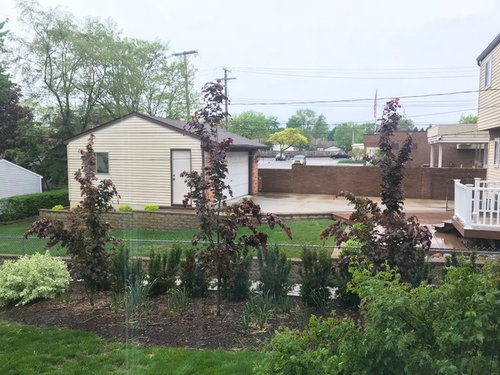
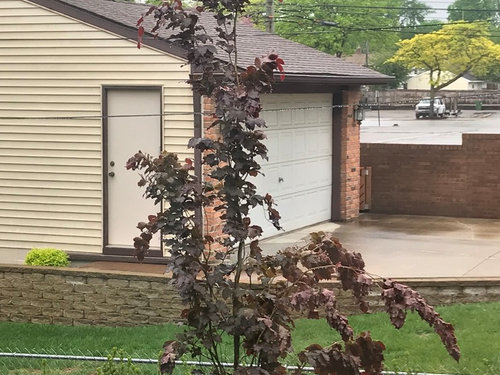
We planted three Red Obelisk Beech in the fall of 2016. Most of the branches were drooping so I tied several of them up (very loosely) to let them get stronger and hopefully stay erect.


After releasing the ties this spring, they continue to droop. They droop more when they are heavy with rain. The attached pictures are from this morning after a moderate rain overnight.


I know there are weeping varieties of beech, but my understanding is that this is supposed to be an upright form.


My questions are:


Will the branches start to stay more upright with age?


Should I continue to tie them up until they stay up on their own?


Should I try and sort of weave the drooping branches together so they support each other?


Or are my particular trees just going to have this drooping habit?


Comments (17)

  • 8 years ago
    last modified: 8 years ago

    'Rohan Obelisk'

    http://apps.rhs.org.uk/horticulturaldatabase/summary2.asp?crit=red+and+obelisk&Genus=Fagus

    produces toothed leaves (scroll down, click to enlarge)

    http://www.ogrodkroton.pl/towar.4806.buk.pospolity.rohan.obelisk.-.fagus.sylvatica.rohan.obelisk.html

    I'm not seeing that here - although I can't get a close view using only your two pictures of course. Anyway if you were supplied the wrong item that could have something to do with it. Otherwise Fagus sylvatica typically has arching branch ends, at least when actively growing. The next step is to check the identification, then if these still seem like something you want there then maybe you'll just have to tip the longest, floppiest side branches back - if they haven't firmed up on their own after a few more years.

    If these are in fact normal habit purple beeches each is programmed to get hugely bigger than they are now, with a single uncrowded specimen developing in time an average crown spread well beyond the space the three are occupying now.

  • 8 years ago

    i do this when i want to see the future with trees:

    https://duckduckgo.com/?q=Red+Obelisk+Beech&t=ffcm&iax=images&ia=images


    by the crotch angles.. it appears to have the proper habit ...

    https://duckduckgo.com/?q=crotch+angles&t=ffcm&iax=images&ia=images


    which then leads me to wonder ... why length its outgrowing branch diameter.. to the point the they can not support themselves ...


    have you ever fert'd these trees??? .. did you throw fert in the planting holes??


    i would probably just shorten those that offend you.. enough so that they stand erect ... and never fert them again ...


    i have grown beech in livonia and adrian... and i find them rather slow .. so excessive growth.. kind of surprises me.. making me wonder about fert ...


    and they are not the type of plant.. that are going to pull themselves upright ... once new woody growth hardens off after the spring push.. it isnt likely to change ... and that is when we start pruning ... hopefully properly ...


    if you bought them at a good nursery ... rather than bigbox.. i might talk to the manager and ask him what he thinks is going on ...


    all that said.. they look mighty fine.. for 1.5 year in the ground large transplants .....


    ken

  • 8 years ago

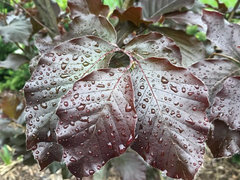
    Here is a closeup of the leaves.

  • 8 years ago
    last modified: 8 years ago

    This just seems to be something some cultivars of beech do. My 'Dawyck Gold' weeps or arches really badly when the stems are new, but their firm-up by midsummer. (As embo said, more or less.) Example found in google images: https://i.pinimg.com/originals/15/79/98/157998bdbfaccd81ce7ce623f9572244.jpg

    (I have no qualms about "stealing" a picture from 'pinterest' by deep-linking to it...since their whole business model is based on actually stealing pictures from other websites!)

  • 8 years ago

    We checked our records earlier (we keep all our plant tags) and it is clearly labeled Red Obelisk. We're headed to the nursery where we bought this anyway next weekend, so we can follow up then. Thank you!

  • 8 years ago

    It's possible the new growth will straighten out & harden as the season progresses.

  • 8 years ago

    you've had a plant where stems were tied in position. ties were released. plant flops. time may allow the plant to recover, or it may need some selective pruning/tying.

    Individual branches on fastigate plants will sometimes flop. In particular with new growth, the elongating stem doesn't always have the strength to remain upright...you should see what cathedral elm does and how people freak out.

    My neighbor has Slender Silhouette Sweetgum planted next to his house. On the gable end, rarely a problem. on the sides under the eaves, individual branches often split. He thinks I'm a lunatic when it comes to pruning, so he ties them up.

    hennen thanked waynedanielson
  • 8 years ago

    Should I in general not tie them up and prune if they are just too floppy for the habit I'm going for?

  • 8 years ago

    These were purchased and planted by a very reputable nursery. They were fertilized when planted but haven’t been fertilized since.

    Our soil was 95/0/5 clay/silt/sand after doing two jar tests, so when I developed these new beds I dug down to sand and filled with soil and some compost. Normally I would not do that to avoid a bathtub effect but since I went very wide I was comfortable with that here. So while there has not been added fertilizer past the initial planting the soil is pretty rich.

    They had drip irrigation last year since they were new. I was going to remove it this year now that they are established.

    The first winter rabbits ate a lot of the lower branches. I don’t know if this triggered a push on upper branches?


  • 8 years ago
    last modified: 8 years ago

    The first winter rabbits ate a lot of the lower branches. I don’t know if this triggered a push on upper branches?

    At least that's how straight species european beech react. Damage such as lost branches, deer rubbing etc. will make the rest of the tree grow faster. I have never seen that reaction as pronounced in any other tree species. Beech seem to have a lot of growing potential that it doesn't normally use, for some reason. I guess it has no stress, being a shade tolerant climax species.

  • 8 years ago
    last modified: 8 years ago

    Tree and shrub shoot response to bark or branch damage is usually something like water sprouts or suckering. I'm not seeing that in the trees asked about. When a woody plant is pruned back for instance and this appears to make it grow faster it is because it is reacting with fast growing, seldom branching shoots in an attempt to restore its previously existing lost top volume. Organized studies have shown that sprouting top pruned plants are not experiencing an increase in the rate of total top volume production. And actually remain smaller than they were before, until the re-growth restores their previous total mass.

  • 8 years ago

    Well, that's why I claim Fagus sylvatica is special in that regard. It does not react as you would expect.

  • 8 years ago
    last modified: 8 years ago

    Would probably have to be something like redirection of energy or hormones, with it being unique to beech seeming rather unlikely - the usual response observed by trees and shrubs (including beech) is sprouting of replacement shoots at or near the point of damage. Otherwise I'd like to see your claim substantiated by an organized trial such as a uniform block of beech with half wounded in a consistent way and half not, following by measuring of growths by each set to see if there way any difference. On the same site with the same weather during the trial period.

  • 8 years ago

    I don't have enough knowledge to take either side of the damage causing new growth argument, but there is not any sprouting at or near the damage.


  • 8 years ago

    I had an arborist here today for a different project and he looked at the beeches. He suggested to tie the drooping branches up, cut about 12 inches off the drooping branches to reduce the weight on them, and leave them loosely tied until the strengthen up. Thoughts?

  • 8 years ago

    Don't.


Sponsored
High Point Cabinets
Average rating: 5 out of 5 stars21 Reviews
Columbus' Experienced Custom Cabinet Builder | 4x Best of Houzz Winner