Software
Houzz Logo Print
teacherofthreekids

Fertilizing container tomatoes

8 years ago
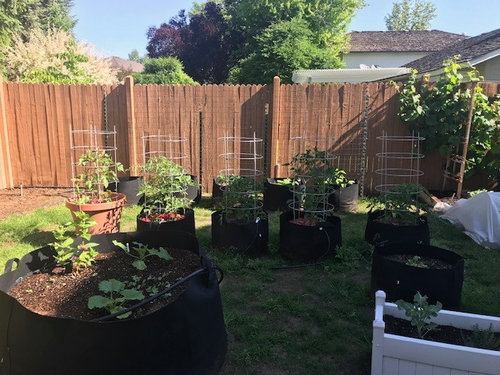
Sorry to ask so many questions. I'm confused about how to fertilize my container tomatoes. I've searched on this site and others and there's a wide variety of advice. Will say I'm trying to grow them organically and grew them from seed indoors.


As seedlings I gave them Organic Start! liquid fertilizer according to the directions. When I transplanted them, I threw in a couple of handfulls of Dr. Earth Home Grown Tomato, Vegetable & Herb Fertilizer (4-6-3). That was a month ago. Now what? We have a local organic nursery that I can buy tea from. I could also use the Dr. Earth.


I'm unclear what I should use and how often. My plants have blossoms and I'm in Boise, Idaho in zone 6b if that matters.


The plants are in 30 gallon fabric pots (except one is in a plastic pot). They get lots of sun, this pic was taken in the early morning when the house was shading them.


Thank you for any thoughts!


Comments (15)

  • 8 years ago

    Agree completely with gardengal. Liquid organics is the solution for trying to grow organically in containers. Dry and granulated organic supplements simply cannot provide the nutrients effective because the containers lack the required "middle man", the micro herd. And there are literally 100's of liquid organic supplements available. For example: https://www.planetnatural.com/product-category/organic-gardening/organic-fertilizers/liquid-fertilizer/

    It is the frequency of application that becomes the real challenge and as a very general guideline - weekly works for me with those containers that are not set up on continuous low-dose fertigation. I prefer the Earth Juice products but General Organics also makes some good products.

    Dave

    C. S. thanked digdirt2
  • 8 years ago

    Ok. Thanks so much! I really appreciate it!

  • 8 years ago

    Texas Tomato Food is also a very good organic liquid fertilizer. I feed daily with it, and have had great results this year. If your container media is anywhere near as fast draining as mine, you'll need to feed often. Tomato plants are heavy drinkers and feeders.

    http://www.tomatoville.com/showthread.php?t=27229


    C. S. thanked edweather USDA 9a, HZ 9, Sunset 28
  • 8 years ago

    Texas Tomato Food is not OMRI listed, so you can't technically call it organic.

    That said, I generally stick to organic methods in my garden, but I use TTF. I get very good results from it. I'm sure getting hydroponic ingredients in bulk and mixing your own would be cheaper and likely work just as well, but in a garden my size (only room for 10 in-ground tomatoes and a few more in containers) it's just easier to buy a pre-mixed product in smaller quantities.

    C. S. thanked gorbelly
  • 8 years ago

    Ok then. I thought it said organic on the label, but must have misread it. Not that I grow organic anyway....just thought it was. Thanks for the correction.

  • 8 years ago

    Their BioActive fertilizer, a dry fert, is organic. But not their liquid formulas.

  • 8 years ago

    Back on track here, I meant to mention with 30 gal containers and a good fertilizer, those plants will get HUGE.

    C. S. thanked edweather USDA 9a, HZ 9, Sunset 28
  • 8 years ago

    And that's ok right?

  • 8 years ago

    Not necessarily! Nitrogen is a highly mobile nutrient and fine to feed from top fed liquid but other nutrients, especially Phosphorus, may be hard to place in the root zone when needed. It may be best to either place most of Phosphorus in the potting mix or better yet use slow release fertilizer like Osmocote when potting. I’ve seen results of a flower trial where water soluble season feeding was compared to coated nutrients in the potting mix and results were amazingly in favor of coated pot fertilizer.

    Not organic and Not normally cost effective unless you plant in pots.

    C. S. thanked Barrie, (Central PA, zone 6a)
  • 8 years ago
    last modified: 8 years ago

    Something like tomato tone should work well. Just add regularly once the fruits are starting to grow, like a spoon every two weeks let's say and incorporate into the mix. The problem is at some point the mix is full of roots and it's hard to incorporate. Organic works good in containers but there might be some microelement deficiencies later in the season since the clay base of the soil is not there for mineral content (you could add some rock dust at beginning of season or buy some microelement mixture to add from time to time in tiny amounts).

    C. S. thanked fungus
  • 8 years ago

    I used Tomato Tone in containers once upon a time. Liquid fertilizer works way better in containers. Much improved yield and plant health.


    C. S. thanked gorbelly
  • 8 years ago

    "Organic works good in containers "

    There is NO way dry organics work well in containers!! Unless you are using some weird poorly draining mix that includes a lot of compost or garden soil. Container potting soil lacks the soil biology necessary to process these sorts of ferts and convert them into plant usable forms.

    If you think dry or granular organics like TomatoTone works well in containers then you do not understand the basic difference between a water soluble synthetic fert and an insoluble organic product.

  • 8 years ago

    Yes, frankly, it's best to leave organics for the ground. In containers, any decent liquid or water soluble fertilizer should work well. Texas Tomato, Foliage Pro, and even Miracle Grow if you're on a budget. Doesn't hurt to have a Controlled Release Fertilizer (CRF) in there as a backup. Osmocote was mentioned, and Miracle Gro make a good product called Shake and Feed, which contains calcium and magnesium. And yes, imo big plants are good if managed properly. If I had 30 gallon containers, I'd need 10 foot cages. Your plants will probably overwhelm your cages in short order. Can you possibly attach another cage on top of those?

  • 8 years ago

    I grow cherries (indeterminate) in 20G containers and it is hard to find tall enough cages that will fit in the containers!! And I lack the patience or creativity to make my own :-) So I just let the plants sort of cascade over the top. It doesn't seem to impede their flowering or fruiting in any way although by the end of the season, some of the upper branching structure is a bit split by the weight of the fruits.

    I also dose with Osmocote Plus when potting up and periodically during the season with Dyna Gro GROW. In an area that is notoriously difficult to grow toms well due to cool summer temps, I get amazing crops from the cherries!