Software
Houzz Logo Print
boris_zakharin

Brown tips on new growth

8 years ago
last modified: 8 years ago
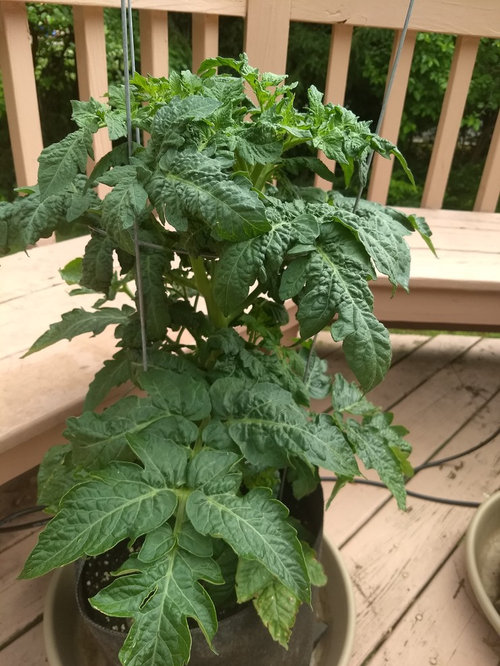
I have planted four tomatoes, grown from seed, in containers on my deck. Two of them are New Big Dwarf. They seemed to be the healthiest of all my seedlings, growing dense leaves and a heavy main stem even indoors. Even now, about 20 day from transplanting they look healthy from far away:

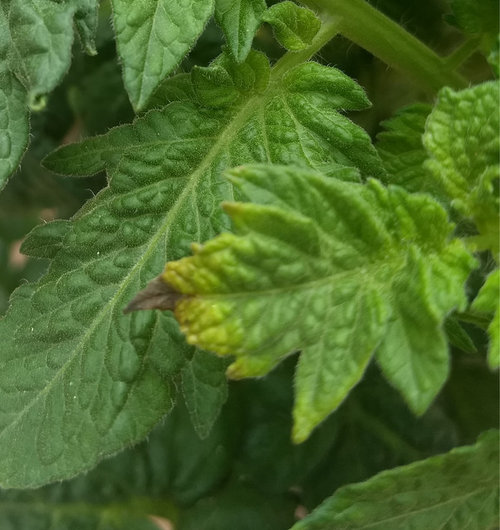
They are also flowering moderately. However, lately, most of the new leaves have brown tips:

Any idea what this might be?

Thanks in advance

Comments (24)

  • 8 years ago

    In this weather, it could be botrytis. I would prune off affected leaflets and treat the plant with your choice of antifungal just in case it is.

  • 8 years ago

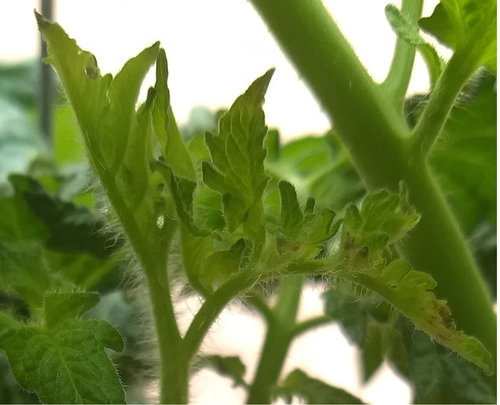
    They seem to all be affected especially on my first plant. At least all the younger growth. That last picture is a zoom in of a newly emerging branch that's already showing brown sections. They are also determinate, so if I start cutting off everything I'll lose all of my crop. I'm also wondering why it's only affecting my 2 new big dwarf plants and not the others.

  • 8 years ago
    last modified: 8 years ago
    Is there something different about the pots or mix that could affect drainage with those plants? Because it may be unhappy roots from all this rain leading to the problem as well.

    Note that New Big Dwarf is NOT determinate. They are dwarf indeterminates. The internode distance is very short, and the plant has a stock tree-like structure, but the plants are indeterminate.

  • 8 years ago

    The pots are 5 gallon grow bags recycled from last year left outside over the winter with old mix still in them, emptied before planting. The other varieties are in bigger pots (20 gal), one of them recycled in a similar fashion, while the other is brand new. The mix is identical in all plants.

    My seed packet says "determinate, 90 days". Looking online, some places say they are determinate, others say indeterminate, while yet others say determinate, but can have several "flushes". DTM is also inconsistent, 60 or 90 days.

  • 8 years ago

    DTM is longish. It's not an early tomato, though not very late. It's definitely indeterminate. A lot of seed catalogs think bush or dwarf = determinate, but this is not accurate.

  • 8 years ago

    As far as fungicides go, I still have my pure neem oil bottle from last year (stored at room temperature in normal light). Would it still be good as a fungicide?

  • 8 years ago

    I think it should be OK, but neem isn't the most effective antifungal. It's good on powdery mildew, IMO, but not great for some of the other issues.

  • 8 years ago

    This is a possibility, but that dark green color is just typical of the variety/type, in my experience. However, this is a good point and something worth considering.

  • 8 years ago

    Looks like fertiliser burn to me, back off on the ferts and/or give it a big flush to get rid of some of the excess.

  • 8 years ago

    Yeah, I think fertilizer burn is more likely. I have diseases on the brain because of the crazy wet weather we've been having and some earlier than usual signs of disease I've been seeing as a result, but go with the obvious first.

  • 8 years ago

    Whatever fertilizer they're getting would be from transplant time over three weeks ago. Wasn't planning to add any more for another three weeks. If it's still dissolving in the potting mix I can't really remove it now.

  • 8 years ago

    It was granular fertilizer?

  • 8 years ago
    last modified: 8 years ago
    I mixed Osmocote 14-14-14 into the potting mix and poured in a month's worth of Miracle Gro Tomato water soluble, same as last year, except I was growing Rutgers last year.

  • 8 years ago

    Oh, yeah, that can cause fertilizer burn. If it doesn't get any worse, then your plants will probably be fine. But I would hold off on fertilization for a few weeks, and then when you start again, fertilize gently more often by watering with the Miracle Gro at 1/4 strength every third watering or so. That approach tends to work better for containers than putting larger quantities of fert in less frequently.

  • 8 years ago

    When someone says they plan taking up gardening as a means to relax,I advise "for goodness sake,don't grow tomatoes". ):

  • 8 years ago

    The regime suggested to me last year was was for a month's worth of feeding at transplanting, and then start regular feeding like you said about 6 weeks later. It worked well for me for Rutgers last year. Is this different because it's a dwarf plant?

  • 8 years ago
    last modified: 8 years ago

    " and poured in a month's worth of Miracle Gro"

    Whoa! That'll do it alright. Not to mention that plus 14-14-14

    "The regime suggested to me last year was was for a month's worth of feeding at transplanting,"

    No idea where that regime came from but forget it when it comes to containers. On second thought forget it period as it could easily burn even in ground plants. If it worked you were quite fortunate. Un-diluted MG is quite strong and well documented as excessive over-kill.

    Dave

  • 8 years ago

    Well, I mean it was diluted in water, but I see your point and won't do it again. Live and learn I guess. I hope it's a temporary situation that will correct itself. I'm just surprised that it took 3 weeks to see any signs of this, and that my 20-gal container plants aren't showing any symptoms.

  • 8 years ago

    I assumed it was diluted in water Boris but my point was that most recommend using MG at no more than 1/2 strength - normal dose in 2x as much water or 1/2 the recommended dose in normal amount of water called for, many use it at only 1/4 strength. That's what we mean by diluted MG.

    A 20 gallon container will "cope" with 3x as much fertilizer as a 7 gallon container would since all that fert is far more dispersed in the large container.

    Dave

  • 8 years ago

    Looks like fertilizer burn...

  • 8 years ago

    Boris, the Osmocote alone would have been a month's supply of fertilizer. Maybe the instructions you got were worded confusingly? Because the usual thing to do would when using Osmocote granular and liquid like MG would be to mix in the Osmocote at planting time and assume it would last about a month and not start feeding with the dilute liquid fert regularly until after that month had passed.

  • 8 years ago
    last modified: 8 years ago

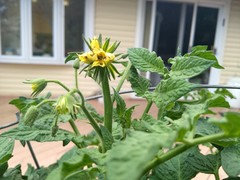
    I believe that my plants have survived the overfertilization. However, I've noticed a lot of what would appear to be superblooms on both plants. At least one per cluster.

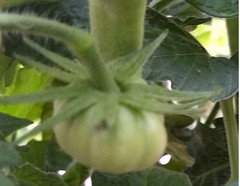
    This picture shows at least 3 on two clusters, but just about every flower has at least 9 sepals (compared with 5-6 on the other varieties I'm growing). Those seem to be producing relatively normal-looking fruit:

    The really crazy ones like the big one in the first picture haven't turned into fruit yet. Maybe most won't, but I do see hints of fruiting on one, and they almost look like multiple individual fruit trying to form around flower material.

    Does this have to do with overfertilization or just this variety? Should I be concerned that I won't be getting fruit from these, or badly damaged ones?

  • 8 years ago

    I find that the rugose, potato-leaved dwarfs are prone to getting fused blooms. Probably something in the parentage that comes from the big-fruited potato-leaved plants which are also prone to fused blooms. If they're obviously going to produce gnarly fruit, I usually take them off.