Software
Houzz Logo Print
destany_fenton

Weeping Willow is in trouble

8 years ago

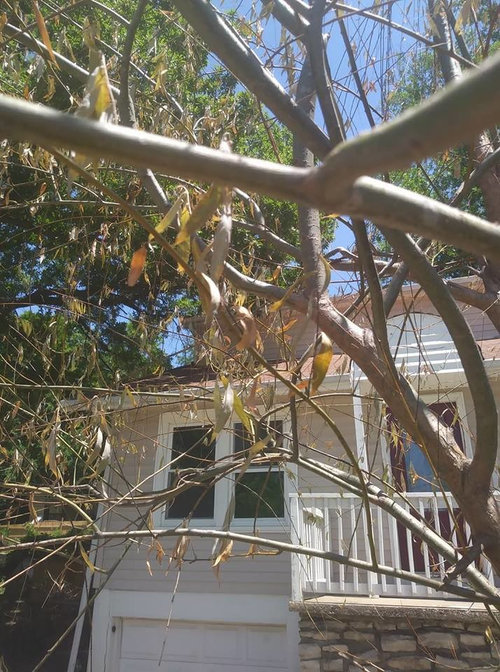
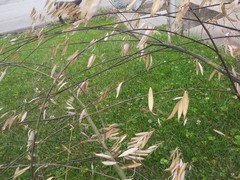
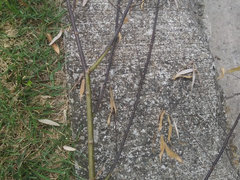
My weeping willow is five years old, started from branches that were rooted. It has never had any problems before. I noticed yesterday that some of the leaves looked yellow. Today I see that they are brown and dying.

We have had plenty of rain and the soil around the tree is moist. The branches are still green and pliant. I have done no pruning or fertilizing to the tree this year, no care whatsoever. I cannot see any evidence of damage to any part of it, and no evidence of pests or fungus. The tree is planted in the middle of a raised yard with good drainage. I'm at a loss. :(

Comments (21)

  • 8 years ago
    last modified: 8 years ago

    Willows are disease susceptible, if the ground is in fact moist to a good depth then presumably this actually is a disease issue. Any sign of anything abnormal on the main stem, a canker for instance?

  • 8 years ago

    It does appear to be some sort of blight. It literally took two, maybe three days to kill all is the foliage. The ends of the branches are now black and dying, I see. I didn't see that earlier. Whatever it is, it seems very aggressive.

  • 8 years ago

    If you are in the US your local USDA Cooperative Extension Service office may be able to tell you what it is.

    They will need representative samples of affected parts.

  • 8 years ago

    Just to mention, if the tree lives, it will become far, far too large--wide-- for the location.

    Destany Fenton thanked laceyvail 6A, WV
  • 8 years ago

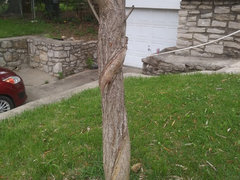
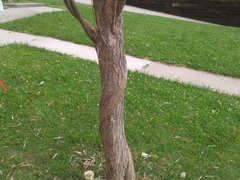
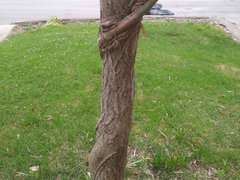
    Can you post a picture of the bowl of the tree between ground and first branches?

  • 8 years ago

    I guess not.

  • 8 years ago

    I'm not online on Saturdays. Sorry. I'm not sure what you mean about the bowl of the tree, but I'll look it up.

  • 8 years ago

    @lacey, why I hate coming to these forums. Alwaysa naysayer with a criticism. You saw one vertical shot of a section of the yard to make a snap assessment that you feel so sure of, you had to comment. The space is fine. The tree is sick, is all.

  • 8 years ago

    I will chime in as well to agree that the space is NOT fine. Weeping willows grow to be very large trees (50'x50' or more) with an equally large, water seeking root system. If there is any inground plumbing in that front yard, it will seek out and invade. They are seldom recommended by anyone familiar with them for planting in a standard urban/suburban garden......these need acreage!! And preferably a ready water source like a stream or pond. And since they are so prone to disease issues and limb breakage, you can face all sorts of damage and liability issues with branches falling on your house, your neighbors or on the cars parked nearby.

    Since it is on its way out, do yourself a favor and get rid of it now.

    Destany Fenton thanked gardengal48 (PNW Z8/9)
  • 8 years ago
    last modified: 8 years ago

    I'm not sure it's an actual weeping kind of willow, so far it's not very droopy. So it might need to be replaced just for that reason anyway. Two small-growing kinds that you may be able to find on the market there - depending on wherever it is you are located - are Salix caprea 'Kilmarnock' (often sold incorrectly as 'Pendula') and S. purpurea 'Pendula'. The golden weeping willow (S. x sepulcralis 'Chyrsocoma') has been much sold by garden centers in the past - usually under incorrect botanical names - but has also been reported well over 100 ft tall and wide from Michigan for instance. (In Seattle, where there are a lot of them about 60 ft high with an average crown spread of 80 ft is typical for the largest ones). So if you don't live in a park it's not really right for your situation.

  • 8 years ago

    Ok. Look, I didn't come here looking for an argument, I just wanted some help with the tree. It was a gift from my sister when my daughter Willow was born too early and fighting for her life in the nicu. It probably doesn't matter because it's "on its way out," but it's in a raised bed with plenty of space for its roots. There is no plumbing beneath the front yard to be concerned about. The ash tree in the front corner is coming out next year because it's a weed tree oddly placed and invades the neighbors driveway. We wanted the tree to shade the house and our own driveway.

    I get it. It's not an ideal location, but it's special to me and I felt that this could work.

    I don't know why I'm defending the damn tree, I just didn't want to see it die. I'll get over it.

    Thanks for the advice.

  • 8 years ago

    There are a lot of 'willows' that could work in that space that don't become full blown trees. And without a comparably large and invasive root system. Yours is still very young and quite small and 'standard' weeping willows often don't display a very weeping habit until they become more mature.

    In addition to the ones Embothrium listed, I'd consider shrub willows like Salix purpurea 'Nana' or Salix integra 'Hakuro Nishiki'. The latter can often be found available in a tree form (grafted standard) and is an excellent choice for a smaller urban garden.

  • 8 years ago

    When grafted to the top of a straight piece of another willow the otherwise up-swept 'Hakuro-nishiki' arches out nicely.

  • 8 years ago

    Wow, I frequent Hot Topics but this is hotter.

    I looked at the original pictures and saw that the bowl (stem) looked irregular and I wondered if it had split, that's all.

  • 8 years ago

    When I saw the first picture that you posted, my response was this tree is too big for that space. That picture gave a false impression of the area where it was planted. It does not show that the area the tree is planting in appears to be about 6' above the driveway and some distance above the steps to the street.

    Based on the small picture on your posted last post, the view from the street; I believe that the willow will live comfortably in that area. On the side walk side you may need to continually trim up the branches that interfere with the sidewalk, but on the drive way side, it will self trim and rarely be a problem for your cars. It can hang over the drive with no problems. The only thing I see as a problem is that it will completely block the view of your house from the street.

    If that area were flat at the same level of the drive, you would constantly be driving through the willow, similar to the curtain that you find in the car washes.

    The willow is the fastest growing tree I know. When I was in High school, my uncle gave me a branch from his willow. 13 years later the tree was 25" high with a crown that was about 20" in diameter. Dad had to continually trim the tree to keep the grass growing under it.

  • 8 years ago
    last modified: 8 years ago

    Part of the basis for confusion is that "bowl" is being presented here in place of "bole". Regarding retention of the tree for the sake of its intended role as a living memento the important thing is to find out what, exactly is afflicting it. And what, if anything can be done to beat it back.

  • 8 years ago

    Sorry for the confusion it must have been the sleeping pills. Bole it is, thanks Embo.

  • 8 years ago

    Ah ok. I was scratching my head over that one. The trunk does look odd, because it was made with three willow branches (representing my husband, our daughter, and me) twisted together so that they would fuse over time. It's quite a pretty look.


  • 8 years ago

    What a lovely idea Destany, it is possible that this is the problem but I don't know enough to offer a useful opinion. There is a guy called Patrick Dougherty (http://www.stickwork.net) who does wonderful work, weaving willow branches, and you might want to try something like that if this tree fails.

  • 8 years ago

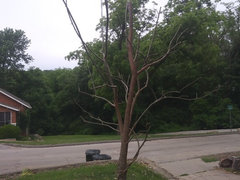
    It's black canker. It happened so quickly that it didn't even take time to put black spots on the leaves, which is usually the first sign.

    Literally, the tree went from looking healthy on Wednesday, a little wilted on Thursday, more than half the leaves yellow by Friday, to all of the leaves dead on Saturday.

    Knowing the tree will likely die (but there is a lot of green still in the trunk and larger branches) I decided to act quickly and aggressively as the disease and pruned it severely, spraying heavily with neem oil.


    Nearly all of the secondary branches are completely black, so they are removed. The branches and leaves will be burnt over the weekend to prevent spreading.