Software
Houzz Logo Print
cjgw

HELP! Something chewed through main stem. Plant dying!

8 years ago
last modified: 8 years ago

I have several tomato plants that are doing really well. This morning I noticed one of them was severely drooping and found that something had chewed through most of the main stem at the bottom of the plant, right above the soil. There was some fruit right above that (still green) that was totally untouched. Only the stem was chewed. I'd never seen anything like that before. The stem is barely attached now and the plant is dying. I dunno if there's any way I can still salvage it. I mounded a bunch of soil around where the chewing had taken place so it's not exposed. Any ideas on what I can do? The plant is about 4 feet high with numerous green tomatoes on it. I really don't want to lose this plant! I'll be putting up some fencing around them to prevent further damage.

Comments (31)

  • 8 years ago
    last modified: 8 years ago

    Cutworms will bore right through the stem of a small seedling right above the soil line. Timberrrr! They typically won't hurt a larger plant. But sometimes they do. I don't think you have any options for saving the plant.

    Fences don't stop cutworms. Put collars around the stems at the base. Cardboard towel tubes, when sliced to a few-inch length, do nicely. You can also sprinkle DE or any manner of insecticide dust around the plants, but collars are best. I ALWAYS put collars around my seedlings.

    BTW, cutworms aren't really worms. They are caterpillars. Moth larvae actually.

    Where are you? If we're talking cutworms, and they haven't already destroyed many of your seedlings, you might be just enormously lucky. The most voracious cutworms are the first generation of the season, in the spring. But if you have four-foot tomatoes, I guess they've been in for a while, and I'd have to assume the first generation is long gone.

    cjgw thanked daninthedirt (USDA 9a, HZ9, CentTX, Sunset z30, Cfa)
  • 8 years ago

    Trying to root a four foot plant is not likely to succeed. But yes, you can take snippets of of it and root those.

    cjgw thanked daninthedirt (USDA 9a, HZ9, CentTX, Sunset z30, Cfa)
  • 8 years ago

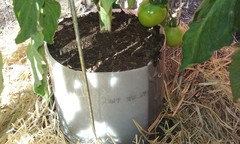
    I've had luck cutting out the bottom of a milk jug or old pot, slicing down the side and putting it around the damaged stem, mounding it full of dirt and duct taping it shut again. Keep it plenty damp and it will grow new roots and keep some of the old ones. Looks kind of silly, but it works.

    cjgw thanked ddsack
  • 8 years ago

    Yes, I was going to say that if you piled moist dirt HIGH on the stem, it might just develop adventitious roots, but I didn't know how to engineer that. This is an interesting suggestion. Of course, the root volume is mostly then restricted to the jug. So the plant might survive, but it's not going to grow.

    cjgw thanked daninthedirt (USDA 9a, HZ9, CentTX, Sunset z30, Cfa)
  • 8 years ago

    It is said that BT can be effective against cutworms when sprayed on the soil at night. Not sure why that would work, though, because cutworms have to eat the stuff to be affected. I guess if they're snacking on soil organics as they make their way to your plant, it would work, but still, it takes some time for the BT to affect them. Seems to me they could topple your plant before the BT kills them.

    cjgw thanked daninthedirt (USDA 9a, HZ9, CentTX, Sunset z30, Cfa)
  • 8 years ago

    If there's already fruit on the plant, it's too large to be damaged that much by a cutworm. I would suspect some kind of mammal.

    Can you post pictures of the damage?

    cjgw thanked gorbelly
  • 8 years ago

    Thanks for all the advice, guys. I will take a photo of it. I do think it was a mammal of some kind. We get raccoons and opossums stealing nectarines from our yard. I was going to fence and net the area when the fruit started getting red but had no idea anything would be interested in the stem like that. I put a mound of raised soil over the damage yesterday but I need to redo it. Try to make it high as possible using the milk jug method. I think the plant may actually be only about 3 ft tall, but still big enough that I thought it was safe. Whatever animal it was, what a jerk!

  • 8 years ago
    last modified: 8 years ago

    Animals don't chew stems at the base. They go after fruit, leaves, and tender new growth. I have coons and possums too. But if you have a coon or possum that just wants to mess with your mind, I guess they might do that.

    cjgw thanked daninthedirt (USDA 9a, HZ9, CentTX, Sunset z30, Cfa)
  • 8 years ago

    Voles do. Groundhogs do.

    cjgw thanked gorbelly
  • 8 years ago

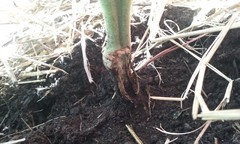
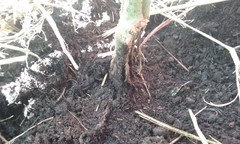
    Here are some pics of the damage. Sad plant now. I'm hoping raising the soil level well above the damage will help. Probably too late though, right? For the record, I overestimated its height. Actually only 2.5 feet.


  • 8 years ago

    Well, the plant may be beyond help but I cut out the bottom of an ice cream pail and used that for ddsack's method (I hope that's what he meant). I really wish I'd had time to get to this yesterday. I'll let you know how it goes.

  • 8 years ago
    last modified: 8 years ago

    I should say that if we're talking voles and groundhogs, ordinary fencing won't do the job. Unless it is buried. Both will burrow under a fence in no time.

    cjgw thanked daninthedirt (USDA 9a, HZ9, CentTX, Sunset z30, Cfa)
  • 8 years ago

    That looks more like some kind of pith necrosis or crown rot or something. But, yeah, that plant's a goner.

  • 8 years ago

    It's difficult to tell from the pics but there seemed to be some definite SHREDDING going on there. One thing I forgot to mention is the straw mulch seemed to have been disturbed as if something had been digging at it.

  • 8 years ago
    last modified: 8 years ago

    Ordinary fencing can deter them if they have other things they can eat. It depends on how determined they are to access the plant you're protecting. I had a vole or groundhog cut down and drag away a 1' tomato plant earlier in the year. I wrapped the rest of the plant crowns in aluminum foil, and it didn't come back for more plants. I have no delusions that foil will stop a determined vole. But it makes the plant strange and unpleasant enough that, with plenty else to eat in the neighborhood, they go elsewhere.

    I use the same principle with my ripening tomatoes and figs and squirrels. I wrap mature tomatoes in panty hose and let them ripen on the vine. And I put organza bags around my figs. Squirrels can easily get through these materials. But they don't because it makes it inconvenient/strange enough to get at them that they'd rather find other things to eat. If I don't bag my figs, I don't get a single ripe fruit from any of my 3 trees. If I do bag them, even though it's just a flimsy organza bag, almost every single fig makes it to my table.

    I'm sure if I lived in some kind of rodent food desert, I'd have to implement Fort Knox level methods. But I live in a very old, established suburb with tons of old trees, including fruit trees and oaks, and a neighbor that likes to feed the wildlife. So this approach works fine for me.

    cjgw thanked gorbelly
  • 8 years ago
    last modified: 8 years ago

    Well, if the mulch was disturbed, then it wasn't a cutworm, stalk borer, or any kind of caterpillar, and disease is probably not the issue. Rodent seems likely.

    I'm curious to see whether your efforts save your plant. Keep us updated. You might want to get rid of much of the older foliage, as the plant is going to have a lot of trouble maintaining all the transpiration through the foliage with a compromised connection to the root system. Pruning off many of the leaves reduces the need for so much water. It will probably delay production if the plant survives, but at this point, you have little to lose.

    cjgw thanked gorbelly
  • 8 years ago

    It looks like you still have half a stem left, so there should be at least a little flowage through there, and hopefully enough energy to start growing some new roots. Don't worry if the leaves stay limp for a week or even a couple of weeks. As long as they don't actually dry up you have a chance. At some point they may perk up at night and still get limp during hot sunlight.

    cjgw thanked ddsack
  • 8 years ago

    Thanks for all the helpful info and advice, gorbelly! I will definitely keep you guys updated on this thread. And I like your optimism, ddsack. I'm not ready to toss this plant into the compost pile just yet!

  • 8 years ago

    So sorry for your tomato plant! I’ve had squirrels do damage like that to houseplants, even ones that are poisonous like plumerias and rubber trees. Seems like they’re just tasting, or more likely being little jerks. I hope you’ve taken some kind of preventive action for your other tomatoes. Maybe wrapping the base in aluminum foil or something.

    cjgw thanked Ohiofem 6a/5b Southwest Ohio
  • 8 years ago

    I put some fencing and netting around it so hopefully nothing will get in. But maybe I'll wrap the bases as well. Maybe I had a squirrel that fancied itself a tomato beaver or something, lol. The plant still seems to be clinging to life, so I've got my fingers crossed.

  • 8 years ago
    last modified: 8 years ago

    UPDATE: So I guess it was a gopher. Something dug up through the bottom of the pail and now the stem is totally severed. The whole rest of the plant remains untouched. I have two other tomato plants and I'll have to move them somewhere else or into containers. Can you transplant a 3 foot tall tomato plant with green fruit on it? I've also got zucchini and cucumber growing in the same area. Dunno if I need to move those as well. They really seemed interested in that particular tomato plant.

  • 8 years ago

    What is your location?

  • 8 years ago

    I'm in the San Francisco East Bay area.

  • 8 years ago

    Transplanting large plants successfully is going to be hard. Success will be measured by how large of a root ball you can dig up and transfer to another hole. It will take many weeks for the plant to expand into the new hole, and replace the roots that were damaged. I don't have underground rodents, so I wasn't aware of the kind of damage they could produce.

    I believe there are a number of strategies for repelling gophers. I'd look into those before trying to move large plants. Chemical, ultrasonic, traps, etc. Those strategies, if they work, will basically recover your ability to use in-ground beds. Just moving plants won't do that. That's just conceding gopher dominance.

    cjgw thanked daninthedirt (USDA 9a, HZ9, CentTX, Sunset z30, Cfa)
  • 8 years ago
    last modified: 8 years ago

    Looking more into this, I think it may actually be voles, not gophers. So thank you, gorbelly, for the advice about foil. Do you just mean wrap some foil around the base of the stem?

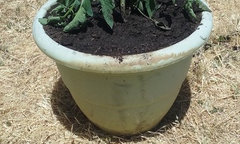
    I have 2 surviving tomato plants. One is about 3 ft tall and the other is a lot shorter. This morning, I noticed the shorter one was wilting even though I'd given it a good watering yesterday. I was worried it had been attacked but couldn't see any damage above the soil. I transplanted it into a pot, trying to keep the root ball in tact (I may have damaged some of the extended roots, though). It look s pretty sad right now but I'm hoping it'll survive.

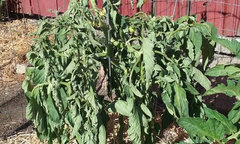
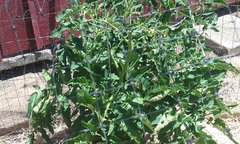
    Here's the 3-footer still looking healthy, but I'm worried!

    Aside from the foil, what's the best vole deterrent, if that's what it is? I've read some stuff online and people are saying castor oil is a good one, although I'm still unclear as to how exactly I apply it. I see no entrance holes anywhere in the surrounding dirt. People are saying sonic repellents don't work that well. I may not be able to get to the store until tomorrow, so I'm hoping it doesn't get attacked by then. I'll add the foil in the mean time.

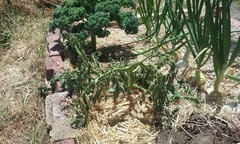
    In a super desperate move, I took the remains of the first detached tomato plant and tried to bury it as deeply as I cold in another area of the yard, right next to some onions and kale. I know I'm totally dreaming this will work out but I figured it was worth a try.

    I know it would be an admission of defeat but I'm still considering moving the zucchini and cucumber, which are still relatively small. I just feel like I need to do something ASAP and not wait around until I figure out the deterrent option.

  • 8 years ago

    I would cut off a sucker and root in water as a backup. You should have plenty of time in your area for the sucker to mature and bear fruit.

    With the rest of the plant, it's probably going to die if you leave it in that bed, if it's not dead already.

    Instead, cut off all the fruit and flowers and cut off the bottom of the plant until it's no more than 2' tall. Remove all of the foliage from the bottom 6 inches, and half of the foliage from the rest of the plant, leaving growing point intact. Put in water up to the lowest leaves or in very moist potting medium which you keep consistently moist. If you can't keep it consistently wet, use water instead. Put the plant in the shade. In the sun, it's just going to dehydrate and die. If it's not too late and it hasn't been hanging out in your hot, sunny bed for too long, it could re-root

    cjgw thanked gorbelly
  • 8 years ago
    last modified: 8 years ago

    Or you could just buy a replacement plant, which is going to be a more reliable option. But if you can't get the variety you're trying to grow there and really want to try to grow that variety this year, then trying to root what's left is an option, provided you haven't killed it already.

    cjgw thanked gorbelly
  • 8 years ago
    last modified: 8 years ago

    I would have advised you against trying to re-pot the healthy plant that you moved. Oh well.

    As it is, you need to keep the plant in shade for a while, not in that blazing sun. It's extremely stressed, and much of the root system it was trying to establish is gone.

    You also should thin out the foliage to reduce the transpiration burden and remove any fruit that might have set. And make sure that potting mix stays on the fairly wet side for the next few days.

    After it perks back up, you can gradually start to expose to more sun over the course of a few days.

    cjgw thanked gorbelly
  • 8 years ago

    Thanks for all the tips, gorbelly! I'm still pretty clueless about most of this, as you can probably tell. I was just concerned that smaller plant was being attacked underground and didn't want it to get massacred like the other one. Yes, pruning and shade. It'll be sunny and low 70s for the next week.

Sponsored
More Discussions