Software
Houzz Logo Print
grabembythegreenthumb

Eastern white pine vs. Mugo pine shrub

I'm looking for a conifer shrub for my front borders and found a white pine that I really love. I have been a sucker for white pines since I got one as a Christmas tree years ago.


A mugo pine would probably fit the bill just as well. I'm looking for a slow grower, reach about 6x6 in eventual time, and something that I'll be able to trim into a nicely rounded shape for under each front window.


The white pine shrub is $80 (and I need 2). I can buy mugo pines for $14,99 plus a 20% off discount at my mother's job.


I love the look of white pines, the smell, and the soft needles. And I think I would probably pick them as the more lovely of the two in winter. But are they really worth the cost difference from a mugo? Anyone with experience with both have an opinion on this?


Comments (12)

  • 8 years ago

    Within the species name of both white pine and mugo pine, there are a large number of named varieties that vary considerably in growth habit, form and size after ten years. A dwarf growing white or mugo pine that has been asexually propagated will always be more expensive than pines raised from seed because of the labor involved in grafting. A 14.99 mugo pine is almost certain to have been seed raised. A white pine with a varietal name has been grafted or possibly cutting grown. In the case of the first, you will have no idea how it will develop over time. In the second, it will develop in the same way all other plants with that varietal name do.

    grabembythegreenthumb thanked akamainegrower
  • 8 years ago

    Your Christmas tree was only a few years old and most likely had been trimmed for increased density. Are you completely sure that the white pine you are considering is a variety that will stay small and not one that is just small for now? Only named varieties with specific genetic characteristics will remain small. Generally speaking white pines become large trees (80’-100’ at maturity) in a short amount of time and aren’t well suited for suburban yards due to dripping sap and limbs that drop in ice and wet snow storms. I live on a property with many white pines, but none close to the house and for good reason.

    grabembythegreenthumb thanked NHBabs z4b-5a NH
  • 8 years ago

    The price for the P. strobus is a pretty strong indicator that it is a clone. Blue Shag White Pine, which has become very common and produced in the gazillions, would be a likely candidate. You might be able to find it at a lower price if you are willing to search. How far are you from Mankato?

    grabembythegreenthumb thanked maackia
  • 8 years ago

    pines are conifers.. and conifers are trees .. but they are not shrubs ... though i understand things in front of the house are usually called such ...


    as trees.. they never really stop growing at some magical height .. so then you are down to pruning them every year ... and with an aggressive growing tree it can become a chore to try to beat it back ... sometimes its hard even with a stick ....


    anyway ... straight white pine.. can be telephone poles.. so they would need to be planted 30 to 50 feet from the house ... especially in snow load areas ... they can be had for a buck or two a piece ... for a one footer.. and in 5 years.. it could be 10 to 15 feet tall ... there is no reason to pay $80 for plain old plain old ...


    once you get into fancy cultivars ... which might grow slower ... and come in a variety of colors.. you are probably down to mail ordering something really cool ... you are NOT going to find exotic stuff at bigbox ...


    try the link below for a flavor of whats available ... since the next good planting time is fall .. you have plenty of time to figure it all out ... one of the pendula versions can be trained to the height you want.. and then will cascade down over the decades ... so they can be fit closer to a house ... and.. if you can grow it.. louis can be incredible ...


    in the conifer/tree world.. the full latin name is used for the best info ....


    ken

    note multiple pages ....

    https://www.coniferkingdom.com/strobus/


    grabembythegreenthumb thanked ken_adrian Adrian MI cold Z5
  • 8 years ago

    The Blue shag is, I believe, the variety I liked. I found it in Mankato at Drummer's =)

  • 8 years ago
    last modified: 8 years ago

    Ken, are suggesting a pendula version of any particular conifer? Looks like pendula can apply to anything.

    Conifer dolt here.

    I search the website and found a "Louie" which is very pretty, although I want deep green in my front beds. I've cut down 4 dead conifers already, so I'll be looking for replacements in the next few years!

    one of the pendula versions can be trained to the height you
    want.. and then will cascade down over the decades ... so they can be
    fit closer to a house ... and.. if you can grow it.. louis can be
    incredible ...

    The variety I looked at said it reached 4' tall and 5' wide in 10 years. If it gets bigger, it is not much of an issue...they are very large beds, nearly 12' deep and 15' wide, I would guess. And if they are able to safely be trimmed to a rounded shape and offer me winter appeal, that's my two main requirements for the time being.

  • 8 years ago

    "pines are conifers.. and conifers are trees .. but they are not shrubs"

    Ken, why do you persist with this?? All it does is confuse new gardeners....and probably even more experienced ones as well!!

    'Tree', 'shrub' and 'groundcover' are just descriptors for a growth habit. And a conifer can have any of these growth habits. Not all conifers grow upward vertically with a single trunk (a tree). Some stay shorter and more squat and with multiple stems/branches emerging from very low on the trunk (a shrub). And some grow very flat to the ground with virtually no upward or vertical growth at all (a groundcover).

    While it is true that trees never fully stop growing, neither do shrubs or any other woody based plant. But not all growth will be upward or vertical. And depending on the cultivar and its specific growth habit, it may never reach anything close to tree-like proportions or have tree-like characteristics!

    It is hard to imagine anyone calling Pinus strobus 'Blue Shag' or 'Sea Urchin' a "tree"!!
    Or Pinus mugo 'Slowmound'. Or Juniperus horizontalis 'Pancake' or 'Wiltonii'/'Blue Rug'. They are shrubs or groundcovers.

    grabembythegreenthumb thanked gardengal48 (PNW Z8/9)
  • 8 years ago

    Hear, hear.

    I actually think this is an easy decision. You’ve expressed an admiration for White Pine, and of the two under consideration, the White Pine also happens to be the one with best growth rate for your needs. Do you buy the less expensive plant, or do you buy the plant that fills your needs?

    Assuming you go with the White Pine, do you want them to be the same clone? I won’t try to talk you out of it (well, maybe a little), but I would find it more interesting to have different cultivars. Gardengal mentioned ‘Sea Urchin’, which I regrettably passed on several years ago. I have not seen another in all of the nurseries I visited since.

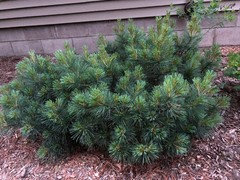
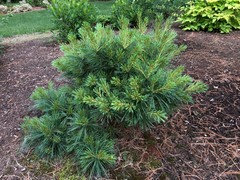
    Here’s a ‘Blue Shag’ and ‘Coney Island’ from my garden:

    grabembythegreenthumb thanked maackia
  • 8 years ago

    I really like the idea of different cultivators, Maackia. I hadn't seen the Coney Island variety, and I might like it even better than the Blue Shag. I think you are right, though. If it's part of a long term plan to completely revamp my beds, I should go with something I really love.

    Sea Urchin is also lovely.

    It sounds like most everyone is in agreement that a "max" size on a conifer is really not feasible. But they are very receptive to trimming and shaping from what the greenhouse employee told me, is that correct? Should I still love them 15 years down the road and they start getting rather large and taking up too much room, I should be able to "resize" them with the shrub trimmer?

  • 8 years ago

    Pines do lend themselves very well to pruning, shearing and shaping. The best approach, however, is to do this every growing season (unless none at all is needed in newly planted ones) instead of waiting until the plant has grown too large. There are lots of videos online demonstrating how and when to do this. Just be sure to shorten the new growth without cutting back into old growth which does not resprout.

  • 8 years ago
    last modified: 8 years ago

    Like rhododendrons pines have what is called a determinate growth habit so relatively speaking this makes them harder to prune - you can't shear them non-selectively like a box or even a yew (another conifer) for instance and have a truly attractive outcome. You must pay attention to their annual growth cycles and prune where on the stems - and during the specific times in their development - it works to do so. Otherwise marked deformity and ugliness is liable to result. Examples of such outcomes are not hard to find in my area, where it seems commercial landscapes in particular are being pruned by crews with no horticultural training at all - I just walked by some neck high mugo pines this week that had been so badly degraded by repeated arbitrary cutting with power tools to the same points on the stems that they should really be ripped out.

    grabembythegreenthumb thanked Embothrium