Software
Houzz Logo Print
apetersenaplenty

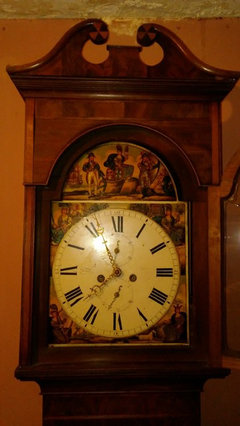
Sheraton Scottish/Irish Longcase 1830s Clock

8 years ago
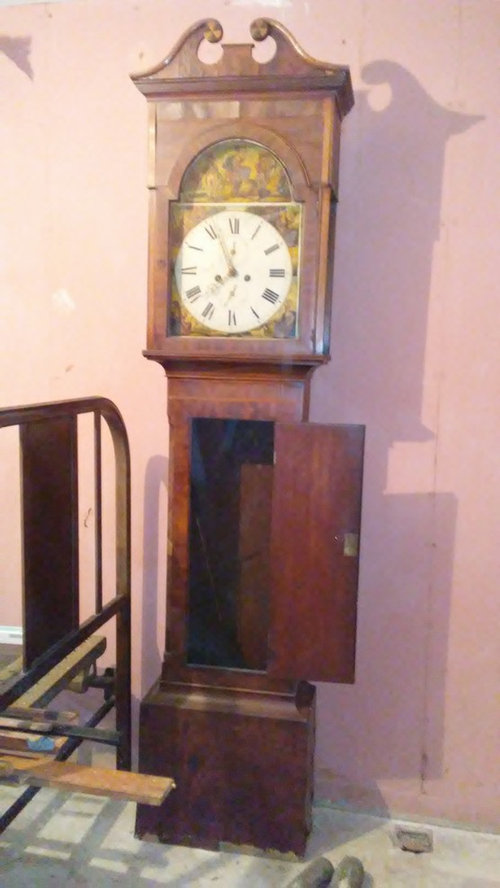
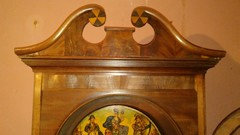
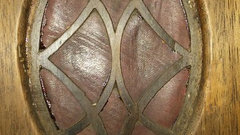
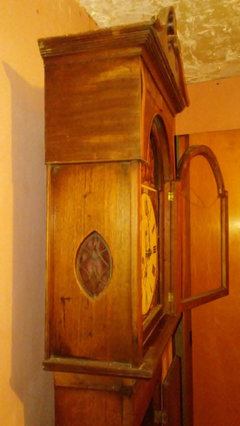
Hello! I'm back to share another piece from my aunt's collection. Here now is a Sheraton Scottish/Irish Longcase 1830s Clock with linlaid crossbanded Walnut veneer. It measures 85" tall, 18.5" wide, and 9" depth. As with many of these pieces, this clock was appraised many years ago. This piece appears to necessitate some repair in order to restore to working conditions. Do you think said repairs would be cost-effective for this piece and would it still hold value in its current condition? Also, any thoughts about the origins of this clock?


Comments (6)

  • 8 years ago


  • 8 years ago


  • 8 years ago

    It's a puzzle in so many ways. The height and width and depth seem out of proportion for the more than 7 foot height. The top part with the inlay seems very finely crafted and the bottom half decidedly more crude...or primititive...and the weights are decidedly crude for so fine a clock. With the painting on the dial and the fine inlay work, the weights would have been formed either brass or cast iron. It must chime by the key holes I see...what does it chime? I think it's lovely! and unless it's missing like all the works...defin itly worth fixing! But try to find out more!
    Upon googling tall clocks, I see that the Scottish and other European clocks were "daintier" than a Pennsylvania or New England clock of similar age.

    Where did you get it? Even if the clock works aren't repairable...it would be worth replacing with new works.

  • 8 years ago

    Apart from much other information proffered, I would say the clock is a bit earlier than 1830, possibly around 1805-1810? A few things stand out: Walnut veneer on longcase clocks had all but died out in the main circa 1770's. The hands also appear to be earlier 18thC design, but, one must bear in mind that provincial clockmakers often received the latest designs from the cities anything up to 10 or more years later and when crossing oceans to different continents, even 20 years later.

    Historical investigation through family history and/or where the clock was bought, by whom, where, when etc., could provide valuable information as it appears to be a commemorative piece from the painted designs depicting a military Sea Captain to the left in front of his ship, with Brittania in the centre and a large anchor. To the right is a gunnery officer and behind is a "fort/fortress", possibly the Moorish Castle of Gibraltar at Trafalgar?? Top left of the square corner clock dial is a lady wearing a chequered red and white banded hat, symbolic of Scottish Army regiments of the period.

    Around this period there were two major sea battles in which prominent Scottish sea Captains played roles, The Battle of Copenhagen in 1801 and the Battle of Trafalgar in 1805 in particular. If you could trace back and find connections to whom the clock is representing it could be far more valuable than just a longcase clock with a painted dial in dis-repair. There are a lot of historical clues on that painted dial.Hope this helps in your quest.

  • 8 years ago

    I think there may be missing woodwork at the bottom edge of your clock case. I have taken a 2nd look at the bottom edge and I believe there once was a piece of quarter round trim along the bottom edge. This served as a finish piece and protected this edge from chipping. The chip pattern along the bottom is consistent with there having been a finishing strip glued there that was ripped away.

Sponsored
Wannemacher Interiors
Average rating: 5 out of 5 stars26 Reviews
Customized Award-Winning Interior Design Solutions in Franklin Cnty OH