Software
Houzz Logo Print
doogie89

New Construction - Soil Prep for Sod

8 years ago
last modified: 8 years ago
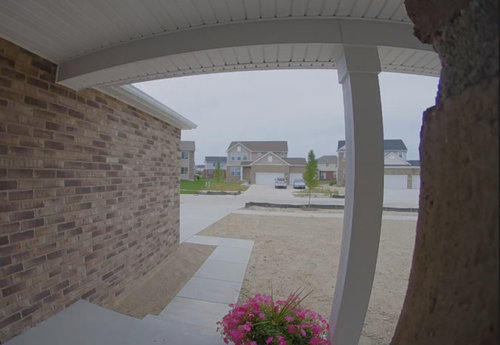
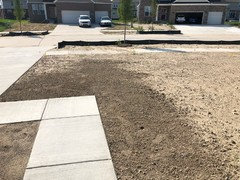
New construction home built in May 2018. Moved in June 2018. Looking to do our own sod installation in late September. Irrigation is being installed August 28th. Once the irrigation is installed, what is the best way to prep the soil? I did a soil test on the lot and the soil just needs some starter fertilizer. The pH was 8.1, so I did buy some sulfur to put down eventually. I am more concerned with prepping the soil for sod installation. Obviously, doing it on our own we are trying to save some money. Sod companies will come in with the big tractor to rough up the soil. I wanted to avoid tilling the soil, because the final grade is done and I don't want to mess with that. And I don't need to add top soil.

Would renting a power rake be worthwhile? Home depot has them for $50-$75 a day. Another local rental place told me to rent a dingo with a special attachment but that was almost $400. At that point, I might as well have a professional come out and lay the sod. Cheapest route would be to just rake it by hand, but that is a lot of labor for 7,800 sqft of grass.


Comments (25)

  • 8 years ago

    Right you do not want to till the soil. Since you are already graded then should be good. Maybe pickup rocks and stuff like that.

  • 8 years ago
    I forgot to mention that the soil is very compacted right now. A hand rake might be very difficult to loosen it up. I m using glyphosate on the weeds to make sure the lot stays weed free. Due to the compacted soil, that’s why I am exploring my options with the best way to loosen the top inch or so of the soil.
  • 8 years ago

    You should post your soil results here. That will help with recommendations. Also, was topsoil already put down? Why do you say you don't need it. What % OM (organic material) do you have in the existing soil? What part of the country do you live in and what kind of sod are you laying?

  • 8 years ago

    If you are dealing with a cool season lawn, you need the exact same soil preparation for laying sod as you do for seeding or hydroseeding.......6-8 inches of loose, friable (non-compacted) and lightly organically enhanced soil. Topsoil, and more especially compacted topsoil, is not really gonna cut it for the best results. And you need way more than an inch uncompacted!!

    Since it is best to roll sod after laying, I would just go ahead and lightly till the existing soil, adding in some OM at the same time. Rake smooth (you are not going to alter the grade significantly) and then roll to remove any air pockets and to level any areas not well addressed by raking. Water thoroughly, lay the sod and roll again to ensure roots are in firm contact with the moist soil.

    And I would remove as many rocks larger than 1-1.5 inches as possible (usually accomplished via the raking).

    It is something that usually gets overlooked (and the reason developer laid lawns look like crap after about 6 months) but the better the soil prep/soil bed, the better the lawn will "take" and thrive.

  • 8 years ago

    I would lay the sod on the existing grade & be done with it personally

  • 8 years ago

    You can forget the sulfur (return it if you can, use it but don't expect much outside of normal test variance if you can't return it). Mostly, unless worked in, it outgasses as sulfur dioxide (smog).

    A pH of 8.1 is sky high, but still not a barrier to a good lawn. Just don't expect much in the way of dark green color as there's no free iron to produce that.

    The very marked shortage of potassium on this test is probably an artifact of your high pH and incredibly high calcium and magnesium numbers, but I'd recommend a Logan test some time early next year using acetate extraction to get more realistic data. However, I'd have no objection to using a balanced (10-10-10 or 20-20-20) fertilizer here when and if you feed when the sod is laid.

    Whether you'd feed or not would depend on your location. Northern lawns, yes. Southern lawns, maybe.

    The phosphorus shortage is probably accurate, hence the balanced fertilizer. And I'm not touching the micros on a test where I'm not familiar with them. Let's let those ride.

  • 8 years ago
    I was actually planning on returning the sulfur and picking up a rake and shovel instead. I just plan on using starter fertilizer when I put down the sod. Local sod companies told me I don’t need soil based on their quote. They said unless your soil is really bad, they only use top soil to level the yard. So I just have compacted topsoil right now with a bunch of small rocks under 1” in diameter. It’s not super hard but definitely compacted. I was going to try a landscaper rake and see if it breaks it up. If not, then I will have to explore my other options. Local equipment rental companies push skid steers and attachments for the job, but that runs $350 for a day. At that point I should just pay someone to come out and install. Really just trying to save money where we can. Newly married and lots of big expenses going out with AC install, furnishing a house and irrigation.
  • 8 years ago

    @doogie, listen to what morpheus recommends. Your test didn't mention % organic matter or TEC, but if morpheus is cool with that then let it go. If I were in your situation I'd do two things immediately. 1) take soil samples from the surface down to 4 inches and follow the procedure to send it to Logan Labs in Ohio. Post results here next week. 2) get another sample and run a jar test to see what your soil profile looks like (sandy? clay?). Do a quick search on "soil jar test" and you'll see how. This is all easy to do since there is no lawn yet. If you have a sandy lawn it might not be as compacted as you think.

    We still don't know whether this is a northern or southern lawn. It matters a lot as to when you should lay sod.

  • 8 years ago
    I was thinking about doing a soil jar test this weekend. I am up in Michigan, about 45 minutes north of Detroit. It’s been rainy every day this week, so I’d like to do the test this weekend. I’ve been told the soil in my subdivision is a lot of clay down below.
  • 8 years ago

    Everybody thinks they have clay soil... everybody. It's kind of a running joke around here. I had convinced myself that I had clay soil until I found out it was about 80% sand, lol. High clay soils seem to be pretty rare but there's only one way to know for sure. You can just get a shovel and throw a cup of soil into a jar. I'd still get a cross section maybe down to 6 inches instead of just scraping soil off the surface. I don't think you need to take a small section from all over the yard like you should do with a sample for soil analysis. I will add that you can have Logan do the test for you and I can say that I think there can be some discrepancy between their results and the jar test. However, you only really need a "macro" result and the exact percentages aren't critical. I know I have a soil that is on the sandy side and drains well. I'm not going to have puddles in the lawn because of high clay. That's the kind of thing you want to know. The TEC reading Logan gives you is related to % organic matter as well as clay content and it tells you how well you soil will hold on to nutrients, which is helpful if you really want to achieve the best lawn possible.

  • 8 years ago

    +1. My heavy "Pennsylvania clay" is 85% silt, 14% sand, and 1% clay. What most people complain about being "puddling" or tight soils is almost always an imbalanced soil biology and/or a bad soil chemistry that's forcing the soil structure to collapse.

    (In this case, magnesium levels are high, which will tend to lead to soil collapse, but calcium levels are sky high, which tends to support a good soil. Without more information, I'm not entirely sure where the balance is here, although I'd lean toward "tighter, heavier to dig, so-so-draining soil") if you make me guess.

    Your jar test isn't definitive, but it is indicative. Because you'd send a wider sample to Logan, and not the same dirt, you'll get a different answer from them. It doesn't really matter, you just want to be in the approximate ballpark, sort of, give or take.

    In this case, you may have to do it twice (you can use the same dirt). With that much calcium, I suspect you're going to get a false reading on the sandy side due to calcification of particles. If you do the test in vinegar (AND DO NOT SCREW THE JAR TOP ON OR IT WILL EXPLODE), your answer should be better. If the soil froths like baking soda and vinegar when you add the vinegar to the soil, you have a calcium-heavy soil.

    In terms of resource balancing, I'm most interested in the EC (exchange capacity) than i am the soil makeup. Soil makeups can lead to many different ECs just due to the size of the sand and silt particles, and the type of clay.

  • 8 years ago

    keep watering the bare soil to get as many weeds to grow, and keep killing with glyphosate.

    I know when we laid our fescue sod years ago, we took a shortcut and didn't treat the weeds long enough, so when many bare spots appeared, the existing weed seeds exploded and took over. a huge pain.

  • 8 years ago

    I disagree with gardengal about lightly tilling. The problem with tilling is that you cannot control how deep the tiller goes. When it hits a root, rock, or a dry spot it bucks up out of the ground leaving an untilled area. When it hits a damp or sandy area it digs in deep giving you a deeply fluffed area. If you come across all the surface with a level drag, then the deeply tilled area will settle and leave a hole while the untilled areas become a hill. This makes it uncomfortable to mow starting the day after you till and getting worse forever. You already had the finish grading done so it's done.

    Rose M has a great idea, though. For the 2 weeks prior to your seeding or sodding, lightly water the soil every single day. The idea is to sprout all the weeds that are going to sprout. After a week of watering, spray with RoundUp to kill all those new weeds. Then continue watering for a second week. At the end of that week, spray RoundUp again and this will really give you a head start against weeds.

    Your soil is not hard but it is compacted??????? ??????? I'm going to ignore the contradiction there and just say use what you have. It was finish graded, so all the soil prep is done. If the soil has settled more since then, (and it has) ignore that and proceed. Having said that, if it is already settling and you see low spots, you might want to put some sand or pulverized topsoil in the low spots only. It will be fine once the grass starts to grow. The roots in the soil make up a lot of volume. Proper watering of the lawn will also help lift the compacted soil by growing the beneficial microbes in the soil. They are languishing currently because there are no roots in the ground and because the watering is inconsistent. You're not going to have any organic matter in the soil because the graded soil is completely jumbled up. Any organic matter has decomposed and evaporated out of the soil. Roots in the soil is the best cure for that, so get the grass in.


  • 8 years ago
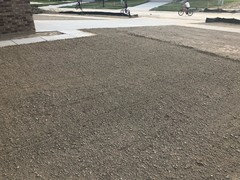
    The soil isn’t hard as a rock. It’s compacted down because it’s settled over the last couple months and it’s been very dry in Michigan. There is no loose soil, just a firm top. I can rake it by hand with a metal rake and it breaks up good. I just don’t know if it’s necessary to have a loose top inch of soil before laying the sod or do I just water the soil before laying the sod and just water the heck out of it.
  • 8 years ago

    A firm top is fine, actually, and the roots have less trouble breaking it up than you do. Nor should you break it up.

    Like Daniel, I disagree with tilling it and will simply say that I consider that terrible advice. What you till has to settle. And you're not going to like what it does when it settles, since you can't be perfectly even on tilling depth, how much you fluff the soil, and where it ends up. Tilling is always a recipe for a wavy, uneven lawn until it settles again. If it settles again.

    Really, lay the sod, then water the heck out of it. Give it a full inch if you can. Whatever you can if you can't give it the full inch. Then keep the top inch damp until the grass' roots grow down and adhere the sod to the lawn. Post that, let the top inch dry out, but keep the next inch damp until active growth begins. Then slowly back off on watering until the end of the season when growth of the lawn stops.

    In this case, I might suggest a light weekly feeding with Milorganite to keep resources flowing into the sod slowly and steadily. It's also very rich in phosphorus, which you need. And iron, which you also need, but won't be terribly effective because of your pH. Still, I'll take what I can get.

  • 8 years ago
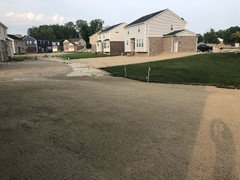
    Notice the darker brown soil is where I raked. It’s pretty firm so it does require a bit of labor with a rake. Doing that over 8,000 square feet will be a lot. See the other picture with just the front yard and what I’m working with.
  • 8 years ago

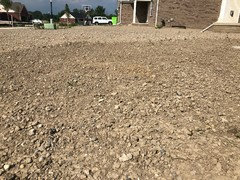
    doogie: forget the raking already! In that second picture are all those clumps that look like rocks actually rocks or clumps of dirt? If they are rocks then you've got problems. The first photo looks OK, but there's no way you can lay sod over the rocks in that second photo. This is a major problem. When my lawn was regraded they first laid down an inch or two of topsoil and then worked it in with a rock hound to remove all the stuff like in your photo (assuming they are rocks). I guess you could say it was tilled but they used heavy machinery to grade everything after removing the rocks (at least I think they did that). My back yard, which was seeded, is still bumpy but my front, sodded, lawn is level.

  • 8 years ago
    Most of the rocks are under an inch in diameter. I’m going to rake up the bigger ones and get rid of them. The photo that looks like clumps is mostly dirt clumps. Just tons of small rocks that I’m trying to get rid of.
  • 8 years ago

    OK well that's good. You might have just as many rocks a half inch under the surface as you have on the surface. Push a screwdriver in the soil and see if you hit lots of rocks. It doesn't matter how small the rocks are. If there are a lot of them it can be an issue. Like many things (painting for example) preparation is important. A little more effort now will help you achieve a great lawn, which will be impossible if the ground is full of rocks, and hard to fix later. Watering the ground will help distinguish rocks from dirt clumps.

  • 8 years ago

    So the moral of the story is the compacted soil will be fine for the sod. Just make sure to water it in. Throw some starter fertilizer down after the sod is laid and use milorganite too. Remove all the rocks that I can over an inch in diameter. The tough part is, all 8,000 square feet of soil has these small rocks on the surface, but most of them are buried in the top of the soil. When they did my final grading, the soil was clumpy and over the last two months its settled and flattened out from the rain and gravity. So now its a compacted soil with rocks stuck in the top 1 inch. It is possible to rake it to loosen the top soil in order to be able to rake up the rocks. Just is going to take a long time to work through the entire lot doing it by hand rake. Not sure if there are any good equipment tools out there that will make removing the bigger rocks easier.

  • 8 years ago

    Look up rock hound. That's what they used on my yard. I'm not sure what is the smallest diameter rock that can be picked up by a rock hound.

  • 8 years ago
    Little bit of an update. The builder never had our township inspect our final grade. So I called them and they sent out a crew to redo our grading. This help break up a lot of the soil with their tractor. I spent a few hours raking up all the big rocks. The soil surface looks much better now and ready to take on some sod in a few weeks. Definitely saved me some bucks from having to rent some equipment to help prep the soil better.
  • 8 years ago

    Sweet! Looks awesome.

  • 8 years ago
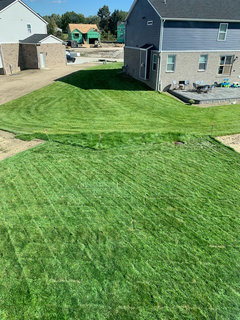
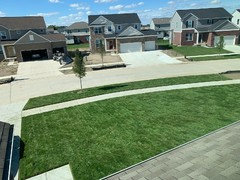
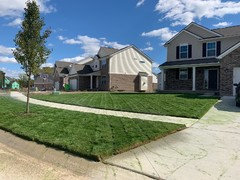
    Some shots of the new lawn one month after installation. I only put down milorganite before we laid the sod and some more immediately after. Just last night I put down another dose of milo. I’m going to buy some starter fert and give it a dose of that this week too. Overall it’s looking good so far. Took root in about two weeks. Still have some very soft areas where the soil underneath is like a water bed. We’ve been getting a lot of rain.