Software
Houzz Logo Print
debbie1000

Does adding city water increase home value?

8 years ago

We've been here 25+ years. The homes are about 30 years old and on an acre. We have wells and septic. Sure, there's some maintenance to it but we are used to it and don't have to pay a monthly bill.


About 12 years ago there was our "last chance" to get city water when there was a new development built nearby. It was to cost around 7K each but it did not get the vote.


Now they are considering it again at more than double the amount. We may move in a couple of years. Do some people completely rule out wells in favor of city?


I'm not sure we would get our return on investment on this.


Any experience/opinions?

Comments (46)

  • 8 years ago
    last modified: 8 years ago

    One of the things that people do not think about beyond the cost is the availability for fire hydrants. Depending on how close the hydrant is to your property it could effect your home insurance. Having lived in a rural area before water and listening to my friends that still lived there especially the ones that did not want to connect it was the intangibles like not worrying if the well was contaminated or about to run dry rather than the cost to install that made them think the installation was worth it.

  • 8 years ago

    It may not add value equal to what you spend, but it will most like hurt value and saleable if you do not do it.

  • 8 years ago
    last modified: 8 years ago

    I'd purchase a home still on well and septic. Well water is cleaner in many ways and of course it's lets expensive. Septic is WAY cheaper than sewer. If you sell down the road, just make it known that the services are available. Once well, or septic have issues (at least in my neck of the wonderful woods) beyond general maintenance the city will require connections.

  • 8 years ago

    Those that mention a well how frequently do you have the water tested? I know how bad the well water is in this area. Tastes fine but tests all kinds of stuff.

  • 8 years ago

    Following. My parents are on well and sceptic, but several years ago sewers and city water were put in on their lane, up to the property lines. Some took it, some, like my parents, did not. Well water in their town varies, by what source they are tapping. As we move toward putting the house on the market, we are not sure what buyers will want. We've had the wate tested, and it was fine.

  • 8 years ago

    It would save you $$ each month without paying water and sewer. A lot of people love that.

  • 8 years ago

    If they had city water and sewer come down this way I would hook up in a heartbeat.

  • 8 years ago

    I know people on one street in my town won’t hook up the sewer due to the cost, they all have septic tanks. We have pretty high property tax here. People are trying whateve they can to keep the cost down.


  • 8 years ago

    Well I don’t know - this is a very location-specific question. I guess you’d just have to make a list of the pros and cons of each and then compare.

    Heres another thought: are all your neighbors on one or the other? If you’re the odd-man-out, that might be a negative.

  • 8 years ago

    Having city/municipal water is almost an absolute necessity for me. I personally don't like using well water and avoid it for my own homes if at all possible. (I recently bought a vacation home, and excluded properties which weren't on municipal water.)

    Sewer vs. septic is less of a concern for me personally. My preference would be sewer, but a properly maintained septic system doesn't "scare" me.

    My only concern buying an existing home would be whether the current/past owners properly maintained the septic. I've seen what happens when a septic system fails and it's not pretty nor easy to deal with.

    As littlebug said, this is extremely location dependent too. Clean/safe well water can be a hard thing to find in some parts of the country. And in a drought, personal wells can dry up. I know people who couldn't do laundry or take showers at home and had to ration water to flush the toilets. Not my idea of a good time. :)


  • 8 years ago

    Has your well ever been dry? How is the well water quality in your area? If you have lived there for 30 years and never had an issue, why spend money to hook up city water now? There is no need. Plus you are going to move out in a couple years.

    I always had city water and sewer in the past until we found a weekend home to escape to the country on the weekends. I think it’s so cool to have free good quality clean water, and I don’t mind the septic at all. I am a gardener, I have just over 1000 roses at my suburb home, the water bill (city water) is high in the summer. Now I am starting a new rose garden in the country with free water! How cool is that! :-) Plus there is plenty water for a 20’x40’ in ground pool and a small orchard. So far I love country living, love well water! :-) Free well water sounds really really cool, and it tastes extremely good just like the spring water. let the spring water flows into your kitchen, your bath, enjoy what you have! :-)

    Are there any country folks here?

  • 8 years ago

    Yes, buyers will absolutely specify water and sewer preferences or that it is okay for well water and septic. I run into buyers that routinely won't consider a home on well water or septic. Having said that, there are many buyers that don't consider it a turn off. Ask a local experienced Realtor, or several, what their experience is in your specific area.

  • 8 years ago
    last modified: 8 years ago

    I think it depends where you live -- if I lived in a large metro area, no I wouldn't want well water, I'd constantly be worried about groundwater/well contamination; out in far less populated areas/rural areas, this would be less of a concern to me. Although groundwater/well contamination can happen anywhere -- PFAS contamination is all over the news in my state, lots of contaminated wells, not safe to eat local fish, etc.

    I'm on a well and septic now, and it has pros and cons, as does everything. I prefer it, though, mostly because I have no water bill!! Water rates were really climbing where I previously lived, 50% was sewer charge, not having a water bill makes a noticeable difference in the budget (we were charged quarterly so every third month = ouch!).

    I do agree that it is area-specific, though -- in some areas there is no option for municipal water supply, so if you want to live here you have well and septic, period. If a lot of people in your area are hooked in and you try to sell, I think you may find it a negative for a lot of people, though. If you're not thinking of selling down the road, it may not matter, although if you're concerned about the safety of your well due to whatever variables, then might be worth it for your own peace of mind. Seems like a tough choice, $14K is a lot of money.

  • 8 years ago
    last modified: 8 years ago

    "Do some people completely rule out wells in favor of city?"

    Yes, some do.

    Would your home insurance rates decline if you get city water? Ours decreased by half when we did.

    We left our outside hydrants plumbed to the well when we hooked up to the new water system. That helped with the water bill because all outside watering was from the well.

    I'm assuming that you're pleased with your water quality and supply?

    Do you have frequent power outages? We lived for awhile in an all electric house with a well. You really miss that free flowing water when you're without power.

  • 8 years ago
    depends on the septic — if it’s a mound system (or would have to be replaced by a mound system on resale), then I would hook up to sewer for sure.
  • 8 years ago

    jrb451 - that no power = no water thing surprised me. :)

    We had power go out in our office building a few weeks ago. An hour or so into the power outage I had a coworker say she really had to go to the bathroom. Um, ok....so go!

    She's lived on a well her whole life and said she figured the bathrooms would be a mess by now with no power. Um, no - the toilets flush just fine on municipal water with no power.

    Was one of those learning moments, for both of us. She felt stupid for not knowing the toilets would flush without power, and I felt stupid for not realizing not everyone would know that. :)

  • 8 years ago
    last modified: 8 years ago

    I am wondering what your neighbors say about the city water. Are they going to pay $14,000 to hook it up? That’s a big expense.

  • 8 years ago
    last modified: 8 years ago

    Yep, no water = no power, unless you have a generator; the well pump operates on electricity. I keep a rack full of emergency water supply in the basement just in case; has happened a couple times already in the almost 2 years I've been here, but fortunately wasn't out of power for too long. You just learn not to flush after every stream (I'm being polite here), and after a handful of non-solid bodily releases you refill the tank with a big jug from the emergency stash, and conserve water in other ways (paper plates, re-use cooking water if possible, baby wipes for cleansing, etc). But yea it's a PITA.

    I've often considered getting a true manual pump installed somewhere on the property (the hand pumps on the property hook into the main well, so no water from those either if lose power), but I wouldn't even know who to call for that nowadays. Well, I guess I could just "do my business" back in the woods if things got that bad...

    I really should just start saving my Ps & Qs for a whole-house generator...

  • 8 years ago

    Or a generator?

  • 8 years ago

    One thing to think about and it would depend on who is installing your lines. In some areas the cost after an initial amount could be in monthly payments added to your water bill. When/if you sell you may have to payoff the balance.

    You may have to hire a plumber to connect the new waterline to the existing inside lines as some areas will not allow a homeowner to do this.0

    If the water line will cross your property you might discuss with the right of way agent some sort of reduction/credit for crossing your property. If there is a general utility easement that is being used this is not possible.

  • 8 years ago
    last modified: 8 years ago

    Mxk3, thanks for mentioning about manual pump. Now I know why we have one on our property. Lol New to country living.

  • 8 years ago
    last modified: 8 years ago

    ^^ Actually, I think I would have been more correct saying manual well -- the hand pumps tie in with the existing well and storage tank, the pump of which runs on electricity. So, a good old-fashioned manual well and hand pump would be a good emergency back-up, worth it for peace of mind for me even if never use it. This would entail drilling a new well though -- $$ and who knows if I could even find a company out here to do it (I'm not that far out in the sticks -- this isn't rouging-it cabin-country LOL!)

  • 8 years ago

    Mck3, thanks for the details. The main house is old, so I am guessing the manual pump is old too. The previous owner added on another well and septic system for an additional building (a family compound) not too long ago. The 2 wells are linked together. I will pump the manual pump this weekend, see if any water comes up. Have to look for the storage tank in the basement, I don’t think we have one.

  • 8 years ago

    Depending on how long ago and type of manual pump you may have to do what used to be called priming the pump. Back in my childhood that normally meant pouring water over the part where the handle went into the shaft. Pumping a couple of times. Repeat until water flowed. It could work immediately or it could take leaving until the next day and trying again.

  • 8 years ago
    last modified: 8 years ago

    Thanks maifleur01! I will give it a try this weekend! So excited! :-)

  • 8 years ago

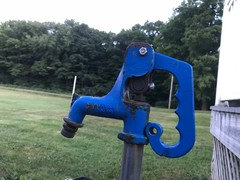
    It’s a country outdoor faucet not a manual pump. There was no water coming out when I pull the handle up. Not sure how to make it work. Do you guys have this in your country yard? It looks antique.

  • 8 years ago
    last modified: 8 years ago

    Take a picture of what is below this. As you stated this is not a pump. The pumping action must take place elsewhere. No where near an antique.

    Edited that this is what is called a Simmons Water Hydrant it connects to a water source probably below ground. You might want to open it and wait a minute or two for the air pressure to bring water to it. If that does not work contact the company for suggestions. Although there may be some sort of connection where the water goes from the electric pump. http://www.simmonsmfg.com/index.php/our-products/hydrants/

  • 8 years ago
    last modified: 8 years ago

    Yes, I have a version of these in my barn and out in the pasture. They are a hand pump -- the lines hook into the water holding tank in the house, which is hooked to the electric well pump. I call these hand pumps, others call them hydrants -- whatever you call them, they're not actual manual well pumps.

    I did a quick Google search and found this: http://www.survivalunlimited.com/deepwellpump.htm

    I really should look into this and see if any of the well companies around here offer something similar -- like I said, worth it to me for peace of mind (because you just never know...)

  • 8 years ago

    mxk it is unlikely with this type that the well is directly under the pump, I call them that also but used what the manufacturer called them for clarity. I would find where the well actually is and have one installed there if possible.

    Having had several nasty infections from the well water at my husband's grandmother's I urge everyone to have their well water tested more frequently than the once a year that you see recommended. One of the protozoa is still with me these many years later.

  • 8 years ago
    last modified: 8 years ago

    ^^ Yes, I know that -- that is what I posted (that's its not directly connected to the well pump). Re: the hydrants.

  • 8 years ago

    Summersrhythym and others may not be aware of that which is why I mentioned it.

  • 8 years ago

    I would rule it out, knowing what I know now. We were on city water but septic for many years. When the sewer went through, we were all required to hook up. I no longer have to worry about whether I can do laundry when it is raining heavily.

  • 8 years ago

    Thanks guys, I will have to find out more about this Simmons Water Hydrant / hand pump.


    midcentury, what do you mean you can’t do laundry when it’s raining heavily? Why not?

  • 8 years ago

    She is just being over dramatic...

  • 8 years ago

    Not necessarily over dramatic. If the holding tank is darn near full and it's raining, adding extra water from a washing machine could cause surface flooding on a septic system. That is not a good sign for the system's health - at all - but it absolutely can happen.

  • 8 years ago

    If your septic system is located in a low area and the ground becomes saturated by heavy rains, then your septic water cannot flow out through the lines. Instead, water can flow from the field lines back into your tank. Your toilet may not flush, your shower/tub may not drain, etc. It happens.

  • 8 years ago

    Actually, I'm not being over dramatic at all; I am being quite realistic. Though I avoided the issue, it was only because we rationed laundry for a few days last time we had torrential rain and flooding. Some neighbors had back ups. Jrb451 states the problem well as does the previous poster.

  • 8 years ago
    last modified: 8 years ago

    Sure it's possible for a septic system to back up, but a well-designed, well-running septic system shouldn't back up; if that occurs, something is obviously wrong. I wouldn't advise someone to avoid a home just because of well/septic. Municipal sewer lines back up, and not infrequently. If my toilet or sink backs up it may end up a mess but at least it's contained; if the municipal lines back up into a house/basement - oh cr@p! (quite literally, if they were the sanitary sewers...), that's a mess and health hazard on a whole other level.

    Water/sewer bills are climbing so high, I bet if I saved the equivalent every year I'd have enough to pay for a new drainage field at end of its life expectancy, so I'd refute any argument about that expense.

    Plus, a good inspection of the well/septic when purchasing a home should uncover any issues, including poor placement of the drainfield.

  • 8 years ago

    A comment about backups. Insurance companies will issue coverage for them. Even if you do not think you will ever use one get one. Most will also cover damage caused by broken pipes but you need to ask what is and what is not covered. Last year I used mine when a 13 inch overnight rain in an area that sump pumps are still connected to the sanitary sewers. Mine was only enough to partially pay to clean out the basement but I would suggest a minimum of $30-50K if you have anything in the basement. More if it is a finished basement. Also ask if the contents will be covered or if it is a flat amount that includes the contents. Mine turned out to be a flat amount. If it is a continuing problem you need to fix the problem.

  • 8 years ago

    What’s the fix for a 13” rain?

  • 8 years ago

    The posters were talking about septic tanks which is what my comment concerned. There are two parts. If someone has a sump pump that is draining into their septic tank they need to stop because with a heavy rain it can cause a backup when the tank is full. Secondly many people do not know that they can get insurance coverage for backups depending on their insurance company.

    Loosing about 1/3rd of the value of my house last year was a wakeup call.

  • 8 years ago

    Thanks for the insurance info.

  • 8 years ago
    last modified: 8 years ago

    I'm baffled as to why anyone would think it's a good idea to drain a sump into a septic tank in the first place???

  • 8 years ago

    mxk there are people that only think of getting rid of the water. People do all kinds of things that if they thought about it could cause problems.

  • 8 years ago

    ^^ Yea, I guess that is the problem --> people don't think first.