

Tips for economy build
Comments (61)
 8 years ago
Been there.
Since money is tight (to me that means just enough for the Needs but not for Wants, YMMV) you might be best off building an addition to your mobile home. We added 15x25 to be used as master bedroom and living/dining spaces and it made a big difference. It cost us about $20,000 but there were special circumstances that I go I to below. We actually framed it so it is seperate from the mobile and cut a 8' doorway between the existing kitchen and the living/dining. We can literally remove the flashing and pull the mobile home away from the addition if we want. It would be a good option if anyone ever wants to complete the house.
We also were fortunate to have connections in the building industry who were happy to barter their work for the food we produce. And we (read, Husband) have the ability to do a lot of the finishing work. It brought our costs way down. Keep an open mind to that possibility, if it is applicable.
If money isn't so tight as all that, good advice above :-)
 8 years agolast modified: 8 years ago
havingfun - I just have to call that out. Wood windows are fine but an old window can't just be "fixed" and be ok. A modern window is significantly better not just in air sealing but R value of the glass. Now adding storms - that can make a real difference. Obviously making a window that is less leaky helps but this is new construction here.
All this plumbing talk - with plastic pipes, it doesn't really help all that much to group bathrooms together. When copper was needed, it was a bigger deal.
Garage - on a budget build?
Driveway? on a budget?
The most important - flat land and build a slab. Simple rectangle. May consider double walls and then use electric resistance heat - works out cheaper at times - in the short run and long run. And then vinyl siding and vinyl floor. Cheap vinyl windows too.
Related Professionals
Richmond Architects & Building Designers · Show Low Architects & Building Designers · Nashville Design-Build Firms · Burlington Design-Build Firms · Elmira Design-Build Firms · Yuba City Design-Build Firms · Daytona Beach Home Builders · Belleville Home Builders · Vineland Home Builders · Zanesville Home Builders · London Home Builders · Cape Girardeau Interior Designers & Decorators · Meridian Interior Designers & Decorators · Shreveport Architects & Building Designers · Muskogee Architects & Building Designers- PRO8 years ago
There are some pretty nice manufactured homes that might be the answer. But keeping it simple ans an average size is a good starting point. I agree kids do not need their own bathroom or a play room An Ikea kitchen will save you tons of money and IMO good value.A 2 storey with a basement is the most economical floor plan. IMO if you are going to build an architect is money well spent if you are honest from the beginning about budget.
 PRO8 years ago
Well...it's a good question, and important.
There are a number of major decisions which affect the cost of a house, starting with:
Site selection and site development: Which land is selected (and where) as the actual building site has significant impact on prices, i.e., buildable ground, access road and length, utility provision and length, porosity and how the ground percs for septic system, depth of drilling for water well, surface and subsurface rock as impediment for foundation, etc. Some ground is buildable, and some is not. Some ground is preferable, and some is not. Find the best ground as your first decision.
House design: Size, complexity, configuration, interior and exterior development, etc. A good place to look is at historic houses in your area and how they were designed and constructed. While a circle has the least amount of exterior surface, and a square has the next "least", neither are particularly good shapes in which to happily live. Your house concept and design is the second area of either expense or savings, and I don't mean whether or not your kitchen has an island.
Construction: There's quality, fast and cheap. Choose any two. You can't have all three. Some builders know what they are doing. Some do not. Find the first category.
You may get lots of suggestions here on the cheapest countertops, refrigerators, roofing and siding, etc. While these suggestions on individual design and construction components may be helpful, they are small potatoes compared to the three categories above, where your decisions will cost 5-figures or more.
Good luck on your project.
 8 years ago
We are doing an "economy" build as well, being 2 23 year olds you kind of don't have a choice. We bought our piece of land over 2 years ago, and cleared it ourselves (it was a very wooded lot). We then (despite what everyone says here) bought our plans online and changed them ourselves to suit our needs with CAD (both him and I have drafting experience). This saved us quite a bit of money. We are also our own General Contractors, with the help of my father (he has built all the houses he has ever lived in himself), again a really money saver. We choose a floor plan that wasn't overly complicated by also wasn't just a box. Its a two story house, because it is cheaper to build up then out. We also went with a fireplace insert and a stone veneer for the "chimney" Both money savers.
We spent this past winter carefully quoting everything out, to what type of hardware we wanted on the cabinets, so we could try to avoid cost overruns as much as possible. We set a budget and stuck to it in this process.
June 1st, we started construction. The house has a few more days before it is completely framed, then the garage will be another week or so. So far, we haven't had any major cost overruns. However, we are doing a lot of the work ourselves. Both the front and back concrete porches we poured ourselves (1200 sq ft worth), we are going to be doing all the finish work ourselves too; painting, installing the floors, installing kitchen cabinets, trim, finish stairs, etc. Again, another huge cost savings. A lot of the subcontractors are people either we or my father knows, so that helps out a lot. It can be possible, especially if you are willing to put in the effort.
Spend the money on things that you cannot change, and save the money on things you can. For instance, don't get the $1,000 chandelier when you can get a much cheaper light fixture somewhere else, it can always be upgraded, same goes with appliances, or anything else easily upgrade-able. If you add up all the small overages, it starts costing a lot more than you think.- 8 years agolast modified: 8 years ago
Sorry to be a meaner but...
The word "economy" doesn't mean paying less. It means getting more for what you paid. There are all kinds of ways to measure economy and they do involve price, but not being cheaper. For example, a three bedroom house that costs $180,000 might be considered more economical than a two bedroom house that costs $140,000.
---------
Now for the real advice...
Forget your cost to build a home, it is largely a red herring. What you need to know is your cash inflows and outflows for a home. Your cash inflows and outflows will break your cost down into actual amounts paid. For example, if you are going to get a mortgage then you are going to actually have cash outflows every month of about $4.95 per $1,000 of loan.
This can become important when you start considering the cost of furnaces, HVAC, insulation, etc. Really you can start looking at most decisions as, "is this worth $15 per month to me," or, "will this save $15 per month on utility bills." I have seen lots of people build very economical houses only to have very uneconomical utility bills. Paying a higher mortgage to get a lower utility is often a good idea, especially as the mortgage rate stays flat while your utilities increase. Additionally, when/if you sell a higher cost has a higher return than expensive utility bills.
You also need to consider whether or not you plan on selling the home or living there forever. If you are only going to be in the house 7-8 years then what will sell well becomes an important consideration when designing a house.
 8 years ago
Site selection, placement, overhangs, passive solar design are essentially FREE and will pay dividends on bry's cash flow analysis. Learn about those things.
Operating costs can vary widely in the future. Think about that as you build. Shaded windows on the south, fewer windows in the west if you are in a warmer climate.
Concrete slab floor that gets sun in the winter and acts as a heat reservoir.
Rectangular design with a simple gable roof, with perhaps a simple cross gable to accentuate the front door. Work on your windows and insulation - fill gaps - even if you pay someone - go around after them. caulk, fill, etc.
Slab floor or basement, and put your HVAC in conditioned space.
IKEA cabinets.
WHITE plumbing fixtures - but decent quality. Find a creative designer to help use less expensive materials in a creative way. For example, I was going to polish my concrete floors ($6-$7 per square foot) but opted instead to use white epoxy ($2-$3 per square foot) Easier to do, high style, brighter to use less lighting, and cheaper! WINNING!
More as I think of them - but build smart, but that doesn't mean you have to sacrifice style, beauty and the "wow" factor - you just need to be focused and creative.
- 8 years agolast modified: 8 years ago
Consider the floor plan long term as well - it can cost more to heat and cool larger "open floor plan" spaces than one with traditional rooms.
 8 years ago
When you are building on a farm, build a regular house that someone would want to buy someday, not a house that will be hard to sell. If manufactured housing is the norm in your area, think about buying a good quality double-wide.
- 8 years ago
wiscokid - do you have a reference for that or some thermodynamic explanation? Envelope matters, what you do in that envelope doesn't (well ok - burning a fire in the summer...).
- 8 years agolast modified: 8 years ago
Something to consider is a used kitchen.
Often in my area I check Craigslist (Michigan- with Detroit and Chicago being within 200 miles). I see used display or showroom kitchens for a fraction of the cost it would be to buy new. Sometimes they will also include appliances that are "new" (only sat in the showroom). I've seen a kitchen this month that a showroom listed for $20,000- high end appliances, granite countertops and quality cabinetry. It's currently for sale for $5,000! I would love to buy it for my house but I have 8' ceilings and they're made for 9' (something to also consider with a new build- may be cheaper to build 8' but 9' will definitely give a more spacious feeling to the home).
Just this past month my husband and I bought a kitchen off Craigslist for $3,000 from a private party. We estimate their original cost to have been around $25,000-$30,000. There's nothing wrong with it, just some very minimal use and it will need a fresh cleaning. We now have high end appliances that would cost over $15,000 to replace brand new and quartz countertop in excellent condition that would cost $3,000 for materials alone.
Also, check out eBay for used showroom or display kitchens. I purchased part of a kitchen from eBay in a previous house we built and went to a local showroom to purchase additional cabinets and saved thousands of dollars going this route. I purchased my hood vent, faucets, under mount sink, silk curtains, and some lighting off eBay too and saved lots of $$, you just have to be patient and keep an eye out for the deals.
I also looked for my appliances towards the end/beginning of the year so I could get better prices on the closeout models. I found a refrigerator I loved and typed in the model number on Google and found a discontinued one in my state on clearance. I traveled a couple hundred miles to pick up our fridge and bring it home. They helped us load it on our truck and it took about 8 hours round trip but saved us $1,500+
Finally, check out the website GreenDemolitions.com for some high end used kitchens. Sometimes they are from showrooms, sometimes from luxury homes. Basically, all the kitchens they sell have granite, marble, or quartz counters. Some are higher quality than others and some come with appliances, while others don't. They offer nationwide shipping and have information about retro-fitting a kitchen to your space. If you become familiar with their website you can keep your eye out for something that would work.
 8 years ago
Don't fall in love with architectural styles that cost a ton of money to execute. Sigh.
- 8 years agoI agree with the comments about reclaimed kitchens. I have installed cabinets from ReStore and Craigslist and also removed kitchens and reused them. The best values are the high quality, large sets that have plenty of cabinets to choose from and the extras can do a laundry room, basement storage or garage. One of the best sets I have seen in recent years was a beautiful maple shaker style for $1100. That particular set was probably sold for less than 5% of original cost and did not need much work.
Countertops are pricey and the modern laminates are a high quality alternative to the higher end materials. For my basement kitchenette, I bought a set of quarter sawn oak cabinets with a strange collection of pieces. They were cheap, about $450, and really caught my eye. I had ten feet of base cabinets and added a trash pullout and a spice rack pullout to get to 12 feet. I went for 12 feet as that was the longest single length countertop I could get. The corner laminate countertops don't look good to me so I designed the space around straight pieces. Dollar for sq ft came to $6, as the countertop cost $149. Because all the basement has white trim, I bought a white wall oven for $40 and tucked it under the stairs. I bought a SS sink with a small dent for $4 and paired it with a new faucet picked up at a garage sale. With flexibility and bargain hunting, I had all the materials including flooring, trim and light fixtures for less than a thousand dollars - and it looks great.
The key to acquiring materials cheap is storage, plenty of it and easily accessible. If you have tons of space and no fussy zoning rules, I would consider spending a few thousand dollars on acquiring a used shipping container for your storage needs while building. After the build, you could keep it for storing outdoor items or resell it and recover a decent portion of the initial cost. - 8 years agoWants versus needs is the primary issue to keeping costs down in the near term. Do I really need a soaking tub, double vanity, skylight, wide plank flooring, three car garage, counter depth fridge? If you think about living in the house for decades to come, keeping costs down is a bit different. In the long term, choosing quality materials that are durable, quality construction methods especially for details like flashings and air sealing, and upgrading HVAC equipment and insulation will make the property more comfortable and cheaper to maintain.
Reread Virgil's comments and articles regularly to absorb his wisdom and try to apply the comments to your situation. Don't set your heart on specific features and be prepared to compromise to get a better overall house at a reasonable cost. As a silly example, you might think you need a six feet wide coat closet and so the foyer becomes awkwardly large. Compromise on a small closet and add extra space in the laundry room, mudroom or garage.  8 years ago
think really carefully. most still think they need a dining room. but most who have built felt it was the most waste of build. i have never understood double vanity, there is only 2 of you in the bathroom, and 2 means normally you have to clean yours and then his. never cut on closets.
 8 years ago
Select a reputable builder who has stock plans, and then tweak. Go with a basement if possible, put it windows and a door to make it future useable space. The kids can play down there when they are little and maybe finish it when they are teens. As was said, put in the basic finishes that can be easily updated as the budget allows.
- 8 years ago
Have long reach in closets rather than walkins. They take up less space (no empty walkway). You can make them an extra foot deep and line the back walls with shelves for seasonal storage - then have a regular clothes rack in front.
In the kitchen, make a built in pantry rather than pantry cabinets. You can save over 75% for the same storage. My sister wanted an 8' pantry run of cabinets - floor to ceiling. She was quoted almost $12,000.00 for cabinets yo match the others in the kitchen. She opted to put in 8' of reach in pantry (think closet) and only paid just under 2000.00 for the framing. Sheetrock, custom finished wood doors, and interior melamine shelves.!
T
Original Author8 years agoI'm appreciating all these comments so much! and thankyou all for taking the time to answer. More tips welcome:-) 8 years ago
dreamng, you might get more specific tips if you can share approximately in what northern region you might be building.
 8 years ago
Not a pro. A carriage house would be cheaper to build, and you’d have rooms for a couple tractors, cars, 4 wheelers & motorcycles.
- 8 years ago
We own a large farm yard so land is not an issue
What size yard and farm are you talking about, by the way?
T
Original Author8 years agobeckysharp-we live in a remote farming community in northern Alberta. Fort Vermilion for anyone that is interested. We have-40°C in winter with only a few hours of low sun on horizon and some +35°C in summer with direct sun so we are not going to underestimate on insulating and passive solar design. We have upwards of 1000 Acres of farmland with the number increasing every couple years but our best choice of land is in our current front yard which is an established yard with power etc. Some of the options given such as Restore and Kijiji don't work so well here as we are quite remote but other tips are definitely thot provoking. Our plan is to go with a walk out basement since we have a slope of approximately 10 feet. We have a reliable general contractor friend we've been talking to and we have been reaching out to ARG. Trades are all available in our local thriving town as are a couple Hardware stores. But....our experience is a great big 0! We peruse Houzz and ask many questions of friends who have built. Real estate near our farm is not an option. Not many neighbors and the ones who are close by won't be selling in this agriculture upswing.- 8 years ago
you know, i can not say if this is helpful, but i have always thought it a cool idea. a long time ago, a very creative tv interior designer said that if you really need closet space take a wall, bring curtains out 18"- 24 from the wall and use the whole wall as a closet. ask around it may be the least expensive, make every room a touch larger and put folding doors or curtains in front of one wall for the closet.
- 8 years ago
dreamng, I'm about 800 km southeast of you near the other V. Even in Alberta the western sun is unpleasant and uncomfortable, so good siting and passive solar is a tremendous boon. We have neighbours who put the living room, kitchen/eating area, and uncovered deck on the west side of their RTM house, so during the summer the windows are all covered and the deck is unusable. I don't even want to think what it would be like today lol. We did find ceiling fans (without lights) on sale at Lowes several years ago, and have them on the main floor, by the kitchen/dining room and in the living room, and in our bedroom, and it's wonderful.
My husband, who built the house with an apprentice and our kids, esp our sons who are now 17 and 19 and about to start their first and second years in carpentry studies, focused on extra insulation and an efficient furnace (Napoleon, which is Canadian-made). If I remember correctly, we used batts of R20 (with R28 in the basement walls), R8 1.5" rigid insulation blanket over the entire house exterior, 2.5" rigid foam insulation under the concrete floor in the basement, and R50 batts plus loose cellulose in the attic. He also insulated under the concrete in the garage floor. The house stays quite cool in the summer, even this summer : ) , and warm in the winter.
Do you have a shop building already on your land to store materials, supplies, tools, and machinery? If you don't already have a shop building, it might be worth putting one up quickly.
We can't get away from the farm much to Edmonton (about 5-6 hours roundtrip by truck), so what we couldn't buy locally (small Rona, UFA, with a larger Rona and Home Depot 40 minutes away), I bought online online and got to be quite good at finding bargains -- light fixtures at Lowes/Rona, Home Depot, and Wayfair.ca; floor registers at Walmart.ca of all places, which were nicer looking and a fraction of the price vs. Home Depot or Rona. I use eBates.ca online for purchases from Lowes, Rona, Home Depot, Amazon.ca, etc.
Where do you get building supplies from, La Crete? If so, I think they have a UFA, worth signing up as a member if you haven't already to get dividends there. Also, we have Air Miles with Rona, using the cash option, though some of the Rona stores are now switching over to Lowes; I would still give that a look, if you have a Rona not too far away.
We got our kitchen cabinets and bathroom vanities from Ikea in Edmonton during their various sales, using our livestock trailer to get everything home.
Good to hear you've been speaking with ARG : ) .
If you want to talk more about specifics, you can message me through my Houzz page. We just finished building our house in June (a few things left to do which will be winter projects).
 PRO8 years ago
I totally disagree about not needing a separate play area. It is essential in order to actually still have an adult space in a house, and that has always been very important to me. When the children are teens and even into college, that play room becomes their hang-out space with their friends. Later, it can become a place where sports are watched on an enormous TV - a "man cave", if you will. Then later, when there are grandchildren, it's back to being a playroom again. That room will have many different lives over the years.
These days, many children move away when they become adults so it's nice to have space for them (and bathrooms) when they return. They are far less likely to visit if they must stay in a hotel, even if the parents pick up the tab.
A well-designed house should suit ones changing needs for decades. They used to do so - people didn't used to move every 5-7 years as their children changed "stages of life".
- 8 years ago
A playroom can always be a spare bedroom, and an older kids' hangout space can always be part of a later addition, which is why I suggested above that they might consider a plan they can add to down the road.
For better or worse, there was no room for a playroom in the house we just moved from, where I raised three kids, the youngest of whom is now 17 (or in the NYC 2br eat-in kitchen apartment I lived in with my parents, grandmother, and sibling). Then again, we have the good fortune of living in rural western Canada on a farm, so I guess you could say the great outdoors was their playroom, because from about the age of 5, when they wanted to play or I needed them out from underfoot, I kicked them all outside, whether it was -40 in January or, like today, 35C/95F in the shade.
Plus this is Alberta -- a lot of families here bring the RV/camper when they go to visit the grandparents, or a pitch a tent in the backyard in summer. I'm also seeing a lot of grandparents moving to be closer to wherever their adult children and grandchildren end up. I'm not convinced of the wisdom of trying to plan for a particular situation 20-30 years down the road that may or may not come to pass, when a young family is trying to budget now.
- 8 years ago
"A well-designed house should suit ones changing needs for decades."
And this is a farming family. I know many farming families who have *never* been empty-nesters because the child who carries on the farm lives with mom and dad forever.
For better or worse we are tied to the land so planning a new build for generations out makes a lot of sense. Not that one needs to build for a multi-family home right exactly now, but building in the ability to adapt and grow the home to encompass a second and third generation is not imprudent, it is in fact incredibly wise.
T
Original Author8 years agoyes Becky. We live in a house trailer so my children play in my kitchen, my living room, my bathroom and even outside in my garden, the snow drifts, the tractor and the combine. But our basement will have a 'rec room' and our office on main floor will be multi purpose as well. We're trying to decide how many bathrooms we need as we tend to have a fair bit of overnight company when we can use our holiday trailer and before our tiny bedrooms were full. Any input? Master ensuite feels important and a full bath downstairs. we're thinking to put another full bathroom close to laundry area as well because of the company we intend to have as well as a place for us to shower when we come in off the field. Any input on that?- 8 years ago
If you can afford it absolutely put a shower near the mud/laundry room. We farm too and we would love that opportunity. My personal best case scenario would be a back entrance with access to laundry, with the master bedroom very close so we could stop and freshen up before appearing in the main part of the house. Especially when we have company (especially drop-in). My poor husband has been caught in his undies more than once by drop in guests on his way from mudroom across the house to master bedroom. And if you're mucky it would be so great to contain that mess and smell in the mudroom.
T
Original Author8 years agoLindsey would you think that should be separate from a powder room for guests?
What's your opinion?T
Original Author8 years agoThis is a quick sketch of what's in our minds and has a lot of flaws but how in the world would we fit a shower area in this laundry room?!?? Not an architects work at all but think of it as a bubble diagram using boxes
- 8 years ago
Yes, seperate. Unless you're much tidier than I am. I try to keep guests out of my mudroom as much as humanly possible, and I wouldn't want to worry about them having to see and smell what might be in my shower if I didn't have time to clean it out after use.
Do you plan to have more kids? I think with 3 kids and 2 adults at home, a bathroom with tub/shower combo near the kid's bedroom plus an ensuite in master bedroom near mudroom/laundry is probably just right. The ensuite could even open into the bedroom and the mudroom/laundry room both. That would be dreamy for me but lots on this forum don't like bathrooms with two entrances. It would be especially unusual to have a master ensuite with that setup but I think I would love it. Would make early mornings and middle of the night call-outs easier too. You could be out of bed, boots on, and out the door in seconds! (I'm assuming you have livestock? How great would it be to be able to roll out of bed to help with a birth and just leave the house through your own master bathroom without having to traipse around the house and wake up your 3-yr-old who loves to help and hates to sleep...I digress)
Guests can use the kids' hall bathroom with no problem. You could add a small bathroom with shower in the basement too but in my opinion it's not necessary, or rough it in and don't finish it until you've saved a bit.
I have very basic needs so my advice is apt to be "do the bare minimum" lol.
T
Original Author8 years agoLindsey I love having someone who can relate to the farm lifestyle. no we don't have livestock but my husband sometimes leaves to hit the field at 4 am and there are times he rolls into bed only at 2 am. so ya....a door from master bath or even closet would be super awesome. Only thing is to persuade my hubby that locking a door once in a while for privacy is NOT ROCKET SCIENCE.- 8 years ago
For our new house, we put a bathroom with shower in the garage near the garage/mudroom entry to the house, and we have another full bathroom (shower only) on the main floor just by the garage/mudroom entry.
We have a master ensuite now for the first time since getting married (25 years!), and it's delightful not to have to share. There's only one bathtub in the house, all the rest are shower only. We found a good deal on the Kohler/Hytec pre-formed shower enclosures, and used those.
We also have a secondhand restaurant supply sink in the garage, for vegetables from the gardena and washing eggs, and just before the build we were given an older secondhand washing machine (the other half of a set where the dryer needed to be replaced and our friends opted for a new matching pair), which we put in the garage as well for chore clothes.
It's hard to know how it works out for farm families. In our part of the province, fewer and fewer young people are opting to farm. Much of it had to do with the boom years in the oil patch, where a lot of farm kids realized they could make more money with less work by not farming. Then with the bust part of the equation, a lot of people had to find other, or second, jobs. Most established farmyards around here have two houses, an older one c1950-60 that the grandparents used to live in and in which the adult kids live with their young children, and a newer house (c1980-90) that the parents live in. And a surprising number of younger farm families have chosen to live in town and drive to the family farm for work everyday; it's an arrangement that many seem to enjoy, especially with kids in school and extracurricular activities, and wives working at jobs in town. When their parents on the farm decide that it's time to retire, they usually switch houses. Maybe these are all Alberta-specific choices, I don't know : ) .
Part of our own planning for the new house and our farm succession plan involved knowing that on our property we have our old house, a "granny suite" over the workshop attached to the garage of the new house (either for granny, one of the kids, or a renter), and the new house which has a basement with two bedrooms for our 17- and 19-year-old and a bathroom with a separate entrance. If we were 25 years younger and didn't already have a house on this property, we certainly would have chosen a house plan that would allow us add on in a later date in a thoughtful manner, as necessary.
- 8 years ago
If you're talking about, say, lindsey, lindsey would have to switch on the messaging feature. I'm borrowing here from JDS, but:
Hold your cursor/mouse over “Your Houzz” in the upper right corner
In the drop-down menu, select “Edit Profile and Settings”
From the list on the left side, select “Advanced Settings”
Near the bottom, find “Who can message me”
Below that, select “Allow anyone to message me” or “Allow users I follow to message me”
If someone does that, then someone else can message them.
- 8 years ago
My husband's uncle and aunt own a ranch (literal beef cattle ranch, not ranch style house), and they have an amazing layout where there are two doors on the back of their house. The two entrance halls are seperated by a 10x7-ish laundry room that has an entrance door on each short wall.
If you walk in the left hand exterior door, a laundry room entrance is on your right and there is a coat closet adjacent to that door. Then walking in further you can turn left to the kitchen/dining and continue through to the living room that is to the right of the dining, or you can turn right into a hall that follows the back wall of the laundry.
If you go in the right hand exterior door, on the left wall you see the other laundry room door and the basement door. There is a bathroom with shower on the right. This is the only guest bathroom on the first floor. You can continue down the hall past a guest bedroom on your right to the master with ensuite at the end. Or you can turn to your left after the basement door into the same short hall that follows the back wall of the laundry and leads to the kitchen/dining. Or you can walk past the short hall, turn left, and you're in the living room.
I hope my description makes some sense... I'll try to sketch out a floorplan later.
T
Original Author8 years agoBecky why does this 'adding on' idea fill me with trepidations? Is it because I like a very simple practical lifestyle and building house already steps out of my comfort zone? I really like the idea of finishing out the house with economical choices and switching up as time progresses. I can see I'm gonna have to be ready for some game changing tho in this whole project.
And this area seems to be a fast growing farm community. Very few farmers live off the farm. Seniors usually move into town at a very old age leaving the children to carry on. So very few farmers are coming into the area to start new....mostly passed on in the family. Right now my almost retired parents in law live across the field in a brand new house. Probably will actually until it's time for a seniors home. Brother in law lives down the road in a new trailer house. We live in an old one. Young families often build because there are not houses to buy. A wonderful community to live in but to be forced into building while balancing land debt is tricky. But we are living the life!- 8 years ago
I should have my messages turned on. Just in case you did mean me :-)
 8 years ago
It seems a lot like buying a car in that a car price is determined by how much it costs per mile to drive over the life of the car......same with a house i think.....look at your mortgage and see what you can build.....$100 per square foot, $120 per square foot, $150 per square foot, $200 per square foot......do your per square foot price and look at your mortgage and see what you can build....you do not want to run out of money at the 11th hour, and you want to have a firm picture of what the finished house will look like.
Also remember that some things in a house will be cheaper than other things but the overall price per square foot will consider the high and low items plus your builder's profit as building houses is his job. Come up with a number that is reasonable and fair to all. Good luck and keep us informed....it is sooo exciting to build a house, and also hell....hahaha.
The lower the pitch of the roof and the fewer corners on the perimeter framing, the lower the price, generally....that is why colonials are so classic and enduring.....and landscape can frame even the most basic house into a beauty.....good luck.
- 8 years ago
Becky why does this 'adding on' idea fill me with trepidations? Is it because I like a very simple practical lifestyle and building house already steps out of my comfort zone? I really like the idea of finishing out the house with economical choices and switching up as time progresses. I can see I'm gonna have to be ready for some game changing tho in this whole project.
Probably because, as you said, this is a big project and a big undertaking. And because "economy build" means different things to different people, and only you know what your particular circumstances are and how risk averse you are.
Our own experiences color our choices, and between my husband and me, we have grandparents and great-grandparents who moved to different countries as children and as adults. My father, who grew up on a ranch, moved across the country to live in the big city, my mother moved countries (from Europe to the US after WWII), my grandmother came from Europe to the US to visit after I was born and ended up staying, my sister went abroad for university and ended up staying, and I, who was supposed to be my parents' retirement policy at the family business, went to Alberta 25 years ago for a friend's wedding and met her brother, the cattle farmer : ) . So in our family, we tend to say, never say never when it comes to jobs, careers, and where family members end up living our lives. We were surprised and delighted when our sons said they want to farm, and if they end up farming with us for five years or the rest of their lives, we just hope they choose to do something they enjoy and find fulfilling.
A wonderful community to live in but to be forced into building while balancing land debt is tricky.
Yup. My husband and I are pretty risk averse, and he had to buy farm land because neither of his parents farmed. There was an old house on the property which anyone in better circumstances would have considered a tear-down, but for my husband at the time (before I met him, and even after I met him) building a new house wasn't an option. We fixed it up slowly, but it was never really the house we needed or the farmhouse that should have been here. We had hoped to build a new house five years after we married, but by that time we had a baby, a toddler, and another one on the way. In the early 2000s after three years of drought and having just paid off the mortgage, we had to sell the cattle -- we couldn't make buying the cattle and buying hay pencil out no matter how we tried -- and decided to take the opportunity that afforded us to live overseas for a year. We ended up starting our build 15 years later than we planned with farming (starting up a new cattle herd, among other things) and life getting in the way, but one of the benefits to the delay, besides more time to think about what we wanted, was being able to pay off the mortgage for the land and save up money for the build.
Good luck with whatever you decide : ) .
- 8 years ago
One thing to consider on a tight budget is to very deliberatly design your home with the intent to add on or finish unfinished parts of it (basement/attic) as the needs of a growing family change and as your budget permits.
With three children, unless they're all the same gender, you should have probably have seperate his/her bedrooms for sons/daughters (in addition to the parent's bedroom) -- so ... you'll probably need at least three bedrooms -- and that would be best for the protecting the resale value of your home as well.
You do, however, still want your home to work for your family in the meantime -- and not bust your budget w/huge utility bills. Pay attention to what side of the house will get the most/least sun and plan your home and the windows in it to take advantage of the sunlight and any seasonal shade around it.
... Better windows and insulation can pay for themselves by saving heating cost.
... Ceiling fans with overhead lights and windows placed in a room to enable a cross breeze when opened can pay for themselves by saving on air conditioning cost.Heat rises so ... ceilings higher than 8' ... nope. Expect multiple floors requiring separate heating/AC systems to add both building and utility cost.
Something as simple as having your and breaker box back-to-back (inside/outside) can save a few dollars as can having only a couple clusters of plumbing rather than having plumbing spread out in every corner of the house..
In the middle of the last century, at least in my home community, most of the new homes being built were retangular brick ranch, three bedroom with a bath-and-a-half w/standard 4/12 roof. (FHA loans ... so, usually either a basement or a carport w/utility room at the back end but not both) (Water pressure usually wouldn't support two showers at the same time anyway.) The one dining area was either a part of the living room or a part of the kitchen -- though sometimes you'd find the three together in one "L" shaped great room -- a more open plan. A lot of working/employee class families raised their children in these homes. Some were designed so the third bedroom could alternately be used as a separate dining room.
A lot of the ranch style homes had all the bedrooms on one end off a long hallway. If you do build any hallways, have them not be a "wasted" room -- you can build floor to ceiling wall to to wall closets/cabients accessible via the hallway as pantry storage, bed/bath linen storage; cleaning tool/products storage; holiday decoration storage; luggage storage -- leaves the bedroom closets for clothing and personal effects.
My preference would be to put two children's bedrooms with a bath-and-a-half between them on one side of the house, w/each becroom accessible from a small (4'x4' or 6'x6') square hall in the middle that opens to the living area so the open doors don't visually open up the children's bedroom to the great room). With the entry, living/dining area part of the great room in the middle, putting a bath-and-a-half between the parent's bedroom and the kitchen/mudroom on the other side would be practical.
Making a garage part of the orginal build of the new house would add initial cost. A separate garage could be built later and connected to the house via a breezeway or screened porch off the mud room, perhaps with a bonus room above it.. - 8 years ago
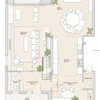
The first flaw I see in your layout is that there are nearly 250 square feet that are useless for anything but walking through (the wide entry plus all the space from the stairs to the master BR door). It can't be a kid's play space you can't put (or leave) anything there. And that costs a LOT of money for no use.
The laundry room is large but needs to be reconfigured for a shower. That's easy.
And you do not frame in a room for the toilet in a house that you are trying to save money building. That's a feature for a McMansion.
 8 years agolast modified: 8 years ago
1748SF (36'x48') is a HUGE for basically a two bedroom/two bath footprint (Now before someone chimes in, I can read room labels so I know this a bedroom and study but the same when compared to the more common two bedroom/two bath concepts).
And I don't know if this is a conscious or subconscious decision or not but one common element in almost all the selected exterior/yard photos is a steep roof. Not a problem with that per se but that WIDE 36' dimension the roof has to cover might be problematic in that regard. Probably a result of sequencial design thinking in lieu of simultaneous design thinking.
 8 years ago
Here is what Tatt's is talking about. The pink area.
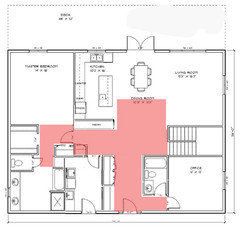
And as drawn, the roof will be massive and expensive.
Some other thoughts.
You don't need two tubs in a house when you're trying to save money.
You don't need two sinks in the master when you're trying to save money.
You don't need and shouldn't have an enclosed toilet in the master when you're trying to save money.
You don't need a cooktop and separate ovens if you're trying to save money. You get a stove and if needed one additional oven.
If you live on a farm, you do need more pantry space.
If that other bathroom is for 3 kids, then it needs more storage.
You don't need such a large hallway to get to your bedroom.
You do need more windows.
If hubby gets up at the crack of dawn, you need better separation between the master and the main area (kitchen) of the house so you can get some sleep.
As others have said, sometimes the best way to save money is to spend it and in this case spending it by having a person with design talent work with you would be well worth it. Especially if it's a house you hope to add onto in the future.
T
Original Author8 years agono its not a good plan! I agree. really I was trying to think thru the previous idea someone had about a shower area by the laundry and then a separate full bath....just couldn't quite get the hang of it- 8 years ago
I have a large walk-in pantry in the new house which has been working very well for us; we cook most meals from scratch and also grow/raise a lot of our own food, and make jams, jellies, sausages, sauerkraut (with my mil's old giant crock). There's shelving for food items and an upright all-freezer and our old fridge (to be replaced with an all-fridge when it dies) on one side, and on the other side upper and lower cabinets to store things we don't need day to day; several outlets above the countertop, so it's a good place to leave a slow cooker for the day. There's also a cold room/cistern room on the basement level with more storage for the bulk of the canning, and all of the root vegetables.
I have a limit to how many bathrooms I want to/can clean : ) , so there's only one bathroom on the main floor, which is a full bathroom with shower near the garage/mudroom entry that serves us and visitors. If people are really dirty/messy, they use the shower in the garage bathroom before coming in the house. Otherwise, I've found the one on the main floor easy to (keep) clean. The vanity is from Ikea and has a one-piece integrated porcelain sink top which cleans up so easily; one key is all the storage -- four full drawers in the 48" vanity and then one tall storage tower on each side. Another key was choosing darker colors -- dark brown for the vanity and storage towers on either side, for the walls Benjamin Moore Grasslands (green) in Regal Select eggshell which is washable/scrubbable (though if the kids were still little I'd consider tile above the sink), medium brown wood-look vinyl plank flooring, and on top of that a good quality tribal wool runner which is incredibly forgiving. A shower head with a hand shower attachment works very well to wash the shower, and I use Gel Gloss kitchen and bath polish on the vanity top and shower to help keep them clean.
- 8 years agoIs the mudroom entered from the garage? Otherwise it looks odd to have two doors so close.
The mudroom next to but not connected to the master bath seems a wasted opportunity. I am wondering about some way of connecting through a pocket door or a shower with two doors. Otherwise, the dirty person can leave their outer layers in the mudroom and then take the rest of the gunk with them through the house or strip down and toss the dirty clothes directly in the washer and walk through the house in their skivvies. If you choose to have a shower in the mudroom, then you need permanent storage for clothes there also.
At this point, you need to make some decisions about where you will be placing this house on the bare minimum functional to luxurious continuum. As commented by other posters, some of your choices are not going to be kind to the budget. Every home needs something special that may be expensive but so wonderfully right that it is worth every penny for the pleasure it brings you. It could be a fantastic light fixture, big skylight, fireplace, gorgeous kitchen island, standout staircase but pick one wow factor and keep other choices plain and practical. If you have too many interesting features, nothing stands out.




User