Software
Houzz Logo Print
barkinmarm

Dishwasher air gap issue

8 years ago

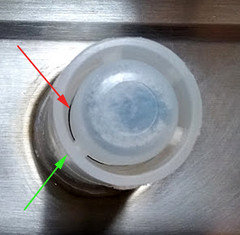
The problem I've been having with my dishwasher air gap is fairly minor but a little bit annoying. During a cycle about 1/4 cup or so of water escapes the air gap and pools onto the sink edge. I've done some analysis and here is where I'm at:

  • air gap screw cap is snug so the discharge should be moving into the drain pathway
  • air gap body and drain hose to are clean, no kinks
  • drains to sink (not disposer). properly angled "t-pipe" in place, above trap. trap is clean and free
  • discharge hose from dw is clean, clear and not kinked

The only thing I can guess is it might be the discharge hose itself. The original installer did not reduce the length at all and left all the slack sitting at the back of the cabinet. I know that in some states where code does not require an air gap the discharge hose should have a loop anchored as high in the cabinet as possible. I've now created a loop to see if it makes a difference. It may be a bit hard to see all of it from the photo but it loops up from the cabinet hole (back of photo), down to cabinet bottom, and back up to the air gap. My concern is whether doing it this way is a big "no-no". Any thoughts or advice?


Comments (16)

  • 8 years ago

    I've not seen a 'T', only a 'Y'.

  • 8 years ago
    last modified: 8 years ago

    I dont have the air gap and dishwasher has never had a problem. My sons did have the airgap, and they did have problems. They just got new sink, faucets and countertops, and the plumber took the air gap out. They now have no problems either.

  • 8 years ago

    But let's say, just hypothetically, that HU doesn't want to replace the sink or countertop. Does anybody actually know how to get it to work?

  • 8 years ago
    last modified: 8 years ago

    I would cut of the excess hose with a hacksaw so the discharge hose is the right length to run up to the air gap. That is how my dishwasher is connected to my air gap.

    The purpose of the high loop and the air gap is too keep waste water from running back into your dishwasher so you could leave your current adjustment in place since you've basically incorporated both the protection of the high loop and the air gap.

  • PRO
    8 years ago

    Fori:


    Forget getting it to work and forget replacing the sink and top. Cut it out, loop the hose, and put a soap dispenser in the hole.

  • 8 years ago
    last modified: 8 years ago

    I'd keep the air gap. The high loop can get knocked down and then you've got waste water back flowing into your dishwasher.

  • PRO
    8 years ago
    last modified: 8 years ago

    How is a dishwasher drain hose running through a hole drilled into the top of a cabinet side going to get knocked down?

  • 8 years ago

    Weedmeister: I incorrectly called the pipe plumbed to the sink basin a "t". It is a "y"

    oneandonlybobjones: I wasn't sure if having both the high loop and air gap would be a no-no, thus the impetus for this discussion. The hose is secured to the cabinet wall with a bracket and she ain't moving anytime soon.

    Won't need to run the dw for a couple of days. Why wait? I want conditions to remain the same to see if this loop makes a difference. I'd be curious to know if the screw cap style air gaps are more prone to this type of leakage.


  • 8 years ago

    The only time I've had a screw-type air gap give me a leakage problem is if the plastic (not the chrome) cap is partially blocked. I unscrew it and clean it out.

  • 8 years ago

    Having run a cycle the problem remains. I had hoped that having the high loop might have a small impact on the discharge pressure at the end of the hose and into the air gap. Yes, to all the engineers out there, that was probably wishful thinking. During the dw cycle I watched the gap at the stages of draining. Water would flow up against the cap and back down as expected. Water never worked its way higher than the slots (see red arrow) and out over the top of the cap which is what I thought was happening. Yet water worked its way out of the cap threads and down the side onto the sink. So I think cheap plastic and crappy engineering are the culprits here. I am going to wrap the threads with some thread tape and see if that reestablishes the seal. Meanwhile, I'll be looking for an air gap with a better design and build. In a couple of years when I put in new countertops and a sink I'll be going with the under counter gap only.


  • PRO
    8 years ago

    I'm tired of having my advice ignored.

  • 6 years ago

    To Joseph Corlett: ... because your advice does not meet code???

    To others:
    I am having the same problem. I have a brand new home. The plumber tried to pass inspection without the gap, but the inspectors wouldn't budge. In fact, they stood there watching him to make sure he completed the job.

    I have verified that there are no clogs or plugged/sealed fittings. Some of the water goes down the drain as it should, but quite a bit still gurgles out onto the countertop and into the sink. I too suspect a poor design of the air gap. Can anyone recommend a brand and model that is certain to work?

    Dean

  • 6 years ago

    deananywhere mn:


    I swapped out my original air gap for this one at Menards - cost 3 bucks


    https://www.menards.com/main/kitchen/sink-sprayers-strainer-baskets/plumb-works-reg-air-gap-without-cover/556pw6336/p-1563517870013-c-8506.htm


    I honestly wasn't expecting it to make a difference, but it did. No more overflow or leaks. Probably a better design and threading. I didn't change anything else and this did the trick. Good luck!


  • 5 years ago

    First of all, the dishwasher drain hose is usually connected to the garbage disposal which provides an air gap between the dishwasher drain and the sinks drain. Also, air gaps tend to cancel out the purpose of the p-trap, because of its placement between the drain outlet and the p-trap. I've had many clients complain about sewer smell coming from there sink, and everytime it was the air gap.

  • 4 years ago
    last modified: 4 years ago

    @Richard Thomas... That's so wrong on so many different levels... if the sewer backs up from a non siphon type of back up then it will flow up and into the drain line.

    Second, you don't install the air gap behind the p trap. You install it BEFORE the P trap. On the down tube of the sink. But 99% of ppl with an air gap use garbage disposals so that's mostly irrelevant.


    Also yes I know this thread is old but this info is RELEVANT and can save many others from headaches. Yes a kink or clog will cause water to spew out of the air gap cap but with this older design most of the "trickle leaks" that seem to come from nowhere or underneath actually come from the second set of inner threads that the cap screws down onto. NOT the outer threads that bolt to the sink.


    Anyways, THE OPs DESIGN OF AIR GAP HAS A DESIGN FLAW. THE THREADS INSIDE WHERE THE INNER CAP TWISTS DOWN GET STRIPPED OVER THE YEARS AND IT STARTS LEAKING FROM THE INSIDE DOWN. It has nothing to do with anything else. Get the other ONE PIECE BODY design.

    Also for others saying just ditch the air gap. NOT EVERYONE WANTS TO JUST DITCH THE AIR GAP NOR CAN THEY BECAUSE IT'S AGAINST CODE IN MANY STATES.