Software
Houzz Logo Print
bcroselover

Mildew on rose bush

7 years ago

Hi Everyone — day before yesterday my Morden Sunrise was busting healthy. Today I was appalled to see the leaves on several major branches curled up and dusty with mildew. Looks like the leaves are dying. One book says that warm days follow by cold nights are one cause, and that's what we're having. But also, this summer I planted a dwarf bee balm next to it. The darned thing got mildew and I didn't think much of it, didn't do anything. Next I know, the rose bush is infected. And it's still got quite a few unopened buds on it. I sprayed it immediately with modified Cornell formula. But I'm wondering whether it's recommended that I cut off the affected branches. Some of the branches still have healthy leaves.

Comments (8)

  • 7 years ago

    Bumping this up for you so hopefully someone will answer...


    I have not had much trouble with Powdery mildew here so limited experience with PM... And no experience with the “Cornell Formula” ...With that said...lol


    I have used a product called greencure 3-4 times with success in the past few years...It seemed to kill the PM but once leaves are badly damaged there done and probably should be removed from the bush..I have never taken off branches just leaves, but, see what others say...Best of luck!

    bcroselover thanked jim1961 Central Pennsylvania Zone 6a
  • 7 years ago

    bc - can you post a picture?

  • 7 years ago

    Hi bcroselover: 2 of my 150 rose bushes also have terrible powdery mildew, which can be difficult to control, perhaps more difficult than black spots, once it breakouts. Green cure was not helpful for me as a preventive agent or when the disease get started. I do cut out the affected buds and leaves. Recently I found an excellent product on the website of Rosemania called Eagle EW 20: http://rosemania.com/page5.html.

    It was very effective. I sprayed preventively starting 2 weeks ago and so far I haven't seen any mildew in those 2 bushes. Normally the roses will be covered with mildew now.

    bcroselover thanked Rose Lai (9b)
  • 7 years ago
    last modified: 7 years ago

    BC,

    Powdery Mildew is tough to deal with, often more difficult to eradicate than black spot.

    Patty's water spray has been effective for many folks. It's cheap, easy, and harmless to the environment.

    Immunox fungicide is reported to be the best conventional treatment for powdery mildew. I get PM infrequently, and use the Bayer fungicide when I do, but progress is slow getting PM under control with it. If I should get an outbreak of PM again, I plan to try Immunox.

    I have not heard of one success story from folks using the Cornell concotion, but it's worth a try. Beware of timing your spraying of it to prevent foliage damage from phytotoxicity or phototoxicity.

    Leaves deformed by the PM will not reverse their appearance to fresh and clean of the damage after it is eliminated. It depends on how damaged they are whether to remove them only, or too, the stem on which they are growing. If they appear to still be able to photosynthesis adequately, leave them since they are feeding the bush.

    Moses

    bcroselover thanked Moses, Pitt PA, cold W & hot-humid S, z6
  • 7 years ago
    last modified: 7 years ago

    Often a summer problem because plants may have become dry at the roots at the same time that there may be dampness on the leaves. So hosing them down in the morning adds moisture to the soil and washes the leaves, getting them wet instead of merely damp.

    It is done in the morning so plants dry as much as possible for nightfall. With drought stress seeming to make plants more prone to infection.

  • 7 years ago

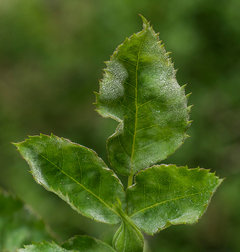
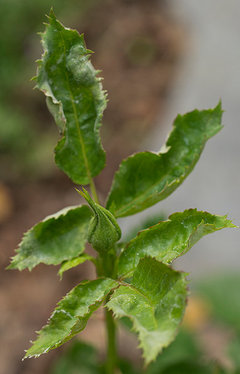
    Many thanks to everyone who has given me feedback. This forum has been an enormous help to me over the years, but it's the helpfulness of people that makes it that way. Photos requested by Karen are posted below. Thanks a lot to Jim for bumping my post up.

    I can report today that, after spraying with Cornell University formula yesterday afternoon, the rose bush looks much better. Unfortunately, I did not take a photo before I sprayed. As I recall, about half the leaves were curled, distorted. Most of them had white splotches all over them, but some were just curled with a little white on the edges. Today after the spraying, the white spots are dramatically reduced, on both the rose bush and the bee balm. Moses says the leaves will not reverse their appearance. I thought maybe my leaves were a little less distorted today, but as I say, I didn't take a photo; besides, much distortion is still there.

    The Cornell University Formula I used is a common organic fungicide used on roses. You can find it on the internet in various versions. I use the precise proportions in the version cited by Field Roebuck in his book, Foolproof Guide to Growing Roses: 1 gal. water, 2 tblsp fine horticultural oil, 1 tblsp mild liquid soap (not a detergent), 1 heaping tblsp baking soda. Roebuck says it was determined by a researcher at Cornell to be at least as effective as chemical fungicides. This was later confirmed by studies at other institutions. I have found it an effective deterrent for black spot.

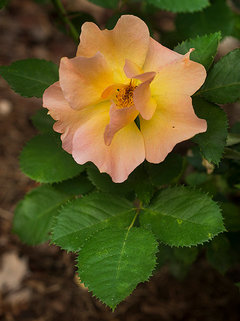
    This photo was taken just a day or two before the mildew struck. I thought it looked healthy then, but now that I go back and examine the photo carefully, I can see the vague beginnings of splotches on the leaves, which had been flawless earlier in the year. One or two days later the leaves were a disaster.

    This morning, after spraying yesterday, though many leaves remain shrivelled, I could find only a few that still had graphic white spots on them. I am thinking if the affected leaves don't improve any more, I will pull them off.

  • 7 years ago

    I also get powdery mildew in my climate - I agree with the other suggestions to just rinse the plants off once every couple of days with a strong spray of water from the hose (I use the "center" setting on my Dramm nozzle). If it's only one plant, I've also had success with taking a cup of water & a damp paper towel outside, and spending 30 minutes wiping off the affected leaves & stems. (After I wipe it off, I give it a good spray with the hose to rinse off any spores i might have spread around.) Obviously, this would be way too time consuming for your whole garden, but if you are just paying extra special attention to a plant or two, it can help a lot. Re removing the leaves, I would only take them off if they're really damaged & bothering you. (As others said, unfortunately the damage done isn't reversible, even once you get rid of the mildew.)

    bcroselover thanked cyndita (west coast zone 9)