Software
Houzz Logo Print
mywormyworld

New Worm "Parent" Here...Long Post.

7 years ago
Been lurking and learning in this forum for weeks now. Decided to post finally and to thank everyone for very helpful tips!

I refer to myself as "parent" due to the fact I check my wigglers as often as if they were my new born child. No joke. I am definitely in the "overprotective" category of wormers. Mostly due to the fact that my initial experience with my relaxing new hobby turned into one filled with that fear parents have over their children. Are they too hot, too cold, are they eating, etc...LOL I quickly felt like being an actual parent just might be easier than being a worm parent. Here's why:

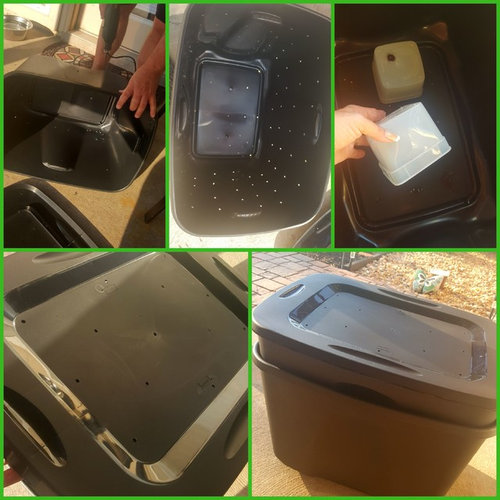
I started my bin July 21st. - Plastic Two bin style. Added some worms a few days later. In total I had approx. 270 worms. Within about 3 weeks though I knew this system wouldn't work for me. My worms kept escaping through bottom holes into second bin.- nothing like having to wrangle up worms when your running late for work ...- Almost every morning, I was gathering them up off the garage floor...and at one point, I must have lost about 50 at once and with that came the horrid smell. Dead worms in the liquid. In an instant, I killed 50 of my worms. HOW is this possible? I peeked in on them 5 times a day! And I refused to ask my husband for help as this was "my rodeo".....he got too much pleasure out of watching me during this time.

Fast forward, I ended up using one bin, placed on an aluminum foil covered piece of cardboard to prevent escapees. Then put tape over all air holes except top row and lid. I freshened up the bedding, etc. and since then no runners!!!

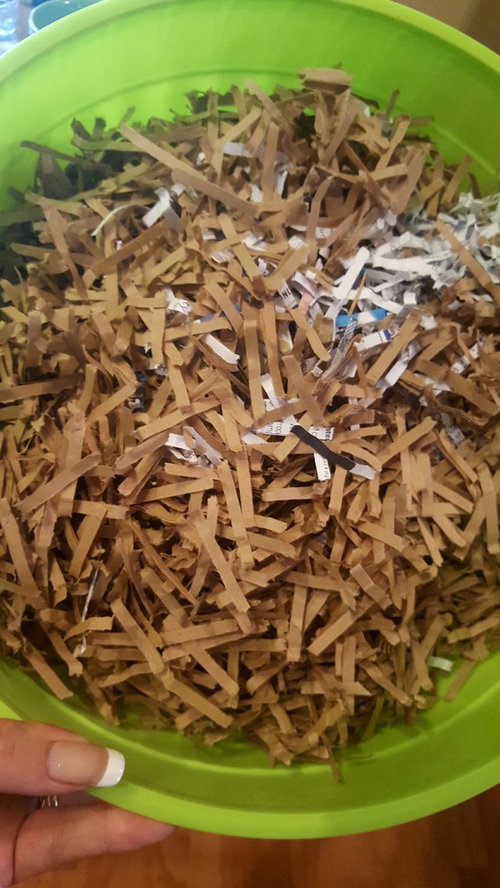
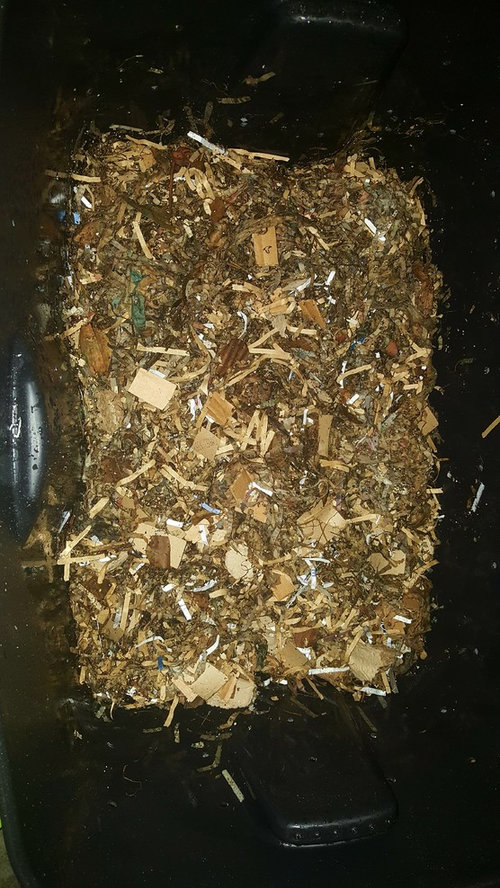
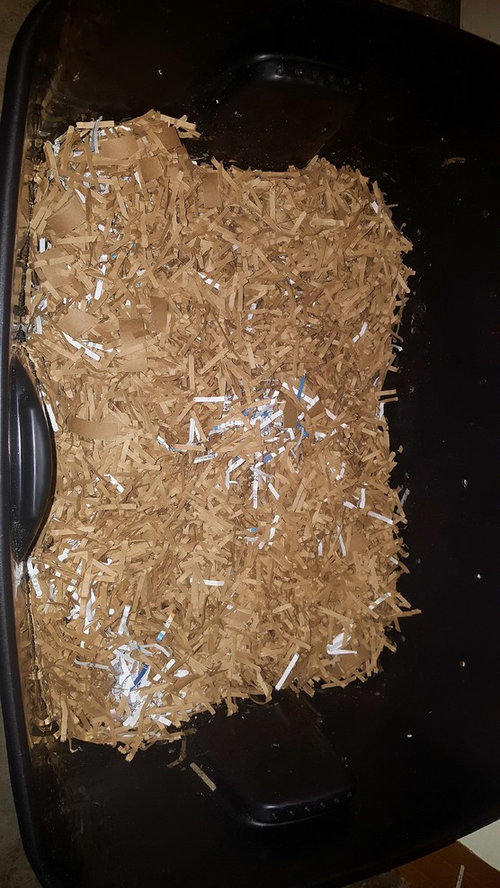
However; I have been battling a mite problem. Taking lid off and airing out seems to help (their disappearance boggles my mind...losing them is almost worse then seeing them!) so today I decided to reclaim my bin. I did a complete overhaul. Turned the entire bin. Took out long strips of newspaper (do not like strip method)...took out corn cob. The worms I found, about 20....seem healthy and active. I could even see some castings in very bottom. I added a bunch more lightly misted cardboard pieces, paper towel tubes cut and my new favorite, shredded brown lunch bags. I also sprinkled coffee grounds throughout and finally, wiped sides, inner and outer as well as lid to get rid of as many mites as possible. I'll update on that when I know if this helped.

The only concern I have right now is the worms seem to stay primarily in 4 corners of the bin even when I feed. Which, btw, due to mites...I am holding out on wet food and plan to start using a dry chow.

Anyway, Here are pictures of how my bin started and how I finished it off today. Will add more worms tonight. Hopefully, I've found a better balance now...

Comments (7)

  • 7 years ago

    I believe for excess moisture, gnats and general bad conditions: add lots of extra bedding, including a thick layer on top of the 'real' worm area. It's okay if the layer of bedding on top is dry as long as the worm area below doesn't completely dry out - it will absorb moisture from below over time, while letting air percolate in, and buffer bad conditions. Also helps keep various flying bugs from getting in and out - they want/need access to moist stuff directly.

    Which leads me to my general rule: although worms can't tolerate completely dry (and prefer damp), 'too wet' causes many of the problems in bins. Until the worms are well established, be very careful about too wet and too much food. The thick layer of bedding on top helps moderate conditions below.

    Or more simple version: there's no such thing as too much bedding.

  • 7 years ago
    last modified: 7 years ago

    Thank you both for your input! I have since added 120 more worms and agree, I was beginning to think coffee grounds may be adding to my mite dilemma so I have cut back on them. As for egg shells, I grind mine up fine and adding them just feels right. The worms currently seem content. Only two runners so far.

    Tonight I did discover my main area was much drier than I had anticipated so I moistened it up pretty well and am taking suggestion of adding a nice dry layer on top.

    So, at the moment....I think I am getting the feel for this. Oh, and since cutting back on wet food...gnats are much less apparent.

  • 7 years ago

    Like you I am a new parent too. I also check them so often I think I heard one of them call me a nasty word. I would find them on the top lip all tangled up when I took off the lid. I thought they were trying to escape but come to find out they just wanted some alone time. I started mine around the same time you did and for several weeks my worms were everywhere. But now they are settled in and doing fine. It takes time for your bin to get established with microbes and other bacteria, compare it to a fish aquarium. When you first set up a tank you are supposed to put in a sturdy fish like a goldfish or a molly to get bacteria growing. Then after a few weeks you can get some exotic fish.

    With worms you need to watch the moisture, PH and how much food is in the bin. I started with about 3oz of liquid vegetables I processed in a blender mixed with coffee grounds and crushed eggshells. I also grind up oatmeal, cornmeal, whole wheat flour and a little sugar. I sprinkle this on top about twice a week.

    Watch videos on YouTube and go to as many web sites of worm farms as you can and read all the info these worm farmers have to say. Also sites like this are the best education you can get for free. When I have a problem I go to Paul piccirillo at Www.wormfarmingrevealed.com I learned almost 99% of what I know from him and his site. I also ordered his 274 page book. Very informative.

    check it out


  • 7 years ago

    Otis; You can control fungus gnats with sheets of yellow sticky fly paper. You can also set up a bug zapper near the bin. Turn it on at night, open the bin cover, the bugs fly out into the light and get zapped. Mites can be controlled with banana peels or melon peels. The mites swarm the peels, you wash them down the drain and put the peels back for the next batch. Also, I've been raising Redworms for 9 years. I never, ever bought a book and all the knowledge I've gained over the years has been from these kinds of forums, interacting with others, many of them far more knowledgeable than me; who were more than happy to share their knowledge, just for the pleasure of helping others. I am still learning, it's a constant process.


  • 7 years ago
    last modified: 7 years ago

    Thanks Shaul. Like you, I didn't buy books or anything and just like on-line,you have to sift what one book says from the other. As here, it's what happened in their/our bin(s).


    I have learned to accept and live with mites up to a certain size of colony. They break down the bigger chunks and give bacteria bigger surface to cover and so helping the worms get their daily food. AND, they stay in the bin. I'm sure those fungus gnats maggots (if you can call them that) help the same way. I have some odd 25 - 3 gal. bins with screen covers and just imagine opening the lid and have these gnats fly in your face. And with how much time from eggs to flying critters, they will come in waves. However, there are some bins that have minimal gnats and I suspect that there are some nematode of some kind in there.

    mywormyworld: There is no such thing as too much egg shells in the bin. What I understand so far, it will bind acid but when there's no more binding to be done it will just sit there as egg shells. I bought a hand-cranked grain grinder and it served me well (as keep me in shape). Just to add aesthetics to the bin, no big chunks of egg shells.

    With your size of worm population, I would put a partition in your bin, i.e. with a cardboard divider across. I found that they breed faster in a smaller space than having to roam the space to find a partner. You can fill the other half of the bin with your supply of shredded paper and extra kitchen scrap. It's OK if some wander off there but your main colony is on the other side. I mostly apply logic to my worm farming rather than scientific, which I have none or little of.

  • 7 years ago

    Otis, You make a good point about the grain grinder. I have one sitting in the store room that I got a couple years ago off the local FreeCycle Network. It's enamel coated and rusted in places, so I don't know if I would use it for grinding flour for bread, but it should work fine for the worms for grinding eggshells and the like. I might even try some other kinds of flours like lentils or beans. What the worms like to eat is always a surprise.

Sponsored
Art Masonry Inc.
Average rating: 5 out of 5 stars142 Reviews
Loudon County's Hardscape and Landscape Expert in Outdoor Living