Software
Houzz Logo Print
mogadsden84

Infested Crepe Myrtle

8 years ago
last modified: 8 years ago

Newbie to the forum... I have a crepe myrtle that was blooming beautifully, but about 3-4 weeks ago the leaves started to wilt, yellow and fall. There was also a lot of wasp activity around the tree. After much research, I believe I found the culprit....an infestation that caused sooty mold! I have been told to prune the tree come fall and cover it in dormant oil. Is this correct ? Also, should I remove the mulch around the tree and treat the ground with dorm oil as well? Any input would be greatly appreciated!!!


Comments (16)

  • 8 years ago
    last modified: 8 years ago


    I just uploaded a photo.... I found what appeared to be very tiny white bugs on the underside of the leave.

  • 8 years ago

    We need to see a photo of the actual leaves to a) evlaluate the damage and b) identify what the white bugs may be. So close ups, please!!

    mogadsden84 thanked gardengal48 (PNW Z8/9)
  • 8 years ago

    Some crape myrtles are very susceptible to infestation from aphids; there is even a species of aphid known only to crapes. Infested trees are typically covered with black sooty mold. The wasps are attracted to the honey dew produced by the insects.

    The advice for pruning is probably faulty, but I always recommend a couple of applications of horticultural oil after leaf fall. The oil is strictly to control the aphids; they and their eggs will be physically smothered by the oil. Do not spray the soil!

    The BSM is simply growing on (feeding on) the sugary aphid excrement. Once you control the aphids, the black mold will disappear. No need to remove the mulch......that's called for in powdery mildew but not BSM.

    I suggest at least three oil applications over the winter, make sure that one is just before they leaf out in the spring.

    In the future, should you be in the market for another crape myrtle, you can read up on the specific cultivars in order to identify those with known resistance to BSM and/or powdery mildew. It's always worth it to locate a named cultivar.

  • 8 years ago

    Regarding the pruning.....don't do it unless your tree is in need of shaping and thinning. In general, crapemyrtles are not improved by slap dash pruning, even though it has become a common practice.

    mogadsden84 thanked rhizo_1 (North AL) zone 7
  • 8 years ago

    where is my longer reply from yesterday .. in case is doesnt show.. how long ago was it planted??? ... ken

  • 8 years ago

    mogadz....click on THESE IMAGES of crape myrtle aphids to see if it's what you have. Any chance of a sharp picture of these insects?

    mogadsden84 thanked rhizo_1 (North AL) zone 7
  • 8 years ago

    well .. it took only 26 hours for my prior reply to show up .. go figure ... ken

    mogadsden84 thanked ken_adrian Adrian MI cold Z5
  • 8 years ago
    last modified: 8 years ago

    @rhizo_1

    those are the bugs I found on the leaves!!

  • 8 years ago

    @ken_adrian

    abt a yr ago

  • 8 years ago
    last modified: 8 years ago

    mogadz, You could start with a treatment of (commercial) insecticidal soap now, making sure to target the underside of the leaves. You can get the soap where they sell the horticultural oils.....any garden center.

    Crapemyrtle aphids can be a bit of a challenge on susceptible varieties, but not impossible to control. Do you by chance happen to know what variety yours is?

    By the way, your tree should not be pruned at this point.

    mogadsden84 thanked rhizo_1 (North AL) zone 7
  • 8 years ago

    oils suffocate the bugs .... its of no use to treat the ground ...


    i would suggest you dig 3 or 4 .. 3 to 6 inch holes.. around the tree .. and FIND OUT if there is moisture in the root zone .... if not .. then you need to water it deeply .... and get the tree in better shape.. health wise ...


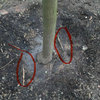
    i would also check planting depth ... trunks are supposed to be in the air ... and if the first 3 to 6 inches is underground.. you have problems ... we should discuss ....


    as i said before.. bugs find stressed trees ... plants ... so lets make sure you have a healthy tree ... then get rid of the bugs ... and then.. i wouldnt be surprised if this never happens again.. plagues come and go over the years .... so hopefully this will not be an annual recurring problem ...


    ken


    mogadsden84 thanked ken_adrian Adrian MI cold Z5
  • 8 years ago

    Ken, your advice is good, but doesn't take into account that some Lagerstroemia varieties are naturally attractive to these particular aphids. Frankly, there's not much one can do to avoid an infestation once you have the pest and the predisposed plant in the same environment.

    In my considerable experience with these pesky insects, if someone owns a susceptible variety, some sort of intervention will be required every year if these aphids are present, no matter how healthy the tree. It might be as simple as a couple of dormant season applications of hort. oil to get the eggs and overwintering adults in the nooks and crannies of the stems.

    Multi millions of dollars have been poured into breeding programs for the development of aphid resistant cultivars....that's how serious a pest it can be.

    A healthy plant can recover faster, no question, but cannot fight off an insect which only feeds on crape myrtles, nothing else.


    Crapemyrtle Aphid

  • 7 years ago

    Has anyone heard of sooty mold from crape myrtles getting onto white house paint? I live in Dallas and I've found another homeowner besides me that has black mildew or something on the underside of our eaves where we have crape myrtles growing higher than the eves. It is not affecting the stucco side of the home, only the painted eaves. I fear I might have to rid my garden of the trees if I have to keep cleaning the painted surfaces of the house. It gets expensive as we have a two story home.

  • 7 years ago

    That stuff will definitely blacken a house.


    If your trees are actually touching the house or close enough to get the eaves sticky or moldy, you probably want to prune them away from it anyway. It would be a shame if you had to remove them completely.


  • 7 years ago
    Apply a systemic for aphid control at the root line. I typically apply it in May before it starts blooming.