Software
Houzz Logo Print
ladylotus_gw

Fertilizing your Citrus trees

7 years ago

It is that of year where we are once again planning to clean up our trees/plants and place them into their winter homes. Perhaps there are a number of you that can leave your trees out as you live in mild winter climates.


I am wondering what type of fertilizer regimen you follow during the summer and does that change during the winter months?


I have been trying all sorts of things. Lately, in the summer I have been using Osmocote and Fish Emulsion. During the winter months I don't want to smell fish in my greenhouse so I have been using a very diluted Peters water soluble fertilizer and spraying it over the leaves and pouring into the soil.


P.S. Brian if you read this I'm very curious about your method. I read in another post you sprinkle on some fertilizer. I have the blue powder like Peters fertilizer that you mix with water and pour into the plant. Are you taking that blue powder and placing a pinch right in your pots and then watering over the top of the soil to disperse it into your pots? If so, that is clever and I would love to give this a try.

Comments (15)

  • 7 years ago

    I use the same feeding regiment all year. In the winter my tree only needs water every 2-4 weeks and in 90F heat I have to water every other day. A lot of pure watering between the weekly feedings. I use 24-8-16 Miracle Grow year around. In the out door months I add 20-0-10 to get me close to 40-8-24 fed at 75% dose.

    ladylotus thanked poncirusguy6b452xx
  • 7 years ago
    last modified: 7 years ago

    When it comes to citrus the three most important keys to success are location, location, and location. Will your greenhouse be 40F or 80F? Will it get 4 hours of sun or 10 hrs? Will the relative humidity be 40 or 70 RH? Do your trees have fruit and what size? Reading between the lines I think you are asking how to make it through the winter and minimize leaf chlorosis. Yellow vein chlorosis is when your citrus tree leaves display yellow veins while the rest of the leaf remains a normal green color. Usually this occurs in the autumn and winter period due to reduced nitrogen uptake by the roots from the soil in low temperatures. Citrus tree nitrogen uptake is generally lowest during dormancy. It increases during flowering and reaches its peak during fruit set. To answer your specific question it won't matter how much nitrogen (which fertilizer) is available in the soil as it is less available in cold weather. If your greenhouse is on the cool side the trees will be unable to uptake enough fertilizer and the tree will display signs of nitrogen deficiency shortly. More water/less water or more fertilizer/less fertilizer won't help if the transpiration has slowed down. Nitrogen is a mobile nutrient and it can move from one part of the tree (leaves or branches) to another. When nitrogen is no longer needed in say a leaf that never gets sun it will borrow nitrogen from that leaf. There are other reasons for yellow vein chlorosis but cooler temperatures in a green house are a likely cause. Putting a pinch of water soluble fertilizer directly on the soil is a fool proof way to burn the roots. You can use a foliar fertilizer which is sprayed on the leaves, where it’s absorbed directly. It’s the quickest method of getting nutrients into plants. Foliar nutrition is useful in condition where the tree’s ability to take up nutrients is decreased and it needs the extra nutrition, such as prolonged periods of drought, wet conditions or cold weather. Citrus have very specific fertilizer requirements. What you are using is all wrong as it doesn't have the right ratios or micro ingredients. Read up on BGI citrus fertilizer and what they have to say about the micro and macro ingredients. I love their fertilizer but it does stink. If you are looking for foliar spray use AG Southern Citrus Foliar spray or Grow scripts. To really understand the dynamics of your greenhouse you need the right tools which are soil thermometer, green house thermometer, infrared thermometer for the leaves, RH meter for humidity, PH meter.

  • 7 years ago

    Lemon Lime Orange,

    What great information. Thank you so much for taking time out to answer my questions. I will be looking into the citrus foliar spray and the BGI citrus fertilizer. I have citrus plants ranging from small seedlings to grown 5' citrus trees.

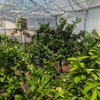
    I do keep my greenhouse on the cool side, setting my thermostat to 45 deg F. The greenhouse is in full sun so when the sun is out the temperatures climb quite rapidly in the greenhouse. The humidity is quite high in my gh as I have a pond in there.

    I will be reading up on an infrared thermometer for the leaves, I've never heard of that before.

    I am off to do some research. Thank you for the information.

  • 7 years ago
    last modified: 7 years ago

    The BGI fertilizer would be fine in a greenhouse. I would not recommend it for a house unless you bury it as it as it has a strong manure odor. The great thing about the odor is you know when to fertilize when the smell is gone to some extent. For a non contact infrared thermometer you can get them for $20 on Amazon. The fact you have a pond in your greenhouse makes it so much easier. Although the needs of individual greenhouses and indoor gardens will vary, growers should ideally aim for a low VPD (vapor pressure deficit). This enables plants to transpire properly and cool themselves. Likewise, a high VPD could potentially cause plant stress. In Florida the soil and air temperature and humidity work hand in hand. In a greenhouse you can get really hot leaves and really cold roots and that is what causes WLD (winter leaf drop). The purpose of the infrared thermometer to keep and eye on leaf temperatures which could cause stress. Research VPD as that is very important in a greenhouse.

  • 7 years ago

    https://crec.ifas.ufl.edu/extension/trade_journals/2011/2011_Nov_root_temp.pdf


    If the link doesn't work Google The importance of maintaining root temperatures during the winter in Florida citrus nurseries. By Tim Spann


  • 7 years ago

    Thank you for the added information. I am assuming you are using BGI CitrusGain? I am going to order some to give it a try.

    Unfortunately, I keep my greenhouse cool enough that most of my plants go dormant. It is not possible for me to keep it warm enough allowing all my plants to actively grow. My plants generally stop growing at the end of November and start up again either the end of February or beginning of March.

    It article in the link you provided is a very good. I used to have my plants sitting on heating cables but now I just keep my plants on the dry side and as I stated in a dormant state.

  • 7 years ago

    I along with many others recommend no fertilizer over the winter (Nov-Feb). Especially with those temps. Resume it in March or so.

  • 7 years ago

    Thank you Matt. I think you may be right and fertilizing during the winter the plant probably will not take up the fertilizer once the temps go down to a certain point anyways.

  • 7 years ago
    last modified: 7 years ago

    Each greenhouse situation is different...entirely different. Lots of growing season left. In the UK there is a product on Amazon UK called Vitax winter and Vitax summer citrus food. Not sure the subtle differences between the two but the goal of the winter seems to be to prevent leaf drop and summer goal formula is to promote growth. Seems to have extremly high reviews on Amazon. From the Vitax website, “We are hugely proud and honoured to have a Royal Warrant of Appointment for the supply of fertilisers to the Household of HM The Queen, a mark we have had the privilege to hold since 1965.”

  • 7 years ago

    In my opinion good review from amazon is equivalent to Volkswagen giving rave reviews for their line of diesel powered cars before the cheating skandle broke out. The fertilizer product in question may be a very fine product though.

  • 7 years ago
    last modified: 7 years ago

    Had to dig around to find some info on that Vitax product but apparently their "Winter" citrus fert is 20-20-20 with trace elements and their "Summer" citrus fert is 25-15-15 with trace elements, for what it's worth.

    Maybe as an experiment, it might be something to try the above ratios - at least the "winter" one, which is basically 1-1-1. I have been using a "Dynamite" slow-release product ("Flowers and Vegetables") for my indoor plants and some of my annuals outside and that is 13-13-13 with micros, and the plants I have used it on seem to have really responded nicely with it so might consider trying that on some of the citrus this winter (instead of FP or Osmocote Plus). The micros that are supposedly added to all of their products include copper, molybdenum, zinc, magnesium, manganese and iron. These are their products - http://www.dynamiteplantfood.com/the-products-rev/

  • 7 years ago

    Winter citrus in cool low light room probably would do best with a 1-1-3 with micros.

  • 7 years ago
    last modified: 7 years ago

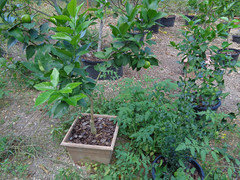
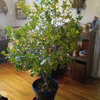
    Did a little " research " about over fertilizing, got this little citrus tree that get its fertilizer regular. Planted a cherry tomato plant beside the container, this plant does not get any watering, just overflow. Tomato plant is all over and around the pot.


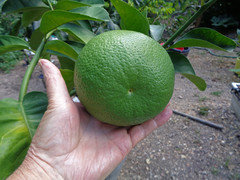
    Does this look like a over fertilized Cara- Cara navel, it's bigger than a grapefruit.