mbst asks:
DEFINITELY the one on the Left! HOW did you DO that???
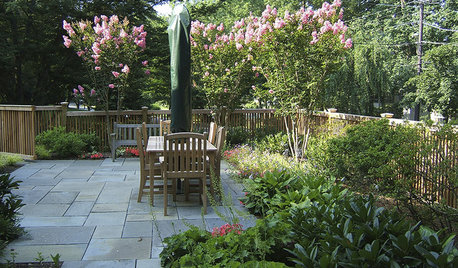
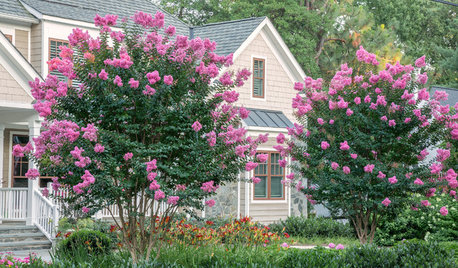
[The pictures are from an old thread that can be accessed here: ["Plant Form."[(https://www.houzz.com/discussions/plant-form-dsvw-vd~1418385?n=68) To give a little background, I started the thread when new to GardenWeb (under former name) in an effort to foster a discussion about form of the multi-trunk tree, asking the question of the two trees in the picture, "Which looks more important?" Enough people picked and defended the tree on the right that I regretted starting the thread and asking the question! Not trying to revive the former discussion here but moving on to answer Mbst's question.]
Over the years I've tried different methods of creating the multi-trunk form but didn't latch onto what I think is the best method until in the last few years. A couple of methods I've tried were standard pruning ... accept what the plant offers and trim bits away as it grows, attempting to develop a proper shape; and cut all the trunks 2' or so higher every year, trying to get them to branch and spread. While these methods work, they are not enthralling. I think a better method is to develop all the trunks first, before encouraging the tree to gain height. This means cutting the plant to within 6" of the ground until the number of trunks are obtained.
To my thinking, the best form is as if a giant bouquet which calls for a lot of trunks. I dismiss the idea of pruning back the number of trunks to the routinely advised (by the professionals) 3 or 4, or really anything less than 10 or a dozen. Doing that simply makes the pronounced cone shape of the trunks just about disappear. To my thinking, the fat, dense, near perfect cone shape is really where the bulk of the plant's beauty lies, not to be appreciated until it achieves some age. Examples that I've created that look about right to me have trunk counts in the forties. Since one doesn't have forever to do all the horticultural experimenting they want to do, sometimes it works best to create extremes in order to make the fastest comparisons and judgments. There can be complications along the way. Trying to achieve the fastest results in tree height means having to tie weak trunks for a while in order to prevent them from splaying out. I've developed a method for tying that works, but it is a pain. For anyone who has the time to grow it, a better and easier method is to not let the trunks grow so tall so fast.
Starting with a young plant, I behead it at the ground once per year, before spring growth, for two or three years (whatever it takes to develop my goal number of trunks.) When I'm satisfied with the number of trunks I let it grow unmolested and never cut it down again. During the next couple of years a few more trunks will come directly from the ground. If they're strong & promising I keep them. If they're weak and scrawny, I get rid of them, usually at the end of the season. Late in the summer, I clean up the lower half of the tree, trimming out lower branches, scrawny trunks and that sort of thing. I also tie a "lasso" around the trunks about ever foot of height in order to refine the cone shape. Late in the winter, before spring growth, I clean up the upper portion of the tree, removing all branches. The difference between a branch and a trunk splitting, to me, is 45*. If it's lower than that it's a branch and I remove it. If it's higher than that it's a trunk split and I leave it. The end result of this annual pruning process is a bouquet of trunks. I also lightly trim the top straight across (avoiding any height reduction to the overall plant) so it will not look lopsided when the spring growth comes. When tree gets to its final height, I trim the top to 9' above grade during the annual spring pruning. This gives a canopy that is above a persons head -- not flopping in their face or obstructing their view -- which is much more useful in any case. I will try to dig up a couple of pictures of something more current.
For quite some time there has been talk of crape myrtle MURDER. Almost anyone talking about it is on the side against. According to the rules of that term, BOTH examples in the above pictures have been "murdered." As they are not remotely alike, I find I like "murder" as done to the tree at the left, but not as in done to the one at the right. Maiming would be a more accurate term since pruning of either example doesn't come close to killing it, or even making it sick. The tree at the right is definitely maimed. But I don't think the one on the left is maimed at all.










Dalton the Bengal (Zone 6)
YardvaarkOriginal Author
Related Professionals
Johnson City Landscape Architects & Landscape Designers · Murfreesboro Landscape Architects & Landscape Designers · Frisco Landscape Architects & Landscape Designers · Poughkeepsie Landscape Architects & Landscape Designers · Evanston Landscape Architects & Landscape Designers · Wilmington Landscape Contractors · Newport Landscape Contractors · Kennewick Landscape Contractors · Florence Decks, Patios & Outdoor Enclosures · New Orleans Decks, Patios & Outdoor Enclosures · Florence Decks, Patios & Outdoor Enclosures · Williamsburg Decks, Patios & Outdoor Enclosures · Muncie Decks, Patios & Outdoor Enclosures · Mansfield Decks, Patios & Outdoor Enclosures · Scranton Decks, Patios & Outdoor EnclosuresUser