

Let's Talk Pruning
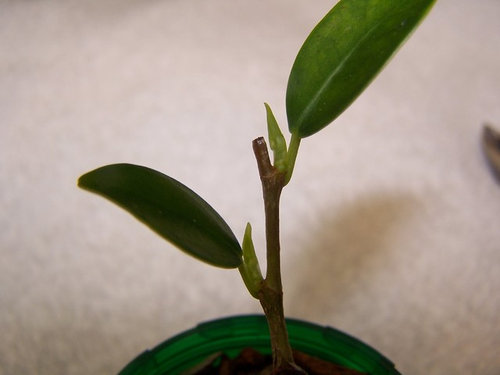
A rooted cutting ^^^ of Ficus retusa in a pill bottle (work great for starting small cuttings - just melt a drain hole in the bottom with a hot nail/ screw .........
What would you do to encourage the plant to put on ht/length as fast as it can?
What would you do to make it as full and compact as possible?
Al
Comments (20)
 7 years agolast modified: 7 years ago
Move it to a wider pot? Put it in good light, make sure the medium is good and water it well? Encourage foliage ramification by pinching out the centers of new leaves? Once it has about 10 leaves feed it nutrients with watering?
Related Professionals
Ocala Landscape Architects & Landscape Designers · Frederick Landscape Architects & Landscape Designers · Plainfield Landscape Architects & Landscape Designers · Murrieta Landscape Architects & Landscape Designers · Quincy Landscape Contractors · Asheville Landscape Contractors · Chambersburg Landscape Contractors · Austin Landscape Contractors · Worthington Landscape Contractors · Evansville Interior Designers & Decorators · Tulsa Interior Designers & Decorators · Jackson Interior Designers & Decorators · Tyler Interior Designers & Decorators · Norfolk Interior Designers & Decorators · Chico Interior Designers & Decoratorstapla (mid-Michigan, USDA z5b-6a)
Original Author7 years agoI was thinking in terms of how you would PRUNE the plant to make it put on ht/length as fast as possible, but you're absolutely correct in thinking that increasing the volume of soil available for root colonization will definitely increase the growth rate, as long as the soil doesn't hold too much water, which could put the plant in jeopardy of being over-potted. Also, it is fine to increase the width of the pot, as you suggest, if using a soil like 5:1:1 or gritty mix, but it can be a problem adding width (as opposed to deepth) if the soil IS water retentive.
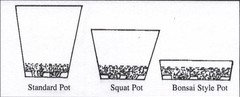
The ht of the perched water column that any medium supports is a constant, no matter the size or shape of the container that holds the medium. You can see that in the image above as the shaded area represents the ht of the perched water column supported by whatever particular medium happens to be filling the pots. You can also see that the taller the pot is, the higher the % of soil unoccupied by perched water. If you make the pot wider only, the o/a volume of soil not occupied by perched water increase, but the % of soil does not.
From the perspective of pruning, my reply to the first question [What would you do to encourage the plant to put on ht/length as fast as it can?] was going to be "Nothing - just let it grow", but your thoughts added valuable insight - so thanks for that.
Consider second question, [What would you do to make it as full and compact as possible?] It might sound counter-intuitive, but rapid growth is not the friend of "full and compact" plants. A full, compact plant is achieved by techniques that help decease internode length and increase the number of leaves it has. An internode is the leafless part of a branch between 2 consecutive leaves or between the points where 2 consecutive leaves were attached to a branch. To get a jump on making the future plant as full/compact as possible, I would remove the 2 mature leaves (if the plant was growing well or about ready to start growing well. So late may to late Aug, here in MI. A little earlier if you live in more southerly latitudes.) The plant's leaves are where it produces it's own food (sugar/carbohydrates). Removing the mature leaves significantly reduces the amount of food the plant can make. A reduction in the food supply means that the 2 new branches that are already extending will tend to produce MUCH shorter internodes than they would if the 2 mature leaves were left attached and producing food. This easy technique, and others, can be applied to improve the appearance of any healthy tree.
So, what would be the next step if the goal is to focus on fullness and a compact plant?
Al 7 years ago
I am assuming we are discussing above soil only?
Height - I would take that top right leaf off and let the newly formed bud next to it go.
Compact - I would pinch both new bud.
This is my "guess" and I am excited to get my test results. 7 years ago
Interesting question. Assuming the plant is actively growing. Let each branch grow 2-3 leaves and prune back to 1-2 nodes. Let new buds form in leaf axils and also remove the leaf itself keeping mind which direction the new bud wants to grow. Repeat again as needed.
Al has a nice illustration of how successive/selective pruning creates a uniform and well rounded growth.
tapla (mid-Michigan, USDA z5b-6a)
Original Author7 years agolast modified: 7 years agoAfter the 2 mature leaves are removed from the rooted cutting, the 2 axillary branches will do their thing and extend without help beyond maintaining cultural conditions that favor the plant. As the branches extend, they will produce leaves that grow increasingly larger as the branch extends and internodes that follow suit by growing longer. If you wait until the 3rd leaf on any branch is maturing, then pinch the branch back to 2 leaves, you'll end up with this:
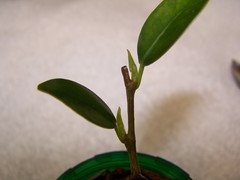
Look familiar? The only difference is, you will have repeated the pattern in the next order of branches. The trunk is the first order. Branches growing off of the trunk are the second order. Once you pinch out the terminal bud from the second order branches, of which there are 2, you will get 2 new branches from each of those branches for a total of 4 branches, then 8, then 16, then 32 branches. If you're diligent, about pinching and are able to keep the plant healthy, you can you can do this (create 32 branches from only the cutting as it's shown, in a single summer, even in the state of MI.Once you are working on the next new order of branches and have pinched out the terminal bud so there are 2 leaves on the new branches. Wait about a week until the new branches in leaf axils are at the stage you see in the image, or a little more mature, then remove the mature leaves that gave rise to the axillary shoots (to limit the plant's food supply, just like you did with the the previous order of branches and the order before that.
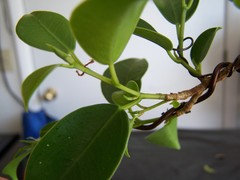
Test: Look closely at the image below, focusing only on the branch with no wire that moves to the left - the one between the 2 wired branches. It's become wild. What's the proper way to reign it in to get back on track to your goal of a full and compact plant? You might as well tell me how you would treat the branch at the right side of the image, with wire and, growing near vertically.
Each pot below has one coleus plant in it, and the natural growth habit of both plants is 'trailing'. Guess which one has been lightly pinched, and which were pinched systematically?
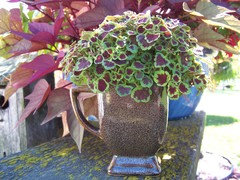
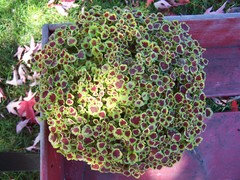
Al
- 7 years ago
Tricky questions Al regarding the ficus. But I will try. The branch to the left I think it should be pruned back to the last node with the big leaf that is after that little side branch near the bottom and remove that big leaf too and let the bud grow. Regarding the vertical branch with a wire stub I am a bit stumped with any ideas. Perhaps snip it right where the wire loop is.
Finding your questions quite fun and illustrative. I have quite few ficus and would like to get into a better habit of pruning correctly. So this is quite helpful. I have been sort of neglecting them. Here is one in a tiny pot that I almost killed (lack of water) last season.
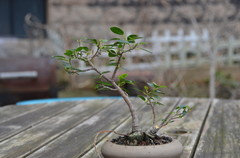
I have no idea which kind this is - may green island ficus. I have another one which is very similar and has tiny figs on it too. I am not yet sure what to exactly do with this one. I am hoping to apply your techniques more religiously on this one and others I have. - 7 years ago
Let's talk pruning.... my Japanese Maples! So I will put a description above each picture for some backstory, but as a summary these are all trees that I got in 2018. Half of them are transpotted into gritty mix, the rest are not but drain pretty well when I water them. I fertilized them but stopped fertilizing at the end of Fall. I must have gotten my first tree around July.
I would like to get advice on how to prune these guys to get ready for the 2019 growing season because I should have pruned them in late Fall but I did not. I would like it if they grew vigorously, but not too tall. Thick and wide. Most of them are grafted and I could ground-layer them if you think it would be wise. Let me know if you have any opinions on that. In any case, here they are:
JM#1My first tree ever, so JM #1, still not transplanted or repotted. It was growing very thin and tall. The label said "Japanese Maple Upright". Really don't know what to do with this one except maybe cut it down to 25% of its current height. The rootstock under it gave me two rootsuckers, which I planted in other pots. The next 2 pictures are of them. This one really puzzles me though....
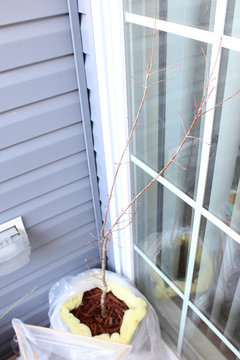
JM#2Root sucker #1 of the tree above. This one when I planted it took to the transplant very well and was quite vigorous, I see this as a good potential for shaping a certain way. Let me know.
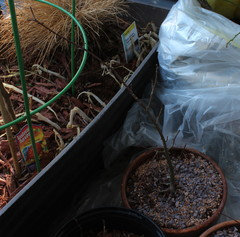
JM#3This one is the second root sucker I got from the rootstock part of the tall Japanese Maple "Upright" of above. Not much pruning to do on this one? What do you think? Also this one was not very vigorous after I separated it and planted it.
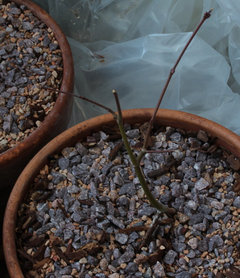
JM#4 This one is a Japanese Maple Katsura. I have three different angles of it because I figured it would be better to have many angles since this one has so many branches. This tree was extremely vigorous when I got it in the Fall. It also looked amazing. I really don't know what I want to do with this one as far as shape goes but I'm sure it needs quite a lot of pruning. Also there are no cut marks anywhere. I think this one has never been pruned since its birth/graft.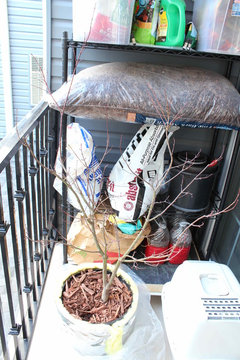
Another shot from the side of JM#4: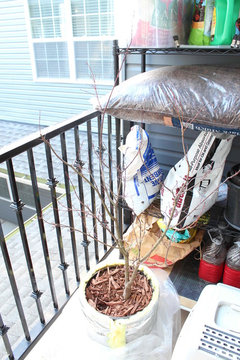
An aerial shot of JM#4. This one should really help to understand the branching and shape?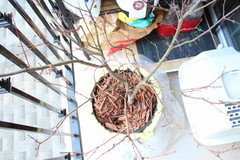
JM#5:This one really caught my eye at the store when I got it. It had red/purplish leaves. It was labeled as JM "Bloodgood" but it is doubtful it is one from discussions we had on this forum about it. I repotted this one without root pruning into gritty mix and cared for it well with watering and fertilizing. Like JM 1 and 4, it has a graft and I'm not sure if that is bad for the tree or not. In any case maybe half of the top should be pruned so that it becomes wider and thicker at the bottom and doesn't keep on growing so tall, what do you think?
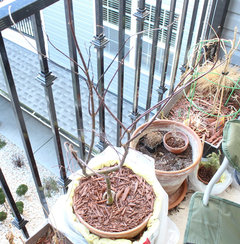
tree #6: Blueberry tree. Not sure if I should prune this one at all as it did not seem to be very happy when I got it. I mean it did not have a lot of leaves. The green branches that you see here appeared most of them when I got it so it was doing better. Sorry for the poor picture quality on this one. Out of focus...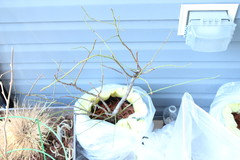
Thanks for looking at my trees and any advice on they pruning, layering an anything would be very welcome. I do intend on repotting #4, #1 and the Blueberry tree (#6) into gritty mix, sometime soon when I'll have another batch made.
Enjoy and have a nice day.  7 years ago
Hi Al, I have a question I have been mulling over. I have a pothos that has long mature vines that have lost many leaves except for some on the ends. I’d like to do a relatively hard pruning, root many cuttings, and replant them with the main plant (likely when I do a full repot). But I’m not sure how to schedule/space these events to best line up with the plants natural schedule since rooting the cuttings will take a few weeks to be ready to be planted with the main plant. Thanks in advance for any input!
tapla (mid-Michigan, USDA z5b-6a)
Original Author7 years agoThe easy way to accomplish what you want to do is to start a cutting in a free draining soil. After the cutting has grown 3 leaves, pinch the vine/runner back to just after (distal to) the second leave. There will be 2 leaves left on the plant, and a new branch will form in the crotch of each leaf - same as what's happening here:
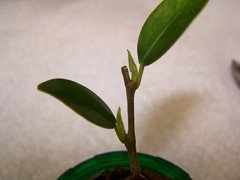
Once the new branches have extended an inch or so, you can remove the mature leaves beneath the new branches. Keep repeating that process over and over as the plant grows new branches. Removing the mature leaves with branches growing in their axils (crotches) might sound counter-productive, but consider that you'll be reducing the plant's food supply, which will automatically reduce internode length (the distance between leaves on the vines). In the end, your plant will still 'trail', but it will be far fuller than if you left the runners/vines to simply extend endlessly w/o branching.
You can also 'chase the foliage back' on your plant, but that will take a while. Trim the runners back to one healthy leaf. The plant will back-bud behind the pruning cut and give you more opportunities to cut it back. I don't play with pothos, but almost all vines can be cut back ruthlessly, only to respond by back-budding profusely on whatever is still attached to the roots. You could try that after you have a cutting started - or several if you like. Careful pinching of 1 plant will produce the same fullness you can get with several in the same pot.
Best to do the work, cuttings and repotting, in Jun if you're in the N Hemisphere. Ideally, the plant will have been outdoors in dappled or open shade for a couple of weeks before you do the work. If you're intent on doing the repotting, let me know and we can go over it.Al
tapla (mid-Michigan, USDA z5b-6a)
Original Author7 years agolast modified: 7 years agoI've made progress, but I'm getting the stink-eye from DW. I'll finish later tonight. You'll have plenty to think about.
Let's talk pruning.... my Japanese Maples! So I will put a description above each picture for some backstory, but as a summary these are all trees that I got in 2018. Half of them are transpotted into gritty mix, the rest are not but drain pretty well when I water them. I fertilized them but stopped fertilizing at the end of Fall. I must have gotten my first tree around July.I would like to get advice on how to prune these guys to get ready for the 2019 growing season because I should have pruned them in late Fall but I did not. I would like it if they grew vigorously, but not too tall. Thick and wide. Most of them are grafted and I could ground-layer them if you think it would be wise. Let me know if you have any opinions on that. In any case, here they are:
JM#1
My first tree ever, so JM #1, still not transplanted or repotted. It was growing very thin and tall. The label said "Japanese Maple Upright". Really don't know what to do with this one except maybe cut it down to 25% of its current height. The rootstock under it gave me two rootsuckers, which I planted in other pots. The next 2 pictures are of them. This one really puzzles me though....
The first thing I have to tell you is, it's exceedingly difficult to analyze a tree's problems and offer work-arounds or solutions when working with 2-dimensional images. The second thing is, what I would do might be too much for you to bear. For instance, I would probably chop the first tree back to the first branch above the graft union that favors a vertical orientation, and start building the tree from that. I'm assuming you don't want to do that, so I'll assume you want to keep at least 1/2 of the trees ht as it appears now. First, prune off any/all branches on the understock (below the graft). That's very important. Then, wherever there are a lot of branches concentrated in one area - like 2 or more branches from almost the same spot, they need to be thinned to 1 branch. If you don't, you'll soon have an ugly swelling/bulge on the trunk that will be a magnet for your eye.
Maples grow in trifurcations (think of a pitchfork with 3 tines) with the central leader of the branch running through. Review the image below.
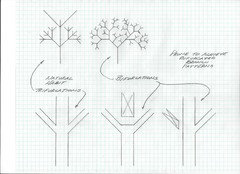
The natural growth habit of a maple is on the left. The branch grows and produces 2 buds which become branches. Above left is a line drawing of what occurs. Try to avoid structural trifurcations by pruning to create bifurcations (think of the 'Y' of a sling shot). You can do that at every node by removing the central leader or a lateral branch or bud as the image at lower middle and right show. If you do that, you'll end up with a bifurcated structure as you see top right. So, where the trunk bifurcates into the 2 large branches, you should decide which of the large branches you want as the leader and which will be subordinate. if that part of the tree is too messed up, you can pinch out the center of the tree below that bifurcation. This makes a new bifurcation with 2 small branches. There's no sense in going further on this tree until you decide how you're going to proceed.
JM#2Root sucker #1 of the tree above. This one when I planted it took to the transplant very well and was quite vigorous, I see this as a good potential for shaping a certain way. Let me know.
^^^ Starting from the bottom: remove one side of any trifurcations I can't see. When you get to the first pair of bar branches (directly across from each other, one side should be removed. I would remove right side, then snip both of the smaller branches on the left back to the first pair of buds. The 2 little branches on that left branch will be short stubs. Moving up, to the next pair of small branches - remove 1 of the branches and keep the one that grows in a favorable direction. Look at other branches and think about where they are growing. The branch you keep should be growing into the void created by where the other branches are not growing. It should point to where the most light will be as the tree grows. Moving up, it looks like either of the next 2 branches will be the leader - doesn't matter which. The rest of the tree above that longer branch moving to the right will not be a part of the tree, but leave it as a sacrifice branch for now. It will feed the rest of the tree and help thicken the trunk.
JM#3
This one is the second root sucker I got from the rootstock part of the tall Japanese Maple "Upright" of above. Not much pruning to do on this one? What do you think? Also this one was not very vigorous after I separated it and planted it.
^^^ Starting from bottom going up the left side. You want a branch to grow toward the left at the bottom of the lowest bifurcation (bottom of the first V. That should occur naturally. If it doesn't, I can show you how to thread graft a branch there. The rest of the left side above that will be a sacrifice branch to be removed later. As I mentioned above, you keep it so it feeds the tree and thickens the trunk. If you get that branch I mentioned, it will form a trifurcation, so at that point - the sacrifice branch should be pruned. Remove the stub above the long branch growing left on the left side.
Hint: When you're utilizing sacrifice branches, keep them pruned as they grow so they don't shade branches you're going to keep. Leave it grow after that, but keep an eye on things to head off problems. You can always ask for advice.
JM#4 This one is a Japanese Maple Katsura. I have three different angles of it because I figured it would be better to have many angles since this one has so many branches. This tree was extremely vigorous when I got it in the Fall. It also looked amazing. I really don't know what I want to do with this one as far as shape goes but I'm sure it needs quite a lot of pruning. Also there are no cut marks anywhere. I think this one has never been pruned since its birth/graft.
Another shot from the side of JM#4:
An aerial shot of JM#4. This one should really help to understand the branching and shape?
JM#5:This one really caught my eye at the store when I got it. It had red/purplish leaves. It was labeled as JM "Bloodgood" but it is doubtful it is one from discussions we had on this forum about it. I repotted this one without root pruning into gritty mix and cared for it well with watering and fertilizing. Like JM 1 and 4, it has a graft and I'm not sure if that is bad for the tree or not. In any case maybe half of the top should be pruned so that it becomes wider and thicker at the bottom and doesn't keep on growing so tall, what do you think?
tree #6: Blueberry tree. Not sure if I should prune this one at all as it did not seem to be very happy when I got it. I mean it did not have a lot of leaves. The green branches that you see here appeared most of them when I got it so it was doing better. Sorry for the poor picture quality on this one. Out of focus...
Thanks for looking at my trees and any advice on they pruning, layering an anything would be very welcome. I do intend on repotting #4, #1 and the Blueberry tree (#6) into gritty mix, sometime soon when I'll have another batch made.Enjoy and have a nice day.
 7 years agolast modified: 7 years ago
My FLF has been declining. Some leaves are turning a bit yellow, a branch in the middle was losing leaves and just died. All winter I've been able to pull the whole root ball, dirt and all, out in one clump, so I assumed the roots needed to be loosened a bit.There are so many big, thick roots, some of the medium sized ones curl under and slightly circle the rootball. My understanding is that you want more of the thin wispy roots, not these thick ones. Tapla, I remember seeing a post a couple of years ago where you showed some pretty drastic root pruning of a bonsai. I searched for that today before posting and saw a couple of pictures but not what I was l looking for. I found a lot of posts on repotting/root pruning that just suggested slicing off parts of the root ball but I think the tree might need something more precise.
Do I leave these thick roots as they are or would it be a good idea to get rid of some of them? ANY knowledgable advice would be appreciated. Thank you in advance!
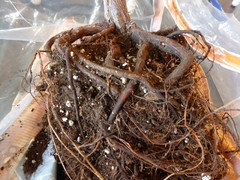
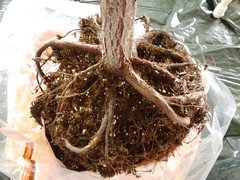
- 7 years ago
Thanks for these directions Al. I'll cut the first tree pretty low when I find a good branch to make a leader. I really don't mind cutting it low. It is way too tall as it stands right now. I just have a question about that, and that question also applies to any other tree I will prune. Can I use the parts I cut as winter cuttings? I would do with them what you explained in some other thread where we were talking about my Trident Maple cuttings (put them upside down and turn them once it's the right time). I see potentially a lot of good cuttings from my Katsura tree, very short internodes scattered within 5 to 6 inch of branch extremity, and a lot of them. I'm not sure exactly what I will prune off of the Katsura though, and I am waiting on you to give your opinion.
In any case I'll get started on the first tree and on both root suckers that I got from them. I do have a question about the second rootsucker (tree #3). You did not talk about the long branch on the right side of the tree, towards the top. Would that be the branch we use for the thread graft, if we go that route?
Thanks again and I'll cut the first 3 trees tomorrow and will be waiting for your opinion on the rest!
Val - 7 years ago
Hi Al, thanks for your response. I'm still digesting parts of the information. I've only been keeping houseplants for about three years and over that time I've slowly integrated strong growing practices. I have repotted several of my plants into 511 (and they're so grateful for it!), but have yet to tackle root pruning and hard pruning of foliage, or even regular pruning maintenance for that matter. I've finally accepted that not all foliage the plant produces is worth keeping forever. So yes, I am intent on doing a full repot.
I've also never ventured to put my plants outside for the summer (Zone 5b/6a). My only outdoor space is a west facing balcony that gets very intense afternoon sun and I would not always be home to "babysit" plants so they get enough sun to make them happy but don't get fried. I also have trouble keeping up with watering plants that are outside. I'd like to allow my plants some direct light, but need to consider if I would be able to manage that without having a mishap.
tapla (mid-Michigan, USDA z5b-6a) thanked Lantana zone 5b/6a - 7 years agolast modified: 7 years ago
So this is a close-up of the section where you were talking about cutting, Al, right? I'd be okay with this. What do you think of that cut a few inches above the graft union down below? That would leave that weird looking stub that is growing straight up. With a little bit of cleanup of the tiny branches around it so they bifurcate and are left to the first internode?
PS: click the picture to see it larger. This site used to let you right click on pictures and click "View Image" and then you would have access to the full resolution picture. This is no longer true apparently... I'm not impressed with the change...
EDIT: I am looking at my picture as if I was someone else and it is not at all obvious to read the text I put in the pictures and looking at the cutting arrows. Sigh... Do we have to start posting external links now? I may contact the administrator..
EDIT2: Okay well here we go I posted the picture below to imgur so you can see it correctly, here is the link:
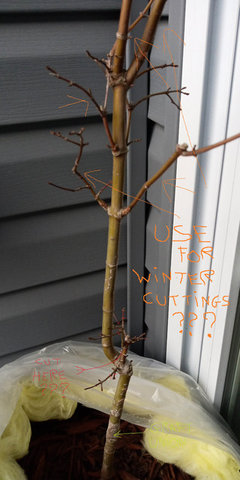
- 7 years ago
Tapla are you under the weather again (insert any botanical joke here)?
I'm about to cut this tree! Let me know!
Val tapla (mid-Michigan, USDA z5b-6a)
Original Author7 years agolast modified: 7 years agoI look at being "under the weather" as sort of your body's way of saying you're WAY too awesome and you have to slow it down, so we sure as heck know THAT can't be what's wrong!
Truth is, I spent a long night looking at your trees last week - prolly took me 2-3 hours to put that post together, and I got a little temporary burn out on pruning. I'll be around tomo afternoon to respond to you and Lantana - took tomorrow off so I could work from home ..... so I can get something done. Besides - it will be too cold and windy to do anything but work in the garage (15* for the high). Thanks for being patient. I know you've been waiting and that inner voice has been buggin me to stop procrastinating. My bad.
Al
tapla (mid-Michigan, USDA z5b-6a)
Original Author7 years agoSPJIN said: My FLF has been declining. Some leaves are turning a bit yellow, a
branch in the middle was losing leaves and just died. All winter I've
been able to pull the whole root ball, dirt and all, out in one clump,
so I assumed the roots needed to be loosened a bit. It looks like a lot of the soil has gassed off or been lost while you were checking out the roots. I'd cover the drain hole(s) with something to keep loose soil in, add soil to the pot, and water it in very well. Then, I wouldn't look at the roots again until June, unless you live in the Southern Hemisphere. The plant should at it's strongest around the Summer Solstice (Jun 21), and it's ability to make food from sunlight actually peaks then, too. That's when it should be repotted because that's when it will best tolerate it. Learning to work with the tree's natural rhythms imstead of at cross purposes with them is better for the tree and will make you feel better as its care-giver.There are so many big, thick roots, some of the medium sized ones
curl under and slightly circle the rootball. My understanding is that
you want more of the thin wispy roots, not these thick ones. That is precisely true. You need a few big roots to anchor the tree and to serve as plumbing. Beyond that, it's the fine, hair-like roots that do the lion's share of the work. Your first repot should concentrate on problem roots. Those would be roots growing straight up or down, or back into the center of the root mass, roots circling, girdling, crossing other roots, or j-hooked. Tapla, I
remember seeing a post a couple of years ago where you showed some
pretty drastic root pruning of a bonsai. I searched for that today
before posting and saw a couple of pictures but not what I was l looking
for. I found a lot of posts on repotting/root pruning that just
suggested slicing off parts of the root ball but I think the tree might
need something more precise.Is this series what you were looking for:
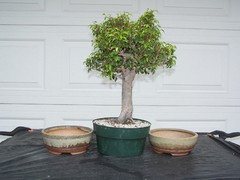
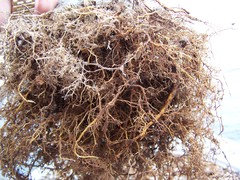
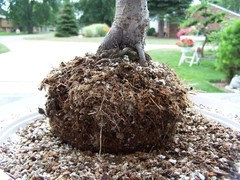
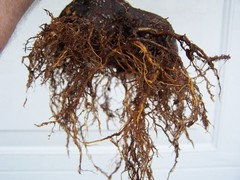
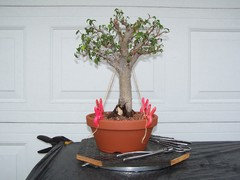
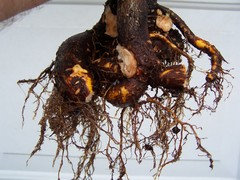 The size of the root mass would never have supported this much foliage; so to prevent indiscriminate dieback of branches, it had to be thinned: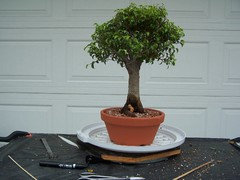
Do I leave these thick roots as they are or would it be a good idea
to get rid of some of them? ANY knowledgable advice would be
appreciated. Thank you in advance! Lets revisit this in early June so you can be ready to repot. If you haven't seen this thread about Trees in Containers, you should find it helpful.*******************************************************************************
Val said: So this is a close-up of the section
where you were talking about cutting, Al, right? I'd be okay with this.
What do you think of that cut a few inches above the graft union down
below? That would leave that weird looking stub that is growing straight
up. With a little bit of cleanup of the tiny branches around it so they
bifurcate and are left to the first internode?PS: click the picture to see it larger. This site used to let you
right click on pictures and click "View Image" and then you would have
access to the full resolution picture. This is no longer true
apparently... I'm not impressed with the change...EDIT: I am looking at my picture as if I was someone else and it is
not at all obvious to read the text I put in the pictures and looking at
the cutting arrows. Sigh... Do we have to start posting external links
now? I may contact the administrator..EDIT2: Okay well here we go I posted the picture below to imgur so you can see it correctly, here is the link:
OK - I can see branches now that I couldn't see in the original image - particularly the ones growing in the area just above the graft at the first elbow. I think you would want to A) build your tree from the small upward-growing stub on the lower elbow and the pocket branch growing down and to the left. The stub can be pruned so it's movement continues to the right, and the pocket branch will grow down to the left to provide visual balance to the tree. If you do that, remove all branches and buds from the trunk in that area except those 2 branches. You'll keep the stub with the dead part on top, and thin the other branches on the vertical stub. I can't see them clearly enough at this point to tell you which to remove. Moving up from the 2 elbows, you have 2 pairs of branches at 90* to each other. Truncate the trunk immediately above the top pair of branches. The purpose of that is to be rid of the heavy knuckle just above it. Take note of how heavy it is. That's what happens if you don't remove the extra buds you'll have all over the tree. I've seen maples with a dozen branches all growing from the same spot on a tree because all the buds were allowed to sprout. That should do it for that tree for this year other than you might want to post pictures from time to time to get some help deciding if you want to abandon building the tree from only the 2 branches at the first elbow, and what will grow from those 2 branches; or, if you want to go to plan B) which is to remove everything from area where the elbows are except that single bud you can see on the right on the outside of the first elbow. If you go that route, the 2 sets of opposite branches at the top of the tree (after it's truncated), + the branch that will grow from the bud on the outside of the elbow will be the 5 main branches of your tree.
If you decide to build from branches at the elbows, you'll want to remove the top of the tree by cutting through the trunk ABOVE the node where you have placed the line. This is important - you want the branches in that area that will be your tree to be larger than the branch you'll cut is now. To keep that branch stub from thickening (bigger scar) don't let anything grow from it. You could even scrape the bark off the stub whenever/ if ever you decide to cut it, but make sure the branches at the elbow have a good healthy start before you chop the main trunk back.
Al
- 7 years ago
Okay Al I know you gave two options, A and B but I am understanding 3 options:
Scenario #1 is to keep the 4 branches at the top of the tree and the stub and small branch to the left above the graft.Scenario #2 is to leave only the small bud to the right on the first elbow above the graft, so remove the stub and all branches around it, but keep the trunk growing after the second elbow, including only the first two pairs of branches.
Scenario#3 is to cut everything above the node that is located at the second elbow above the graft, but only once the branches around the elbows start showing signs of life and grow a tree from the stub and its buds and branches of the first elbow.
I just don't have vision for trees yet so I can't tell which one of my options would be better. "Better" is also relative as I understand. I like nice trunks and a lot of leaves, maybe that defines my version of "better". I also like to experiment.I hope this was not too confusing and thank you for your excellent post.
Val - 7 years ago
Thank you for the reply, Tapla. And the pictures of the root trimming was just what I was looking for. ( :








kingd Z6A michigan