Software
Houzz Logo Print
reolee

Baseboards pulling away from wall!

7 years ago
last modified: 7 years ago

We moved from PNW to Eastern Tennessee last Aug. & moved into our “new” (1983) home in Dec. Before moving in, we had to hire a painter to entirely paint the house with Kilz & new colors due to buying from a very heavy smoker. We also tore up bedroom carpets & installed Kempas hardwood (which was “supposed to” match existing Brazilian cherry, but that’s a whole other discussion!) Being unfamiliar with the area, I chose an installer who was “in the book.” (I was less than impressed with the installation & have tried contacting him, with no response.)

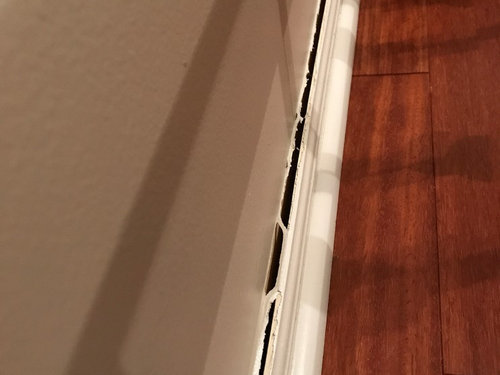
In the last few weeks, I started noticing the baseboards in the guest room (west-facing) are pulling away from the wall. Upon further inspection, I also found two of the cherry floorboards (existing floor) in the hallway are bowing up, just outside the master bd. (Across the hallway from the guest room)

I am wondering if this is caused by humidity or what? The locals say it’s been unusually wet this summer.

This is on an interior wall, backing up to the hallway. So far, it’s been the only room in the house where this is happening. There is a crawlspace under the house; no basement.

Any advice/suggestions or input appreciated!

Thanks!

Comments (13)

  • 7 years ago

    That's wild. I can think of only 1 way high humidity could play a role. If baseboard is a single piece from corner to corner and it's a type wood that expand's more than normal. Being trapped between walls at ends,it has nowhere to go but out while expanding. Solution,shorten and cover gaps at corners with flexiable caulk.

    I'm more inclined to say the problem is with floor shrinking from low humidity. If baseboard is more securely fastened to floor than wall and floor shrinks,it will take the baseboard with it. Solution,remove and clean up then fasten to wall only,caulk only between baseboard and wall,no caulk at floor.

    With those in mind,inspect to see if either is the case.

  • 7 years ago

    All of the above mentions are possible solutions. But I'm concerned with the "unusually wet" summer and the "crawl space". Those two put together can cause issues...


    Photos of the wood floor would REALLY help. But while you wait for someone to come out, you will want to get some photos of what is going on underneath the house. Humidity readings inside the space (especially where you are seeing issues) as well as from the crawl space will tell us loads of information.


    You can get a basic hygrometer from HD for about $35. Put it into the space and then give it a day. Then start recording the measurements. And you will need to do the same for the crawlspace.

  • 7 years ago
    last modified: 7 years ago

    Maybe high humidity and improper fastening with the baseboard.

    Is the crawl space vented and are the vents open?

    This is a ranch and the bedrooms and bowing cherry floor are over the crawlspace, correct? Or are the bedrooms on a second floor?


    ETA: Have you investigated the crawl space for standing water? Is there a layer of plastic covering the dirt in the crawlspace? Is the ground outside the house properly graded to slope away from the house. Do you have gutters & downspouts that drain away from the house? Have the gutters been cleaned? What are your soil conditions--sandy, clay, etc.?

  • 7 years ago

    Thank you, all for the input! (You’re making my head spin! )

    When they inspected, there was moisture under the house, coming from a leaking pressure gauge, which we fixed right away. We personally have not been under the house, but several people have & told us it was dry, has plastic, & looked good. There are vents along front of house, but only 3-4, and none in back. They are open, except the crawlspace door. (My old house in WA had a screen over crawlspace door, with a solid panel I could insert for winter.) Yes, this is a ranch with no basement. We have guards on the gutters, however, at least one of our downspouts seems to possibly be plugged causing overflow. They all drain out away from house. Our soil is clay & rocky, with trees (& roots) around, but not close to house. In back, there is a pool with flagstone patio reaching across back of house. (I’m pretty sure this was done more recent than when house was built.)

    As for the floor installer... My husband was in hospital across the state (I was with him) when floor was installed. I had spoken with him a couple times, stressing how important it was to me that the new flooring match the existing floors. He went ahead & installed it without calling to verify or even let me know it didn’t match - even after our painter said something to him about it. When we got home & I saw it, I flipped! Since it was a done deal & my husband had just gotten out of CCU & didn’t have the energy nor inclination to object, we went ahead & paid him, but contacted the seller to let him know it was the wrong product & we weren’t happy. Initially, the floor looked pretty good, but several “nail heads” (he said they were staples) showed, which I have NEVER seen in ANY hardwood floor —- EVER! I asked him to come back & fill, which he did begrudgingly, demanded his $1400 & quickly left. After he left, I found that the color didn’t match, the filler came out, & it did not improve the mess! At first the boards laid flat, but as some of you suggested, they are starting to curl up at the joints (bowing) and I’m thinking we were scammed! (He had also told me that he had really bad luck keeping helpers & that “reputation is everything” to him. (I’ve given him bad ratings on his website, and Yelp.) Previous to that, I had tried to contact him about the 3 1/2 boxes of flooring that weren’t used. The seller said they’ll take it back, but will charge restocking fees that I don’t feel we should have to pay! I feel it was the installer’s error & he should pay the fees! (Am I being unreasonable here?) I have never heard back from him.

    Thanks again for your input!

  • 7 years ago

    The baseboard pulling away from wall and floor buckling are not related. I agree that floor buckle is likely caused by one or more of failure to acclimate floor before install,not leaving prescribed gap between boards and/or high moisture.

    When and if you determine humidity is too high and cause,I seriously doubt that will have anything to do with baseboard pulling away.

    reolee thanked klem1
  • 7 years ago

    I also thought about roofing concerns. Do you have photos of the floor?

    reolee thanked SJ McCarthy
  • 7 years ago

    @klem1- Flooring was in the rooms where it was to be installed for approx 1 week to acclimate. The boards have a notch that fits into the cleft of the next board, so I’m not sure how they could be too tight together, unless not enough room was left under 1/4-round @ edges.

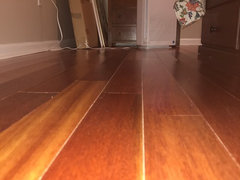
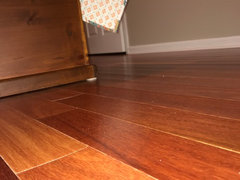
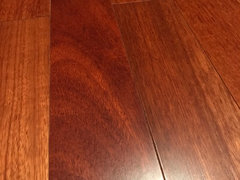
    @SJMcCarthy- These pics don’t show the cupping well, but at the corner of the bed, in the shadow, you can see it a bit.

    We bought our house in Sept, ‘17. The roof had just been replaced after hail storm damage, so it was brand new.

    We did have a builder/friend stop by this evening & look at it. He is going to call his friend (the inspector we used to inspect the house) to come get a humidity reading under the house.

    I currently have an air purifier in the room. It outputs cool air. Not sure if that’s doing any good or not.

    Do any of you happen to know the likelihood of a mold issue happening if it is caused by humidity? (Would that be the expected “next step”?)

    Thanks again!


  • 7 years ago

    Thanks for the photos. The first one (as you point out) shows the cupping by the bed. That's what I was looking for. You have tongue and grove hardwood (solid?). Was it nailed, cleated, stapled or glued down or floating?


    The wood will tell you where the moisture is coming FROM. Imagine the centre of the plank like an arrow head. If the centre of the plank is pointing DOWN (that means the edges are sitting HIGHER than the centre as in your case) the moisture is coming from BELOW. We call this "cupping". If the centre of the plank is pointing UP (the edges are sitting LOWER than the centre) then the moisture is coming from ABOVE.


    The air purifier should be fine so long as it does NOT add water vapour into the air. Does it have a humidifier/dehumidifier capability?


    As for "acclimation for 1 week", that may not be enough. The hardwood flooring installer should have taken readings of your subfloor (it had to be DRY) as well as the wood (random readings of roughly 10% of the planks). He would have DOCUMENTED the readings (written them down). He would have done this at the time of DELIVERY. And then after 1 week. And then would have continued taking readings until the wood AND the subfloor were within "appropriate range".


    In damp conditions, this can take 3 weeks. Sometimes it takes as much as 6 weeks. It isn't about "time" it is about "moisture content in the wood/subfloor".


    As for mold, it is always possible after a "wet" event. A puddle of water sitting underneath a home (in the crawl space) means the possibility is there. Water evaporates. Wood absorbs water moisture. If the puddle evaporated "up" into the air, the wooden subfloor (and anything attached to it) could have and probably did absorb it. Now that "puddle" is in the home. The subfloor is the most likely place to absorb PLENTY of water from that puddle (big surface area that is highly absorbent).


    Traditionally this isn't a big deal SO LONG AS the subfloor was allowed to DRY OUT COMPLETELY before adding new flooring. If moisture readings were done by the installer, we would know where the "starting point" was. If he didn't do it (and he probably didn't...because he didn't know he had to) then we are working blind. All we can do know is start taking readings from everywhere we see "moisture" issues.


    And that includes drywall and baseboards as well as wood flooring and wood subflooring material. Sigh. This could take a bit of time.

  • PRO
    7 years ago
    last modified: 7 years ago

    I think queenvictorian had it right in the first comment.

    Was the new floor laid up to the existing baseboards with quarter round to cover the expansion space? If so, the installer probably didn't leave enough expansion space. I suspect the floor has expanded and is pushing the baseboard out at the bottom, causing the gap at the top.

    The minor cupping doesn't surprise me because I assume you have solid wood. There may be a moisture issue but the presence of very minor cupping at this point doesn't prove it. Solid wood takes time to acclimate and the finish on the top means it can only absorb from the bottom. As it acclimates it wouldn't be unusual for the bottom to grow more than the top, resulting in cupping.

  • PRO
    7 years ago
    last modified: 7 years ago

    FYI, your installer should have consulted you but nothing is likely to match aged Brazilian Cherry.

    The installer's statement about returning the wood is likely to be correct. By the time you pack it, ship it and pay the return charge it seems a little futile for the $$ return.

    For a floor installer the only thing worse than having boxes of wood left over is running out of wood. How many square feet were done and how much in each box? Manufacturers recommend ordering at least 5% extra to cull out unacceptable boards. Room layouts may dictate ordering more than 5%. Sometimes everything goes perfectly and you end up with more than expected.

    If you covered 500' and have 75' left, you have a good case. If you did 1000' and have 45' left, you don't.

  • PRO
    7 years ago

    You obviously need a moisture meter and can cir one up for $30 from Home Depot. Looking at pictures is a guess. You need to check the area and surrounding areas. You can rent a floor fan or dehumidifier or buy on they are relatively cheap.


    When installing baseboard molding you should have a stud finder near. Run it across the wall when nailing. This way every nail hits a stud and it won't pull away. What you see here is they didnt do this and had to fill the gap with caulking. Also use one nail at bottom and one near top.


    Another tip is if they are MDF do not use drywall mud to fill it will swell every hole. Use Sherwin Williams wood filler. It fills the holes but does not swell the hole.

  • 4 years ago
    last modified: 4 years ago

    I kmow this is an old post, but I currently have the same issue! Once the cause was addressed, how did you end up fixing the baseboard? Re-install?