Software
Houzz Logo Print
lynn327

Philodendron Propagation - how wet to keep soil?

7 years ago
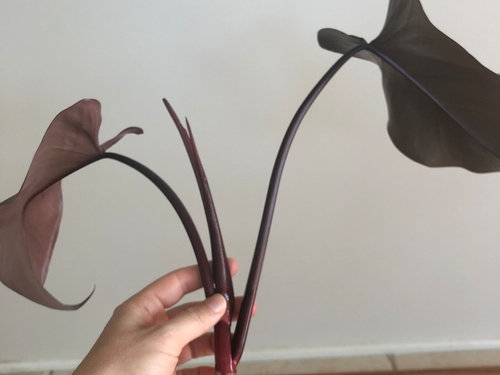
Hoping you guys can offer some tips -- I've just received 1 philodendron pink princess cutting from a friend and have never propagated this type before. From what I've read, it works best in soil instead of water, but I've never propagated in soil before.


From my research, my loose plan is to -

  • Use 50 peat / 50 perlite mix
  • Use rooting hormone
  • Try to keep soil moist but not soaking wet (not sure how to achieve this.. tips?)
  • Keep in an east-facing window
  • If I want to check to see if roots grew, just a gentle tug and see if it's rooted (not too often).


My questions / need advice -

  • Does above sound correct?
  • Any tips on how to keep soil appropriately (but not too) damp?
  • Should I tent it in plastic?
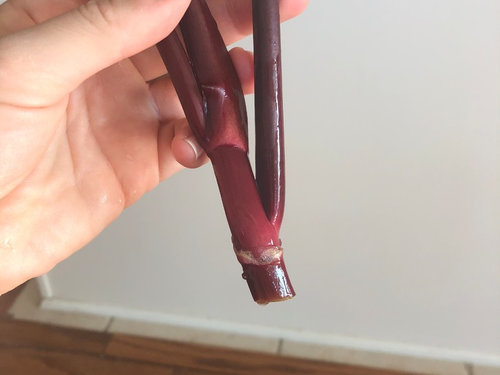
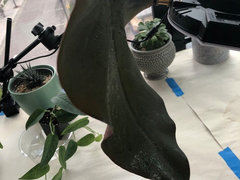
  • Does attached pictures look like enough nodes/leaves to root from? How far into soil do I put it? (the bottom node is so close to the biggest leaf, but I'm pretty sure I shouldn't have that leaf stem in the soil)
  • When do I transfer it to regular soil (planning on using 5-1-1 mix)?


I'm a little nervous because I only got one cutting and I don't want to mess it up. I'm currently keeping it in a glass of water until I can pot it up this weekend.


Thank you!


Comments (15)

  • 7 years ago

    A lot of people like to root aroids in water, but I don't. I prefer soil. It needs to be light and airy, and kept moist but not wet (soggy). Probably better to remove that lowest leaf. Don't cut the main stem, new roots will come from the leaf nodes along it.

    lynn327 thanked tropicbreezent
  • 7 years ago

    Agree, remove the lower leaf near the main stem and root in moist soil.

    lynn327 thanked Matt Barnett
  • 7 years ago

    there's no need to remove the lower leaf - it will drop off by itself once the cutting uses it up . one leaf is not enough. just add 1:1 soilless mix :perlite. or starter mix for seeds + perlite. you can dab rooting hormone or cinnamon on the cut .

    i root aroids/philos a lot and they will produce roots in a week when given very high humidity. however that end-cut can mildew.

    the easiest thing to do is to dampen the paper towel (not wet , squeeze it dry), wrap it loosely around that last node but leaving the cut free and then put the whole thing, leaves and all in a plastic bag, closed. and just leave it in good light, not sun. in 1-2 weeks you'll have roots. then you can plant it in soil. you might need to dampen the towel from time to time.

    long-fiber sphag slightly moist works even better then paper-towel. it can grow in it actually, but it needs to be watered carefully, so as not to get soggy.

    lynn327 thanked petrushka (7b)
  • 7 years ago
    last modified: 7 years ago

    Ideally, your soil's moisture level should be about the same as that of a sponge that has just been well wrung out. Damp or moist - never wet or soggy.

    From my research, my loose plan is to -Use 50 peat / 50 perlite mix I'd use all perlite

    Use rooting hormone. Not necessary. If you decide to use one, you should know in advance that not all rooting hormones will give the same results, and some are likely to be counter-productive

    Try to keep soil moist but not soaking wet (not sure how to achieve this.. tips?) Spritz the soil instead of watering it until the plant is pushing new growth

    Keep in an east-facing window That'll work

    If I want to check to see if roots grew, just a gentle tug and see if it's rooted (not too often). Resist the urge. Tugging breaks fine roots and represents a setback. Be patient and watch for the plant to signal a successful strike with new growth


    My questions / need advice -Does above sound correct? See notes above

    Any tips on how to keep soil appropriately (but not too) damp? Spritz the soil (not the leaves.

    Should I tent it in plastic? Unnecessary. If you're worried about too much leaf surface, cut both leaves in half at 90* t o the main vein.

    Does attached pictures look like enough nodes/leaves to root from?
    How far into soil do I put it? (the bottom node is so close to the
    biggest leaf, but I'm pretty sure I shouldn't have that leaf stem in the
    soil)
    You can stick it to about where your finger is in your first image

    When do I transfer it to regular soil (planning on using 5-1-1 mix)? You can START it in 5:1:1 if you want. That's what I would do.

    Trim about 1/4" off the base of the cutting with an extremely sharp tool before you stick it. The microscopically rough edges and the crushing that occurs when you take a cutting with scissors contributes significantly to the potential for rot to spoil your efforts.

    Al

  • 7 years ago

    Thank you all! I ended up placing it in damp 50 % perlite/ 50% peat moss and have been spritzing with a water bottle every day or so when the surface looks dry, and did not cover them. (I actually potted up a few other cuttings at the same time -- begonia, monstera adansonii, some jades that had root rot and had to be cut back).


    I did use rooting hormone, as Al I didn't see your post until after the fact but will take that into consideration next time I root cuttings for sure. I didn't know rooting hormone could be counter productive, this is actually the first time I used it. Previously i've always just rooted in a juice glass of water :)


    Next time I will try rooting directly in 5-1-1, but I have yet to make some up and learn how it holds water. (actually am trying rooting my jades in the gritty mix, so I want to take baby steps with new soils since I have to learn how to water properly/differently).


    Thank you for the tip on waiting for new growth before moving to 5-1-1. Depending on how fast they root/grow I may wait until spring to repot them in a new mix so that they are nice and strong and established. Will keep this updated!


    Clearly I still have much to learn, and I so appreciate how helpful everybody on this forum is! Thank you!

  • 7 years ago

    I posted this some time back on another thread about rooting aids. You might find it interesting:

    Rooting aids

    I don't think it's accurate to pitch a particular brand or type of rooting hormone because different plant species respond to different chemicals, whether we are cloning hardwood, summer wood, or herbaceous/tip cuttings. Even though it's generally true that the most effective concentration levels normally vary and can be roughly grouped by the 3 types of cuttings you mentioned, the most effective chemical to use also varies and can be much more important than concentration levels; so, it is a combination of the concentration AND the choice of chemical + type of cutting and time of year that determines the effectiveness of a rooting chemical.

    The rooting aids are synthesized forms of the plant hormone/growth regulator 'auxin'. Indole butyric acid (IBA) and naphthalene acetic acid (NAA) are the two most common chemicals that have been found to be reliable in the promotion of rooting in cuttings. IBA is widely applied in general use because it is non-toxic to most plants over a wide range and promotes root growth in a large number of plant species.

    Some plants respond better to either IBA or NAA, some respond to ONLY one or the other, some may have a toxic reaction to one but not the other which will lead to poor or no growth and actually, mortality; and some respond best to combinations of both chemicals, or to other variations of either IBA or NAA based on K (potassium). Both IBA and NAA are commonly available in talc or in liquid formulations of varying concentrations.

    I do lots of propagating of several hard-to-root species, but only use a rooting aid occasionally for the most difficult. As a generalization, you should know on a per plant basis which chemical and concentration is most apt to be effective before applying it. I have found it mostly unnecessary. Learning a little about the cultural conditions cuttings prefer and some other tricks (like methods of wounding) along with cleanliness will add more to what it takes to be successful at propagating (plants) than rooting aids (except in the very hard to root plants).

    Al

    lynn327 thanked tapla (mid-Michigan, USDA z5b-6a)
  • 7 years ago

    Thank you, Al! That is very informative. I will avoid using rooting hormone in the future!

  • 7 years ago

    You're welcome .... and thank YOU for the kind words.


    Al

  • 7 years ago

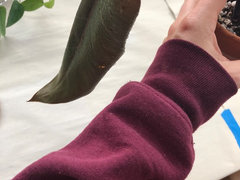
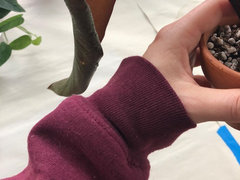
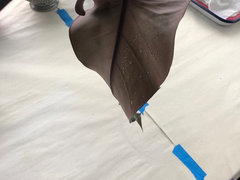
    Progress question! This guy is getting a little droopy — is this normal? The stems started dropping the first week, and now the leaves are starting to curl. is this normal / okay or should I put plastic over it to keep it more humid?

    I’ve been misting the soil almost daily and started misting the leaves once they started to curl but am unsure if this is effective as it hasn’t helped.

    the soil still feels like a damp sponge (but not too wet) when I put my finger in it and I’ve been keeping a bamboo skewer in it as a less disruptive (than my finger!) indicator as well and it hasn’t dried out too much.

    its in an east facing window. No signs of growth yet.


    Just lost a begonia cutting I was trying to root in the same manner (all the leaves dropped one by one) so I want to make sure this is still correct or if I should adjust. Here’s some photos —

  • 7 years ago

    Ditto to being jealous. Good luck.

  • 7 years ago

    Ha don’t be jealous until it’s actually rooted. Could go either way at this point. Still trying to figure out how to keep it healthy enough to root! :P

  • 7 years ago

    just tent it - even semitransparent bag is ok, just needs to accommodate the leaf.

  • 7 years ago

    The suggestion I left above about cutting the leaves in half across venation (the veins) was taking into account the potential for the propagule to shed the leaves if it couldn't keep them hydrated. A simplification of what causes this physiologically: When leaves are unable to carry on photosynthesis (due to lack of water), it causes a reduction in the hormone that prevents the leaves from being shed. This causes a layer impermeable to water/nutrients/photosynthate ...... to form at the base of the leaf where it attaches to the stem/branch, effectively isolating the leaf from the rest of the propagule and causing the leaf to be shed.


    Again, don't be tempted to look for roots or to tug on the plant to see it it's rooted. At this point, it doesn't matter much whether or not you tent the plant because the most significant parts of the plant through which water loss occurs have effectively been taken out of play. Now, it's a race to see whether rot organisms clog the plants plumbing before a root to shoot connection can be made.


    Strangely, the propagule will ignore or sacrifice the leaves proximal to (closer to the base of the branch/stem) in order to keep the branch/stem apex supplied with water. So keep an eye on what's happening at the distal end of the propagule. If the apex dies, the potential for growth will switch back to latent buds above the attachment point of the leaves that have lost viability.


    Al

    lynn327 thanked tapla (mid-Michigan, USDA z5b-6a)
  • 7 years ago

    So it sounds like it has already blocked those leaves off and is shedding them? Shoot. Okay.


    If I manage to get another one (if this one doesn't make it), just to clarify, I should have cut off 50% of the leave perpendicular across the vein? So essentially half of the leaf / tip of the leaf. Correct?


    I'll keep on keeping the soil moist and hold out hope. I'm still trying to resist pulling it out and putting it into water to "save" it -- which is the type of propagation I've always done in the past! But I assume that also wouldn't help much at this point.