Software
Houzz Logo Print
nicole_cozby

Oak floor installation worries

7 years ago
last modified: 7 years ago

Looking for some advice! Our contractor let the 2" oak floor acclimate for LESS THAN 48 hours before installing. The house is totally open (no doors), no HVAC yet and they are in the middle of wet work (drywall and paint). This is in Southern California where it is relatively dry. They keep saying it will be fine and plan to sand and finish the floors in another 4 weeks. Do you think we will have issues with these floors down the road? I'm really worried. Thanks so much for any advice or insight!

Comments (14)

  • PRO
    7 years ago

    That was common years ago. I recall a fellow installer years ago from North Carolina who said they'd go from one tract home to another without drywall in and probably windows. He was a true Tar Heel. "Job went faster, you could 'swing the mallet' through the walls.


    It's all abut what the average indoor living conditions will be. Will it come close to the current conditions? I'm speaking of indoor relative humidity.

    Nicole Cozby thanked Uptown Floors
  • PRO
    7 years ago

    Unless you're getting wide solid planks I'm not concerned about the 48 hours of acclimation. Floor acclimates better in place. The important thing is the indoor relative humidity and how it compares to what the floor will be subjected to throughout it's life. A thermo-hygrometer can be purchased fairly inexpensively and be placed in the home. Some have memory so you can learn what high and low humidity and temperature you have now and compare it to what you think it will be long term.

    Nicole Cozby thanked Johnson Flooring Co Inc
  • 7 years ago
    Thank you both so much for your advice and insight! I assume the humidity now will be similar to the typical living conditions down the road as we don’t tend to run the AC or heater all that much and like to have windows open. They have plastic on the floors to protect from the wet work. Hoping it will be okay!
  • 7 years ago

    Just when I was going to get on my high horse about building conditions...Charles Ross Homes beat me to it.


    It is *possible this will be OK...but it is also possible this is going to go sideways (which I think is more likely). I would bring this to the attention of the builder (go ahead and cut and paste Charles Ross Homes' post) and make sure you point out that what has just happened with your flooring is against flooring instructions.


    Tell them that you are willing to leave it in place with a caveat (written out by someone who can write a legal document) that you will require an extended (ie. LIFE TIME) guarantee on the floor. Builders like to offer 1-2 years of labour/material warranty. You want that extended on the flooring. And that at any time you choose, you can call in a NWFA Flooring Inspector (on the Builder's dime) to have the floors inspected.


    Go ahead and let the floors stay in place...but make darn sure you are CLEAR on your expectations. And be sure to point out to the builder that you know what was done goes against all "good building practices". .... 'no doors' - Wow! Who thought that was a good idea? It sounds like the building schedule got behind and the flooring delivery date was left as-is. And the flooring installer, being a SUPER busy guy (ahem...assuming they used a professional flooring installer...not likely) would have had to reschedule MONTHS down the road.


    It sounds like there is something else going on other than 'just' the floors being delivered/installed in a home without a fully enclosed envelope.

    Nicole Cozby thanked SJ McCarthy
  • 7 years ago
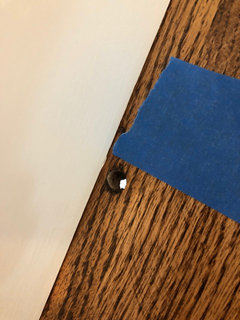
    I have another question if anyone is able to help. The floors are beautiful but it looks like a step was skipped. There are holes and cracks everywhere that have not been patched. Does patching/filling happen before stain and polyurethane? I think you guys are right and there is something else going on here.... maybe they were rushing?! It this normal? It’s on both the original oak floors and new oak floors
  • 7 years ago

    Not sure what the industry standard is in the US but certainly here holes and cracks are filled before the sanding stage and then the floor is sealed.

    Nicole Cozby thanked colleenoz
  • 7 years ago

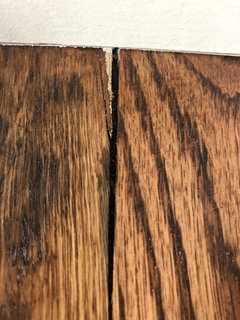
    That is one HELL of a gap between planks. This is how you can tell things were done WRONG!


    Wet wood is "puffy". An unfinished envelope = high humidity and NO control of temperature = PUFFY wood (that includes EVERYTHING that is wood...not just flooring). Once the envelope is enclosed AND the HVAC is up and running the humidity DROPS (quickly) and the temperature goes UP. Both of these events DRY OUT wood.


    Dried out wood is SKINNY. It SHRINKS! So puffy floor planks shrink down to skinny/narrow planks = gapping. And the photo that shows the gapping has TWO issues, not just one. The chip in the planks is what will continue to happen with these wide gaps.


    The snug fit of one plank next to another PROTECTS the edges. Once those gaps open up, the edges become EXPOSED to abuse and begin to splinter. Which you are seeing in the first pic. The fact that a splinter has come so close to a wall (where NO ONE walks) is a big red flag.


    I'm sorry but I think you need to get this dealt with immediately. We've already seen poor building practices that *could lead to problems. Well, the problems have just shown up for Christmas dinner. They will be here until you get in a floor that has been properly acclimated, sanded, patched, stained and then finished.


    And in answer to your question, the patching happens BEFORE the stain. With this much movement, the patching would have begun to crumble and pop out of your floors.


    I REALLY think you need to go get an NWFA Certified Flooring Inspector before you spend another DIME on this floor. I really, really, really mean that.


    www.nwfa.org


    What have you said to your contractor about ALL these issues???? What has been his/her response? And PLEASE tell me you have NOT offered payment for any of this well-below subpar work. In fact I would halt payment (after telling the GC you are going to halt payment because of these issues) until you have the floors fixed - properly - to NWFA Standards.


    I will bet dollars to doughnuts that your GC doesn't even know what standards I'm talking about. You need an NWFA Wood Flooring Inspection Report to back you up. It is time.

    Nicole Cozby thanked SJ McCarthy
  • PRO
    7 years ago

    I won't make any inferences based on a picture or two.

  • 7 years ago

    Is someone installing solid wood on a slab foundation? Because that is what this post is sounding like.

  • 7 years ago
    Thanks for all the input! This is not on slab, it’s on a raised foundation with a wood subfloor.
  • 7 years ago
    Does anyone know what a NWFA Wood Flooring Inspection might cost?
  • 7 years ago

    @Nicole - Like all things related to the industry, the costs vary depending on your location and the location of the nearest professional. They charge for travel time and will also base their costs on how large the square footage they are looking at.


    A 400sf floor that is located 5min. from the nearest NWFA Inspector will have a lower inspection cost than a 2500sf floor that is located 1.5 hours away. And like real estate, it is all about location, location, location. Urban areas have different pricing than rural.


    That being said, I've seen price tags ranging from $300 - $1100 for an inspection. Again, all of the above scenarios will have their own price tags.


    The best thing to do is go to www.nwfa.org and search for a local Inspector under "Certified Professionals". You can then look at inspectors in your local area. You would then call them to find out a "rough" estimate based on some of the above criteria I just mentioned.


    And to be clear, their reports are many many pages long (with pics) and are able to stand up in court. What you are buying is "back up". Any contractor with an ounce of intelligence will recognize the impact the report could have on their business.


    And the person who pays for the report "owns" the report. You have no obligation to hand over the report (you can show it to them...but you then take it back after they have seen it) until requested by a court of law....or until the contractor pays you for the "out of pocket" expense for the inspection.

  • PRO
    7 years ago

    An inspection by a NWFA-certified inspector is a good investment if you want to credibly document the existing conditions and get expert help diagnosing the root cause of an ongoing problem. For example, they can help identify, and document, the conditions in a damp crawl space that are causing problems with the hardwood flooring, or a too-dry interior environment that is contributing to shrinkage of the flooring.


    If the problems with your floors are not due to an ongoing condition or a measurable installation defect (e.g., a poor nailing pattern) I'm not sure the inspector's report will be of much benefit. They can't infer the conditions on site when your hardwood was installed nor can they determine whether the flooring was properly acclimated--they'll need to rely on data provided by the supplier and/or installer for that. Based on your initial post, the site conditions when the flooring was delivered were not consistent with NWFA recommendations. You don't need an inspector's report to tell you that.