Software
Houzz Logo Print
bostonbull

What went wrong?

Tried growing kale, carrots and spinach this summer, and again in late August, on my porch in five galllon containers using 511. They all sprouted quickly and looked good. None of them got bigger than 3" tall.

Any tips?

Comments (56)

  • 7 years ago
    @floral_uk - summer Temps were unusually HOT! Several stretches in the 90s, mid to upper 80s for long stretches as well.

    What do you suggest I try to plant in the spring? Do I start them indoors from seed, in my 5 gallon containers? (not bucket, actual planting container)
  • 7 years ago
    last modified: 7 years ago

    would like to but I've never grown vegetables because all of the houses we've owned had wooded lots and no sun..I was thinking (daninthedirt mentioned it too) not enough light!!..I have a nice porch but I wouldn't consider growing vegetables there..not sure about the spinach and kale but carrots need sun..

  • 7 years ago
    My front porch is 2nd floor and gets 8+ hours of sun a day. The carrots were full sun, all day. The spinach and kale I snuck back in a bit from the edge so they got less sun as I read they prefer some shade.
  • 7 years ago

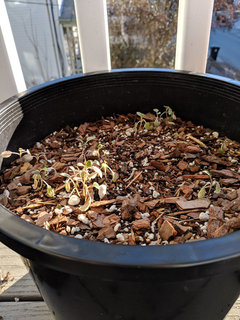
    Here is a shot of how big my kale got.... Took it now

  • 7 years ago

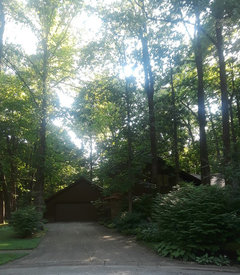
    sun was just my first thought..you definitely have more sun than I do..imagine my shade..

    I can see that your kale isn't growing..having no experience I have no advice for you but someone will..good luck..

  • 7 years ago
    As an Arborist your photo made me drool a little. Like a blank canvas to an artist!
  • 7 years ago

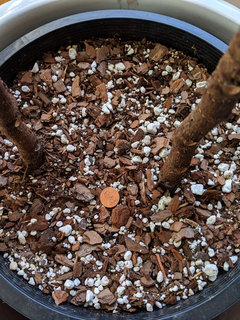
    I grow my edibles in containers using the standard 5-1-1 mix. So it can be done successfully :-) However the consistency of your mix looks off - the bark pieces are far too large! And while many do start seeds in the 5-1-1 (I don't), the larger particle sizes of your mix could impede good germination, so if that's the method you prefer to follow, I'd suggest a finer textured seed starting mix and start the seeds inside where you have better control over the growing conditions, then transplant to the containers when the seedlings are mature enough and have been hardened off.

    What you choose to grow should depend a lot on what you like to eat :-) You are limited to some degree by the size of the containers - tomatoes and most cucurbits (squashes, melons, etc) would prefer much larger accommodations. And root veggies like carrots or beets need a very finely textured, almost sandy soil in order for those fat roots to develop properly, so the 5-1-1 would not be my first choice for them either.

    Because when growing in containers, your crop size will always be more limited than if growing in the more expansive real estate of a garden plot, you may want to consider planting already started plants rather than from seeds. That way you can plant one or two (or 4 or 6) of several different types rather than 25 of the same!!

  • 7 years ago

    Here is a better photo of my mix. I would love any and all critical feedback!! The hoizeppants seems to be enjoying it, they are all taking off in it.

    For the outdoor plants, we eat vegetarian at home, all vegetables we love. Kale and spinach would be huge for us to be able to grow. What would work best given our containers?

    The carrots were in a giant 15gal (maybe larger) pot that is 24" deep.

  • 7 years ago
    last modified: 7 years ago

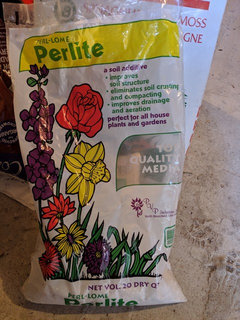
    Yes, that's what I was saying. 5-1-1 isn't standardized. It's made up with what you have laying around. You seem to be using pine mulch for what are supposed to be pine bark fines. Those are big pieces. Pine bark fines are partially composted pine bark, and are mostly pretty tiny pieces. Pine bark fines are hard to find, labelled that way. They're sometimes labelled as "soil conditioner". Shredded hardwood mulch might do the trick. Is the white stuff perlite? Big pieces of that as well. My perlite is all 1mm-sized or smaller, and becomes part of the soil, rather than rocks intermixed with soil.

    Your kale picture shows not only a very small plant, but a very yellow and unhealthy looking plant. Practically dead.

  • 7 years ago
    I'll post photos of my 511 supplies in a new thread. If you know what to buy, and where within 20 miles of Boston, I am all ears!!

    Of course it's yellow and dead, it's December in Boston after three hard frosts and no care since the first week of October
  • 7 years ago
    :)
  • 7 years ago
    last modified: 7 years ago

    That "soil" looks like a mix of bark/wood chips and perlite (is anything else in there?), for veggies I'd mix what you have with 50% real topsoil/dirt from the ground. Personally I've never had much luck (or skill) growing vegetables successfully in pots.

  • 7 years ago

    Well, kale has a kill-temperature of somewhere around 10F. I guess you might have gotten that low. So a hard hard frost could do it. Actually, for a container plant, a freeze is worse, because the roots freeze too. In the ground, it might have been fine.


    I think what we're recommending is a mix that is less "chunky". If you run a lawnmower over a pile of wood chips, you'll probably get something like bark fines.

  • 7 years ago

    Don't use topsoil/garden soil in a container, ever!! It is texturally wrong for that purpose and can serve to slow drainage and raise the PWT to the point where any plants will start to suffer and decline.

    FWIW, there IS a standardized formulation for the 5-1-1 mix:

    5 parts decomposed (partially composted) pine bark fines (3/8")

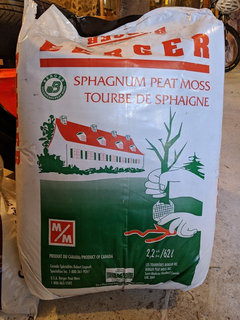
    1 part milled sphagnum peat moss

    1 -2 parts perlite, medium fine grade

    garden lime to adjust for pH

    However, many container gardeners do adjust the mix to work best for the plants they are growing and their specific gardening conditions. I tend to use slightly less bark and slightly more peat........more of a 3-2-1 formulation.....for most of my veggies and other annual containers and stick with the standard 5-1-1 for houseplants and permanent container plantings.

  • 7 years ago

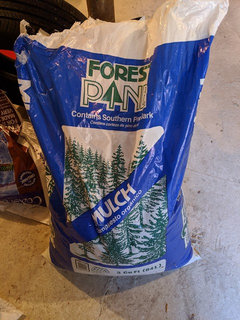
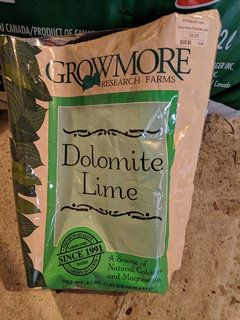
    Here are the ingredients I used. I read, for hours, Al's posts and others posts regarding 511.

    Is there a way, this June, to salvage the mix my houseplants are in, or do I start fresh?

    Don't be shy, give it to me!

  • 7 years ago
    @gardengal48 I wouldn't use garden or topsoil! I'm a certified Arborist, I get it.

    What I would use, if not 511 is a beautiful potting mix from a company like Coast of Maine, for instance. For my outdoor veggies. My indoor friends, they will forever be in a mix I make. The befits are too numerous not to.
  • 7 years ago

    For a single season crop like most container veggies, something like the Coast of Maine product would be fine. I'm not sure I would attempt to reuse for a second season, however.......would depend on what it looked like at the end of the season :-)

  • 7 years ago
    last modified: 7 years ago

    Gardengal is right, that there IS a standardized recipe for 5-1-1 mix (as in, that which Al came up with), but the cloud is filled with "alternate", "somewhat modified", "adjusted" recipes for 5-1-1 that try to preserve the spirit, if not the content of the standard mix. Betcha most people who think they are using 5-1-1 don't use the "standard" recipe.

    If your indoor plants are thriving on your stuff, why change it? But for small starter plants, use something finer grained.

  • 7 years ago
    Based on my ingredients and photos.... How far off am I? What actions can I take to get as near to perfect as possible?


    I just started some ginger, indoors, yesterday, in this mix. Should I put it in potting mix?
  • 7 years ago

    It appears to be primarily the bark size that is of issue. Generally it is suggested to screen it to make sure the majority is in the 3/8" range, give or take. If too much of it is larger, you could perhaps grind it smaller but success with this process seems to be mixed. Not something I have undertaken personally :-)

    IME, most pine bark that comes labeled as 'mulch' is not composted and is of too large a size. Just saying..........

  • 7 years ago
    last modified: 7 years ago

    How much of that lime did you use? Could the mix be too alkaline? May need a pH test.

  • 7 years ago
    What brand of bark could I find near me then that would work. I now understand the problem, help me with the solution if you can?

    Can I screen what I have down to 3/8" even though it's already mixed? I have at least 30 gallons mixed that I tried growing veggies in, it's just sitting there now.

    In terms of lime I followed Al's recipe exact.
  • 7 years ago

    Treegeek..this is off topic but I'd like to ask you something..what's your best guess for the age of my trees?..the biggest (an ash - treating all of them since 2012) has a DBH of 30"..we have trees from 10 up to the 30 inch..lots about 20 DBH..are they maybe 50-60 ft tall?..there's 22 ash now (removed 6)..burr oaks..sugar maples..hickory(3)..tulip poplar(1)..box elder(ugh)..ironwood..linden..there's more but I mentioned these in case it was helpful..I would appreciate any info..

  • 7 years ago

    a backyard pic..

  • 7 years ago
    Nicholsworth, I just followed you, you should be able to send me a PM/DM.
  • 7 years ago

    Treegeek, you need to have your messaging feature enabled to PM/DM. And according your profile you do not :-) Following has nothing to do with this.

    Screening is best done before mixing. But you could get away with doing so after, although you may have to hand pick the larger bark pieces from the screen as it could filter out some of the perlite as well.

    Can't tell you about brands of bark - they are different according to region. But if you have any Agways in your neck of the woods, many seem to find their pine bark mulch well suited to the 5-1-1.

  • 7 years ago

    Treegeek..I looked..there's not an option to msg you..I'll check back to see if you set it up..

  • 7 years ago

    GardenGal, I tried every Agway, HD, Lowes, and independent Nursery i could. I finally found one 30 miles away and that is what I ended up with. Do you have a photo of the bag I should look for from Agway?


    nicholsworth, try now?

  • 7 years ago

    All I can say is to check out some of those previous posts I linked to....there are pics included. I have no Agway stores in my area so can't comment otherwise. It seems that not all stores will carry the right mulch in stock but can order it for you.

  • 7 years ago

    Just FYI, there is some question as to whether the Agway stuff is really partially composted, as the 5-1-1- mix calls for. Using non-composted organics in a garden mix is really not advisable. Again, the phrase "soil conditioner" is the right stuff. I think Lowes used to market that as Greensmix. But be careful, lots of gross stuff has been called soil conditioner. I think they used to call Ironite that.

  • 7 years ago
    last modified: 7 years ago

    dan, see my post here [link[(https://www.houzz.com/discussions/is-agway-pine-bark-composted-bark-or-uncomposted-dsvw-vd~5217373). I was told in that thread that it's Uncomposted and it's great stuff for the 5 1 1 mix.

  • 7 years ago
    last modified: 7 years ago

    Thanks. I see in that post that you asked straight out whether the Agway stuff was composted or uncomposted, but in my skim of that discussion thread, it isn't obvious that you ever got an answer. Uncomposted organics are not ideal for planting mix, because they tie up nitrogen. The way that works is that the bacteria that populate the mix in order to digest the organics need nitrogen themselves to survive and multiply. So they suck the organic nitrogen out of the soil and into their cells, leaving the soil deficient in plant-accessible nitrogen. Plants don't eat bacteria. When the decomposition is done, and those bacteria die, that organic nitrogen is returned to the soil in plant-usable form. But that can take many weeks. Now, I suppose that if you sauce the mix with a lot of nitrogen fertilizer, you can make up for that.

  • 7 years ago

    Now my experience is with sowing in the ground. I find that spring sown carrots grow large and late June or later sowings do not grow as vigorously....plant earlier.

  • 7 years ago
    last modified: 7 years ago

    "Thanks. I see in that post that you asked straight out whether the Agway stuff was composted or uncomposted, but in my skim of that discussion thread, it isn't obvious that you ever got an answer."

    On that thread I linked, at the top click where it says "See 7 more comments" and you can see the replies which answer my question.


  • 7 years ago
    Seems like folks agree it is uncomposted?

    So.....
  • 7 years ago
    last modified: 7 years ago

    Ah, boy, Houzz hides those comments well. Never noticed that before. I guess when there are more than 50 comments, you have to click an inconspicuous link to see the earlier ones. Since the earlier ones are more likely to directly answer the question posed by the OP, hiding them is not very convenient. Houzz, ya listening?

    But I'll say again that having the majority of the mix as uncomposted organic material is not too nitrogen-smart. Fixable, but not smart. Not completely clear which fertilizer the OP was using, but fish fertilizer is very low in nitrogen. That may be the answer.

  • 7 years ago
    For next year.... What pine Bark should I be looking for and which fert is natural and a high source of N for veggies? I'm thinking blood or bone meal would work well?

    We try to eat organically and stay away from chemicals best we can. Certainly wouldn't want to intentionally douse our plant foods in them if we can avoid it......
  • 7 years ago
    last modified: 7 years ago

    Because a container garden operates under entirely different principles than does an inground garden, natural or organic fertilizers tend to be pretty inefficient and are unlikely to deliver the nutes in the concentration and ranges you need to maximize production. There are some fully water soluble/liquid organic fertilizers available that will work better than any dry or granular organic product but they also tend to be pretty low octane (like the fish or seaweed) as well :-) You would be better served and your plants will grow better by using a commercial synthetic product, something like Dyna Gro's Foliage Pro or GROW. Or even dilute Miracle Gro.

    btw, everything is chemical in composition :-)

  • 7 years ago
    I won't do it on principle. I can not support a company like that who tears apart our earth.

    Any chance I get to use naturals VS synthetics, I will.
  • 7 years ago

    I won't bother much with the "organic" argument. I always tell people that that awful chemical H2O is something I wouldn't want to have touch me! Give me real water, but not that H2O stuff.


    But yes, liquid organic fertilizer is pretty low octane.


    Now, it is of interest that this mix worked well for you with houseplants, and seems to work well for many doing container gardening. How do we explain that? Here's a thought. Your hydrated fish emulsion fertilizer, if that's what it was, is pretty water soluble. So every time you water, you're leaching the stuff out of the top layers of the container, and those top layers are precisely where your seedling roots are. Your mix itself has ZERO nutrients, so your fertilizer is all your plants have got. If you water often, you leach it away, and they have nothing (except after occasional application of fertilizer). So I'll bet it works OK with applied fertilizer and deep roots. This is why when I'm growing seedlings, I always water with dilute fertilizer, and not with plain water. Now, I just use MIracle Gro. On principle, our Earth will survive.

  • 7 years ago
    Bad example. H20 is naturally occurring and not created in a factory. Two different things. Making fert from naturally occurring products and synthesizing chemicals from naturally occurring products are two different things.

    I'm glad you think our earth will survive and have good lick with miracle gro. I disagree. I do agree that anyone with zero understanding of soil biology or plants in general can be successful with miracle gro. It's like lighting a cigarette with a flame thrower, kind of hard to mess it up.
  • 7 years ago
    last modified: 7 years ago

    I'm successful with MG, and I actually have a lot of understanding of soil biology and plants in general. But for those who don't, and who aren't scared of factories, it's a blessing.

    Urea is considered organic, but the urea you'll get in ag supply stores is most certainly created in a factory, by the Bosch–Meiser process. Ammonium nitrate is a naturally occurring mineral, but all the ammonium nitrate fertilizer you'll get in an ag supply store is created in a factory. It is created there by combining ammonia and nitric acid, both of which are naturally occurring. It is not considered organic. Go figure.

  • 7 years ago

    Plants don't care where their nutrients come from. Petroleum industry by-products or naturally sourced plant and animal products.........it is all the same to them :-) It is how those products are utilized and the organic or natural products require processing by soil biology to be converted into plant accessible forms - the synthetics do not. In a container growing situation, soil biology.is extremely deficient or even lacking. And that is by intent, as the conditions that encourage a healthy soil biology are not well accommodated by the needs of container gardening - they work to opposite purposes.

    You will simply not get the same sort of plant health, vitality and crop production by using organic ferts in a container setting. They just do not have sufficient oomph :-) (btw, that is a technical horticultural term - LOL!!) You can of course use whatever you like to fertilize your containers but keep in mind that synthetics will work better than organics. Period. No way to get around it!!

    FWIW, there are dozens of manufacturers and brands of water soluble synthetics on the market if one has objections to MG. They are all very similar in composition. But they work and work well. More effectively and efficiently than any organic product, water soluble or not.

  • 7 years ago
    last modified: 7 years ago

    I think the OP probably understands that plants don't care where their nutrients come from. But the OP, who wants to eat those plants, does care, and that's smart. No question that eating only organic plants can be a healthy way to live. But if you don't eat plants that have been fed or treated with with the wrong stuff, eating non-organic plants can be a healthy way to live too. How do you know what the wrong stuff is? MSDSs and LD50s tell the tale. Read them carefully. But if you don't want to read, organic is probably the best bet. I don't do organic gardening, but I'm fixated on doing healthy gardening.

    Now, eating store-bought non-organic veggies can be unhealthy, because the store isn't giving you the MSDSs and LD50s to read. That's an issue of trust that someone in the food chain read them and is being responsible. That's a different issue. But if you grow them yourself, you have all that info accessible to you. Of course, another issue might be whether you trust the people who did the MSDSs and LD50s. Those are required to be done by scientists at independent labs. If you want to reject independent scientific research, then there is a whole lot of other stuff that you need to reject as well.

    One should remember that the world is full of entirely organic (i.e. no factory, naturally occurring) stuff that is deadly poison.

    Sorry, I did bother with the organic argument. Time to duck and cover.

  • 7 years ago
    I'll keep feeding them with my little Yugo that lacks oomph and deal with the consequences. I agree to a degree, that organics aren't as powerful in containers due to a smaller and less robust soil herd.

    FWIW

    1. Urea is natural/organic in urine only, otherwise it's a deritove of a chemistry set . Even in urine it is a byproduct of mammalian waste systems compounded by many chemical reactions within their internal systems.

    2. Ammonium nitrate is also made with chemistry sets and is banned in many countries due to how volatile it is even in small quantities, how dangerous it is to manufacture, and how easy it is to make massive bombs out of it. Ammonium Nitrate is also responsible for many many factory explosions and fires in the USA and abroad. Good stuff though from what I read on Houzz. ;)
  • 7 years ago
    last modified: 7 years ago

    Correct about urea. Tell that to those who declare that the bags of it you get in the store are "organic". Those evil industrialists with chemistry sets make it in their despicable factories.

    The volatility of ammonium nitrate has nothing to do with whether it is organic or not, whether it should be used as a plant nutrient, or whether it impacts the health of people who eat those plants. Never heard of a plant blowing up because it was fertilized with ammonium nitrate, or a diner getting incinerated by eating one. Then again, there are stories about people being killed by falling rocks. Falling rocks are part of the natural world, and they are hugely dangerous! Never ever use rocks in your garden. Speaking of which, look up "volatile organic compounds". Eeek! Bad stuff. Of course, the word "organic" means something totally different in that context.

    You're welcome to continue to use your Yugo, but your question here was answered. I'm still willing to bet that it was more than low-oomph fertilizer that kept your plants from growing at all for a few months. But that was probably part of it.

  • 7 years ago

    While I avoid pesticides as much as humanly possible and when forced, restrict my usage to fully organic or natural products, I do not follow the same dogma when fertilizing. In ground, yes, I prefer to grow as organically as possible but with containers, I put plant health and productivity above concerns about how the fertilizer was manufactured. Personally, I just do not believe the source of the fertilizer used has that much impact on the taste, substance or improved benefit of the produce. And whatever science I have read on the topic supports that.

  • 7 years ago
    Daninthedirt. You made me laugh! Nice.

    What I am getting at is that these are pretty hard core products. I don't want them on my skin, or in the air I breath in my home. I also, 100%dont want to eat vegetables grown in them with my own two hands, if I can avoid it.

    VOC's are nasty for sure. And I get what you're saying.

    Rocks are beautiful, can't stay away. Kill me if they might.

    Walking past a property recently fertilized with Urea drives me bonkers. The stench!!!

    Agreed, in the soil is far different than in the pot. I still stand firm that with the right application, and a bit more work, you can get great results using the Yugo of fertilizing methods.

    Let's all hug, fist bump, whatever, and call it a day here, OK? We're here for the plants, not to be "right".
  • 7 years ago

    Treegeek, I appreciate your sense of humor, and I agree that a hug or fist bump is what is needed here. You feel one way, and I feel an other way, and we can all accept that. But it's good to have these discussions, and it is profoundly important for all people to be concerned about their environment.


    It'll be interesting if you manage to make seedlings thrive in a 5-1-1 mix. Let us know.

Sponsored
Hope Restoration & General Contracting
Average rating: 4.7 out of 5 stars35 Reviews
Columbus Design-Build, Kitchen & Bath Remodeling, Historic Renovations