Software
Houzz Logo Print
bostonbull

Rooting Cuttings

What is the preferred method around here? I've read that rootings in water have a hard time when put into container soil?

Is there a rooting hormone that is better than others?

Do you root into a bagged potting soil first, then transfer to a 511 or similar mix at a later date?

Lokig to learn. Links to studies and first hand experience is greatly appreciated!


Right now I am propogating Cestrum nocturnum and Pothos......

Comments (10)

  • 7 years ago

    There certainly are many methods of rooting and propagating cuttings. In my experience some things will root with no effort and others are a bit of a challenge and luck, and some will not root at all. So, the method may depend on the kind of plant you are trying to root. You may want to google the specific plant name with "cuttings" for specific examples. Some people swear by water only. Some use a piece of willow or ivy in the water - as they produce natural root hormone. I rather like the willow if I have it. Some swear by using dark colored glass, but I think changing the water is more important.


    I've also used a piece of floral foam as the rooting medium sitting on a saucer with a minimum of water in the bottom to make sure it doesn't dry out. If you use floral foam (like for floral arrangements) make sure it is the wettable kind "for fresh flowers" - dark green, not the light colored dry sahara kind. I've found this method useful for geraniums. Some types of plant stems may not be strong enough for inserting into the foam. Just cut and wet completely - it takes a few minutes to absorb, a fresh piece about an inch and a half square and stick that cutting in. I've also noticed when buying plants like hibiscus that growers also use this method to root because the floral foam square has stuck out of the soil. Hmmm. Thanks for reminding me.

    Pothos is one of the root in anything kind and personally I'd just stick it in water and watch those roots form.. Be sure to change the water daily or as close to as possible. I sometimes don't and then come back a few weeks later and find a soft mess.

    If using soil or sand or any sort of medium like that, you can choose to use a rooting hormone. The type depends on whether your plant is woody or not. If you are doing say, rosebushes or something you'd want the woody plant formula. You can get rooting hormone in powder, liquid or gel form. It may help to have better success. I kinds like the gel. When using soil you need to be concerned about keeping the area around it moist. I sometimes just slip a pot into an clear lidded container (with no holes) from the grocery store that had lettuce or donuts or whatever. That way you don't need to mist as often to keep the environment stable and moist.


  • 7 years ago
    last modified: 7 years ago

    Pothos has preformed root primordia and can easily be rooted in a damp (never wet or soggy) medium. If your medium happens to be on the water-retentive side, use a deep pot and be sure the basal end of the cutting is not submerged in water that occupies the PWT - same with the jasmine. Neither should require a rooting aid - more on that in a sec.

    Propagules started in water produce roots that are physiologically much different than roots of plants started in a solid medium. The root pith of propagules started in water will consist of a spongy tissue called aerenchyma, an adaptation that allows gas exchange from the air above the waterline instead of from the solid medium, as is the case with terrestrial plants that have a tissue called parenchyma that performs the exchange. Aerenchymous roots are very brittle, often break during transplanting, and often die back because they transition poorly to a solid medium. The effect is, you are essentially starting over with a propagule that has already expended a lot of energy to grow a root system capable of coping with its aquatic environment, and is now being asked to use even more energy to adapt to terrestrial conditions. In the end, you'll be way ahead if you learn to propagate terrestrial plants in a solid medium. BTW, if it's a stubborn terrestrial plant that all but refuses to be cloned except by following a strict methodology, odds are about nil it will change its mind because the propagule is inundated.

    The topics of rooting in water and rooting aids are frequently discussed, so I saved a couple of post I wrote. I hope find them to be of some value:

    Rooting aids

    I don't think it's accurate to pitch a particular
    brand or type of rooting hormone because different plant species
    respond to different chemicals, whether we are cloning hardwood,
    summer wood, or herbaceous/tip cuttings. Even though it's generally
    true that the most effective concentration levels normally vary and
    can be roughly grouped by the 3 types of cuttings you mentioned, the
    most effective chemical to use also varies and can be much more
    important than concentration levels; so, it is a combination of the
    concentration AND the choice of chemical + type of cutting and time
    of year that determines the effectiveness of a rooting chemical.

    The rooting aids are synthesized forms of the
    plant hormone/growth regulator 'auxin'. Indole butyric acid (IBA) and
    naphthalene acetic acid (NAA) are the two most common chemicals that
    have been found to be reliable in the promotion of rooting in
    cuttings. IBA is widely applied in general use because it is
    non-toxic to most plants over a wide range and promotes root growth
    in a large number of plant species.

    Some plants respond better to either IBA or NAA,
    some respond to ONLY one or the other, some may have a toxic reaction
    to one but not the other which will lead to poor or no growth and
    actually, mortality; and some respond best to combinations of both
    chemicals, or to other variations of either IBA or NAA based on K
    (potassium). Both IBA and NAA are commonly available in talc or in
    liquid formulations of varying concentrations.

    I do lots of propagating of several hard-to-root
    species, but only use a rooting aid occasionally for the most
    difficult. As a generalization, you should know on a per plant basis
    which chemical and concentration is most apt to be effective before
    applying it. I have found it mostly unnecessary. Learning a little
    about the cultural conditions cuttings prefer and some other tricks
    (like methods of wounding) along with cleanliness will add more to
    what it takes to be successful at propagating (plants) than rooting
    aids (except in the very hard to root plants).

    Rooting in Water

    Though roots form readily and often seemingly more
    quickly on many plants propagated in water, the roots produced are
    quite different from those produced in a soil-like or highly aerated
    medium (perlite - screened Turface - calcined DE - seed starting mix,
    e.g.). Physiologically, you will find these roots to be much more
    brittle than normal roots due to a much higher percentage of
    aerenchyma (a tissue with a greater percentage of intercellular air
    spaces than normal parenchyma).

    Aerenchyma tissue is filled with airy
    compartments. It usually forms in already rooted plants as a result
    of highly selective cell death and dissolution in the root cortex in
    response to hypoxic conditions in the rhizosphere (root zone). There
    are 2 types of aerenchymous tissue. One type is formed by cell
    differentiation and subsequent collapse, and the other type is formed
    by cell separation without collapse ( as in water-rooted plants). In
    both cases, the long continuous air spaces allow diffusion of oxygen
    (and probably ethylene) from shoots to roots that would normally be
    unavailable to plants with roots growing in hypoxic media. In fresh
    cuttings placed in water, aerenchymous tissue forms due to the same
    hypoxic conditions w/o cell death & dissolution.

    Note too, that under hypoxic (airless - low O2
    levels) conditions, ethylene is necessary for aerenchyma to form.
    This parallels the fact that low oxygen concentrations, as found in
    water rooting, generally stimulate trees (I'm a tree guy) and other
    plants to produce ethylene. For a long while it was believed that
    high levels of ethylene stimulate adventitious root formation, but
    lots of recent research proves the reverse to be true. Under hypoxic
    conditions, like submergence in water, ethylene actually slows down
    adventitious root formation and elongation.

    If you wish to eventually plant your rooted
    cuttings in soil, it is probably best not to root them in water
    because of the frequent difficulty in transplanting them to soil. The
    brittle "water-formed” roots often break during transplant &
    those that don't break are very poor at water absorption and often
    die. The effect is equivalent to beginning the cutting process over
    again with a cutting in which vitality has likely been reduced.

    If you do a side by side comparison of cuttings
    rooted in water & cuttings rooted in soil, the cuttings in soil
    will always (for an extremely high percentage of plants) have a leg
    up in development on those moved from water to a soil medium for the
    reasons outlined above.


    Al

    Edited to say: The parent plant's state of vitality, how you select and prepare the propagule, and where the parent plant is in its growth cycle, all have a great deal of influence on how likely you are to be successful. A plan is better than a prayer when it comes to propagating plants.

  • 7 years ago

    Tapia, That's some interesting stuff. Glad you chimed in with the details on the difference or water formed roots and soil formed roots. Is wounding as beneficial with house plants as with shrubs, etc., or does it depend on the plant in question? Do you feel that layering - as in pinning a piece attached to the mother plant down in a separate pot - is a worthwhile option for propagating houseplants? Also which forum should I post in for tips on say rooting a redbud tree cutting?

  • 7 years ago
    last modified: 7 years ago

    Suggest the Tree forum (quite active) and the Plant Propagation forum (not as active).

    Al, I'm guessing most of your propagation that you mentioned is for your bonsai? Would you mind writing a brief description of the species you propagate and your methods?

  • 7 years ago

    Hi, Mary. Since there's always a wound when we excise a cutting from the parent plant, and that's so obvious, I'm thinking you asked about wounding as it relates to various types of layering - air layers, various types of ground layers (tip layers, compound layers, serpentine layers), or even stooling. There are usually several potential methods you can use to get the job done, and of the several methods, one or two will stand out as either the easiest or most reliable, sometimes both. As a general rule and for most plants, you'll find that wounding is beneficial, especially in plants that grow to be woody with time. Some plants respond very favorably to wounding that's additional to the excise cut. If I'm propagating Juniperus or Thuja, for example, I usually snip the cuttings with scissors, then recut the proximal end with a scalpel-sharp grafting blade, then use the blade to cut an inch long strip of bark on opposite sides of the basal end of the cuttings. Usually, you'll see heavier callusing and more root development along those wound strips. Wounding stimulates cell division and production of root primordia, this, due to the accumulation of auxin and carbohydrates at the wound site, which increases respiration and creates a new energy sink. Wounding also produces the growth regulator, ethylene, which indirectly promotes formation of adventitious roots.

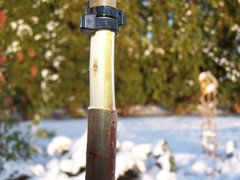
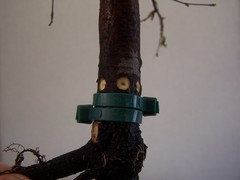
    This is a zelcova I've prepared for an air layer:


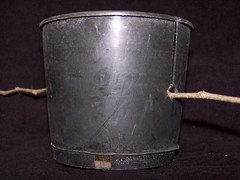
    This is how I might air layer a branch:

    The wound can't be seen, but the branch has been wounded like the zelcova above it. Typically, I would orient this type of layer so the branch is growing upward. It will root and grow much faster than a horizontal layer.


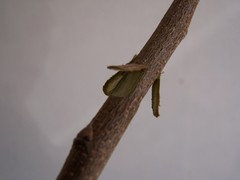
    Another way to wound a branch prior to establishing a layer:


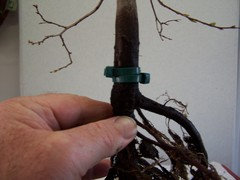
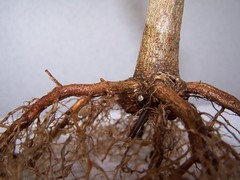
    Sometimes, if I have a tree with really ugly roots, I'll layer the entire top off of the ugly roots:


    Ugly roots ^^^


    Layer prepared ^^^


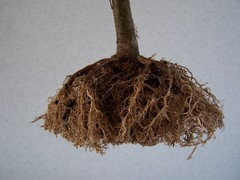
    This tree was layered off its old roots and now has a gorgeous root system:

    You can still see the tourniquet wire at the bole ^^^


    Same thing, only different ^^^


    Cercis cuttings are tough and usually require summerwood, a misting set-up, and a 5 second dip in K-IBA @ 10,000 ppm ....... much better/easier to layer a branch, though the variety "Mexicana" isn't too hard to propagate from 6" cuttings of summerwood

    ******************************************************

    Illsstep - One way or another I've propagated most of the 125-150 species of woody plants I grow as bonsai, and I can't help myself when it comes to more herbaceous material, either. Trying to describe all the different ways/species I've propagated would take a very long time. I rely heavily on cuttings and/or layering. Layering especially for branches thicker than 1".


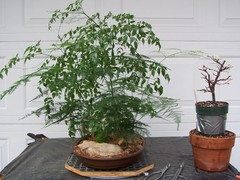
    The plastic pot on top of the soil in the clay pot is another tree being layered off of its old roots - this one a Korean hornbeam that is now a very nice shohin size bonsai that will finally get its first quality pot this spring.

    Al

  • 7 years ago

    I don't suppose you kept written records of your cutting propagation attempts?

  • 7 years ago
    last modified: 7 years ago

    I do a lot of cutting and air layer based propagation. Mostly successful which can be pain by itself - since sometimes I do not know what to do with those rooted plants. I do them mostly in Summer but I have done some (tropicals) in winter too. Here is one I posted on [Japanese maple air layer progression[(https://www.houzz.com/discussions/is-there-a-really-good-post-on-air-layering-that-i-cant-find-dsvw-vd~4666480). This is the regular green JM Acer Palmatum which is, I am guessing, often used as rootstock for other JM cultivars. I have consistently failed to successfully air layer JM 'Nishiki Gawa' which is growing in the ground.

    And here is one on [Chinotto orange air layer[(https://www.houzz.com/discussions/chinotto-air-layer-potting-in-pictures-dsvw-vd~5408661) but does not show how I prepped the air layer but it is the same as any other.

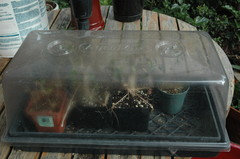
    For cuttings I often use a humidity dome, eg:


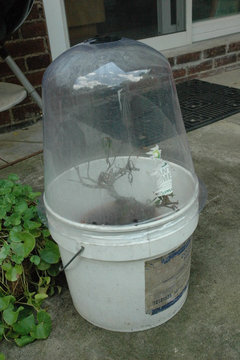
    The dome above has adjustable vents to keep humidity under control. For taller or larger cuttings I use a different dome that can sit on a bucket. This one also has adjustable vents on top. Although most often I use to revive a plant that suffered because of lack of water.


    For both cuttings and air layers I use 511 mix. In case of air layers I mix in some sphagnum moss to help retain a bit more moisture and for its anti-fungal/bacterial properties. I usually do not use any rooting hormone unless it is a new type of plant. In this case I will try to divide the cuttings into two groups - one with and one without hormone. I am not quite consistent and label them properly to distinguish if one is better than the other. The one I have consistently failed to root from cuttings is JM - Shishigashira.

  • 7 years ago

    Forgot to say: Cestrum nocturnum will root very easily. When I prune mine in Summer I stick the cuttings in the yard in a shaded location and they rarely fail. When they are ready which is 2-3 weeks I scoop them out of the soil, wash the dirt and put it in 511. They are easier than even ficus which I also often root the same way.

    A quick story: Moringa Oleifera (if you know this supposedly super food plant) is similarly easy. In India, local farmers often setup make shift shops to sell their goodies. They often use 3-4 inch dia Moringa branches as four posts to support a thatch roof. Within weeks all four posts would have rooted and farmer can make some extra money selling the leaves, flowers and eventually fruits of his living shop.

  • 7 years ago

    I can relate to ending up with more plants than I know what to do with. I found a biannual plant exchange at my local farmer's market, where you can drop off extra plants for people to take home (for free). They love getting 1- to 3-gallon shrubs (mostly they get bulbs and perennials), and I love that plants I've grown mostly as propagation experiments are going to good homes rather than the compost pile.

    Down the road I plan to get the necessary licensing for my area to be able to sell the plants I grow, and to do so at that same farmer's market. I doubt I will make any significant money, but the fees are small and I will be growing anyway because it's an enjoyable hobby, so why not recoup some of what I'm spending through sales?

    Tropicofcancer, have you had any success with cuttings of other Japanese maple cultivars?