Software
Houzz Logo Print
russell63

step cracks in brick

7 years ago
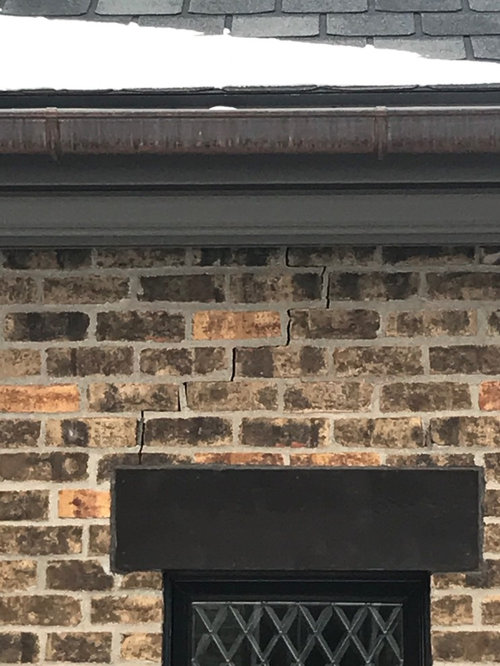
Not sure if this is a foundation issue. Our house is under 2 years old. Cracks are from the roof to the top of the lintel in a step pattern (zoom in). It’s 30 feet up and no cracks at foundation. Any ideas?

Comments (36)

  • 7 years ago

    I'm no expert, but it looks like a lentil problem. Maybe they didn't put in a strong enough lentil and it is sagging causing the crack. Good lentils should be steel.

  • PRO
    7 years ago

    Diagonal cracking is a typcial symptom of movement, i.e., some sort of movement in the wall plane.

  • 7 years ago
    Steel lintel under that wood lintel. It’s just weird that it’s from the roof. Can movement/settling cause cracks from the top and not foundation area? And how would this be fixed?
  • 7 years ago

    The steel lintel is not probably not carrying any load. The wood lintel has probably shrunk enough to crack the brick.

  • 7 years ago
    Wood lintel is decorative. Above all the windows was a steel carrying the load. Is it possible the cracks could be caused from something else? We have lintels like these all over the house and this is the only spot we found this. Just worried this is something serious. I was just wondering if anyone has seen this type of cracking pattern from the roof like this on a new build. Thanks for all your insights, I appreciate it
  • 7 years ago
    last modified: 7 years ago

    Then its something lower down the wall. The horizontal gaps in the crack suggest its the foundation to the right of the window possibly at a corner. Include that part in a photo.

  • PRO
    7 years ago

    Look carefully at both the interior and the exterior below, left and right of the diagonal cracking along the foundation...do you have a basement where you can look as well?

  • 7 years ago
    I found nothing inside the house, but I did find another window where there is the same step cracking above the lintel to the roof. It’s on a different wall and different part of the house
  • 7 years ago

    Do you know anything about the soil? Where are you located?


  • 7 years ago
    Yes. We are on sand. No clay
  • 7 years ago
    Also- Michigan. Extreme temps
  • PRO
    7 years ago

    What sort of foundations do you have? Is this a custom or tract house? How old is the house? Do you have standing water and/or drainage against the house and foundations?

  • 7 years ago

    It could be freeze-thaw damage.

  • 7 years ago
    2 years old. Custom home.
  • 7 years ago
    No standing water
  • PRO
    7 years ago
    last modified: 7 years ago

    Michigan!!!! That explains it.

    My guess is the house is settling due to lumber quality and moisture content. The movement could be within the house itself. Is the house located north of Midland or south of Midland?

  • 7 years ago
    Tile and stone around entire foundation. Sump pump, etc.

    What else besides foundation could cause brick cracks?
  • 7 years ago
    North. But movement is from roof to top of windows. Is that normal? What do you think needs to be done?
  • PRO
    7 years ago

    I don't mean to pry, but Traverse City area by chance? That's where I am sitting right now.

  • 7 years ago
    Sorry. I did see your comment. Thank you. If that’s the cause, will it just keep happening everywhere and nothing I can do? I owned brick homes before without step cracking issues here in Michigan
  • 7 years ago
    last modified: 7 years ago
  • 7 years ago
    Ok. Well I just hope it’s not going to continue or it will be an easy fix.
  • 7 years ago
    Funny. I read that this afternoon
  • 7 years ago
    Hey mark... you being an architect, do you think it’s serious? Something the builder or architect did wrong?
  • PRO
    7 years ago

    I had a brick (veneer) house south of Frankfort that was built in 1955. It had a couple cracks similar to yours. I owned the house for ten years and the cracks didn't change and I never did anything about them. I assume yours is a veneer brick (3 1/2" thick brick attached to a 2x4 or 2x5 stud wall) so it is not structural to anything but itself. Keep an eye on it over the years to see if it changes. You could tuck-point it to replace the mortar to help keep water out. I do not think it is anything to worry about. Now Michigan weather may be something to worry about . . .

  • 7 years ago
    Thanks for your info mark, I appreciate it. I have passed on my worries to our builder and masonry sub and I’m sure to hear back from them this week. Stay warm! We do need some snow though!
  • 7 years ago

    How big of a wall is it overall? It could be something that a control joint could cure. It appears the only broken brick is the first one off the lintel. Everything else is a mortar joint fracture. id guess that grinding the mortar out and retouching the grout/ mortar would fix this also. I don't think it will be an ongoing problem.

  • 7 years ago
    I hope it will be ok. The wall is 30 ft high. I did find another crack, exactly the same pattern and above a lintel to the roof except the space/crack is way smaller and I can barely see it and that wall is only 1 story high.
  • 7 years ago
    last modified: 7 years ago

    I agree since there is no crack inside. As Rollie suggests the movement in the brick veneer could be due to expansion and contraction assuming there are too few control joints which is typical of residential brickwork. Make some samples of the new mortar and let them cure in order to get the color right.

  • 7 years ago
    Our bricks are made of clay though. They’re handmade glen gery Atlanta. You don’t think that could have anything to do with it?
  • 7 years ago

    That would not be a factor.

  • PRO
    7 years ago

    Brick is a very brittle material. The slightest movement can cause cracking. I think RES was right in the first place. If you're not seeing cracking anywhere else, The wood has probably shrunk just enough to crack the brick above it. The steel lintel should have been installed directly under the brick, not under the wood. It doesn't help that the masons had to install partial bricks to make the wood lintel fit.


    While this is annoying, I don't believe it's serious or an indicator of structural issues with the home. Monitor the situation and seal the crack to keep water out of the walls.

  • 7 years ago
    Thank you for this info. Question though. You say that cracks in the brick can lead to water in the walls? Well this crack is located on a south wall but in the same space where we have a leak in a big picture window on the east wall. The big window isn’t directly adjacent, but is still in the same interior space. In the pic below shows the location of the small window to the right (not center) where there are exterior brick cracks above, and then the big picture window. Seems like a long way to travel but maybe not.
  • 7 years ago

    I have been looking at the picture of your window with the crack. I agree with Summit. The lentil above the window should of been sitting on a full brick not a cut in half brick. Poor brick mason work. There also should of been a lentil above the wood piece. The wood piece is also acting as support for the brick above. I would of personally had the hole thing brick and the wood piece applied to the brick just as decoration. Wood expands, contracts and eventually being a natural product decays . It is not good to support brick. This kind of decoration on this style of homes is suppose to done with concrete or stone slab. Not wood. You now only have two windows with this problem at the present, but I expect the rest of the windows will also develop cracks in the brick. On a less than 2 year old house I would have them either remove the bad section of brick and add a lentil above the wood and re-install the brick or just have them take that wood piece out all together and make it all brick by an experienced bricklayer or fork over some money and have a slab of concrete or stone replace the wood.

  • 7 years ago

    This can be nothing... or it can be serious.

    Having a water leak at a window is a problem also that you aren't going to "caulk away".

    Do you have any photos of the outside of the home being framed before the brick went up?

    There was some exterior sheeting that is still being used that doesn't provide much in the way of stiffening of the wall (it's basically cardboard). The structure moves and cracks the brick veneer.