Software
Houzz Logo Print
d2mcfall

anyone used larger tile in a shower floor?

7 years ago
We want to use a 5in by 5in marble hex tile for the bathroom and shower floor so it’s continuous. My architect says typically a smaller tile is used for shower floors to prevent slipping. Anyone have experience with this. Would love to hear thoughts. Thx!

Comments (14)

  • 7 years ago

    I thought about a large tile for my master bath, but my designer said we would have to change the plumbing to use a trench drain. And it couldn't be a shiny tile, or it would be slippery.

  • 7 years ago
    You will be fine with that size tile. I would be more concerned if it was like a 12x12 or larger.
  • 7 years ago
    last modified: 7 years ago

    I have a shower with a large format (18 X 18), very slippery tile on the walls, so I went with the same tile in a 2 X 2 for the floor so that the grout lines would compensate. I also have another shower with 12 X 12 tiles on the floor that is smooth, but completely non-slippery. So my advice to you is to determine how slippery those tiles are: Coefficient of Friction for Tiles. Also be aware that, if you have a conventional center drain, it will be a challenge installing 5 X 5 tiles as they taper in to the drain.

    Lastly, I am going to ask you if your tile looks like marble, or actually is marble? If it's natural stone you may want to reconsider. There are numerous threads on GardenWeb by people who have had bad experiences with staining and an uneven look when they installed marble on the shower floor. Some of these are worth reading: Marble tile staining

  • 7 years ago
    Thanks so much! Super helpful info!!
  • 7 years ago
    You can only have a certain size tile for a shower floor before you start compromising the slope of the floor unless the slop was pitched more for larger tile it’s a common mistake diy’ers and many pros make.
  • PRO
    7 years ago
    last modified: 7 years ago

    We would never recommend/design a shower floor with that size. Two reasons, both safety (slippage) and achieving a proper pitch (possible but not an easy task and you will need to cut the tile into smaller shaped pieces nearer the drain, like diagonal, depending on linear verses standard drain). Now if you have a very large shower, the pitch is easier. I would be explaining all of this to our client if they requested this tile and be clear as to how proper pitch would be achieved and the aesthetic outcome (and cost of labor) as well as making it clear that slippage is a greater issue with this size.

  • 7 years ago
    last modified: 7 years ago

    Dragonfly-

    I know that you are a professional in this area, so I am not trying to pick a fight, but I do want to point out to others that there are some larger tiles that are non-slippery, even when one has soap underfoot. Mine are 12 X 12 porcelain tiles that have a slightly-striated texture that has never once been remotely unsafe. I am not representing that this is the majority of tiles, but you can find them.

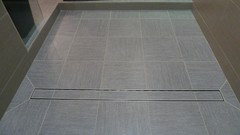
    I went with a linear drain across the center of the shower so that the shower floor could slope from each end in two flat planes:


  • PRO
    7 years ago

    kudzu9 as we said, "depending on linear verses standard drain", this can work and you are correct if it works in your specific situation (we've used that same approach when appropriate), but the size of the shower was not revealed here and is very important for proper pitch. Just remember, we are speaking to the masses on these forums and we would be less than responsible to suggest it is the correct approach for most of the designs and materials we see presented here.

  • 7 years ago
    last modified: 7 years ago

    Corrector-

    Please explain what you mean. In my experience, if you are not using a linear drain, and you are using large format tile, the only way to get a smooth transition that follows the slope to the drain is to make cuts in some of the tiles so they can be "bent" to conform to the slope. Tiles are planar (flat), while a conventional shower floor is not. I have seen some floors that were done with a conventional center drain and large format tiles and it just looked "off."

  • 7 years ago

    You can do an X cut to the center drain, creating 4 individual planes. You could technically use just 4 pieces of stone or tile for that, if it met the DCOF rating.


  • 7 years ago
    last modified: 7 years ago

    " In my experience, if you are not using a linear drain, and you are using large format tile, the only way to get the proper slope to the drain is to cut the tiles so they can be "bent" to conform to the slope "


    [https://www.houzz.com/discussions/using-diagonal-cuts-to-slope-your-shower-floor-planning-guide-dsvw-vd~635709[(https://www.houzz.com/discussions/using-diagonal-cuts-to-slope-your-shower-floor-planning-guide-dsvw-vd~635709)

  • 7 years ago

    We aren't disagreeing. I didn't say it couldn't be done at all. My post was so that people understood you couldn't lay large format tiles on such a floor without cutting them in certain ways. The link you posted illustrates that point.

  • 7 years ago
    My shower has large format tile done that way, with the diagonal cuts. Drainage is fine, and the tile isn't slippery. I suspect it's a more common practice here in Australia than in the US.