Software
Houzz Logo Print
actionclaw

Best way to extract calcium carbonate from egg shells?

This is actually a chemistry question more than anything else—specifically chemistry in the context of plants, soil etc. I suppose there may be a few in the hydroponics area that might have the knowledge & answers but I'll start here.


I tend to repurpose/recycle everything. We eat a lot of eggs so I save, dry, grind up and try to make use of a lot of egg shells. Unfortunately, over the years reading, research has revealed that every commonly suggested garden related use (adding calcium, lowering soil pH, repelling snails, etc.) for them has proven false. I’m aware it has repeatedly been discussed here and and elsewhere that egg shells can/should be added directly to the soil or to the compost pile. This can be done, causing no harm, but it seems neither will any benefit be received. I won't go into all the details here (though this covers some), it can be easily found online, but apparently they don't decompose much or very fast, they don't break down but simply get smaller and smaller. I was surprised to find one article about how in one case, chicken & duck eggshells were found to not have decomposed very much after being in the soil 165 years!


Based on whatever I've read, all the research I've done I’ve come to the conclusion that the only way they can be utilized—specifically their calcium carbonate, is to extract it by applying to them something as acidic as they are alkali. I used to mix them with old wet coffee grounds & let them stew awhile but it's unlikely they are nearly acidic enough to make any significant change.


I suspect any common acid (acetic, citric, hydrochloric, lactic, malic, oxalic, phosphoric, sulfuric, etc.) of the right type, amount and concentration would be sufficient to release calcium carbonate but might or could also introduce any number of other unwanted, harmful elements as well.


A frequently recommended method to lower soil pH is the addition of elemental sulfur. Thus far, I've been unable to determine what the actual pH of elemental sulfur is. So, I suppose my questions are:


• What is the pH of elemental sulfur?


• Is elemental sulfur sufficiently acidic that it could be mixed with water and powdered egg shells to render something near neutral, that would add to the soil calcium carbonate, sulfur, possibly other beneficial nutrients but nothing harmful?


• If elemental sulfur is not sufficiently acidic, could the above be accomplished using sulfuric acid?


• …or phosphoric acid instead rendering calcium carbonate, phosphorus (and possibly other beneficial nutrients but nothing harmful)?


• If “no” to all of the above what are your suggestions on how this could be accomplished?


Thanks

Comments (17)

  • 7 years ago

    My first reaction to these questions was whether the cost, in every sense, of the provision of resources used to prepare the eggshells was equal to or greater than the good done by repurposing/recycling them, especially if you grind them using electricity. I'd like to know if there was net gain. I'd also like to know whether your soil has been proven to require more calcium.

  • 7 years ago

    Thanks for your (super fast) response.

    True enough. Valid points but more as some sort of a philosophical thought experiment.

    Serious consideration of the effort and all the time spent in the garden that results in a harvest of fruits and vegetables I could otherwise purchase from the grocery store for a few dollars should prevent me from gardening at all …yet I continue.

  • 7 years ago

    You can crush them and feed back to your chickens. Just make sure to crush enough thst they don’t get the idea of eating their eggs. I also question the conclusion that they’re wasted in compost. The same is said about coffee grinds. If you think of compost as a soil amendment rather than fertilizer isn’t anything organic good?

  • 7 years ago

    A quick look on the internet shows that the egg-processing industries - who deal with vast tonnes of waste eggs have been looking at this problem for a while, without a whole lot of success. There are lots of posited uses but none would make sense in a home environment - they don't even really in an industrial context.

    I approach from a different angle - eggshell pieces in compost may not add as much usable calcium to your soil as some think, but it doesn't hurt either. Having soil with mixed components is overall a good thing, and the benefit of diverting from landfill is, too. (If like me you don't wash the shells, the egg part is mostly collagen i.e. proteins so feeds something in there).

    Maybe someday a different process will be found, but for the time being, it adds to your soil, keeps it out of landfill, and doesn't hurt.

  • 7 years ago
    last modified: 7 years ago

    To me time spent in the garden isn't effort and it is good for one both physically and mentally. There are huge positives even before there are any veggies to show for it. If one enjoys experimenting with eggshells there might be a positive pay off. But it would have to be a good return on time, effort and resources. My eggshells go on the compost heap simply crushed in one hand.

  • 7 years ago

    toxcrusadr

    I'll take a crack at these questions.


  • 7 years ago

    I have chickens. All the shells go in the compost, then into the garden. I always find it interesting that people worry about eggshells breaking down. First, they do. They break down pretty quickly in my garden---into small chips. Second, if the didn't, why would I care? The other thing that I find to be a positive contribution is that if you vermicompost, you quickly notice how much worms like gathering all their family into slimy balls to take up residence in an eggshell half. If worms are half as enthused in the yard as they are in Tupperware, then I think eggshells are valuable as a worm attractant.

  • 7 years ago

    I usually (when I was composting them that is) crunch them up with my hand before tossing them in the kitchen bucket. That way as soon as the membrane holding them together breaks down, there are just a lot of small pieces that are not very visible in the garden.

  • 7 years ago

    The first question that comes to mind is, how do you know your soil is Ca-deficient? Then, asking how to extract CaCO3 from eggshells is a bit like asking how to extract iron from horse shoes. Horse shoes, for the most part, are essentially iron, and eggshells are, for the most part CaCO3, which is pretty much insoluble at pH levels that favor garden plants. Decreasing the particle size to something close to fine powder will increase the mineralization rate in soils with active microbiota.

    Al

  • 7 years ago
    last modified: 7 years ago

    I thought the calcium did leach out in the soil or compost, albeit very slowly, which may not be a bad thing...?

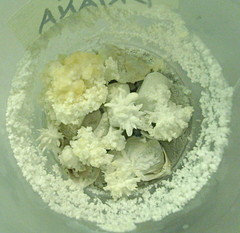
    And this made me think of a fun science project I do w/ kids in our rec program, we put seashells into white vinegar in a cup to see them bubble up, and then leave the cups for a week or so to allow the vinegar to evaporate, and as it evaporates, it grows a "crystal garden" of what I presume to be calcium crystals.

  • 7 years ago

    Neat experiment. The crystals are a compound containing Ca, but not Ca in elemental form, which doesn't exist in nature because it reacts vigorously with water and other elements to form compounds of Ca.

    Al

  • 7 years ago

    Might it be calcium acetate?

  • 7 years ago
    last modified: 7 years ago

    Yes. The product of the reaction is H2O + CO2 + Ca(CH3COO)2, the later being calcium acetate.

    Al

  • 7 years ago

    Questions are always good, even the ones like these. What I took from all this is to not worry about the decomposing rate of egg shells in the soil at all. I actually do not believe the original post about the poster did research and found out egg shells do not decompose much in soil, which sounded to me like a pile of poop, but to each his own.

  • 7 years ago

    ^ I agree. A pile of poop of course would be better, but there's nothing wrong with crumbled eggshells in the soil, becoming white little soil particles that are high in calcium and slowly break down. I think it's fine if you don't specially grind them, just mix them in your regular compost, and they do crumble down to little white bits. Nothing wrong with that!

  • 7 years ago

    Coffee grounds are not very acidic, so wouldn't do much to dissolve the eggshells. If nothing else, eggshell pieces can improve soil texture.

    Eggshells (ground up) are good for vericomposting. The red wigglers will take care of them.

Sponsored
Wannemacher Interiors
Average rating: 5 out of 5 stars26 Reviews
Customized Award-Winning Interior Design Solutions in Franklin Cnty OH