

CFMs for Induction Range
Comments (23)
 7 years ago
The required flow rate (cubic feet per minute) to achieve the containment function in a hood system, that is, keeping captured effluent from reflecting out of the hood, varies with the upward velocity of the cooking plume to be captured as it approaches the hood filter system. The specific flow rate of 90 CFM/sq. ft. of hood entry area is known to work for most residential cooking and provides a baffle gap velocity that is approximately the maximum found by measurement for a gas range. (Figure 3, Kosonen Risto, Koskela Hannu, Saarinen Pekka, Thermal plumes of kitchen appliances: part 2 cooking mode). The counterpart level for induction cooking is about 70% of that, and this may prove adequate, except perhaps for searing and wok cooking. In any case, the specific flow rate has to be multiplied by the hood aperture area to find the total required flow rate.
The hood aperture area should, for good capture, overlap the area of pan surfaces because the cooking plumes expand as they rise. Of course, this increases the total flow required required and pushes one toward the deliberate MUA limit of 400 CFM. For a 30 inch cooktop a 24 x 36 inch hood would be suitable. This is 6 square feet leading to not less than 0.7 x 90 x 6 CFM = ~380 CFM (for induction). Unfortunately, the building inspector will use the blower rated CFM. The rated CFM will never be achieved in practice when the blower is working against the pressure losses of the hood filter, house-leakage MUA, and duct. To achieve 380 CFM under these conditions, a blower should be rated for around 600 CFM. To get the rating down to 400 CFM, the hood should shrink by 2/3 and hot plume cooking performed only at the rear or else the larger hood used and cooking should be less energetic on all hobs. A 2/3 sized hood could be 20 inches by 30 inches. Side cabinets or side skirts would be helpful.
In case the above is too fire-hose like, please review the many other hood threads on this forum for similar approaches to this topic.
Related Professionals
Vicksburg Kitchen & Bathroom Designers · Erie Kitchen & Bathroom Designers · Great Falls Kitchen & Bathroom Designers · Minneapolis Bathroom Remodelers · Ogden Bathroom Remodelers · Bloomington Kitchen & Bathroom Designers · North Adams Kitchen & Bathroom Designers · Kalamazoo Kitchen & Bathroom Designers · Scranton Kitchen & Bathroom Designers · Las Vegas Kitchen & Bathroom Designers · San Angelo Kitchen & Bathroom Designers · Eau Claire Kitchen Remodelers · Clarksville Custom Countertops · Coldwater Custom Countertops · Youngstown Custom Countertops- 7 years agolast modified: 7 years ago
Think about the kind of cooking you do. The reason you don't get consistent feedback is because some people cook a lot of spicy foods, and/or fry frequently, and/or sear steaks in a cast iron pan. Others don't. So their exhaust needs will be different. I would say 400 cfm is minimum, and most people feel that 600 cfm is fine. I would not go above 600 cfm because then you get into the requirement of make-up air, which will add a lot to your project.
When you said you are venting up through the ceiling, make sure that the duct that is installed is 8" diameter. Be careful of going smaller than that; some contractors want to do 6" because it's an easier installation.
Re induction - any reduction in needed cfms compared to a gas cooktop due to the elimination of the effluent of the gas itself is cancelled out if you are a family who makes hamburgers or other greasy or smoky foods on your cooktop. Those foods will emit the same amount of smoke and grease whether cooked on gas or cooked on induction.
- 7 years agolast modified: 7 years ago
What type of cooking do you do? That's a bigger consideration than the type of fuel you use. In addition to Kaseki's post above...
Do you fry or stir fry? Saute? Do you do a lot of meat browning and/or similar?
Or, do you primarily boil water (e.g., for pasta or cooking/steaming veggies)?
Ellen
Original Author7 years agoWe do stir fry a lot. Not much oil, so not a lot of grease, but we do get some plumes going! We also like to brown chicken and fish and then pop it into the oven. That's why we are moving from a downdraft on the island to a new range on the wall, so we can have decent venting. And in our town, above 400 CFM requires make up air. But interestingly, our contractor wasn't familiar with it. So I called an HVAC company whose main thing is ventilation, said that they rarely install MUA. He says you can achieve the same by opening a window when on the highest vent level.
Kaseki, I have read many of your posts, but I get a little lost in the science of it all (but indeed do appreciate it, don't get me wrong!). I think the bottom line of your post above, is that we may indeed be stretching it with 400CFM. We will have cabinets right next to hood, and are only using, a 30" hood.
Weird that something that seems ilke it should be simple, isn't! So many decisions in this total kitchen remodel, my brain is starting to hurt! lolol
Ellen
Original Author7 years agoKaseki, actually, I read your comment again, and maybe you're saying that with the smaller hood, 400 might be okay. And as for inspection, both contractor and HVAC company said they don't usually pull permits for installing hoods. Seems surprising to me. We do have a 25 year old home and they said we might not be as "tight" as newer homes, although we did have windows replaced, so perhaps we are tighter than others of the same age. I dunno.
- 7 years ago
I wouldn't expect a permit would be required to install a hood, or any other appliance. Something where plumbing, electrical and/or walls are moved: sure.
MUA can be simple or complex. If you were to get a 600-700cfm hood, you would need to supply MUA in excess of 400cfm. And HVAC guy could tell you what size duct you would need for this. You would also need either an electric or barometric damper. If you live in a cold location, they make inline thermostatic heaters to raise the air temperature. You should also have a filter box for an air filter. One can debate whether the vent should go under/behind/over the stove, in the ceiling or directly to the furnace.
- 7 years agolast modified: 7 years ago
If you stir fry, then a larger and more powerful hood may be necessary.
The bare minimum would be:
- 6" wider than the cooking appliance
- 24" deep.
- 600 cfms
Ellen
Original Author7 years agoShannon - you caution about 6" duct, but so many hoods we are looking at come with 6".
- 7 years ago
If you were just installing a new hood, maybe a permit would not be pulled. But if you're remodeling the kitchen and it's going to be inspected, the building inspector might not be satisfied without MUA if the hood is over 400 CFM.
You should have this conversation with your contractor (and HVAC guy, if you are doing other things to your HVAC). For us, the options were
a) MUA with unconditioned air and bring it into the basement, a "semi conditioned space," allowing the unconditioned air to come to temp before it enters the living area,
or b) integrate the MUA into that system and get conditioned MUA.
If we go with the 600-700 CFM hood then I think we are doing option b, because are already adding new HVAC so the cost difference is not as much as it would otherwise be. If we were trying to work it into existing HVAC the cost would be thousands.
- 7 years ago
If you stir fry a couple of times a week, you want it to work better than "minimally acceptable". That means more CFM, a bigger hood, and MUA. If you stir fry one a month, the 400CFM and no MUA with more cleaning after the stir fry might be OK. But you want the hood larger than the cooking surface, no matter what.
Ellen
Original Author7 years agoGreen designs - "larger than cooking surface". I see that a lot on here, but why? I mean is there something bad about having a 30 over a 30? seems like it is fairly common.
- 7 years agolast modified: 7 years ago
Short answer...Because smoke, steam, etc.*, expand outwards as they rise, which means they go beyond the bounds of the cooking surface. So, a 36" hood over a 30" range/cooktop provides 3" of space to accommodate and capture the expanding smoke, steam, etc., on each side.
* We sometimes call it FOGSS for short -- fumes, odors, grease, smoke, steam
(Grease aerosolizes and rises as well)
- 7 years ago
I think a 36” hood over a 30” cooktop is great - but for me, I couldn’t forego the 6” of upper cabinets. It is better to go 6” wider than your cooktop, but not absolutely necessary.
 7 years agolast modified: 7 years ago
@Ellen, you need to be very careful about installing anything more than 400 CFM without make-up air before checking on the building code in your area unless you want to have to go back and install a MUA system if the inspector finds out. Most jurisdictions have some type of regulation (some go as low as 300 CFM, others may make exceptions up to 600 CFM). The standard is 400 CFM, with any hood 401 CFM or higher requiring MUA. No, you don't need a permit to replace a hood unless you are going from a recirculating hood to a ducted hood, but you do need to abide by the CFM requirements if you have no MUA. There is a reason for this; the draw of air can bring hazardous fumes from other appliances or a fireplace into your breathing air.
Based on my general research, an 8" duct is really recommended for anything above 300 CFM. If the hood you purchase comes with a 6" duct and an internal motor already installed, then you'll probably be fine to stay with what came with the hood. There are a lot of other threads here at Houzz about how to find a hood with sufficient under-hood capture area and how to size the hood based on the range underneath, so I'd encourage you to do some more reading. I recently ended up with a Wolf hood versus a GE hood I almost bought before finding some of the very helpful advice by @kaseki and others here at Houzz.
- 7 years agolast modified: 7 years ago
The "larger than cooking surface" recommendation is for enhanced capture of the cooking effluent which spreads out as it rises. May start out as 30" wide at the stove top (assuming you are using all four burners at the time.) At 24 to 30 inches above your stove (i.e., where the hood starts), the plume will have spread out close to 36" wide. Thus, a 36" wide hood is recommended/suggested for a 30" wide cooking surface. Getting a hood with greater depth (front to back) is also suggested for better capture.
Now, as Kaseki says, we've had many, many threads on this subject and this particular one seems to have been coming up every few weeks. You can get quite an education if you read a bunch of what turns up on a search. for older threads. (FWIW, you'll find more threads if you use an external search (like Google) rather than the houzz's internal search engine.)
All of that said, do you have the time or interest to get that educated? Beyond that, it may be important to realize that much of the conversation here will be about getting "the best" or the "most optimal" solution. We don't seem to have many conversations here about "good enough" or, more precisely, "good enough for your circumstances" which is what I'm guessing you meant when you said " that with the smaller hood, 400 might be okay. "
So, let's talk about what may be "okay" for your situation.
First question. You say you will be fitting a hood into an existing kitchen over an existing range and you want it to vent straight up 10 to 12 feet. You said: "We will have cabinets right next to hood ..." Does that mean the cabinets haven't been purchased or ordered yet? If so, you might be able to adjust the cabinets to allow a wider space above the range and get a 36" wide 400 cfm hood. OTOH, if you cabinets are already built or installed, then you are limited to the 30" space and that is as wide a hood as you can fit in your space. Not "optimal" but probably good enough -- although it means you will have to be cleaning the nearby cabinet surfaces more often.
Second question. Do you have an limitations on how tall the hood can be in your space? If not, then you can look for a tall hood with a good canopy (what some might call a "real" hood as contrasted with one of the sleeker models with a flat base and whose intakes are inset flush with that bottom surface of the hood.) As kaseki has often explained here, a good canopy enhances collection of the effluent plumes and can be as important a consideration as the CFM rating of the fan(s) in the hood.
Third question. Regarding make-up air, what other fixtures and appliances do you have in your house? Gas or oil Furnace? Woodburning stove or fireplace? Gas water heater? Do any of these already have their own make-up air? For example, maybe you have a direct vented water heating appliance which won't be backdrafted by a range hood (or, for that matter, by a bathroom fan if your house is particularly tight -- and I might add that I have seen that happen in a house being built to net zero specs.) The formulation of "more than 400 CFM= MUA" is a something of regulatory compromise. It may be more than you actually need in a drafty old house but might not be adequate for a house that has been made very tight and equipped with appliances and fixtures without their own, separate air supplies. IOW, state and local laws do not override the laws of physics. Many power and gas companies will do free energy audits, the results of which will let you know how tight your house actually is.
Fourth question --- or maybe more of a comment. On 6" diameter ducting (or 3" x 10" rectangular ducting) versus 8" ducting --- 6" is "good enough" but 8" is "better." A hood with a 400 CFM fan will work fine with the 6" ducting that it is designed for.
Also, one final point about matching CFM to hood size and fan capacity. Home builders and remodelers have had longstanding rules of thumb for minimum range hood sizing. For pro-style and other higher-powered gas ranges, the rule of thumb was to figure 1 CFM per 100 BTU of stovetop burner power. For electric ranges lesser powered gas ranges, the rule of thumb was that the minimum CFM should be 100 CFM for each linear foot of cooking surface. These, of course, are just rules of thumb for minimally tolerable effectiveness.
Ellen
Original Author7 years agoinspo inspo, thanks. we are actually installing vent where none currently exists. we have a downdraft cooktop in our island,but are switching to a range on the wall. my husband seems to think those guidelines take into account all types of situations, such as the enclosed kitchen as well as the kitchen ioen to other large rooms, such as ours. I am actually a rules follower though, so we have to decide between a 400 which might not be enough to clear our cooking stuff, and a 600 and use the high setting rarely and maybe with a window open. my husband just thinks MUA is overkill for our use. ugh, why can't things be easy? I appreciate all the input I'm getting. this is a great forum. thanks!Ellen
Original Author7 years agojwvideo. thank you for your thorough comments. I have indeed been reading a lot on here and elsewhere. I appreciate your input. (I think you were commenting at same time as I was!)- 7 years agolast modified: 7 years ago
Some supplementary comments:
The duct should be sized for a duct velocity on full power of approximately (or perhaps roughly) 1000 ft/min. This is calculated from the actual (estimated) CFM achieved divided by the duct sectional area in square feet.
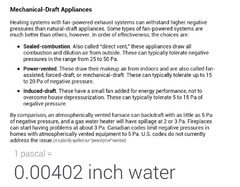
The issue with MUA, as noted above, is the hazard related to back-drafting combustion appliances and pulling carbon monoxide into the house. This is bad. If there are no combustion appliances, then an open window will suffice to allow the hood blower to reach its air moving potential. But the powers that be (and the homeowner) can't ensure an open window will be applied all the time. Hence the rules exist for low risk.
Further, where there are combustion appliances, the 400 CFM rule is pretty crude. No mention is made of what pressure losses are developed in the MUA duct, filter, heater, or whatever scheme is used. Even a window screen can be a restriction. Below is a listing provided by another forum member here (as art) specifying allowable house negative pressure by combustion type. The best approach is to have separate MUA for the combustion appliances, and seal them in a room not connected by air to the kitchen.
Last, my comments about getting away with a smaller hood are dependent on the meaning of getting-away. Marginally sized wall hoods can be aided by additional blower flow rate (not helpful here where the flow rate is being restricted), or side skirts. Side cabinets that don't violate combustible material distance rules can help, side skirts (sometimes called curtains) can help more but may be considered unaesthetic, and are rarely provided with residential hoods.I encourage everyone who is going to deal with kitchen ventilation to read the first 12 pages or so of the Greenheck Guide in order to understand what is going on.
http://www.greenheck.com/media/pdf/otherinfo/KVSApplDesign_catalog.pdf
Ellen thanked kaseki  PRO7 years ago
I live in a house built in 1948. My two furnaces, are drafted to the outside and both have a cold air intake vent. My gas hot water heater is direct-vented. About 8-10 years ago, I have a 600 cfm hood installed over my 1948 O'Keefe & Merritt gas stove with 5 pilot lights. I was not required to have any MUA for this installation. Hood is vented straight up through the 2nd floor furnace closet and out the 2nd floor roof. It works very well.
I have a 38" gas range. There was no room for a hood larger than 36" so that is what I have. Again, it works just fine, but I'm not stir-frying and I only fry chicken maybe once every two years! I also have a kitchen that is separate from the other rooms - no open concept.
So, the answer is that one-size-does-not-fit-all where advice is concerned on a hood. I would suggest you go to a local appliance store that deals in high end appliances. They will have salesmen who have made a career of selling appliances, not ones who last week were selling cell phones, and the month before that, working on a car lot. Their installers will also know what you need - this is how they earn their living - installing appliances in very high end kitchens - so they know what they are doing.
- 7 years ago
@Ellen if you live outside city limits, you can probably get away with installing a 600 CFM without make-up air (MUA) since you won't have to follow the building code. It's honestly hard on a practical level to find a good hood right at that 400 CFM mark. You can find 300s, 350s, 450s, and so on, but to get a hood with a good capture space underneath (that is, not flat underneath but with a cavity to collect bursts of effluent that may outpace the blower), you will have many more options open to you if you can go up to a 600 CFM. If you live inside city limits, then check your building code. Some cities make exceptions under certain circumstances up to 600 CFM without requiring MUA. Others limit it as low as 300 CFM, usually in northern climates where homes are tighter. Most abide by the International Residential Code which limits it to 400 CFM or lower without MUA.
Unless you cook all day long, or unless you have an easy budget to install an MUA system, my personal opinion is that it is overkill to install an MUA just so you can have a more powerful blower. After much research here at Houzz and elsewhere, I opted for a Wolf range hood with 300 CFM blower to fit within my city's code of 400 CFM or less without MUA. We will duct this to the outside, and I'm sure having a ducted hood regardless of blower speed will already be a huge improvement over our recirculating hood with which I could set off fire alarms in the house just from cooking hamburgers.
- 7 years ago
Wow, Anglophilia, you have some amazing appliance salesmen. The higher-end appliance stores I've been in and dealt with have competent salesmen, but they aren't HVAC engineers by avocation or even instinct. What they "know" they heard about from someone, maybe a district sales rep, perhaps complaining customers. Their installers are likely movers who can position a SubZero, but not even lock it in place. Not their yob.
I suggest the OP and others who do not want to engage in do-it-yourself HVAC engineering to hire a HVAC company. It will likely employ capable people as well as have the facilities or connections for any sheet metal fabrication needed. But many installations, particularly those without dedicated MUA systems, or those with self-contained systems (e.g., Fantech) can be installed by general contractors, given that the owner has taken the time to know what he wants, performance-wise, and understands the basic issues.



Shannon_WI