

fertilizer regimen
Comments (18)
 7 years ago
I use one heaping handful of ordinary corn meal, scattered under each plant, once a month. My wife supplements that with way more than a handful of alfalfa pellets (rabbit chow). No other amendments or supplements needed.
You can buy feed grade corn meal at a local feed store. Call first for availability. Price should be less than $10 for 50 pounds. If they tell you it's $30, that is a different product called corn GLUTEN meal. It is also good for the roses, but you don't need to spend that much. If you can get soybean meal, that is great also.
 7 years ago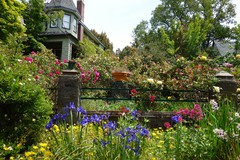
I think that different people have different philosophies about growing roses in general - people who grow the latest modern roses every year, for competition purposes, for example, are probably very concerned about the issues you bring up. That's one end of the spectrum. The other end is probably where I am (and possibly Jeri). Find roses which like your micro-climate, and let them do their thing without obsessing over precise pruning, complex formulas of amendments, etc. Old/antique roses seem to be more amenable to this sort of approach.Having said that, here is what I actually do in my garden (when/if I get around to it - which does not always happen). I grow almost exclusively teas, tea noisettes, chinas, polyanthas, banksias, rosa gigantica hybrids, some possible hybrid perpetuals, a few once blooming old European roses, and hybrid musks. We irrigate all of them throughout our normal 6 month summer (no rain whatsoever). In the winter we do not irrigate them but Mother Nature does. When we plant roses, we just dig a large hole and put the dirt back around the rose. If there is not enough dirt, I add commercial planting soil. Nothing else (I must note that our garden soil has been actively gardened for 114 years now, and is lovely clay based loam). For established roses, if they need shaping they get it maybe once a year, mainly to keep the climbers from falling off whatever they are growing on, and to keep the others out of the paths and driveway. At that time I throw "9 month" osmocote around them, and add 2-3 inches of compost which my DH makes from the leaves of our trees. No spraying, except the 3 mid century HTs which are our only HTs, and all get BS and rust, and mildew! (I keep them in large pots on the patio, away from the other roses!)
The above pic is about 1/5th of our garden.
Jackie
Related Professionals
Selma Landscape Architects & Landscape Designers · Bowling Green Landscape Architects & Landscape Designers · Eau Claire Landscape Contractors · Medford Architects & Building Designers · Lagrange Architects & Building Designers · Wilmington Landscape Contractors · Asheville Landscape Contractors · Tacoma Landscape Contractors · Panama City Home Builders · Fall River Home Builders · Aberdeen Home Builders · Denver Landscape Architects & Landscape Designers · Saint George Landscape Contractors · Danbury Home Builders · Yuma Home Builders 7 years ago
Jackie, that is a killer picture. I especially like the color combination.
Lesli, I basically do nothing other than drip watering, deadheading the roses, throwing some leaves under the bushes for mulch when I have the energy and pruning a few of the roses in winter. The most important issue in my opinion is to choose roses that are happy in your area (i.e. no gallicas in Tennessee or tea roses in Alaska). I garden organically and the roses do reasonably well considering the drought we've had for far too long and the increasing intensity of the sun. I no longer expect roses to do well in all-day sun, and focus on areas now that have morning sun and late-afternoon shade so the roses are not as stressed. Fertilizers are wonderful, especially such organic ones like horse manure and alfalfa, but my roses have to do without and they're reasonably content.
- 7 years ago
I'm another of the non-fertilizers. As others have said, it depends on the kinds of roses you grow, or want to grow, and on your soil and conditions. Our soil is very heavy gray clay, poor in organic material. We dig big holes and amend heavily with old hay, then plant, preferably having let several months pass after digging the holes. Once the roses are in place, we mulch with more old hay, and continue mulching until the roses are growing well and the beds have a good covering of self-seeded annual herbaceous growth, mainly annual grass. That becomes the mulch. When I prune I leave the pruned matter on the beds. So in time, the roses and the beds largely feed themselves. Our roses are mainly once-flowering old roses, which are frugal plants adapted to our conditions. I love Teas, but it's difficult to create a soil light enough for them to do well.
The garden looks fairly wild, and these methods wouldn't work for someone who likes a tidy appearance. Our garden is large.
 7 years agolast modified: 7 years ago
As I'm still in the "learn what the roses like" mode, I've tried different fertilizing approaches every year. Last spring (March, before the flush) I bought Jobes Knock-Out Rose granular plant food, and placed between 1/2 cup to 1 1/2 cups (depending on size of rose) around the base of each of my roses (it wasn't cheap!). But it was, hands-down, the best spring flush I've ever had. Now - was it specifically the food, or was it other conditions - no way to know. But I do know that I just bought 7 bags of it yesterday at Home Depot, and will do same this March. Then I think I'll probably do again maybe May time frame, and then decide if I do so again in fall.
This is in addition to amending with horse manure (I have horses) every year. 7 years agolast modified: 7 years ago
I think I have been what would be considered an over fertilizer.
I saw a YouTube video from Jackson and Perkins last year and he pruned, used a granular fertilizer in the Spring and again late summer and that's all
No fish emulsion no other fertilizer and it seemed to work very well. So this year I'm going to follow suit I'm going to prune, use granular fertilizer add a top feeding of manure and call it A-day.
Now, my pots are another story those get Fish Emulsion and kelp every month.
 7 years agolast modified: 7 years ago
My garden was started in 2013. The native "soil" was thick red clay, on the acid side, and with random pockets of compressed "clay-rock", Basically, think clay subsoil brought to the surface. Where I live we get an average of between 3.5 and 5 inches of rain per month, throughout the year. In Winter, some of that may be snow. USDA zone 7a.
The garden was started by creating raised beds on top of the native soil, without any tilling. I had roses waiting back in 2013, and planted then into the native soil, then filled in around them with snipped up twigs, branches, and leaves from the tree I was cutting back, using the larger limbs to make the edging. Later, partially composted wood-chip mulch was filled in on top, to a depth of between 6 and 10 inches in the beds. The following year, active (i.e. with live red worms and other organisms) composted manure was added to the mulch, followed by daily collection of used coffee grounds from Starbucks, which I put down about 2 inches thick. When I finished the entire garden, I started back at the beginning again. This continued for two years, until I changed jobs and no longer had a schedule that allowed the collection. If all goes well, I can resume collecting coffee grounds this year.
I mention this because it's important to know what the soil is like before considering a person's fertilizing regimen. So, that's my soil -- native red clay base, with about a foot of composted mulch, manure, and used coffee grounds on top, which has certainly made its way down into the clay as earthworms do their thing.
Every year starting as soon as we're done with cold blasts -- which could be February or as late as the end of March -- I start pruning the roses and clematis, and cut back any dead top-growth from the previous year's annuals and perennials. This all gets snipped up into bits using my clippers, and dropped back in the beds. When it's all done, I put down a layer of Espoma Garden Tone organic fertilizer and a light dusting of slow-release lime, then cover it all with a fresh layer of mulch. And that's basically it. If I'm adding any new plants -- at this point, that means just annuals -- then I throw a little more Espoma Garden Tone in the hole at planting.
I should also mention that I don't exhibit, and I don't currently have any Hybrid Teas. What's out there are some Bourbons and Hybrid Perpetuals, a few David Austins, some Gallicas, Damasks and Damask Perpetuals, Hybrid Chinas, Chinas, one Tea, some Polyanthas and a Poly-Tea, a couple of Ramblers, a Hybrid Musk......basically, oldie or oldie-like roses. They put on an awesome show at first flush all together, then repeat (if they repeat) at their own rates individually the rest of the season. I also have other plants in there that start a bit before the roses (bulbs, clematis, some perennials, and self-seeding annuals) and some after (lilies, daylilies, some perennials, and bedding annuals I use to fill in gaps).
:-)
~Christopher
- 7 years ago
My garden is in Seattle, WA (8b). I don't spray, and have a high tolerance for imperfection -- so am not a person to take advice from if you want a row of manicured hybrid teas, for example. I grow a mix of OGRs and old-looking modern roses, underplanted in a style I have come to think of as "farmhouse apocalypse." In the spring I typically add some compost and/or organic bagged fertilizer around the base of my roses, and then top with a thin layer of fresh mulch (natural cedar chip mulch, not dyed). In general, I prefer compost to chemical fertilizer because compost improves soil health (with the addition of soil organic matter) whereas chemical fertilizer moves quickly through the system and does nothing to improve the soil. Because my roses are in a particularly sunny spot, they get some water in July and August. That's it. My potted roses get some granular fertilizer a couple of times over the growing season.
- 7 years ago
After a decade of 3 or 4 feedings a year of Rose Tone, Holly Tone, Mills Magic and/or alfalfa pellets I am going to quit fertilizing cold turkey. I can accept smaller and perhaps fewer blooms; if somebody looks like they need a tonic I will make them some tea or fish emulsion.
I think I have encouraged/attracted voles right to my bushes with my routine of feeding and mulching. This fall I pulled the mulch back from the base of my roses, and even tho I'd already purchased compost to put around each rose I didn't apply it.
I have teas, noisettes, polyanthas, hybrid musks, modern shrubs and an assortment of newer Kordes roses. So if anybody really doesn't like their new slimmed down routine, I'm sure I can find them a nice new home!
I mulch generously twice a year with shredded hardwood mulch and the soil in the rosebuds is gorgeous. I'll let the soil feed the roses from now on!
- 7 years ago
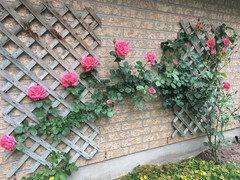
After reading this post, I stumbled across an old picture of some roses at the side of my house. I couldn’t believe the difference between the two.
The first picture was taken years ago when we first bought our house. The roses are untrained and pretty much ignored. No fertilizer etc.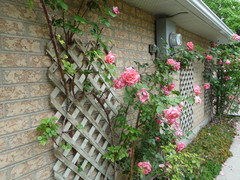
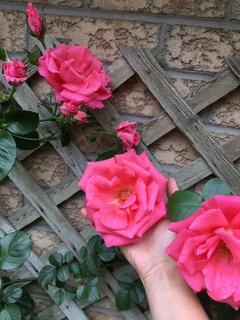
This picture is of the same roses, but with some TLC from me. (manure, rose food, seaweed fertilizer, regular watering etc)I couldn’t believe the difference, especially in the colour of the roses, and thought it worth sharing.
 7 years ago
Tammy, how interesting. I love the first photos too. They surely do look totally different.
 7 years ago
I do fertilize, compost and mulch, usually twice a year. Once in spring and once in fall. I am more interested in building up my soil than anything else. My house was about 13 years old when I moved in. Dirt (ack, my teacher would be aghast that I used the word dirt instead of soil!, but it was crummy dirt!) was builder grade junk that wouldn't even support weeds! I started with compost, worm castings, organic fertilizer, fish emulsion, bat guano, etc., to build up the soil to support some sort of life. Soil was mostly clay that wouldn't drain at all. So through amendments, after digging them in, adding fertilizer and compost for several years, I have some decent soil going on! I was shocked the other day when I was able to dig down over a foot with no difficulty! Soil was nice and friable. I guess what I was doing was making a difference after all!
Since where I live it is so hot during the summer that my roses go dormant in order to survive, I fertilize and add compost and a thick layer of mulch in late winter/early spring for my April bloom and then again in the fall (October) for my fall/early winter bloom. The compost and mulch help to retain water since I can only water either once or twice a week (no run off and can't water during certain hours). Keeping the roots cool during my hot summer really helps the plants to survive.
My soil instructor stated that if you have lawn, there may not be a need to fertilize if you take care of your lawn. He sees problems with over fertilization all the time. I have no lawn nor is there lawn anywhere near my yard. The lawn that is closest to me never gets fertilized and it shows. It truly looks awful.
I do use a good organic rose fertilizer, compost and mulch that breaks down over a couple of years. I have seen it make a huge difference in my soil over the years that I have lived here. That in turn, makes for better plants or plants that can better withstand the elements.
- 7 years ago
Mustbe, sounds like great advice for those of us starting with subsoil. I may try a second organic fertilizer/ manure/compost application this Fall this year to get a better Fall bloom. Last Fall, we didn't get much rain, and the Fall bloom was meh. I never prune the Tea roses, and I have read sometimes a little trim in the Fall could stimulate a better Fall bloom. I sure hate to push plants stressed by heat, thinking that might be harmful in the long run. It is great hearing from you.
- 7 years ago
Good to see you too, Sheila! I too worry about fertilizing again when it is hot so I tend to fertilize when the weather has cooled down in mid to late October. Gee, we are only hitting over 100 degrees every now and then during that time. I have to force dormancy late December to early January to give my roses a rest before they start all over again.
- 7 years ago
Now if only the rains would start as it cools down to alert me to get out there in the Fall. Here's hoping.
 7 years ago
I’m in the Pacific Northwest and I also have a mix of heritage roses, hybrid teas, floribundas, shrub roses, rugosas etc. My regime changes slightly year to year with a few constants. Firstly watering is most important, Our summers are considered meditranian with little to no rainfall... So for me with soil made up of almost entirely sand it’s all about building up organic matter and keeping things watered. Every spring I put about 5” of moo doo compost. (They changed the name, I’m not sure what it is now but they know what I’m talking about when I order it.). I give my roses a handful of pelleted fertilizer. (The fertilizer may be what the local rose society purchases or it my be 16-16-16.). I spread coffee grounds on the beds. (I’m using much more this year) and I water in fish fertilizer/ kelp sporadically. I’m hoping to get ahold of arborist wood chips but so far chipdrop has been a bust so maybe I’ll purchase some this year.
 7 years agolast modified: 7 years ago
I fertilize annually with an organic fertilizer at bud break, followed by a topping of compost. Most years, that is it. This produces a healthy, pretty garden but will NOT produce competition-worthy roses. Also, I have a clay based soil. Sandy soils don't hold onto fertilizer very well, and would need more frequent fertilization. To be honest, I plan to do a second round of fertilizing on the stone-mulched areas that where I cannot put down compost.



Ken Wilkinson