Software
Houzz Logo Print
highsierrabob

Mastic for dryer vent duct

7 years ago

What type of mastic can I use to assemble galvanized dryer vent pipe? Also, to assemble galvanized to ABS plastic that was used for dryer duct.

Comments (21)

  • 7 years ago

    The most typical process is three self-tapping sheet metal screws, spaced evenly around the flange, and then sealing with foil HVAC tape (not the same as duct tape). https://www.lowes.com/pd/Simply-Conserve-24-Pack-2-in-W-x-150-ft-L-HVAC-Tap/1000115073

    There are also brush-on HVAC mastic products (e.g., https://www.lowes.com/pd/Design-Polymerics-64-fl-oz-Gray-Duct-Sealant/3736193), but you shouldn't need them if you use the screws and foil tape. The screws and tape are also a lot easier to take apart later if you need to disconnect the dryer.

    Bruce

  • 7 years ago

    Building code prohibits screws anywhere in a dryer vent system. Lint will collect on them and grow until it creates a blockage.

  • 7 years ago

    I would check to see if the mastic can stand the heat of dryer exhaust.

    highsierrabob thanked weedmeister
  • PRO
    7 years ago

    Modern day clothes dryers temperature range is 125-135 degrees. If you have thought ahead and use a double wall vent pipe for the dryer, the double wall vent pipe has slide on locking mechanism that doesn't require screws or any form of mastic.

    I don't know that ABS plastic would be ok for such temps of a dryer. You would have to check your local codes. I doubt I would chance it if it were me.

    You should never use any form of screws on dryer vent pipes as stated above by other poster, because any form of blockage will lead to fire risk.

    In addition to that the run should be as straight and short as possible. (The dryer should be located indoors near an exterior wall.)

    Any dryer vent pipe, should also have means to be easily cleaned out. ( I wouldn't use mastic to seal anything on a dryer vent.)

    highsierrabob thanked Austin Air Companie
  • 7 years ago

    "Modern day clothes dryers temperature range is 125-135 degrees."

    That's typical for the low temperature setting. High temp runs 30°F higher ... typically reaches 155°F to 165°F. Can be more than that if a malfunction occurs.

  • PRO
    7 years ago

    I'm sure there are variances from one manufacture to another and depending on if a commercial dryer is chosen.

    But it's also possible to have a automatic temperature sensor which detects moisture and temperature level of the clothes which will 'automatically' effect the overall temperature level achieved by the dryer.

    Dryer temperature ranges

  • 7 years ago

    Greetings, Austin Air.


    I've worked on washers & dryers for years since working for an appliance dealer during and a few years after high school ... which was, let's say ... more than 30 years ago.


    The article you linked is very simplistic and wrong on several points.


    Moisture sensors do not control the temperature. Thermostats or thermistors do that. Moisture sensors control the time by reacting to ... moisture levels.


    Temperature control is not a new thing. Dryers had thermostats all the way back to the 1950s. Various brands/models had choices of 2, 3, up to 5 temperature. Some had individual bimetal thermostats, one for each temp choice. Others had a variable thermostat similar to an oven or room air conditioner (Whirlpool is one of the brands that used this method on some models). Kenmore had some models with a misleading "Fabric Care" switch labeled for up to 6 settings but really had only high and low temps.


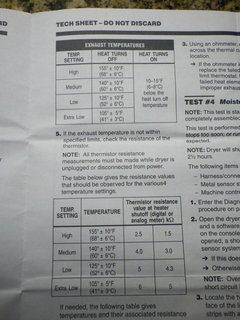
    I recently replaced a bad thermistor on a 2006 Whirlpool that caused the machine to overheat and blow the (91°C / 195°F) thermal fuse on the blower housing. Here's a snap from one of the service docs regards to the temperature settings.


    Did the same repair a couple years ago on my sister's Samsung. High temperature reached 165°F+ (via an instant-read thermometer at the exhaust) after the heating element cut out (*after* the repair), with no clothes loaded. Clothes in the drum absorb heat and help moderate the swing "differential" between around the setpoint when the element (or gas burner) cycles on/off.


    The service documentation for my dryer, circa 2010, states high temperature is 149°F. Medium is 140°F. Low is 127°F. It's a model that touts better clothes care via lower temperatures and higher airflow rates.


    Etc.

  • PRO
    7 years ago
    last modified: 7 years ago

    I said 'Modern Day' meaning 2019. Not 2010 or 2006 etc.

    If you read the article it tells you that manufacturer's have been dropping higher temps as of late.

    Moisture indicators if provided would work in combination with temperature sensors.

    With that said this isn't meant to include every single dryer ever made or the technology of sensors and so on, because there is a broad range in price of various dryers available and functions those dryers provide in terms of sensors and such or the high temp sensor of the dryer itself will ultimately vary due to the cost of the dryer. Not to mention, things change from time to time. The high temp limit of the dryer would be one of them.

    It would be like me saying the high temp limit for every furnace is 150 degrees. Blanket statements do not work... which ultimately is why I said 'MODERN DAY'. Those words provide context for what I mean.

  • 7 years ago

    I looked up the bimetal temperature control thermostat located on the blower housing of a current model dryer on Whirlpool's web site. It's an L-155.

    Some models from some brands may well operate at lower temperature. Or may have an "energy saving" cycle that heats to a higher target temperature for the first heat-up, then drops to a lower temp for remainder of the drying.

    The OP doesn't say what brand/model/age is his dryer.

    Can't bank on everyone asking questions about exhaust design having a modern-day low-temp machine.

    Best wishes to all!

  • PRO
    7 years ago

    Can't bank on everyone asking questions about exhaust design having a modern-day low-temp machine.

    Well there was an assumption being made that if someone was installing a 'new' vent... that in all probability that 'new vent' would be hooked to a new machine.

    Certainly there's parameters of being outside the range given... there isn't a 'set' specific high temp limit for such things just as in the case of a high limit cut out for a gas furnace. It will vary from one manufacturer to the next as well as how it's designed in relation to moisture & temperature sensors of the machine, if so provided.

    The statement I made was merely trying to be contextually specific, but that being said you have to actually read and understand my thought process. I used information to back up the statement, whether you like where I obtained that information or not it's still a provided source.

    Just like you can't bank on someone having a machine at all. Clothesline dryers operate most of the time at less than 90 degrees (OAT). Due to the context of the thread we know it's not a clothesline dryer.

  • 7 years ago

    " Clothesline dryers operate most of the time at less than 90 degrees (OAT). "

    And here I thought it was always hotter than that in Texas...

  • 7 years ago

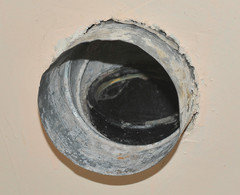
    The reason for the post is because a plumber recently told me about mastic that could be used to assemble dryer vent ducting but he didn't mention a brand. I have run into homes where the main galvanized duct protrudes through the wall into the laundry room about 1/4 inch. It is damn near impossible to attach the transition duct to that and properly secure it with a clamp. I am trying to avoid cutting into the wall to add a duct extension, so that's the reason for the inquiry about mastic or duct adhesive. The added section would be directly behind the dryer, so the heat would be around 140 degrees or so. JB Weld?

  • 7 years ago

    You might be able to find a mastic that would hold, but how will you detach the vent to clean it? And to be clear it must be cleaned at least once a year or you risk a fire.

    highsierrabob thanked hcbm
  • 7 years ago

    The added section of dust might be 2 inches in length, if that. Just enough to easily attach the transition duct and be able to securely clamp it.

  • 7 years ago

    HU-295....Now I understand. Artist often have to join dislike materials. I'm thinking a two part epoxy might work. Or think outside the box and possibly some double stick tape. Art supply houses have all kinds of adhesives, including double sides tapes etc...

  • PRO
    7 years ago

    No, you don't need an epoxy. You should visit HD they have dryer vent extensions that have a clamp prefixed to the extension. Fix that over your vent, tighten via the provided clamp and then attach your flexible dryer vent to the extension piece.

    The other option you may have to use is an extension that is perforated on one end, that end should slide in your vent that protrudes from the wall. It should fit snuggly then attach your flexible dryer vent to that.

    In terms of Texas heat, today were supposed to have highs in the 60's. By Saturday closer to 80, then next week highs only in the 50's.

  • 7 years ago

    I use tape followed by mastic. Makes for a clean install. Why are transtitioning to ABS though. I would try to eliminate that in the run if possible ?

  • 7 years ago
    last modified: 7 years ago


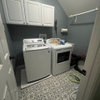
    a1fan - I have come across some houses where the builder used ABS plastic for the main dryer duct in the wall and under the concrete slab. Some I have come across are even 3 inch instead of 4! Notice the galvanized elbow here that connects to a 3 inch ABS pipe in the wall. They must have used ABS so that the concrete wouldn't attack the galvanized in the cement slab.

  • 7 years ago

    Yes, particularly at the 90 degree elbows.

  • 7 years ago

    I bought a bucket of DP-1020 and connected two adjustable galvanized elbows together with it. Connected it to the rear of the dryer and ran it for one hour. It is water based and is rated for 200 degrees and seems to have withstood the heat load. Does anyone know anything about using spray foam around the dryer vent penetration in the wall? Is that stuff safe to use directly on the vent pipe? The manufacturer says it is safe to 240 degrees, but I like to question everything!