Software
Houzz Logo Print
waynealabama

Drainage problem.

7 years ago

I noticed some bulbs (Iris) drowning in a container. I emptied it and discovered that the drainage hole in this large(15 inches?) ceramic pot is less than the size of a dime. Additionally, the drainage hole is elevated from the lowest part of the pot. I live in central Alabama where there are long periods of hot weather without rain and long periods of heavy rain, and I can be inconsistent because of health problems. I wonder if it is even possible plant this so that it will drain and not drown the plants. Maybe I should let it be wet and grow Bamboo.


Comments (13)

  • 7 years ago
    last modified: 7 years ago

    You could also try a wick. Common materials used for wicks include propylene felt strips, tiki torch wicks, fibrous rope, nylon rope, braided polyurethane yarn, mop head strands, cotton rope or even strips of old fabrics and blanket.

    waynealabama thanked mblan13
  • 7 years ago

    Hole is probably too small. But I have a question. Is your container elevated or sitting on the ground? If the latter, I would suggest elevating. A few pieces of flagstone, slate, or pot feet.

    waynealabama thanked popmama (Colorado, USDA z5)
  • 7 years ago

    Agree with GG, water barriers are quite effective with bamboo, so obviously it doesn't like saturated soils.

    waynealabama thanked dbarron
  • 7 years ago

    Thanks for the ideas. I am especially reminded of the need to elevate the pot. I have learned (and forgotten) this in the past. Other, better drained, pots hav become too wet during the rainy season.

  • 7 years ago

    This is a very thick pot. It would be tough to enlarge the hole, or add another.

  • 7 years ago

    Mblant, regarding the wick idea...do you mean a wick going out the hole to improve drainage?

  • 7 years ago

    If drainage hole is in elevated area as you mentioned, I would rather add some (2 or 3) in lowest areas.

  • 7 years ago

    wayne-

    You can get masonry bit sets at Harbor Freight or Amazon for cheap. For example, Harbor Freight has a set of 5 bits ranging in size up to 1" and the whole thing costs less than $20. I've drilled out many pots with these. You turn the pot upside down, put some water on the surface you are going to drill, start with a smaller diameter, and work your way up. I've enlarged existing holes and added new ones and have yet to break a pot.

  • 7 years ago

    I love the pot. I think I will try it.

  • 7 years ago

    Wayne, Yes it will keep the water moving downward like there is more earth underneath, and out of the pot.

  • 7 years ago

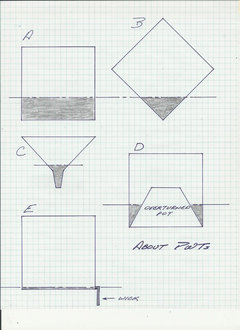
    It doesn't matter if there is a 3" hole in the bottom of your pot, or a 1/4" hole. When the pot has been watered to beyond the point of saturation and left to drain, the amount of water in the soil is called 'container capacity. A battle between 1/4" and 3" would turn out to be a draw, same amount of water in the soil at container capacity. This also holds true for 1 hole vs 10 holes - same amount of water in the soil at container capacity. Also, if the soil supports perched water, the ht of the PWT in either case would be the same. The only real benefit to having more "hole space" is the pot drains a little faster, but the plant doesn't care if it takes 60 seconds or 6 minutes for the soil to drain. It does matter if the drain hole(s) is/are not in the bottom, though. That can be a serious problem. The bottom of any drain hole in the side of the pot should right on the bottom of the pot to avoid unhealthy issues. The ideal place for the drain hole(s) is through the pot bottom at the pot wall. That way, you can tip the pot with the hole at the lowest point. If you use water-retentive media, simply tipping your pots after a thorough watering will passively eliminate a LOT of excess water from the soil. See A vs B below.

    Also, take note of E - using a wick. The shaded area represents perched water.

    Drilling holes in pots

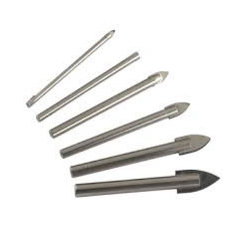
    Masonry bits work fairish for drilling soft clay terra cotta pots, but are not the best choice. The 2 types of drill bits most appropriate for
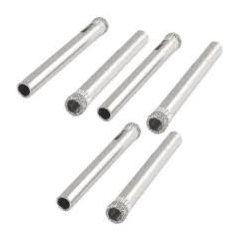
    drilling holes in pots are a diamond core drill for the highly
    vitrified (hard material - baked at very high temps - glass, ceramic,
    ......) pots, and a drill with several names for drilling clay pots
    fired at low temps, such as terra cotta. That (carbide) drill is
    called a 3-point drill, spear point drill, or a spade drill, seen
    here:

    For the hard stuff, diamond core drills are best,
    though the 3 point drill will drill the hard stuff, too.

    You can buy either type at big box stores. They're
    not that expensive, and they last a long time if you take care of
    them. They are best used with a steady stream of coolant from a
    squeeze bottle (contact lens solution bottles work great for this) or
    with the work surface barely submerged; that is to say, put the pot upside down
    in a tub and fill the tub with water until it just covers the work
    surface. If you use a spritzer or squirt bottle, a 50/50 mix of
    antifreeze and water is an excellent coolant, and soapy water is
    better than plain water but not as good as the antifreeze mix. The
    coolant keeps the tool from over-heating, and in doing so, increases
    the life of the tool substantially - like triple or quadruple the
    number of holes you can drill.

    As noted, regular masonry bits are "ok" for drilling terra cotta or
    cement (you can make them work), but inappropriate for anything
    harder. The right tool makes everything easier.

    Al

  • 7 years ago

    Never thought of using antifreeze. Cool idea :)) Often I use plumbers putty to make a small dam to hold the coolant usually soapy water. Pointy tip spade bits will break through and the coolant will leak away with my method. But as long as the bit is in constant contact with the material it will slow down the leakage of the coolant. A blob of putty on the exit side is also helpful - if it sticks.

    waynealabama thanked tropicofcancer (6b SW-PA)
Sponsored
Whisler Home Improvement
Average rating: 5 out of 5 stars9 Reviews
Franklin County's Committed Home Improvement Professionals