

How Decorating Has Evolved
In looking back I think it is interesting how decorating of spaces has evolved. Some were utilitarian spaces never meant to be decorated but rather were where chores were done -- the kitchen, the laundry and even the bathroom.
In looking at old pictures or decorating magazines, these rooms are never mentioned -- instead it is the living room, dining room, libraries and even bedrooms where decorating takes place.
Kitchens had cabinets and cupboards and perhaps a clock on the wall so the cook could tell time. No art, no decorative stuff -- if it was out, it was useful! In the 50s, IMO, kitchens started getting "decorated" -- canisters had a theme, often there were decorative items on the walls and wallpaper and color were added. And it grew from there!!!! Now we have statement pendants, art, decorative items on shelves and in glass front cabinets. Kitchens often look show room ready rather than a work place to fix a meal -- all the workplace stuff is hidden in drawers or cabinets.
Bathrooms, too, were utilitarian. You went in there for two purposes -- to clean up and to ... well, you know! Fixtures were white, there were rods so towels could dry and perhaps a rug on the floor for wet feet after you stepped out of the bathtub. And again in the 50s, bathrooms started being "decorated" -- stuff on the wall (although what I remember is often "water" themed like shells and the like -- and then as we progressed to vanities, those got decorated not only with lotions and soap but "things". And early on, a lot of that was "water" related with a basket of shells perhaps. Now we have pictures on the walls, the stuff on the vanity is often purely decorative (except perhaps for the soap) and it is a pretty room.
Then there is the laundry room -- in the basement for years and years. Concrete or brick walls, concrete floor, perhaps something between the washer and dryer (once those began being made -- in early days it was a wringer washer and lines to hang wash out in the winter). But we moved them upstairs where they were more convenient. At first it was just a room with sheetrock walls and a linoleum floor and a shelf for the laundry detergent and fabric softener. But then we decided that we needed to upgrade that space. And so we hung pictures, we hid the laundry detergent and fabric softener in either pretty containers or behind closed doors. Then we began hiding the washer and dryer itself so it was a prettier room!
Lastly, there is the back door. It's where the family came in. Perhaps there were some hooks to hang a coat but that was about it -- it was pretty plain Jane. NOW, we have "mud rooms" with benches and cubbies and lockers! And decorative items like boots and hats hanging out to "make it pretty" and pictures or sayings on the walls.
I'm not saying what we've done is bad . . . I'm just saying that as space becomes closer to living areas, we decorate that space.
I love watching old movies and seeing the bathrooms and kitchens of a time now past. A time when life was simpler and we didn't have to "decorate" spaces that were used as "workhorses"!
Comments (40)
 7 years agolast modified: 7 years ago
Keep in mind that "decorating" was initially an upper class endeavour, and at a time when labor was cheaper and income tax was nonexistent, the upper classes could well afford ample help. So they did not perform their own household chores and would not have decorated spaces used solely by the help.
User thanked mtnrdredux_gw 7 years ago
Well I am heading back the other way. Function over form. I want easy to clean and easy to access what I need. No desire to clear decorative clutter or dust knick knacks so I can use the space. I have gone back to the way of my parents. The skillet I use almost daily lives on a range burner, not in some cabinet.
User thanked wildchild2x2Related Professionals
McAlester Interior Designers & Decorators · Savannah Furniture & Accessories · Lafayette Furniture & Accessories · Hannibal Furniture & Accessories · Shreveport Furniture & Accessories · Rock Hill Furniture & Accessories · Petersburg Furniture & Accessories · Peoria Furniture & Accessories · Harrisonburg Interior Designers & Decorators · Richmond Architects & Building Designers · Concord Architects & Building Designers · Miami Architects & Building Designers · Plymouth Architects & Building Designers · Marinette Architects & Building Designers · Hilo Architects & Building Designers 7 years ago
I did a tour of a wealthy families home from back in the 1920's and 30's and the main two floors where the family lived was decorated and done very nicely with beautiful finishes but the helps floor which was the very upper level was very utilitarian.
User thanked katrina_ellen- 7 years ago
Indeed, the amount of money and time people spend on decorating what were functional spaces continues to astonish me. Clearly people have ample funds and excess time to be able to devote so much of each to aesthetics. When updating my bathroom, the contractor asked me to select a toilet. I told him that he should pick one that fulfilled its basic function. Beyond that, a toilet wasn't worth my time. Life is too short and too precious to worry a toilet.
User thanked User - 7 years ago
One exception that I can think of is the beautiful tile work that was done in the bathrooms of the 20's to 50's era.
User thanked User - 7 years agolast modified: 7 years ago
I'm gonna have to take issue with this. Attention was always paid to kitchens and bathrooms.
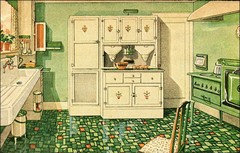
Two ads featuring kitchens, from 1924 and 1929:

A couple of existing bathrooms from 1928: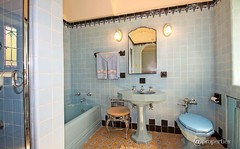
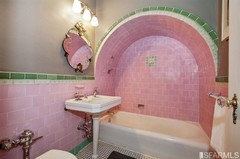
I deliberately chose that second kitchen to show that what was super-trendy at the time isn't in tune with today's tastes, but they did care, a lot, if they could afford it. Now for a lot of folks a very basic bathroom was already a big upgrade at that time--the 1924 Kohler catalog, for instance, devotes a lot of space to explaining how much nicer life will be if you can come in all filthy from the farm and soak in a huge porcelain tub, as opposed to washing in a galvanized washtub, but people have always cared about these areas. We just can't see their ideas as stylish because we think they're just outmoded.ETA Those are all very middle-class. The rich were every bit as lavish as today, and then some.
The tented bathroom at James Deering's Vizcaya, for instance:

- 7 years ago
Decorating style is forever changing. The one style I could never figure out was "shabby chic" . I hated it. I just couldn't make sense of it. My furnishings were all shabby when I was first married . I wasn't proud of them , but we had what we could afford. Now I do minimal ( but nice ) decorating . If I have to dust it - I don't want it ! LOL
- 7 years agolast modified: 7 years ago
I don't even understand what shabby chic means, other than fake distressing and peely paint. It seems to be a catchall term these days for anything that isn't MCM, the way people over in the houzz kitchen forum call any kitchen they don't like "tuscan" even though that term is only applicable about one time in ten that they use it.
User
Original Author7 years agolast modified: 7 years agoWritersblock -- those kitchens emphasize my point -- the floor is beautiful -- but where are is the art? The "stuff" hanging on the walls to "decorate" the space? I LOVE both kitchens! They are functional -- so they don't have wall words or a huge clock or a wreath -- they IMO are PERFECT kitchens!
As are the bathrooms which are today I assume. Everything is beautiful but functional! You can have both beauty and function -- it's the extra layer of "decorating" that I was talking about! There are no seahorses on either bathroom wall . . . or a statement piece of art. They're there to do what you are supposed to do in them!
 7 years ago
I grew up in the 50's and I can remember our kids' bathroom as having wallpaper....and several framed pieces of artwork. Ditto the main level powder room. The kitchen didn't have much in the way of added decor simply because there wasn't room. What wall space there was was filled with cabinets, appliances and windows. The adjacent breakfast nook did have a shelf under a high window that was filled with houseplants but the opposing solid wall did have a display of decorative plates.
 7 years ago
Keep in mind that our country went through the Great Depression during the 1930s, and that didn't really end until after WWII was over - mid 1940s(?).
I think this factors in. There was an big rise in prosperity, and lots of new consumer goods that were marketed to the masses starting mid 20th century.
- 7 years agolast modified: 7 years ago
Am I allowed to point out that humans have been decorating their living spaces since the dawn of time? Many cave dwellers weren't content simply living with plain ol' rock, but created works of art such as this, and surely found it beautiful and life-enhancing. This may have been a means of communication among traveling tribes, but I don't think there's any question that it is also art and "decor" of sorts.

OK, so you probably didn't mean to go THIS far back, but still. Just saying that the inherent need to "pretty up" one's personal space is simply part of who we are as a species.  7 years ago
My favorite kitchen in all the world was my great aunt's kitchen. It was totally utilitarian, but big and roomy. If I could have any kitchen, I'd have that one.
Another change in decorating is using the dining room for different purposes than dining. My son used his as the "boat room" where they kept things having to do with their sailboat. My niece used hers as a playroom. The $1M+ house across from me doesn't even have a dining room. It does have a large eating area in the very fancy kitchen.
 7 years ago
I think a lot depends on how you define "decorating". It can mean hanging art, but to me it also means thoughtful use of tile and colors other than white, so for me those kitchens and bathrooms posted by writersblock certainly qualify as being "decorated".
writersblock, I would take that second kitchen in a heartbeat, with the addition of a few modern conveniences.
Victorian bathrooms were things of beauty. Here's a tub from 1888,

from a good article, "A Quick History of the Bathroom" in The Brownstowner. The article points out that few photographs of those early bathrooms exist, because first it was considered unseemly to photograph the room where the ablutions took place, and also because most of the original details "just didn’t survive the constant change for the newest thing". The article describes an ad for some new Brooklyn row houses in 1897 with fancy bathrooms and also dressing rooms,
“The second floor, reached by a broad staircase of hard wood, consists of elegant alcove apartments, and the dressing rooms are provided with marble trimmed cabinet lavatories, spacious wardrobes and large beveled plate mirrors. The bathrooms are wainscoted in marble tile, and the appointments comprise a full sized bath tub, marble lavatory, etc.”
Following up on some of the pictures writersblock posted, the article continues,
In 1927, the Kohler Company introduced the bathroom set: matching sinks, toilets and tubs. It was not only a great marketing tool, it heralded the beginning of the acceptance of the bathroom as not only a sanitary necessity, but an important room to be decorated, with care and an important expenditure of funds.
Which reminds me of the toilet seat and tank covers, with matching rugs, I remember first seeing in the sixties as a child, and I thought they were so fancy lol. On the other hand, I was thoroughly unimpressed with our 1920s-era white and black tile and porcelain bathroom in our prewar NYC apartment, which looked like the bathrooms of pretty much everyone else I knew who lived in an older apartment. My grandmother's friend in the suburbs even had that knitted thingamajig to cover the toilet paper rolls.
How we've lived in the past 125 years or so has definitely changed how we use and decorate our houses, and also how we design/build our houses. Part of it is the decline in domestic help -- up until the 1950s for so, maids (including live-ins), cooks, cleaners, nannies used to be a fixture of even for the middle class, but now it's something reserved for the wealthy. Part of it is the ubiquity of car culture, where attached garages and entering the house through the back/side entrance (often directly from the garage) have helped to make the front door/entry almost vestigial for a lot of people.
When you don't have a maid or a cook, and have to cook and clean the kitchen yourself, and work outside the home and look after the kids by yourself, the dining room can become vestigial too, especially as life becomes more casual and a lot of families aren't able to eat meals at the same time. And then it starts to make sense to take down walls, so that if you, rather than the maid or the cook, are the person in the kitchen, you're not not off in a separate room, away from the fun in the living room during the few hours (or less) you have together.
- 7 years ago
Writersblock...that pink and green bath made my Lilly-clad heart swoon! :) If my husband could tolerate it, I’d retile my bath to that in a skinny minute. :)
- 7 years ago
There were folks who hung pictures clipped from magazines on the walls of their outhouse. I recall seeing them when I was a child.
- 7 years ago
grew up in the 50's and I can remember our kids' bathroom as having wallpaper.
Yes, I grew up in a 3-br built in 1960, and our bath as kids had lovely wallpaper. I would actually like to have that bathroom now.
The kitchen didn't have much in the way of added decor simply because there wasn't room
Yes, exactly. The older I get the more I appreciate how very well the kitchen in our house was designed, but there was only enough blank wall space there for a not-very-large clock. Since space is the cheapest thing to build into a house in most areas in the US, with the highest ROI for the developer, I think that's what has driven the need to find stuff to use to cover blank wall space. There's just a lot more of it. Also, air conditioning. Old houses in FL have as many windows as they could squeeze in, for cross-ventilation. - 7 years ago
I was thoroughly unimpressed with our 1920s-era white and black tile and porcelain bathroom in our prewar NYC apartment
becky, I grew up in that same kind of apartment, and my mother remained in the building for nearly 50 years. When she passed away the landlord gutted the kitchen and bathrooms; the new ones, while I'm sure much more appealing to renters, now lack all charm.
- 7 years ago
becky, I grew up in that same kind of apartment, and my mother remained in the building for nearly 50 years. When she passed away the landlord gutted the kitchen and bathrooms; the new ones, while I'm sure much more appealing to renters, now lack all charm.
It wasn't until I was in college that I properly appreciated the bathroom and kitchen : ) . My parents lasted just shy of 50 years in theirs, until their deaths nine years ago. They had been rent control the whole time (part of the building went co-op), and as soon as my mother died and we got everything cleared out, they redid the entire apartment, which wasn't a surprise, since there weren't proper kitchen cabinets, just built-ins, including two china cabinets which separated the kitchen proper from the eat-in area, covered with decades of oil paint. And the cabinet over the fridge was so low you couldn't get a decent-sized fridge in the space. I especially loved the double cast-iron enamel sink (in a metal sink cabinet), and the original 1920s gas range. I knew nothing would be saved from the original apartment, so I removed the old glass doorknobs and replaced them with some basic ones from the nearby hardware store lol.
I always thought it would have been fun to do a sensitive remodel of the apartment -- especially the glass-paned doors to/from the living room, which someone long before my parents had painted over, sigh. But since they were rent control, my parents never wanted to make the investment.
The hex tiles in the bathroom were quite worn, and as a child I used to look for "faces" in them : ) .
- 7 years agolast modified: 7 years ago
including two china cabinets which separated the kitchen proper from the eat-in area, covered with decades of oil paint.
That sounds exactly like my mother's kitchen. But she was only rent-stabilized, not rent controlled, and her building never went co-op, alas, or I'd now own a nice apt. on the UWS!
 7 years ago
I imagine a lot of decorating is very personal and all about who you are and what you want to have around you. I have to have art in every room, including the bathroom and certainly the kitchen, because it makes me happy and enriches my life. Lots of other people would think that to be so much clutter that they'd never look at and would just take more dusting. There's no right or wrong and it transcends time because I've done it for decades, no matter what the fashions of the time. I imagine that's true for a lot of people; you surround yourself with your idea of a happy and comfortable home, whether minimal or maximal, and whether in great taste or rather tacky. I can remember being very happy in surroundings very different from what I would choose in my grandmother's and great aunts' homes because of the association of love and familiarity, with all kinds of clutter and knicknacks that was rather cozy. The whole topic of decoration is so complex because of what we all bring to it in our own experiences, memories and even education and culture.
My kitchen with 19th century doggie on the wall and 18th and 19th century Chinese porcelain and 19th century German porcelain pug. This could very well look tacky and old-fashioned to quite a few people.
- 7 years ago
That sounds exactly like my mother's kitchen. But she was only rent-stabilized, not rent controlled, and her building never went co-op, alas, or I'd now own a nice apt. on the UWS!
Very few of the rent control tenants, and a lot of the rent stabilized tenants, opted to buy when they had the choice in the eighties. My parents and a lot of tenants who had been in the building for 20+ years had legitimate concerns about the building being able to afford the necessary upkeep without 100 percent co-op ownership.
It occurred to me at the time, while dealing with the estate, where we ended up having to pay some costs ourselves, that it would have been helpful if my parents had decided to buy, so that we would have had something to sell, sigh.
 7 years ago
Agree that this all depends on how you define decorating. My grandparents 1920,s home had fabulous bathroom tile, and fancy medicine cabinets with etched mirrors. All original to the home. A lovely claw-foot tub too. My grandma had placed a painting in the bathroom above the tub, but no idea when it was placed there. Kitchen also had beautiful tile, no room for any artwork there, very small.
- 7 years ago
It's interesting to consider that one of the current popular decorating styles is "farmhouse", because a real farm house is about as utilitarian as it comes. I think a lot of what some people consider "decorating", especially the more utilitarian spaces like bathrooms and laundry rooms, is the result of some people seeing a style that's so different from what they're accustomed to and then adopting/adapting it for their own homes because it strikes them as attractive and different. So people in more rural areas might be taken with the idea of covering the powder room walls with New Yorker covers, and some in the burbs will be taken with beadboard/board and batten in the laundry room, along with old-fashioned glass or enamel canisters for detergent etc.
I do think in recent years, Martha Stewart and her magazine have played a large role in getting people, especially women, to consider "prettifying" their everyday surroundings. I still remember the big fuss everyone made at the time about her idea of decanting dish soap into a glass bottle, and making each corner, including garages and closets, attractive as well as functional. And not so surprisingly she's also been selling a variety of items over the years to help aptly-termed consumers achieve that end. Ikea and their catalogues have been good for showing how one can easily and inexpensively decorate every corner of the house. And the past 15 or so years saw first people with blogs, and then Pinterest and Instagram looking for ever-more DIY projects as blog/Pinterest fodder, which has meant that no corner of the house was spared.
- 7 years ago
I have no pictures hanging in our bathroom, just a couple of vintage shelves and some vintage ceramic items for storage. It's pretty utilitarian, I guess. I just don't care for decorative things that can absorb germs and dirt in a bathroom.
Now I'm wondering whether some of this might be more specifically called 'accessorizing', rather than simply 'decorating'...?
- 7 years ago
Julia Child's Kitchen
https://lithub.com/how-to-arrange-your-kitchen-according-to-julia-child/  7 years ago
It definitely has something to do with where you live. My sisters (one in Germany the other in Australia) both have bathrooms without decorations.. as well as my relatives (in Germany).
The kitchens are really eat in kitchens, and have paintings and stuff on the walls, in the eating area. In the kitchen proper, is no room for such.
Moni
- 7 years agolast modified: 7 years ago
That pink bathroom with the arched bathtub cove is one of the most fantastic things I've seen posted on Houzz! Love it or hate it, that is some serious style, and style is sorely lacking in many people's homes nowadays.
I remember the bathroom in the first house I lived in back in the early 70s -- it had green, black, and white tile. I don't think my parents put that in, so I would guess it would have been from the 50s or maybe 40s? That was a great-looking bathroom.BTW: Love the dog painting -- I'd totally go for that in my house.
 PRO7 years ago
I have pictures in two of my three bathrooms - used to be in all, but I decided to let the color of the wallpaper shine in that one. Decorated laundry? It's in the basement and is about as far from being "decorated" as it can be! Strictly utilitarian.
My in-laws had live-in help, and the did "decorate" her room if one means nice paint, carpet and curtains. She added her own pictures etc. They also provided her with a LR as well as her BR - all furnished by them. They were simple but pleasant rooms.
- 7 years ago
seniorgal mentioned hanging magazine pages in outhouses for decoration. I have original pages from old National Geographic hanging in my bathroom. I guess I haven't evolved much :)

- 7 years ago
In my kitchen I try to go functional over décor, although I do have some décor there. I do leave my microwave, coffee maker and toaster oven out on the counter - I use them often (mostly to re-heat coffee or to make tea). The cutting board (well, it's 2 x 2.5 feet), the knife stand are all out for use. If I had a spot to hang cast iron skillets, I'd be doing that. Instead, those spots are taken up by the spice racks. And a clock. And space for the garlic to hang.
There are a couple decorative items on a small shelf, and I keep three items on top of the fridge, two of which are actually functional - one is a working replica of an old fashioned coffee grinder, which I haven't yet used because I don't want to dirty the wood with ground coffee - but if we get to a long power outage, I'm set...
- 7 years ago
Everything is beautiful but functional! You can have both beauty and function -- it's the extra layer of "decorating" that I was talking about! There are no seahorses on either bathroom wall . . . or a statement piece of art.
Yes, but don't forget they had wallpaper to do that. I thought of this thread when I ran across this photo from a house that I looked at and loved, loved, loved last year but it was way out of our price range: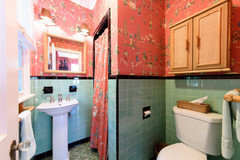
The sink is a replacement, and maybe the toilet, but otherwise they kept it as it was in 1946. Of course, the wallpaper and shower curtain have been renewed but it was always a red chinoiserie. Really now, what could you add to that? It seems to me there's at least enough going on in that room.User thanked writersblock (9b/10a) - 7 years ago
Thought of this conversation while watching these videos on Youtube.
Lately, I've become fascinated with these old educational and industrial films, and there are tons of them on Youtube.
It is fun to note the styles, colors and decor details of these 'modern' kitchens, and I wonder, where these shown in theaters, or maybe at the World's Fair?
These films are marked "ca. 1941", but they look like they may even be slightly earlier.:
So modern!  7 years ago
I do think you're right, Becky about Martha and her influence on that regard. (I remember buying my mother a parody magazine called, "IS Martha Stuart Living?" that poked fun at the idea of making utilitarian things decorative). Though I do have to give Martha props for the fact that each of her homes that she showcased was distinctly different. And much of what appeared in her magazine when I used to get it in the early 2000's still looks good today. I don't think I could say the same of BH&G or other shelter magazines aimed at the masses. Much of it was timeless. Although much of the decor that got sold under her label (especially at K-mart) maybe not so much.
Of course, every time I want to rage about social media in general an Instagram in particular being responsible for the painful sameness of modern decorating trends, I run across something like this, and realize it's pretty much always been the case:
I would, however, argue that sometimes the whole modern farmhouse things FEELS more samey-samey because everything is in the grey/white color family. You can recognize other period styles for what they are pretty easily, but most of them had somewhat wider color palettes. You kitchen was rusty orange OR harvest gold OR avocado green. Now all True Kitchens(TM) are white or grey.
Possibly that's another nuance: for so long now, wallpaper has been verboten and the dominant color schemes for walls and flooring has been either grey or beige. That requires lots of decorative elements to bring in color.
- 7 years agolast modified: 7 years ago
Very interesting, carolb. I happened to be looking at books of house plans from 1941 last night and was struck by the fact that they all had a big patriotic sermon at the beginning, something you never see in plan books from previous years, so that does seem to be a 1941 thing, for some reason. Maybe getting people ready for the war. Even before Pearl Harbor it was becoming obvious that we'd have to get involved.
I loved the under-cab lighting and that fold-up kitchen nook. But I had to laugh at how many of the "new" features had been in the old kitchen, too. The hoosier would have had a bread drawer and flour bin, too, for instance, and there'd been deep well cookers as far back as the 20s. Dishwashers, too, although not front-loaders. I'm not sure what they meant about "dreary" colors, though--everything post WWI was very colorful in the kitchen, more so than the early 40s, actually, when colors began to get a hefty dose of black or beige as opposed to the clear colors popular before.
- 7 years agolast modified: 7 years ago
That is a fascinating article and explains a lot. Thanks, Holly.
I had no personal experience with weird sofas until I left the Upper West Side of Manhattan for rural Alberta, when two weird, and strangely weightless (and incredibly uncomfortable), orange and brown plaid sofas greeted me in my new home. My new husband, living in the 1950s bungalow on the farm he had bought in the early 90s, needed furniture, so he bought the two sofas at an auction sale. I was appalled, and couldn't wait for the moving truck to arrive with all of my NYC furniture, including my B. Altman sofa. The orange sofas lived in our basement for a while, covered with sheets, until I was able to get rid of them.
Possibly that's another nuance: for so long now, wallpaper has been verboten and the dominant color schemes for walls and flooring has been either grey or beige. That requires lots of decorative elements to bring in color.
The Gunsmoke sofa article led me to this one, which is equally fascinating,
https://www.collectorsweekly.com/articles/the-great-wallpaper-rebellion
I always find it rather whiplash-inducing to go from GW/Houzz where wallpaper is the devil to the designer projects I favor (Peter Dunham, Mark Sikes, Michael S. Smith) where wallpaper is highly desirable.
 PRO7 years ago
We have paintings and sculpture hanging in our bathrooms, but then we have paintings hanging in the garage. We've always had more paintings than space, and so we've always had paintings in the bathrooms.
- PRO7 years ago
When I was at UT studying Interior Design, I tried to find as many historical books on interior design as I could - and that is not an easy task. I was especially interested to find anything Russian, but when I did, it turned out to be rather dreadful. It had pictures of Russian kitchens from around the 1930s or maybe 1940s, and they were a bit more primitive than I had expected. I'm very limited in the amount of Russian I can read, but I can read enough to find the books and then look at the pictures.
I don't think it has been all that long ago that some people still used wood-burning stoves, and refrigerators are a fairly new invention as well.
- 7 years ago
Becky, thank you for the link! I enjoyed that piece, as well.
Lars - Some people still use wood burning stoves. There is an active market for them. I actually tried to figure out how to work a 2 burner Esse into my new kitchen as an emergency back-up.





leela4