Software
Houzz Logo Print
salvatore_giordano8

Garage Sub-panel Wiring Confusion - Please Help?

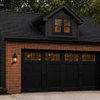
Hello all – I’m looking for some clarification on wiring my newly-built detached garage.


At the outset, I’ll say I am not a complete novice with electrical, as I wired half of my house myself and installed an automatic standby generator myself as well. I’ve done a lot of minor electric work, though never major stuff like service entrance work with large aluminum wire. My setup is as follows:


I have 200 amp service in my house (2 main panels), with plenty of empty spots for circuits and breakers. I would need a little over 100’ of wire to connect the main service panel in the house to the subpanel in the garage. I already have 1 ¼” grey pvc conduit buried between the house and the garage site. I do wish now I have gone for something bigger, depending on what size wire I end up having to pull. AND, for what it’s worth, it is considered a farm building by my county, so it will not get inspected (which does NOT mean I want it to be unsafe, however!)


The garage is going to have two garage door openers, some general use receptacles, some lights, and a workshop. The biggest load I’d have in the workshop would be a compressor (just larger than a pancake one, but NOT one of the big stand-up ones) and a table saw (not a real industrial one, basic Lowes model). Only one or two tools would be used at the same time – no welders or anything like that.


My plan was to install a 60-amp breaker in my home’s main service panel, a 100-amp subpanel in the garage, and to connect to the two with 6-3 copper wire (NM-B/Romex). In reading about the question of a ground wire, it seems that my sub-panel in the garage should be the SE-R type and have a separate ground and ground rod, right?


My questions are about 1) the breaker in the house main panel, 2) the sub-panel in the garage, and 3) the most confusing part of it all seems to be the wire. I’ll start there.


1) Will 6/3 copper wire suffice for this project? AND, how much of a bear will it be to pull 100’ of that through the 1 ¼” conduit?


2) I am very confused about THHN wire – are they copper or aluminum or either? Why would I choose THHN over either NM-B/Romex or aluminum?


3) If I needed something more than 6/3, should I consider aluminum? If I went with aluminum would I need #2, #4, or #6? If it’s being fed from a 60amp breaker in my main panel, it seems like I could use #4 wire (smaller and easier to pull I imagine)


4) If I really needed to, I could dig and use Direct Burial Romex if that makes the process easier (although it seems they also make direct burial aluminum).


It’s really the wire that there seems to be a lot of debate about. Perhaps 6/3 is too small?


Any help greatly appreciated!

Comments (10)

  • 7 years ago

    so Bruce, can you just explain the numbers in the way aluminum wire is classified? 2-2-2-4 means the wire is 2 gauge (as in thickness) or 4 gauge? Those numbers confuse the heck out of me. Also, are you saying that something like "#4-3 w/gnd" aluminum wire would be too small? I'm reading that that wire would be appropriate as a feeder for a 60 amp subpanel. I guess ultimately the question is, do I size the wire for the garage sub-panel (in this case 100 amps) OR is it sized for the breaker in the main house panel feeding it (60 amps)? Will giant aluminum wire (#2) sized for the 100 amp sub-panel even fit into the 60 amp double pole breaker in the main house panel? Thanks again!

  • 7 years ago
    last modified: 7 years ago

    It means three of the wires (the "current carrying" ones: two hots and a neutral) are 2 gauge and the fourth (the grounding wire) is four gauge. This is just common nomenclature (doesn't necessarily apply to aluminum vs. copper). The ground, which doesn't normally carry current is sized based on the breaker on the circuit and can be smaller in many circumstances which is why many of the large "feeder" cables provide a smaller one like this.

    Again, what you need to do is compute the load that the garage needs. Then you size the conductors based on the ampacity required. You then have to protect the feeder conductors (and all other components) with a breaker that is not larger than the ampacity of those components.

    A decent sized air compressor typically draws about 16A (usually installed on a 20A) circuit. You then have to add in the prospective loads of all the other stuff you're going to have out there. Frankly, 60A is not unreasonable.

    A 60A feeder is going to require 4 gauge aluminum for the current carrying wires. Even at 100' (one way) the voltage drop is going to be within limits there. You can get away with an 8 gauge grounding wire.

    6 Guage is right out for more than 50A.

    Breakers are spec'd for a large variety of wire size, and while each manufacturer is different, a SquareD QO breaker at 60A is spec'd for up to 2 gauge wires (either aluminum or copper).


  • 7 years ago

    ok, Ron, that makes sense - thanks!

  • 7 years ago

    You might want to think about picking up a book on basic wiring to better understand the types of wire/cable and their approved uses. NM-B cable (frequently called Romex [a brand name], much like facial tissue is often called Kleenex) is only approved for dry locations. Anything underground, even in conduit is considered a wet location. UF-B cable is approved for wet locations and direct burial (at a specified depth). Typically one pulls individual wires in conduit or uses a direct burial cable, sheathing it as it comes out of the ground for physical protection if necessary.

    Aluminum is used because it's usually cheaper than copper but because you need to use a heaver gauge, it's more difficult to work with. Largely a matter of personal preference and budget.

    At 100' you need to consider voltage drop. I'm getting #6 copper or #4 aluminum to keep drop under 3%.

  • 7 years ago

    If you use stranded wire it will easier to pull. Use cable lubricant

  • 7 years ago

    60A is going to require 4g Al just for base ampacity. (and I did run the voltage drop numbers and it's less than 2%).


  • 7 years ago

    Thanks for all the responses, everyone. Based on the size of my conduit, it looks like i will have to go with #6 awg copper. I looked at the aluminum wire I'd need and that would be insane trying to pull that through. Copper is more expensive, i know, but I guess that's the price of my poor planning!


    so XHHW-2 stranded copper it is - 3 conductors at 6 gauge for the hots and the neutral, one 8 gauge conductor for the ground -


    BUT, about the ground, everyone is telling me that I'll do a separate ground rod at the garage (2 rods actually), so why do i need the ground running from the house to the garage subpanel?


    As for the subpanel, I've read that I need to "isolate the neutral from the ground," but I do not know exactly what that means. I'm looking at a sub-panel that is "plug-on neutral ready." Is that the kind I'm looking for?


    Thanks again!

  • 7 years ago
    last modified: 7 years ago

    A panel has a bonding screw that makes the ground and the neutral the same. To make it a subpanel you want to remove the bonding screw. Then the neutral and grounds are separated, and you need to have a grounding bar. When you wire your garage the neutrals (white) will go to the neutral bar, and the bare copper grounds will go to the ground bar.

  • 7 years ago

    What you have to do depends on the panel. It depends on the manufacturer of the panel (we probably can help if you tell us what you have). Geoffrey_B describes one type of panel (Square D panels work the way he describes, remove the bond screw and add a separate grond bar). My CH ones, you just unscrew an interconnection strap and you now have one bonded (for grounds) and one non-bonded (for neutral) bus bar. But the fundamental answer is that the grounds and the neutrals must be kept separate at locations other than at the service disconnects (in my house even the main panel has isolated grounds and neutrals as the actual service disconnect is beyond the generator transfers witch).