Software
Houzz Logo Print
svengoli123

Flower Bed Design

7 years ago
Hi,


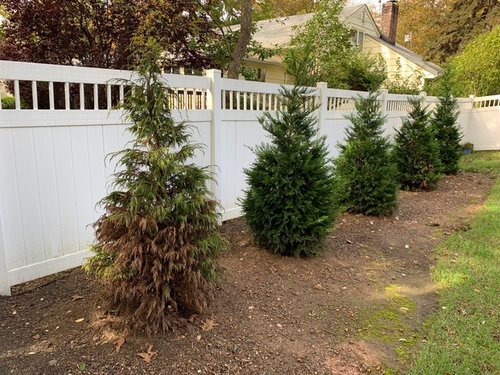
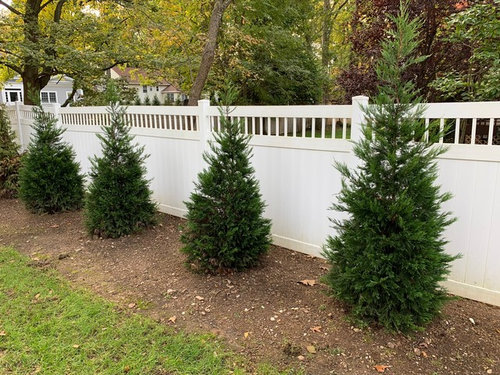
I recently planted 5 Leland Cypress (1 died, but being replaced) for a privacy screen. I would now like to create a flower bed at the base, but need help and recommendations. The area unfortunately has rocky clay soil, and receives partial sun. I will be mulching the area w/ black mulch.


Ideally, I would like some flowering plants throughout the season.


Open to ideas. Appreciate the help!


Comments (17)

  • 7 years ago

    I forgot to mention, I am in Zone 7a (New Jersey)

  • 7 years ago

    Smaller flowering plants/shrubs and perennials are not good companions for Leyland cypress. In fact, not much of anything is!! Between the spread of the lower branches of the leylands and the very dry and rooty soils that exist at their root zone, it would be extremely difficult to get much of anything established and survive long term. If you want to plant something in front of them, it would need to be placed at a good distance away from the leylands....at least 10' and more would be better.

    IOW, if you want a flower bed, pick another location :-)

  • 7 years ago

    You could have a flowerbed while they're small, but that won't be for long.

  • PRO
    7 years ago

    The term "flower bed" says "annuals" to most of us ... the kind of flowering plants that are changed out a couple times per year, as they do not last all that long. Dry, rocky, rooty soils are not the kind of soil that a person would want to bother amending (including expense) so as to create nice, rich, fluffy soil like annuals require. I would consider this an area for groundcover only as they do not need all the soil prep, with the knowledge that the Leylands will eat some of it as they grow. Liriope muscari gives a nice bloom in summer so that might be an option. Maybe even daylilies if you can get with that look.

  • 7 years ago

    To clarify, I am thinking of Perennials, not annuals.... Sorry about that

  • PRO
    7 years ago

    Groundcovers, of which I gave a couple of examples, usually are some type of perennial. Why don't you create a short list of things that appeal to you. (You can search google for Perennials for zone 7, or your state in order to find pictures of them) and then submit the short list to the thread. We can tell you what would be likely to work.

  • 7 years ago

    Being totally transparent, the only plants I ever planted were some hydrangeas, and some small emerald green arbs. For this project, I am hoping to add some flowering plants that bloom at different periods of the season. I like the purple, pinks, dark blue, maybe even some red colors. I am open to some hostas, and maybe some ornamental grasses. I don't want it to look like I planted some random plants. I guess keeping it symmetrical is somewhat important.


    hope that helps....

  • 7 years ago

    One of my favorite beds when I was living in NY was to start with daffodil's, and then perennial tulips, bearded iris and then day lilies. That gave me flowers throughout the season and the larger flowers would eventually cover over the dying leaves of the earlier flowers. Plus all are so easy to upkeep in your area.

  • 7 years ago

    Are you aware of how fast and how large these trees grow? What you may decide to plant there now and hope to keep alive will likely be smothered/covered by the trees next season. Unless, as I suggested previously, you plant a good deal in front of or away from the base of the trees.

    btw, limbing up Leyland cypress is not an attractive look and not recommended. You can shear them into a hedge but that requires considerable attention and maintenance.

    These trees simply do not play well with others!! They grow too big too fast and produce a very wide-spreading root system.

  • PRO
    7 years ago

    Perennials that you might consider are Blackeyed Susans, Shasta Daisy & Cerastigma (Leadwort). They are very easy care & will thrive until the trees get very large.

  • PRO
    7 years ago

    "I guess keeping it symmetrical is somewhat important." Ha ... keeping it PLAIN will be important! As Gardengal said, these trees are going to eat up the space fast. It's not good soil so you can't really "play" in it like you might in a normal perennial or garden bed. This is more going to be a matter of putting in the most durable, quick thing you can find and enjoy it until they are eaten by Leylands.

    "I don't want it to look like I planted some random plants." I think if you put more than one thing in -- since you have very little room -- that's what it's going to look like.

  • 7 years ago
    last modified: 7 years ago

    You will have to shear these to get them to work in that setting. In my climate area Leyland cypress was producing average crown spreads of as much as 25 ft. by the 1990's. One at the Seattle arboretum was over 90 ft. tall by 2005, with over 120 ft. having been seen elsewhere.

  • 7 years ago

    When these were put in, I was not aware of their size potential. Ideally, I don't want them getting taller than 15 feet or so. Once they reach that level, I will need to prune or eventually remove and replace. So, I will ensure anything that is planted, will not be swallowed by the leylands...

  • 7 years ago

    How about Phlox?

  • 7 years ago
    last modified: 7 years ago

    You can't let them go until they are 15 ft. tall and then start shearing. If they are going to be used as formal specimens they need to sheared as they develop. And you will need to keep them small enough that you can reach all the way to the top.

    Even with close shearing from the start you will have to let them grow a little bigger every year, not ever cut back into them farther than the outer shell of foliage.

    So if you are thinking in terms of eventual replacement it would be a lot easier to remove them now and start over with something else, that is not a large-growing tree requiring much more space than that bed provides. And will not grow well beyond the fence and onto the neighboring property, if not kept sheared.

    Also if you let them grow for some years and then cut them down, in addition to having to handle and process the tops you will be left with their stumps and roots. Are you going to dig them all out? Even if the stumps are cut low to the ground the beds will have been filled with roots, that will be in the way every time you try to plant anything new. Or divide and re-plant existing perennials.

  • 7 years ago
    last modified: 7 years ago

    In addition to Leyland cypress the much sold - including at warehouse stores, at this time of the year - and planted screening conifer in my area is Thuja occidentalis 'Smaragd' (Emerald in English). This forms a compact rich green cigar (or similar shape) that is much smaller growing than the cypress. Probably it is more the kind of thing you had in mind. If flowers are to be planted with the screen the most practical thing would be to plant that closer to the fence, to provide a backdrop, rather than mixing the screening and the smaller plants together.

    Also the conifers need to be planted close enough to one another that they merge within a reasonable period of time. Otherwise it will remain possible to see past them for the all the years it takes them to grow together with a wider spacing.

    And the evergreen backdrop will need to be installed far enough from the fence that it is possible to walk between the fence and the hedge any time the fence may need to be attended for some reason. If you need more room to have both a hedge and a strip of flowers of much consequence make the bed wider.