Software
Houzz Logo Print
longtee81

Jefferson Elm Tree - Pruning Advice

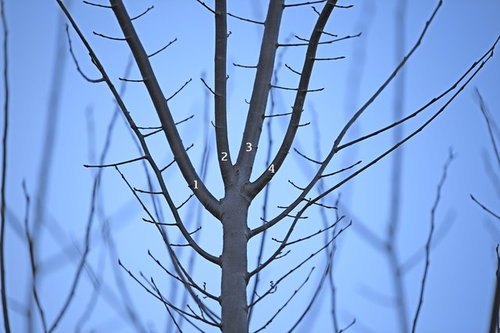
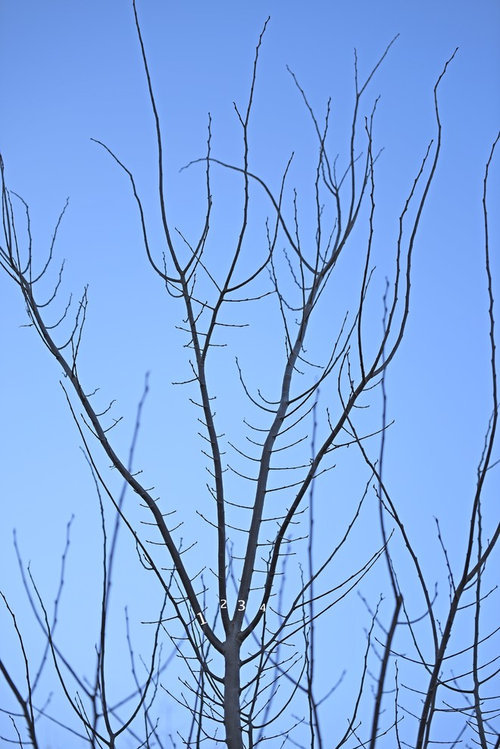
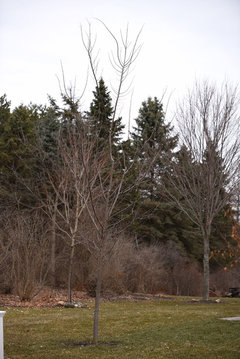
The following four branches on my Jefferson elm tree are about 12-15 feet off the ground and the tree appears to be losing the single leader it had up to that point which is OK by me. I would like to keep all four of them as they spread in different directions, but was wondering if the Branched marked #2 should be removed as it appears to be included.


I know that this is common in elms, so maybe it's OK but was looking for some advice on which of these I should remove (if any).


Thanks!

Steve

Comments (12)

  • 7 years ago
    last modified: 7 years ago

    Agree with Ken, #2 should go, and I think I'd subordinate #1 and #4 a bit.

    Also agree with Ken's postscript ;)

  • 7 years ago

    I'd remove #2 and #4. Both are too tight to the central leader (#3) for my liking. If they don't have included bark in the crotch, they will when the branches continue to grow and fatten up. And then subordinate/reduction cut #1. It's an elm so it'll fill back in quickly. Smaller branches with better branch angles will start to develop and grow once they have more light.


    And I disagree with Ken's post-script. Green has already won enough. Go maroon & gold. :P

  • 7 years ago

    the good wishes is about the big 10 teams winning ... lol


    as dave notes .... the term is SUBORDINATION PRUNING... im sure you can search that term out.. and learn about it ... in tree time.. you just dont need to cut all the way back.. all at once ... just dont leave a large stub there forever ....


    BTW ... none of these ideas are elm rules.... the rules are all the same.. regardless of tree type....


    going to need a pole trimmer ... the type with a hook and rope ... to shorten the others .... the idea is simply.. to clearly inform the tree which is the leader by shortening others ...


    ken


    https://duckduckgo.com/?q=SUBORDINATION+PRUNING&t=ffcm&ia=web

  • 7 years ago

    Thanks everyone for the advice!


    I went for it and took off both #2 and #4. #2 came off well, but #4 was a tough angle and pulled away some fo the bark. I think it should be OK with time.


    What would a subordination cut do on branch #1? I'm thinking of keeping both #1 and #3 as permanent branches and letting it fork from there. Would there still be a reason to make a subordinate cut if I do not plan to remove it later?


    Thanks again and just this one time.... GO BLUE!


  • 7 years ago

    A reduction cut (NOT a heading cut) would just help slow down the growth of branch #1 so you don't potentially end up with such a large wishbone fork. The branch joint appears strong though. Your choice.


    https://hort.ifas.ufl.edu/woody/stem-reduction.shtml


    Great pics you've posted, BTW. Rotten game! :D

  • 7 years ago

    the 64000 dollar question.. how did you get up there???


    i didnt know msu was playing mn .. lol ... oh well ...


    ken

  • 7 years ago

    I measured it, and it was only 11.5 ft :), but I managed to get to the top of an 8 foot ladder and could barely reach with my tools. Pretty scary, don't think I will try that again!


    Thanks all for the very helpful comments!

    Minnesota had a few moments, but MSU was playing too well to beat.


  • 7 years ago

    I managed to get to the top of an 8 foot ladder and could barely reach with my tools. Pretty scary, don't think I will try that again!


    ==>> pretty sure that what the guy who fell off the ladder said ...


    back in the day .. i used to chain my extension ladder to the tree .. lol ... but then the trees were about 6 inch diameter .... i quit doing that ... lol


    ken

  • 7 years ago

    I can't believe you took advice from the blue! lol


    With a tree that naturally has concurrent leaders you're sometimes better leaving them that high up but structurally you're in a better place. I'd suggest following mntree's advice and make that cut to the left side branch. The wishbone/y effect is visually too dominating and will remain so.

  • 7 years ago

    Exactly Ken!!


    Yes, taking advice from the Blue was definitely questionable, and probably crazier than scaling that ladder to make the pruning cuts!


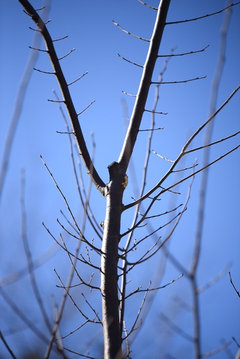
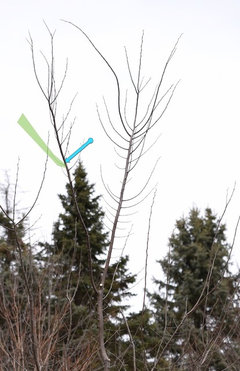
    Now that I've created this wishbone, I'm contemplating taking the recommendation to subordinate the left side branch. I am thinking it would take place with the blue marked off area in this picture, allowing the green horizontal branch to move away from the primary leader.


    Am I correct to assume, I would need to come back in few years and take the rest of it off then, or would this be a future permanent branch, and if that's the case I'm not sure what direction I should be steering it with this subordinate cut.


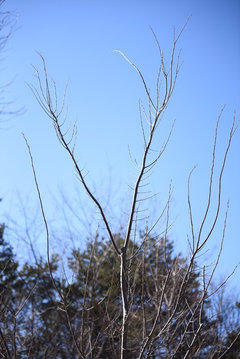
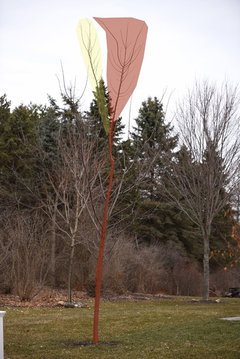
    Also, one other element that I want to keep in mind is that there are some trees not in the picture to the left of this (maybe 35-40 feet), which I believe are causing the trunk to veer right a little bit as shown in the picture below:


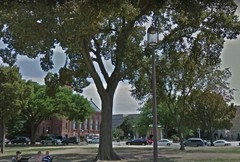
    If I eventually remove the yellow branch in a couple of years (branch 1), will the remaining trunk look a bit silly? I think it may continue to fall even more to the right which could pull this tree even more in that direction. Looking at the original Jefferson Elm tree in Washington DC it appears to start with the wishbone dual leaders and then fills out nicely above that. I am leaning towards keeping them both with hopes that it can look like this when I'm long gone. Any recommendations after these additional facts?


    Here are a couple of pictures of the original Jefferson Elm:


    Thanks!!


  • 7 years ago

    Personally I'd cut it off completely so that its balanced.


    Although it may look a bit thin in the top half this year, a vigorous and established plant will fill in quickly.


    I'd be inclined to nip off that left side vigorous lateral on main branch #1 - you're new leader.


    If you don't have a stable ladder that is tall enough to comfortably reach these cuts than skip it all together, lol