

Trees I'll be growing from seed.
Just thought I'd post up here, showing what I'll be growing this season.
I wanted to try these:
- Hackberry (Celtis occidentalis)
- HopHornBeam (Ostrya virginiana)
- Northern White Cedar (Thuja occidentalis)
- Norway Spruce (Picea Abies)
- Eastern Hemlock (Tsuga canadensis)
The germination period has been successful to varying degrees.
I stratified and tried to germinate hundreds of seeds but I'm okay ending up with just one to a couple/few of each because they are intended for my own personal use in the yard.
These all germinated within a week or so of each other but the development speed varies quite a bit between genus. All native local collected seeds by me last Autumn.
Hackberry: (2)
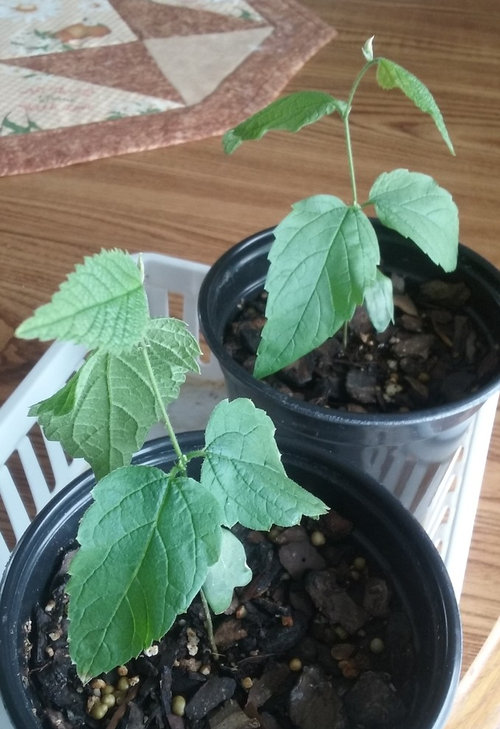
HopHornBeam: (6)
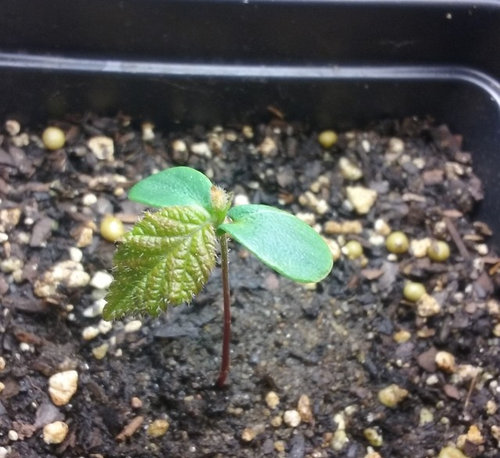
Northern White Cedar: (500) (all but 3 are for my sons wildlife project).
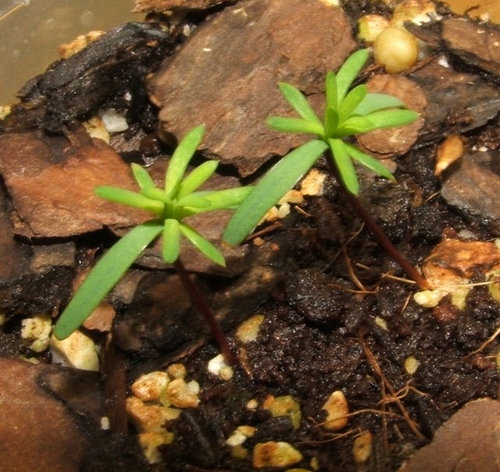
Norway Spruce: (1)
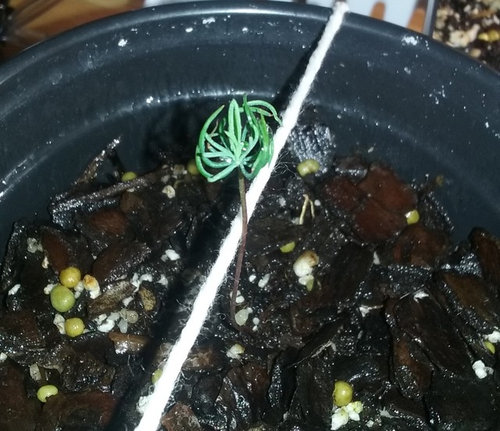
Eastern Hemlock: (2)
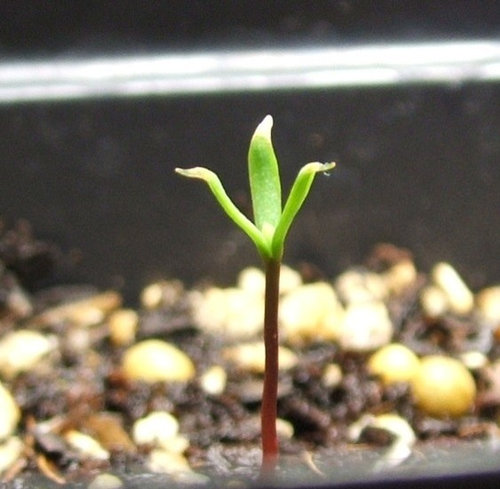
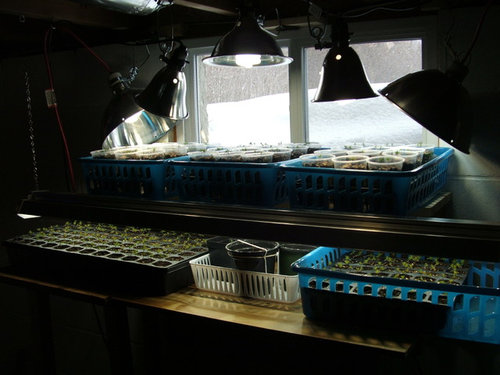
My (windy/cool days) light station for when plants can't be out on the deck. :-)
So there you have it for this season. I'll try to update as things succeed, or fail miserably. ;o)
Comments (87)
 6 years ago
I've been following this all year Bill, it's one of my favourite threads on the forums.
It's inspired me to post my own thread for my 2019 seedlings, which I might get around to today.
Quick question on your tree shelters, which you may have answered at some point above but I didn't catch it on a quick scan just now: Did you drill those air circulation holes yourself? Or did those tubes come with some at the base of the tube?
User thanked brothergarm
User
Original Author6 years agoThe extruded translucent tubes that I bought, were from our local 'soil & water' conservation office. These particular ones didn't have holes, save for a couple 'tie straps' to go through. So I drilled some in.
Some tubes I've seen are perforated or have a row of holes the entire length of the tube.
I like having a couple of rows around the bottom perimeter that I either drill or punch. I don't think you can over do it. :-)
A quarter inch diameter is a good size bc it limits the size of bugs that can enter. I almost lost the Celtis when it was first planted, only 2-1/2" tall by a bug that ate almost all the leaves, so for a tiny seedling, it may be wise to use some mesh over the top of the tube. Fortunately, the tree came back and is the one in the last picture.
Yes, It's important to have good air circulation, especially during the hot weather.
Related Professionals
Myrtle Beach Landscape Architects & Landscape Designers · Norfolk Landscape Architects & Landscape Designers · Oxnard Landscape Architects & Landscape Designers · Fort Myers Landscape Contractors · Los Angeles Landscape Contractors · Charlotte Home Builders · Las Vegas Home Builders · Mesquite Landscape Architects & Landscape Designers · Cheyenne Landscape Architects & Landscape Designers · Cornwall Landscape Architects & Landscape Designers · Madison Home Additions · St. Louis Home Additions · McComb Home Additions · Calgary Home Additions · Montréal Home Additions- 6 years ago
Awesome, thanks Bill, I will do the same with mine. I have a roll of window screen material that I could use that may work.
User thanked brothergarm User
Original Author6 years agolast modified: 6 years agoFWIW: We have good snow cover so my new Thuja o. should be protected quite well for this winter.
I talked to my son who told be 'the bog' didn't have time to freeze before all the snow came so we'll find out if that's a good thing or not. It should mean the deer won't be foraging there bc it's too unstable and rabbits generally won't dig the deep snow for food.
Here's what the Thuja in my side yard looked like today. :o)
I'm sure the one in the back yard looks near the same. :-)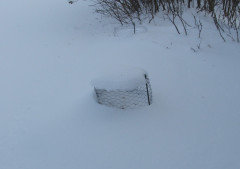
(the chicken wire a little further up in the pic is protecting a cutting of Red Osier dogwood I rooted/planted a year ago, rabbits seem to like it).
User
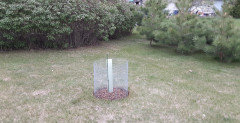
Original Author6 years agoPlanted one of the surviving 2019 Tsuga canadensis in the ground today. ~4" tall if it would stand up. ;-)
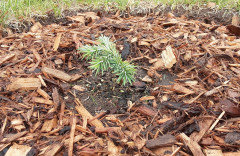
I chose a place in the yard that has the highest accumulation of snow during winter, hoping it will remain covered later in the spring. There's a grove of young Red pine to the south (right) that should keep the area shaded in February-March, in a couple of years.
User
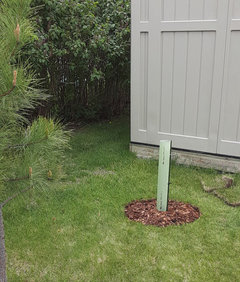
Original Author6 years agoPut the 'second best' Tsuga seedling in a protected area of the yard today. Did I mention these were seeds from the 'Minnesota State Champion Tree' ? :-)
 6 years ago
I just saw your earlier post with that thick snow cover. I don't even remember when was the last time we had so many snow... I kinda miss those winters, to be honest.
That Eastern hemlock seedling looks quite vigourous. :) Are these growing fast by the way?User thanked Norbert (zone 7a - Hungary)User
Original Author6 years agoLast couple winters we had a lot of snow but it can vary from year to year.
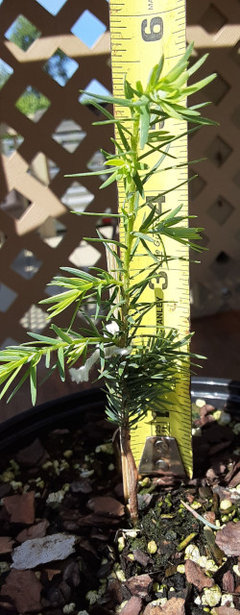
The two Hemlocks above were grown from seed last year and didn't do too well for me (1-1/2" high all season). I think they didn't have enough light early on and too cool.This year they've improved with better lights and warmer temps (added 3" so far) but I don't think they're considered 'fast growing'.
User
Original Author6 years agolast modified: 6 years agoOh, and just to update:
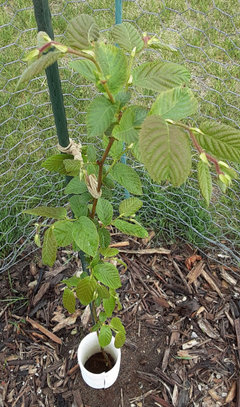
The hop hornbeam(2) came through winter quite well. They both are leafing out without any apparent damage. No more tubes on these as I want them to branch out like a smaller tree that it is. Ostrya viginiana:
One of the Thuja occidentalis came through very good and has continued growth. The other, in all day sun, I think, took a beating from the Mothers Day freeze or sun burned. It's making a come back but I may replace it. Here is the on that looks good. 7" tall, It's got some growing to do. :-)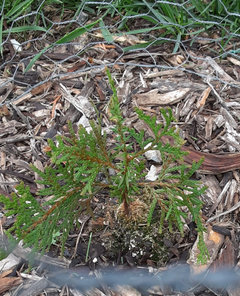
Hackberry came through good. I had to snip 8"-10" off the terminal end, could've been the MD freeze or just winter kill, idk.Celtis occidentalis:
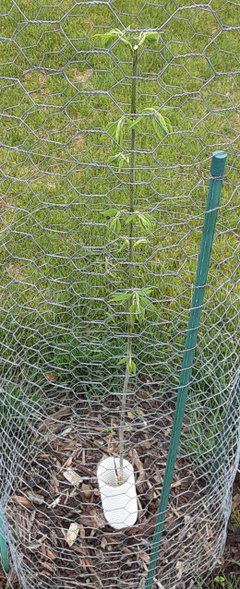
eta: the hackberry is back in it's tube for another foot or two: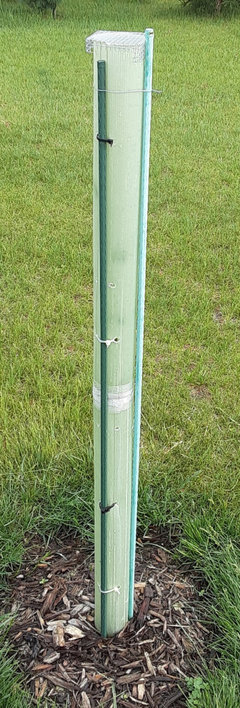
The Norway spruce went to my sons house/woods. :-)User
Original Author6 years ago6-9-2020
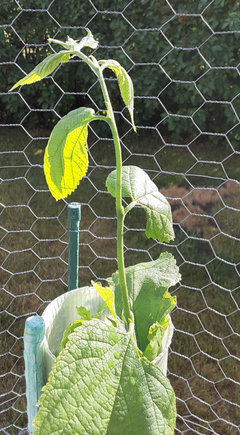
The hackberrry is liking these 90d+ temps, rain and high humidity. :-)
User
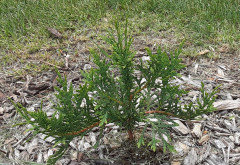
Original Author6 years agoThe Thuja occidentalis in my yard are branching out under full sun conditions. Approximately 10" wide x 8" tall. I haven't gotten word from the bog/tundra lately so not sure if those are doing as well.
User
Original Author6 years agolast modified: 6 years agoUpdate:
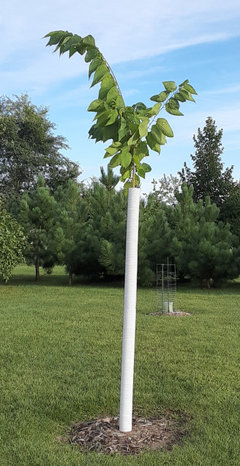
After Celtis occidentalis getting to 6 ft. tall and severe winds whipping the top part of the Hackberry against the chicken wire, I decided to remove the deer protection.
From past experience growing seedlings in tubes, I knew the trunk would be tall and spindly and would need support for a while. So what better time to start hardening off than now (early July)?
The trunk was so thin (1/4" dia.?) and the top 2-1/2 ft. is new growth, this is a little more unstable than even my Gleditsia triacanthos (honey locust) that I grew a year earlier. That one still needs one stake and a tie near the top, to prevent partial bending over at the bottom (but it's close). The rest of that trunk is pretty stiff and stable after supporting it last season.
So, here we go. It's branching out nicely at the top and even the smaller side branches are sending out new shoots even though I shortened them with the clippers several days ago.
I had to put the lower tie on to keep the trunk from bowing out, that's how unstable it was. I'll remove them as they lignify. (more to come end of summer). :-)
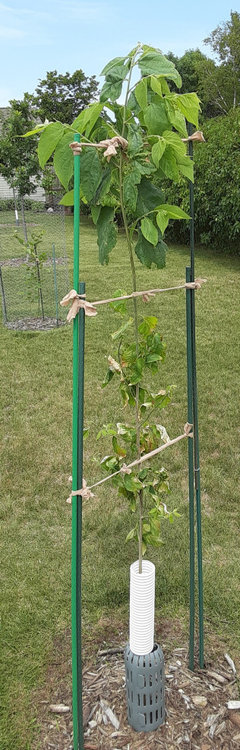
Now I just have to hope deer don't chomp into the middle of the trunk like they did last year to the HL. That made a nasty wound that is finishing it's encapsulation this season. I might use the 'fishline' technique too on this.eta: Just another pic after using a stick to straighten up the top.
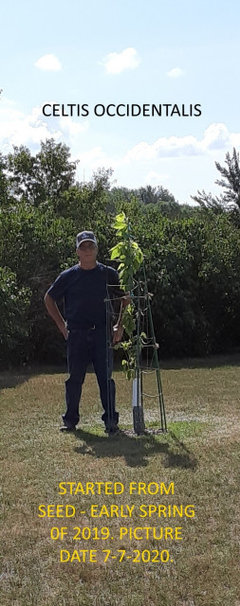
User
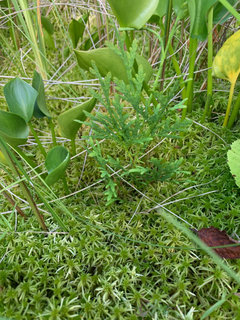
Original Author6 years agolast modified: 6 years agoPictures began coming in from the Floating bog yesterday. It appears there was a good winter survival rate for the Thuja occidentalis seedlings. :-)
User
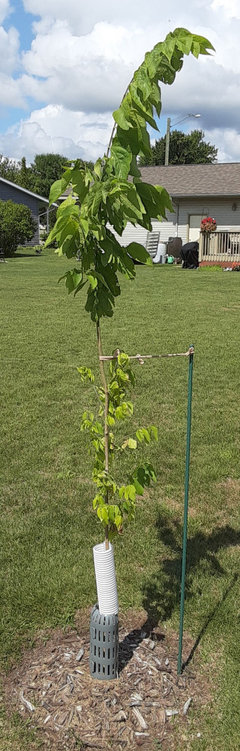
Original Author6 years agoGot the Hackberry down to one stake and one tie. NNE wind 10-15 mph today (view is from SE to NW). I let it go with no stake and it still leaned a little too much to the left. Maybe let it go in a couple of weeks.
User
Original Author6 years agoThe HopHornBeam are on their own. I'm keeping a rabbit fence around them bc of their low growth. I'm not worried about deer browsing them at this stage, they generally only eat the branch tips this time of year. Nice growth and are fully 4 ft. tall.
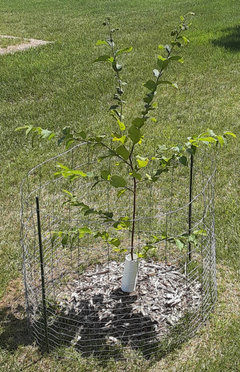
I do still have one tie on the specimen in the back yard, but it only leans an inch or two left, so I might just release it, in hopes it will become a more interesting form.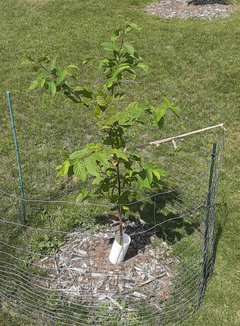
The Tsuga canadensis (MN state champ tree seed) in the ground haven't grown much but have 'thickened up'. I'm thinking they probably are putting roots down so maybe more growth will occur next year.#1 best of seedlings.
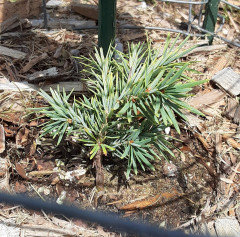
#2 best of seedlings: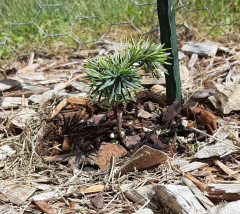
The one left in the pot (#3 best) has out done them all but could be a result of a very mild solution of fertilizer that all my potted plants receive.
The Thuja occidentalis that was winter sun burned this spring has recovered and the center stem is growing again although suffering somewhat of a set back. The side branches are growing as if nothing happened.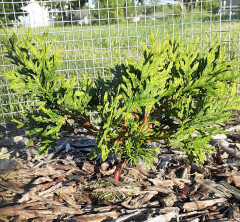
User
Original Author6 years agoToday, 20+MPH gusty wind with only one stake and a very loose tie.
The tree swayed and bent, almost bent over. When the wind died down, it stood back up perfectly straight. So it's on it's own now. I put the tubes on to prevent possible deer damage but may remove them during the day if winds get too strong.
User
Original Author5 years agolast modified: 5 years agoFWIW:
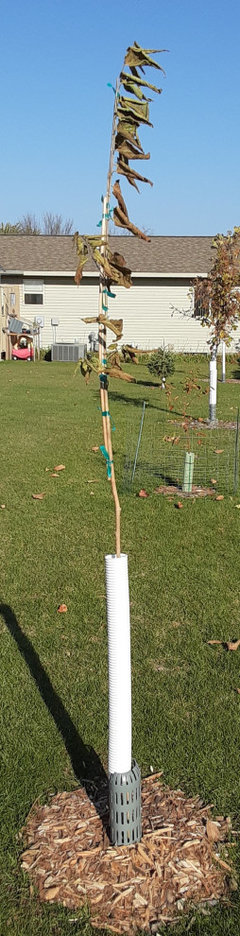
Celtis occidentalis is now loosing it's leaves. It's stood by itself all Fall. I tied a stick to the main leader to take some of the 'curve' out and that added to the weight up top but still standing.
So second year from seed, grown in a 'Tube' and very tall & spindly (early this season) is standing on it's own (hopefully next season too). :-)
 4 years agolast modified: 4 years ago
Time for an Update: :^)) 07-20-2022
I just thought I'd show these trees again, like a progress report.
Celtis occidentalis: Free range? (Is that a horticultural term?) ha-ha
Deer like to nip the lower branches.
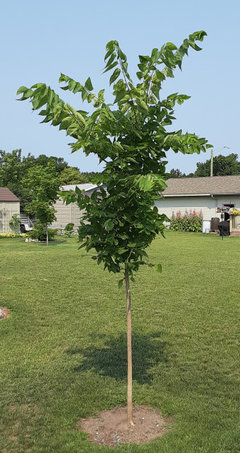
The trunk is beginning to show its form.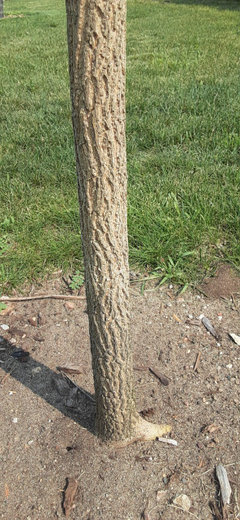
Ostrya virginiana: (east side of the house). It grew remarkably this season from ~5 ft to guessing near 10 ft. Water only no fertilizer on this one. I had to stake it again until it hardens off later this season.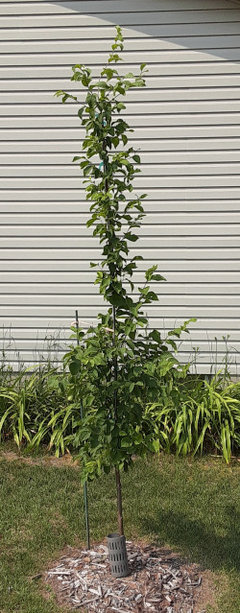
Ostrya virginiana: (Back yard). I cut an errant root right about bud break. I think that slowed it down but then I didn't have to stake it either. Live & learn but it'll be fine. lol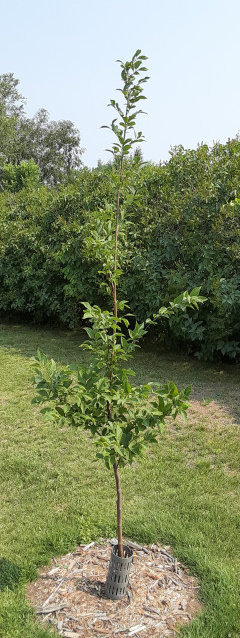
Thuja occidentalis: (back yard twin) The one that winter burned a couple winters ago. I moved it to a new location last Fall to avoid utility ROW problems. About 16" tall now and growing.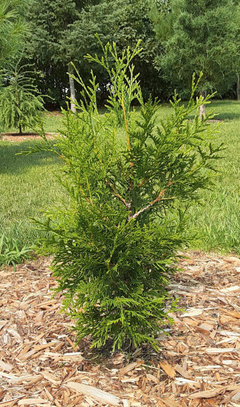
Thuja occidentalis: Front yard east side. About 3 ft. tall.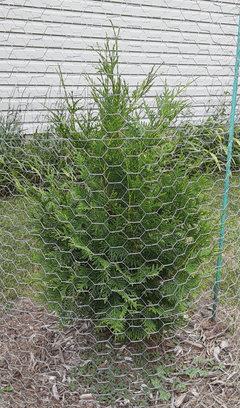
Tsuga canadensis: (back yard) It's my #3 potted 'back up' State champion MN tree seed. I ended up replacing the original bc it didn't perform well (probably my fault). It's over a foot tall and looking healthy.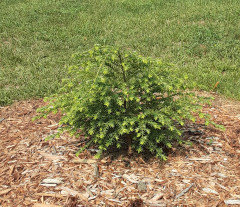
Tsuga canadensis: It's another replacement for the other T.c. from State champ seed that wasn't performing. I grew this one from seed collected somewhere in the northern New England states so it should have good provenance to grow around here.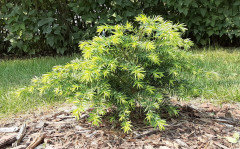
As an aside:I can't report on the Thuja o. we planted in the bog anymore as the land was sold to other people to buy land for a new adventure. Kids! :^)
FYI: Any trees not reported on in this last post, from earlier in this thread were either gifted and planted to the wild or died, or both. :)
- 3 years ago
Final season update: 9-9-22
The 3 trees that made remarkable progress since last update.
Thuja occidentalis from seed made 41" in overall height. I gave it a haircut a few weeks ago to prevent competing leader from taking over.
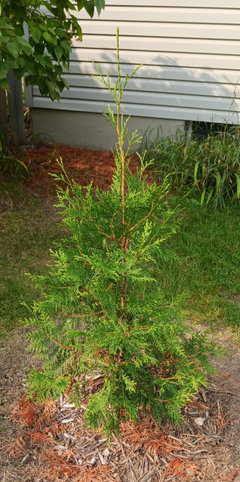
The two Hemlocks, first one from Dr. Kehrs tree in Brainerd and one from collected seed in northeast NH, both liked the warmth and moisture we experienced in August.24" tall. (The thin stake helps prevent snow from crushing the small plants during winter).

The NH tree is about 18" tall.
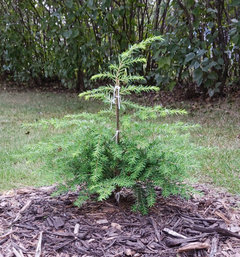
That will about do it for my growing season. Temps went from 90dF yesterday afternoon to 60dF last night. A shower of cold rain came with it. Lows in the low to mid 40's forecast next several nights. That'll slow things down.
:^)
 3 years agolast modified: 3 years ago
The compost around your hemlocks is a good idea as they are very shallow-rooted and don't like competing w/grass. Crushed needles of hemlock are very fragrant.
- 3 years ago
Thanks, beng!
I pulled the mulch back on most of my newer trees, last spring, and layered on composted manure, before re-mulching. That included my original 5-1/2' Hemlock. Things seemed to look much healthier this season but maybe that was just me. ;-)
- 3 years agolast modified: 3 years ago
8-21-2023: update!
Just thought I'd post some of the later of the few trees that I haven't updated yet on this thread.
Excuse the tree protection, these are already set up for sun shades later this Fall.
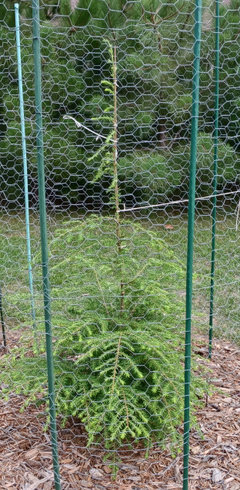
Tsuga canadensis: Seed from the 'Rocky Gorge NH'. 33" tall
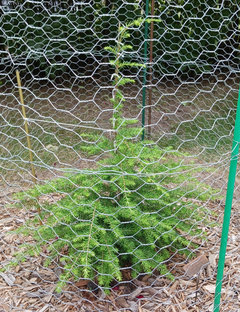
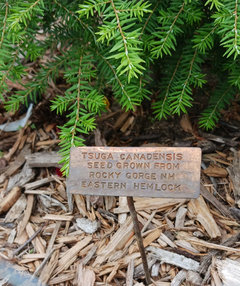
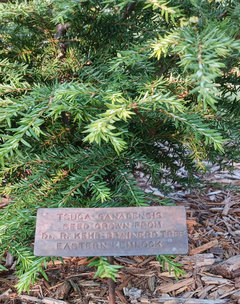
Tsuga canadensis:From seed collected at the once MN state champion tree in Brainard MN.
I don't know why so much of this year's growth was on the main leader. 45" tall. It had a lot more sun than the one above, but I'm satisfied with the growth of both of these.
Thuja occidentalis: East side of house. Seed grown from I think a local tree. 57"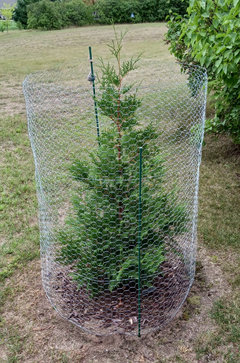
That's all that're worth posting about. ;-)
eta: this threads original postdate was April 12, 2019.
(Houzzs method of tracking dates is unusable for gardeners when wanting times of year, month posted etc.) - 3 years ago
Yeah, one down two to go. :-))
The above are in locations where winter burn should be less of a problem. Future updates coming.
- 3 years ago
Thanks floral.
DW likes them too because when she shows friends around the yard, she can make a quick reference if needed. ;-)
- 2 years ago
9-12-2023:
There's a story behind these two newer Tsuga c. ;-)
This all started in Sept 2018 when I collected seed from (at the time) what was the Minnesota state champion tsuga c.
I never grew much from seed before and by Sept 2019, the 3 or 4 little seedlings were barely an inch tall.
I put them into the cold frame for the winter and got them to start growing better the first months of 2020 (april-may?) after I brought them into the house.
At the same time, I started more seeds I collected somewhere out in northern New Hampshire.
When the growing season began, end of May, I planted two of the best State Champ seedlings outside in the ground, in two sperate areas. My vision was a spot that might provide more protection from sun and wind during the winter (I was already struggling with a larger tree that sunburned every winter I didn't cover it).First area: State Champ tree #1. I figured the red pine would keep late winter/early spring sun off the tree, even though it might take a few more years for them to mature. Snow accumulates more in this end of the yard also.
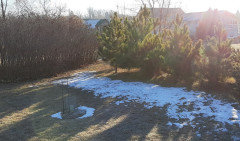
Second area: State champion tree #2. It doesn't show in the picture but the small shed is just right of the new tree. To the left is a red pine that I'll someday sacrifice when the tsuga is ready.
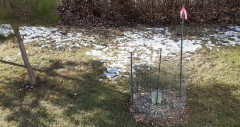
Stupidly, I simply watered these without any fertilizer at all and by middle of summer, they didn't look good at all.
Not wanting to keep messing with these struggling trees, I pulled them and sometime in midsummer of 2020, planted the last two Tsuga c. I had, that I had kept in pots and were growing quite well on the plant table under controlled conditions.One was a MN State Champ seedling and the other was from the New Hampshire seedlings.
So, with more experience and a garden hose to get through the dry spells, they pretty much look like they do pictured above in my last post.
Below shows the NH tree better in its sheltered location. I may have to sunshade it a year or two yet.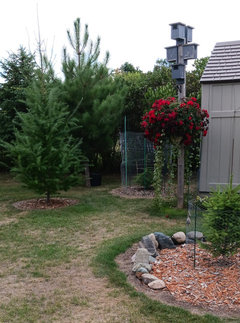
This is a better shot of State champ tree (left center) on the SE corner of the yard.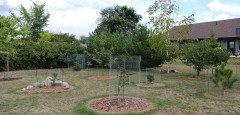
:-) - 2 years ago
Your next to last pic shows either something on the camera lens, or amazingly long stem-growths on the hemlock?
- 2 years ago
lol: Not the greatest picture beng, I'll admit. ;-) You're probably talking about the Larch on the left?
Here's a closer view of the New England 'Rocky Gorge' hemlock (inside the chicken wire).
I was satisfied with how good everything o mine grew considering the scant precipitation all season.
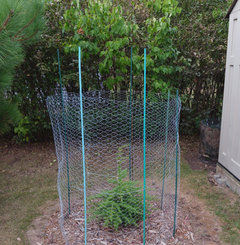
- 2 years agolast modified: 2 years ago
Good sheltering of the hemlock. Again tho, the growth on your larch is amazing. That might be a characteristic of larches, as my 2 (Japanese and hybrid) started very fast. The hybrid died of prb'ly root-rot, and the Japanese slowed way down and now even at 35 ft tall is questionable how it will end up (lower branch loss). Prb'ly Amer larch would do better as it's native to the endemic disease/environmental issues. This huge European larch died very suddenly in a Bedford, PA cemetery. Just turned brown and gone.
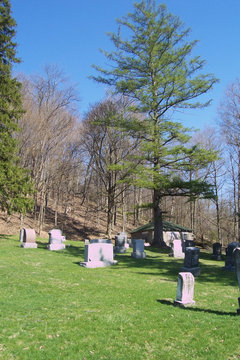
- 2 years ago
I've read Larix laricina is one of the fastest growing trees in north America, at least for the first 2/3 of its 150-year lifetime.
And something about liking phosphorus in the soil which around here is at fairly high levels ATST.
Even though Larix is deciduous in nature, it should, in the next year or so, begin to provide at least filtered shade on the hemlock from the SE, late winter and early spring. The critical time for winter burn on sensitive plants like young Thuja & Tsuga.
And I have options if things get too crowded back there, I can remove the red pine and by then the White spruce that resides ~10ft. more to the left (south), can take over supplying shade. It's already as tall as the red pine.And the small shed may need replacement by then. A little like 'Garden Editing'. ;-)
Our sun angle is already down to 47d, 20d lower than mid-summer and will drop another 27d by winter solstice.Below gives you an idea how the shade falls as the shadows lengthen. This is about what it will look like on March 21.
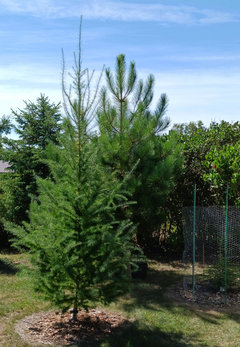
:-)
- 2 years agolast modified: 2 years ago
Eastern hemlocks take well to pruning if that were ever necessary, and certainly they are shade tolerant and compete easily with surrounding trees (actually prb'ly like it).
- 2 years ago
I agree.
The one I had out in the open didn't work too well.
It's starting to make sense why the Brainerd tree grew to maturity.It was hardly 6-8 ft. from a large house with a basement, so most likely the ground never froze completely on that side of the tree.
Admittedly, there are other trees in that part of the state growing well but the specifics are a mystery.
This is all I got, so will be my last attempt growing Tsuga.
Stay tuned. ;-) - 2 years agolast modified: 2 years ago
11-15-2023:
I didn't think that the Red pine grove was going to be enough to provide the shade needed to protect the Tsuga c. yet this winter. So I constructed some sun shade over the chicken wire surround. With high 50's and sunny, it was a good time to go and check it out.This time of year, with low sun angle (25*) it might have been enough with just the pines for shade. But in March with sun angle increasing from 40* to 47*, that's the critical time for these trees to sunburn, I'll probably have to add the burlap the next year or two until the pines get taller.
Tsuga c. from State champ tree seed on the left, Hicksii yew center. High noon.
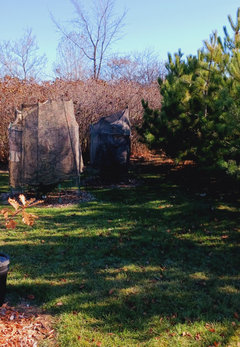
Another angle of the State champ tree.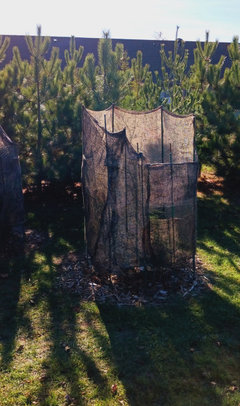
Tsuga C. from NH collected seed. Afternoons may be more of a problem than mid-day at this location.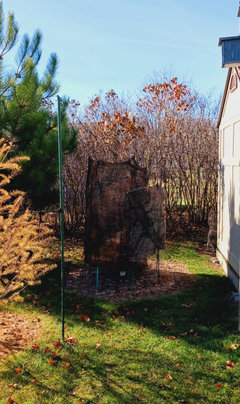
I know, I know, 'Artificial shade' but you have to consider, this is a managed vision for establishment and growth here and is only temporary until either the trees adapt or die. Simple strategy when you think about it. ;-) - 2 years ago
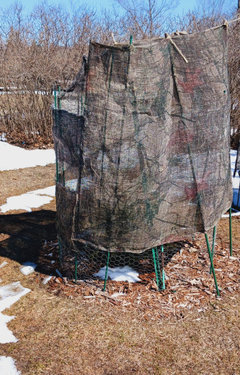
4-3-24:
Another thing I'm trying on the Tsuga(s) this year, is leaving space from the ground to the bottom of the burlap, to allow sun to penetrate closer to the tree, helping thaw the ground at the base of the tree, earlier in the spring. The frozen ground is the real culprit for these trees.
It's a challenge to not want sun on the crown and yet still want sun at the base. No good way I can think of to do that without a lot of messing around and no, I'm not installing an electric blanket.Even with the space under the shade, it allows sun underneath only part of the day and shade the rest, slowing the thaw process. I'm sure it must help to a certain extent and things can vary from year to year.
- 2 years ago
4-21-2024:
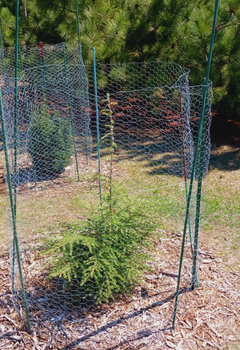
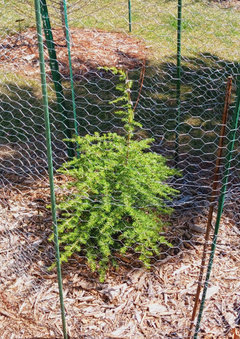
Just for the record, I took sunshades off the two Tsuga canadensis today.
For there not being any snow most of the winter and very high winds at times, enough so I was out there doing repairs on the shelters, I would say things came through exceptionally good.
No brown needles or any other signs of degradation. Rain forecast end of the week. Bring it on. ;-) State champ seed:
Rocky gorge seed.
- last year
10-04-2024:
Update: Winter prep so Hemlocks can prevail in Frozen ground with constant full sun (my yard).
disclaimer: Instead of starting another long boring thread, I decided to just add on to this one, being it's about the same two Hemlocks (Tsuga canadensis) that are talked about earlier.
And there is some history about their origin if one cares to page back to about the middle of the thread then going forward.There is no book you can buy telling how to do this sort of thing, but I may be writing one in a couple of years. j/k ;o)
Tree #1: Seed grown from the 'Brainerd Tree' (once MN state champion with north country provenance).
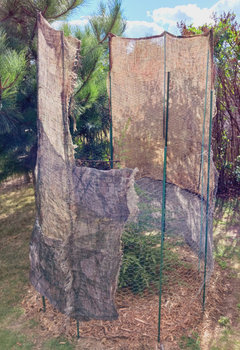
Probably didn't need this big of a frame but it was already built, sitting in the shed from previous uses protecting Hemlocks from winter sunburn. And really did the job quite well as long as the tree was left covered until the ground was completely thawed. Generally, end of March to late April.
The chicken wire around the bottom prevents bunnies from entering under the fabric and creating a cozy winter getaway spot. :-/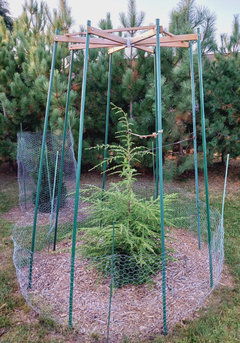
The top frame is simply some scrap lumber, deck screws, 1/4" x 2" L. bolts (8) to connect the 8' x 3/4" dia. garden stakes to the wood. And a short piece of pvc pipe coupler, with screws to hold the wood together at the center.
I checked earlier and could see that the sun angle (@ solar noon) on September 21st (~same as March 21), would be too high for the 15-20 ft. tall Pines that are South of the hemlock, to supply enough shade, until at least mid-April. So, I may have to sunshade for another 2-3 years on this one. I didn't want to place the Hemlock any closer to the pines to reduce root competition until the hemlock can get established. The pines can grow 2-3 ft. annually so you can figure by the shadow on the tent, we'll be getting more and more shade every season. :^)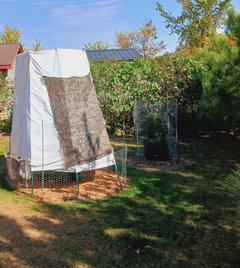
The camo burlap scraps are just to keep the inside of the tent from becoming so bright in the full sun. At this time of year, we're trying to reduce sunlight to help the trees shut down.
The pine trees are beginning to help with this problem.
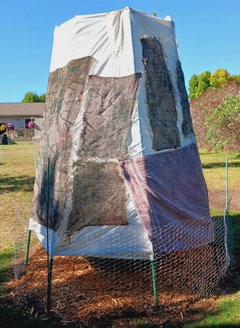
Tree #2: Seed grown from seed collected near the 'Rocky Gorge' NH.My 'Deep Woods Tree'. Located where there are existing trees to the SE, S & SSW.
This one isn't far away from having enough of its own natural sunshade to survive. But one must remember, this is all experimental so establishment of these trees could end abruptly at any time without prior notice. lol. As an aside, it was such a warm beautiful Fall to be outside working on this. :-)
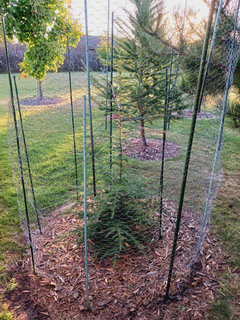
Just to be on the safe side, I added some shade to the ESE and WSW sides of the burlap.
The pine tree should take care of the middle. 🤞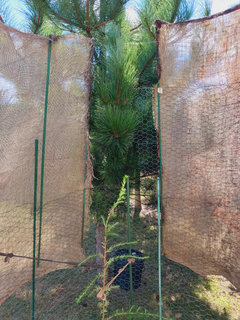
Garden shed is to the North to break any strong winter winds.
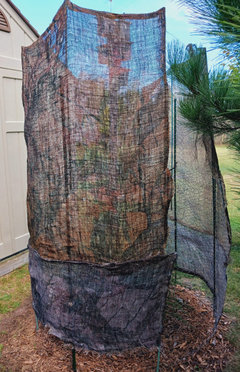
A good snow cover in November to December is our best defense in keeping the frost levels shallow but you can't tell from year to year exactly what kind of winter you're going to get.
Again, all experimental but I enjoy the challenges, it's within my capabilities and consider it 'Cheap Entertainment'.
:o)
- last yearlast modified: last year
Second pic from bottom an Amer larch?
Good works there. Same weather-wise here, calm and sunny in the upper 70s daytime w/honeybees working hard on the field asters. With good soil moisture here now, some good food production/root growth in the plants even this late.
- last year
Hemlock. ;-))
I've been letting things dry out some with no rain. Things have been hardening off well using JIT irrigation. Windy today with next 2 days forecast the same. A few more near 80 highs, end of next week. Fire danger warning alerts broadcasted. - last yearlast modified: last year
11-8-24: update.
Now that our sun is 27d at Solar noon, 6 weeks after the Fall equinox, I thought I'd observe what's going on as far as my sunshades are concerned, in the yard today.
First, I'll show the original location where I fought for 7 years to protect from winter sunburn, my first Tsuga canadensis, planted 7-6-2016. Hoping it would someday be able to take full sun, all day and all winter/spring.
After all this time, I've learned that won't happen, being that area is just too wide open and would remain sunny for a much longer period of time than I cared to work, providing artificial shade, possibly for many, many years.
Below is what the original spot looks like today. Wide open to direct sun. equates to a hostile environment for a tree known for issues like this. This spot now has Picea Abies growing which will not need sunshade, possibly even by next year).
Facing WNW:
Facing ESE: No chance of shade here in anyone's lifetime that I know.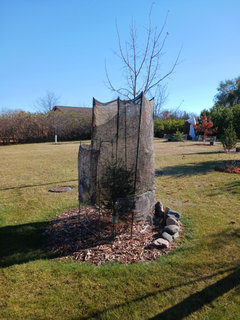
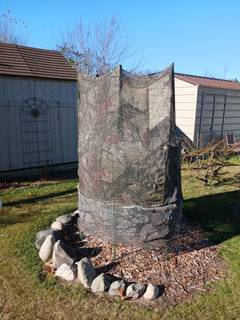
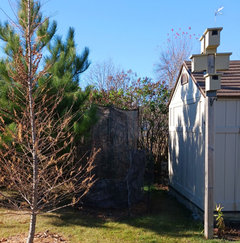
Now in contrast, here's a few pictures of what the sunshades for the newer Tsuga, mentioned in the previous posts, are looking like already this season.The Eastern hemlock started from seed from NH in 2020 already looks like it could be on its own. I put the burlap on this one to ensure the sun will not be a problem all the way into April when the ground generally thaws but I'll need to observe this spring to see what happens before letting it go and trusting the surrounding trees for enough shade. Which is plausible compared to the original site shown previously.
Facing West:
eta: Facing East: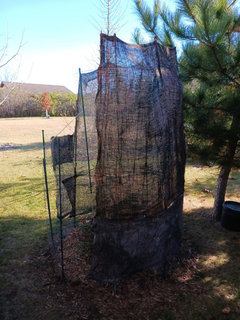
The other Hemlock, started 2019 from seed procured from the MN state champion tree in Brainerd, is not quite as sheltered as the above NH tree but is still much closer to having its own natural protection than that original location. I'm thinking another year or two after this winter but with enough rain and good weather, maybe one more year after this.
Looking North: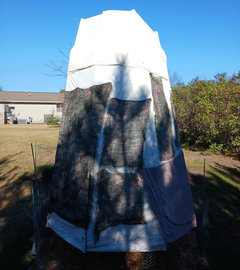
Right behind me to the left, in this last picture, is the bicolor oak and directly behind me is the Meyer spruce, which in a few years will be adding to the protection of this hemlock.
Looking NNE: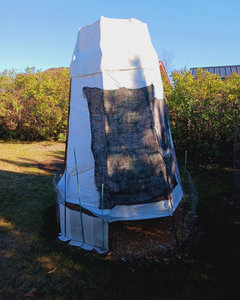
If I wouldn't have thought I could pull this one off in the next few years, I would've given up on hemlock. And if it doesn't work this time, it might not matter as long-term projects most likely will not be on the agenda. :-) - last year
2-1-2025:
Just a short story of the fun I been having 'up north'.
We've has so much strong wind last January. The big surround seemed to be holding fine.
A couple of weeks ago, I looked out and noticed it was rocking back and forth in a strong westerly wind (35-45 mph). Went out to see and one of the poles broke off at ground level with all the rocking. New spot, new exposure.
I did pick the right spot for this as the snow is over a foot deep around the area and only half that every other place in the yard.
The easiest fix was to pull the top of the surround with broken leg to the north with some nylon strap. Worked great! The celtis o. is getting pretty stout and came in handy. :-)
The west winds continue a few days, Next I notice corner further west of the strap looked a little odd. Went out even though I was sicker than a dog, to discover the next post had the nut unscrew, I suppose from all the rocking, and the post came off that corner and was supporting nothing, so that corner kind of drooped several inches.Tried as I may, I couldn't get the corner pushed up high enough to get the bolt back on the post.
I should've double nutted the bolts and thought about that at the time but never thought it necessary.
So, threaded a wire through the hole in the post and just pulled it over to that corner and tied it good to the wood which I hoped holds it another 2 months. What fun! :-))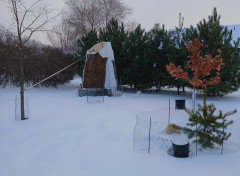
Windy from the ESE today with ~3" of snow. But the surround hardy feels that with pine grove. The last week has been sunny and mild (20's-30's) and we lost a lot of snow. More snow predicted this weekend and next week.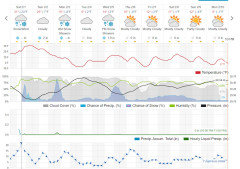
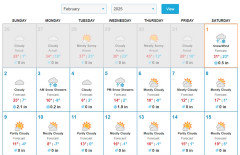
February doesn't look too bad. The forecasters are saying a little below normal but if single digit below is the coldest, we'll take it! ;-)Through Feb 15th.
- last yearlast modified: last year
1-9-2025:
With the straight westerly winds being the bane of that surround this season, it came through the last few days of 40's mph just fine.
The 3-5" predicted snow turned out to be 8-10", so after getting that cleared out of the drive,
I went out back just to take a look. All snow was very cold and fine, not real heavy. Picturesque.
Picea Abies (right), Tsuga canadensis (left). Surrounds were snow covered but were doing their job.
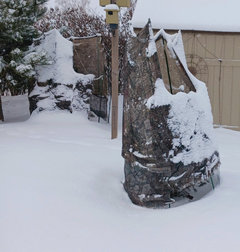
Same as above, Tsuga canadensis: getting good shade and snow cover.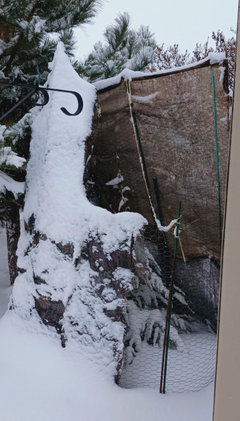
Quercus bicolor (left) #2 Tsuga c. (center), Taxus hicksii (center right), Pine grove (right).Snow cover collects well in this SE corner of yard. Getting deep.
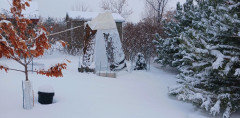
Just a few other shots around the yard. :-)Pinus banksiana: (below) Ostrya v. (right) New house just built. on other side of lilacs. Picea glauca upper left.
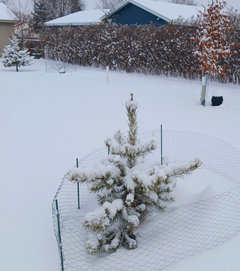
Pinus Cembra: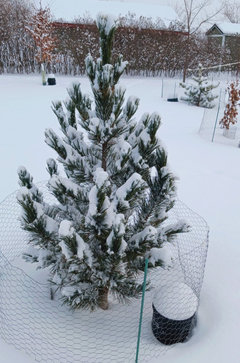
Pinus resinosa: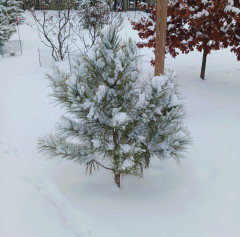
Picea glauca: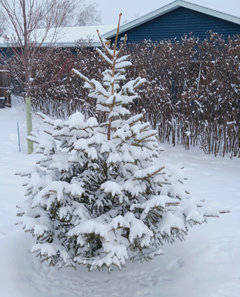
More: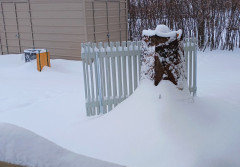
So real nice snow cover to take us through the next week or two of subzero temps.February can go either way temperature wise but sun angle by the 12th is a full 10d above the winter equinox. I shoveled the deck off yesterday and the sun dried it off nicely today so it's gaining in intensity.
Am I getting tired of building surrounds on these trees? Yes, but as I mostly do, I look at the bright side. It's looking better for next winter with no protection for the P. Abies needed. And after next winter, I'm done protecting the Hemlocks.
I might baby the T. Plicata for a while, but we'll see what the climate does. Never hurts to shovel snow on more sensitive plants, it's been my go-to, all winter, right along.
- last year
3-1-2025:
The other day I finally realized why my surround had troubles with the strong winds we had last January. If you notice, the last times, I surrounded my original hemlock with a frame, the first two posts in the ground were 8ft L. T-Posts (white), driven into the ground a good 16", one opposite to one another.
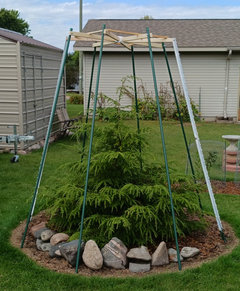
Now if you notice in the picture from last Fall (below).
I simply drove the 3/4" garden stakes in all 8 places. What was I thinking? Or not?
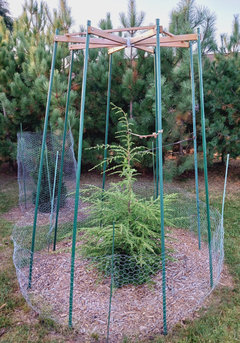
Anyways, yesterday, a cold front came through from the NNW, with gusty winds up to 60 mph maybe higher. It made my surround look like Dorothy's house on the Wizard of Oz. It tipped it on its side breaking all the remaining posts, then launched it up in the air and back down again.I was concerned it would damage the hemlock, so I went out and picked the whole mess up under my arm and carried it inside the garage.
My next concern was, with many sunny days forecast, this will be the end of this tree, but with gusty winds and temperatures dropping, it was impossible to do anything constructive.
So, this AM, with calm winds and 3df, I went out before the sun was completely up and managed to drive in several metal posts which I wired some of the broken garden stakes to and covered the stakes with the remaining left-over materiel, to form a makeshift sunshade.Catastrophe averted, at least I hope so. The wind yesterday was the strongest in 10 years and of course, happened the year my senescent mind forgot the steel T-posts. ;-)
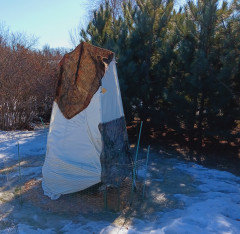
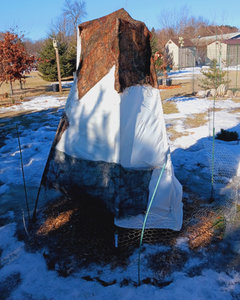
////
- last year
4-21-2025:
I removed the sunshade from the two remaining hemlocks.
Everything in my past posts and pictures suggested it would be safe to do so by this point in time.
Hemlocks fibrous root systems don't move much water with soil temperatures below ~40df, so you want to make sure the ground is not only thawed but warmed up a bit to prevent sunburnt needles in early spring. Acclimation to real sunlight is also a concern so bringing the #1 state champ seed tree, out of total shade into intense, all day full sun, required a simple, temporary, partial sunshade that I'll remove when I get back next week. Hopefully, this acclimates the tree to UV and will keep the top from experiencing irreparable damage as in the past.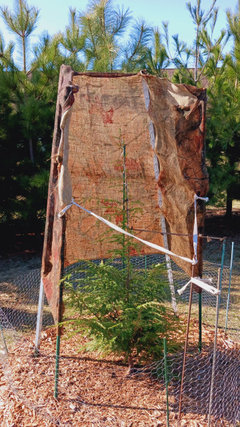
The #2 tree from seeds collected 'out east' has enough 'natural shade', mostly midday and has received some 'dappled sun' already this spring, I think it will do fine with the sunshades removed.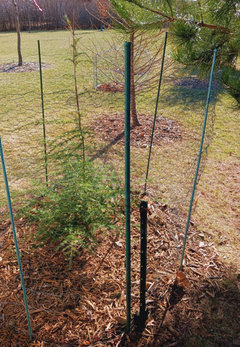
if I'm wrong, you'll see these again over in the 'Winter damage thread' later on.
- last yearlast modified: last year
Bill, your observations about sun-burn is why hemlocks very much like growing in at least partial shade. And that's some rocket-growth there. :)




bjb817