Software
Houzz Logo Print
suzycothran

Landscaping Advice: shady yard

7 years ago
last modified: 7 years ago


We’ve finished renovating our new old house, and we’re ready to make a landscaping plan. We have lots of mature trees (mostly oaks) and shrubs (mostly azaleas). The neighbors tell us how hard is it to grow grass, so I am contempla


ting expanding the beds and filling in with ground covers.

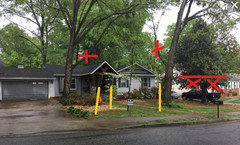
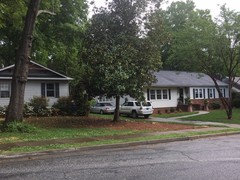
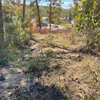
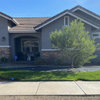
The soil is poor: hard-packed clay. The front yard faces south; pics were taken about four pm today. Major tree-trimming in March should give a little bit more sun, but the yard will still be shady.

I am open to all suggestions that leave the existing trees and shrubs in place.

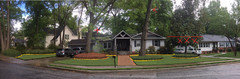
i am attaching pictures that show the full yard from left to right*. On the far left, ALL the trees are along the property line, on OUR lot. The magnolia on the far right is ours as well. Sadly, I fear the magnolia may be dying due to rough treatment during sewer line repair.

I thank you you in advance for sharing your ideas. I will be posting before and after pics from pre-Reno til now.


Comments (34)

  • 7 years ago

    Climate area?

    ClemsonFan Suzy thanked Embothrium
  • 7 years ago

    Before you proceed, have a pro check the health of the mature trees. They may be past their prime and a danger to your home. Try stepables.com for ground cover. You can't beat azaleas for color under shade, but their season is so short. Tuberous begonias may work well there. Try advice from a local nursery and use native plants to your locale, but be sure they aren't invasive.

    ClemsonFan Suzy thanked decoenthusiaste
  • 7 years ago

    We live in Greenville SC. Hot summers, fairly mild winters.


    We used a professional tree guy who just removed five dead or dying trees and branches as well as those leaning over houses.

  • PRO
    7 years ago

    You second picture did not show up. Be sure to let the greyed-out image become full color before submitting. And hopefully, you will be posting slightly overlapping shots from the curb, with the camera in line with the front door, panning from left to right, so that we can see the whole, unified scene. (It doesn't matter that it's in sections so long as all pictures are from the same camera point of view.

    ClemsonFan Suzy thanked Yardvaark
  • PRO
    7 years ago

    some plants that will do well in the shade in your area are: fatsia, aucuba, brunnera, ferns, hellabores, mahonia beali, camellias, gardenia, ajuga, vinca, viburnum, hosta, ...

    ClemsonFan Suzy thanked Dig Doug's Designs
  • PRO
    7 years ago

    Insofar as your landscape goals, what are they? Do you intend to use landscaping to enhance the view of your home? Or, do you want to use it to obscure your home?

    Each of the two large trees has a lower branch that seems to be working against balance and/or attractiveness. I'd remove those which I've X's out in red. I'd also remove the lower hanging foliage of the magnolia as it obscures the view of the main part of the house, making it appear neglected. Even if it turns out that your goal is to obscure your house from the street, low hanging branches from trees are not the way to go about it. The three young trees (through which I've drawn a yellow line) seem like too much to me ... either by being too close to the walk or another tree. It's just too busy with with saplings.


  • 7 years ago

    Page from Clemson Cooperative Extension.

    Plants for Shade

    https://hgic.clemson.edu/factsheet/plants-for-shade/

    ClemsonFan Suzy thanked Embothrium
  • PRO
    7 years ago

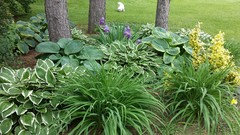
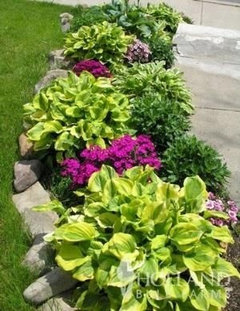
    Pachysandra is a great ground cover instead of grass


    See images below.


    Also consider all variety of Hostas under the oaks. They do well also.


    ClemsonFan Suzy thanked BeverlyFLADeziner
  • 7 years ago

    Thanks Beverly. Your pics are very helpful. I don’t think I posed my question very well. What I need help with is drawing out what I should put where. The pictures I sent don’t really show my questions very well.

  • 7 years ago
    last modified: 7 years ago

    I know that this borders on heresy, and against my better nature, but I'd consider taking both oaks out. The one on the left is already buckling the driveway and is in the way, and the one on the right looks spindly and not oak-ish in its growth habit (probably because of crowding from the other oak). They both lean oddly.

    Take them out, and plant one oak (or a sycamore/London Plane tree or locust) in the middle, where Yardvaark's middle yellow line is. That will give it room to grow properly and give you more light. A sycamore or locust would give you a clear understory and more light. And a locust provides nitrogen because it's a member of the bean family; grass grows well under locusts.

    At the very least trim the low branches as Yardvaark indicated.

    And, as Embothrium notes, use the Extension Service's resources. This goes for everyone. There is a USDA Cooperative Extension Office for every county in the US (even urban ones like Manhattan, Philadelphia, etc.), run by each state's land-grant university.

    ClemsonFan Suzy thanked tatts
  • 7 years ago

    I can see the first pic you posted but not the second one for some reason? So my comments are based on the area in the first pic, not the left side of the driveway.

    There are arguments saying that grass is more work than gardens, or landscaping is more work than grass, but in your case it looks like the grass would be more of a long-term pain than throwing mulch over that area and getting some plants in the ground. You already have a perfectly defined space to work with, so that's convenient. I also think it would suit the look of your house nicely! Having a clean slate of mulch on the ground would help to clarify the possibilities. Right now the patchiness of the lawn makes the space look visually busier than it really is.

    The front path isn't well defined at the moment (Is that a brick path? Does it need to be cleaned?). The Asian pachysandra is invasive but the native version (Pachysandra procumbens) is well behaved. Looking to native woodland species in general could turn up some good possibilities. There are many plants that appreciate a little shade. Dotting spring ephemerals around under the trees would be so pretty this time of year!

    Your biggest challenge with planting will be root competition from the trees. I'm not familiar with plants for your area, but you'll want to lean toward plants that are less hungry and thirsty. I'd limit my plant choices to repetitions of just a few things at first, partly to see what sticks around and partly to keep the look from getting too busy.

    RE soil: you can improve your soil for free if you get in the habit of chopping your leaves up with a mulching mower and spreading them over the garden.

    ClemsonFan Suzy thanked User
  • 7 years ago

    Also consider Lamium (Silver Beacon) as a ground cover.

    ClemsonFan Suzy thanked harold100
  • PRO
    7 years ago

    If basic reader questions go unanswered and relevant pictures are not provided, it seems that the OP has little interest in the thread making progress. If the OP's question need clarification, then she (unless it is a he-Suzy) should clarify them.

    ClemsonFan Suzy thanked Yardvaark
  • 7 years ago

    I have to laugh at the idea of removing my old trees and planting new ones. At my age, I simply won’t live long enough to grow much more than a crape myrtle! The old trees in our neighborhood, even when they lean oddly and obscure the view of the houses from certain viewpoints, are a major part of the beauty and charm, like the wisdom wrinkles on an old face. I guess some say potato and some say potahto.

  • 7 years ago

    Yardvaark: I appreciate your thoughts on how to the most out of the forum. I am less than great with the technology of the site, so that when I have tried to post the series of pics as you suggest, I have been unsuccessful..i will keep trying, because I know that what you suggested is necessary For you to provide useful response.

    What does “OP” mean?

  • 7 years ago

    Original Poster - the person who initiated the thread.

    ClemsonFan Suzy thanked gardengal48 (PNW Z8/9)
  • 7 years ago


  • 7 years ago


  • 7 years ago


  • 7 years ago

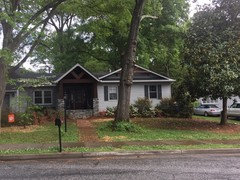
    House before the porch was added.


  • 7 years ago
    last modified: 7 years ago

    Ashyasian: Your idea of spreading mulch all over makes a lot of sense at this stage. I kinda have to actually see something before I can visualize it. So letting the garden evolve over time works for me.

    The brick walkway will be pulled up and replaced in order to level it out and widen it to accommodate the new 4’ wide steps up to the porch. The building of the porch resulted in cement being spread on the bricks and the surrounding soil. There wasn’t much growing there anyway.

  • 7 years ago
    last modified: 7 years ago

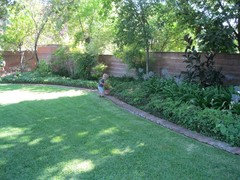
    Regarding your grass issue, we have pretty much the same situation...shade from oaks and hard, clay soil. We're in Southern CA, so I'm not sure it's much help...although we do have hot summers and very mild winters. Our grass (St. Augustine) looks good year round. There's some dappled light for brief periods but much more shade.


    ClemsonFan Suzy thanked chloebud
  • PRO
    7 years ago
    last modified: 7 years ago

    We're too far away from the house to look at the foundation planting area. but the pictures are good for looking at the overall front yard. Here's an example of how I might organize beds. I'd also widen the front walk.


    There's presently a lot -- too much -- going on in the way of plants, making the overall yard look very busy. Too many individuals and too much variety. I would have a goal of simplifying things for a cleaner, more straightforward look and easier maintenance. As I'm showing it now there are about a half-dozen beds in addition to the foundation planting area. Rather than having each bed filled with variety, I think it would be much easier on the eye if one bed had one type of plant. The taller beds could be low shrubs (a little of that goes a long way, IMO) such as dwarf azaleas. and lower beds could be groundcovers. I'm not trying to show what is growing in beds, or how they might be subdivided, but where logical places for beds are and what their shape might be.

    I think you could grow some grass in the brightest areas and it would be an asset if you could. I'd put forth some effort into increasing the light flow ... remove low hanging tree branches. Remove limbs that are lopsided or cause an unbalanced look to the tree.

    If you move the camera up onto your sidewalk and take a closer, similar set of pictures, we could take a look at the foundation planting area.

    ClemsonFan Suzy thanked Yardvaark
  • 7 years ago

    Dig Doug: I was hoping you would share some of your ideas. You always put a lot into them. This time is no exception. Thanks For the inspiration!


  • 7 years ago

    For heavy clay soil, tons and tons of additional organic matter is key. By the truckload. Also mulch, mulch seems to help regulate the soil from experiening extremes (wet pudding/cracked concrete). You will def. have to look at drought tolerant plants as someone else mentioned, due to the root competition. It can be nice to add a mid layer, between tree and groundcover for a more cohesive, balanced look. What sort of gardens in your area do you like? Sometimes they can be a guide.

    ClemsonFan Suzy thanked J Williams
  • 7 years ago

    J. Williams: Should I try to till the organic material into the clay? I don’t want to damage roots of the dogwood or other trees.

  • 7 years ago

    J. Williams: We have many older, well-establishes gardens here in Greenville SC. I will begin taking pics for an ideabook.

  • 7 years ago

    I had a similar setting where I lived Suzy and it was hard keeping up the grass due to acorns if it was me I would remove the tall trees. Place seatings at front of window. Have pavement all around except the front...especially don’t know where your cesspool is you can have a sewage covering for it.

    ClemsonFan Suzy thanked User
  • 7 years ago

    Folks: I have been AWOL on this for a bit, but I’m back! (While trying to delete my duplicate postings, I accidentally deleted this one. Ugh. Thanks Houzz Tech for helping me out.)


    So... I’m doing bits at a time, rather than having an overall plan from the git-go. I received a large quantity of mondo grass from my brother, so this week I planted plugs of it about a foot apart under the magnolia tree on the far right side of the yard. It is the creeping, spreading type, rather than clumping, so I am expecting overall coverage eventually. The shape of that bed has morphed from a semi-circle to more of a kidney shape, extending all the way from the front sidewalk to the front foundation shrubs (large azaleas). I’m tying the mondo grass bed and the front right foundation planting together to try to reduce the number of chopped up pieces in the yard.


    Looking straight on, from the driveway to the walkway, there is a large rounded bed of azaleas. All across the front, on the right hand side, is another group of azaleas, just straight instead of curved. Now that the blooms have faded, I would like to reduce the size of the azaleas by half. I had already cut back the azaleas on the left side to about three feet. I bought 14 dwarf gardenias, with plans to plant them as an intermediate layer between the tall azaleas and whatever is at ground level on both sides of the walkway. Don’t know if the root competition will do them in, but I like the fact that they bloom after the azaleas are done, and their sun requirements will probably be met. We’ve been adding a topsoil / compost blend as we plant the new things, breaking up the clay and mixing in for several inches.


    I like the look of big swooping curves for plantings, such as Dig Doug and Yardvaark have pictured. So I’m moving s-lo-w-l-y in that direction. We will try for grass in the remaining places this fall. To plant grass here this late in spring is a total waste of resources. We bought the house in December, so it has been a pleasant discovery that we have a good bit of Hosta scattered around In odd places. I plan to relocate most of it, incorporating it as part of the layering from tall to short plants in these beds. We do have a lot of different kinds of plants which can look pretty hodge-podgy, but I have more eclectic tastes, preferring something resembling a cluttered cottage garden over anything formal or highly structured.


    Is is there a question hidden in here somewhere? Not especially; this just a response to some of the ideas I’ve gotten and an update on the progress being made. I’ll post some pics after this first phase is planted and mulched.


    Thanks for reading!

    Suzy


  • 7 years ago
    We have two enormous oaks in our front yard and here is what I have discovered: oak trees make the soil underneath their canopy very acidic. If you want to actually have grass grow 1) put down lime every spring and 2) be sure that you aerate the soil and work some hummus/peat into the soil before you over-seed grass. It is a hassle preparing the soil but it will be time well spent. If you don’t, you’ll never get grass to grow.
    ClemsonFan Suzy thanked mle0782
  • 7 years ago

    I’ll keep that in mind, thanks.

  • 7 years ago

    The notion that trees - any trees - make soil acidic is a very persistant gardening old wives' tale!! Soil acidity is a factor of a) the underlying mineral content of the soil; b) amount of annual rainfall; and to a much lesser extent c) by high nitrogen fertilization (usually associated with agricultural cropping, not gardening).

    Trees only grow in acidic soils because they prefer acidic soils. The reason grass will not grow well under them is due to shade, excessive rootiness and the fact that the tree's very large and aggressive root system hogs any soil moisture and nutrients, depriving the grass of these essentials.

    Test your soil pH before liming around oak trees. Raising your soil pH by liming may actually affect the growth and health of the oaks, which like most plants, prefer an acidic soil, and can certainly led to chlorosis

  • 7 years ago

    Do I see a Pagoda Dogwood tree in your yard? If so (envy).

    I would not like you to take out those big oak trees, unless they are dying, of course. How blessed you are to live under their years of wisdom.

    I am not familiar with Georgia, but if hostas grow there, they may thrive under those trees. Everyone loves hostas, and they grow like crazy, and there are thousands of varieties you can play with. Gardeners often joke if you have to buy a hosta, you don't have any friends. LOL.


Sponsored
Peabody Landscape Group
Average rating: 3.5 out of 5 stars8 Reviews
Columbus' Reliable Landscape Design & Contracting