Software
Houzz Logo Print
pandoraw

Peace Lily Serious Sudden Drooping

7 years ago
last modified: 7 years ago
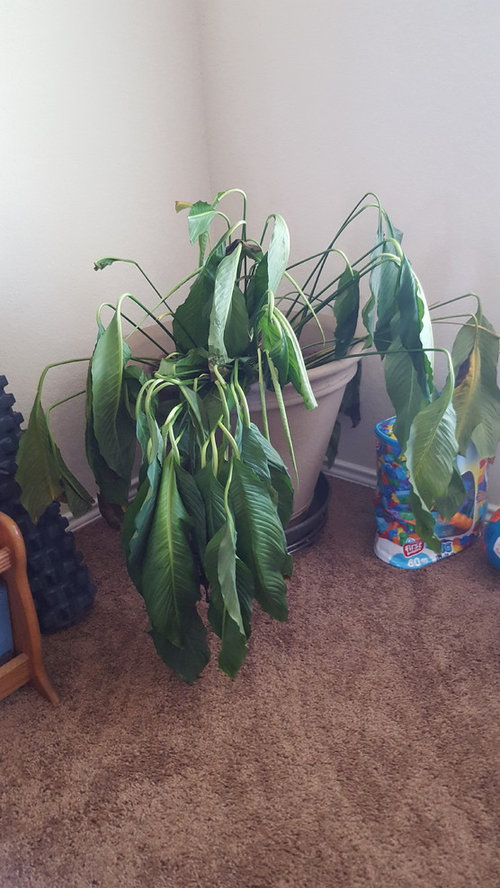
I have had this Peace Lily since 2013 and he's always done great. I only water when I see a slight droop, usually once every week or two. Suddenly he's gone super droopy for no reason. My mother says she sprinkled some miracle grow powder and removed some dead leaves without my knowledge a few days ago and I've given him water since then. But he keeps getting worse. What can I do? He has never been overwatered so I really doubt root rot.

Here is a picture. I hope it shows up, I keep having issues getting it to post!

House · More Info


Comments (29)

  • 7 years ago
    last modified: 7 years ago

    Did this sudden chronic drooping happen after your mother tended to it? Overfertilizing? sprinkle :D ???

  • 7 years ago
    last modified: 7 years ago

    Fertilizer salts are no different than curing salts in their ability to 'pull' water from plant/meat cells. Water moves toward areas where there is a high concentration of dissolved solids/solutes. That's how cells absorb water. It crosses through the cell's semi permeable membrane until a level of isotonicity (equilibrium) is reached, where the level of dissolved solids in bound water (water inside of cells) is the same as it is in the soil solution.

    If a plant wilts when you can still easily detect moisture in the soil, odds strongly favor over-watering, but when you include the information about the wilt occurring immediately after fertilizing, that has to be included as a suspect. Generally, one doesn't sprinkle water soluble MG fertilizers on the soil. A small amount is added to water and applied during the process of watering. There might be MG fertilizers that get some of their nutrients from organic sources, but we don't know what was actually used.

    Over-watering limits the soil's ability to hold the oxygen needed to drive the metabolic processes of roots. How much water a soil holds often determines the difference between bane or boon. Endlessly frustrating, as though it's their job, are soils you need to battle constantly for control of your plant's vitality. We'd all do well by our plants if we establish as a minimum standard, that we must to be able to water a planting to beyond the point of total; soil saturation w/o the plant having to pay an over-watering tax in the form of poor root health/function and lost potential.

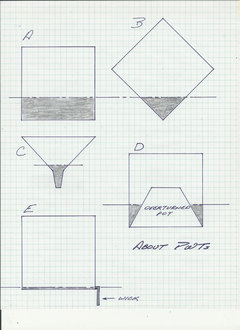
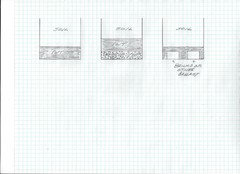
    I suppose I would flush the soil thoroughly/repeatedly by pouring room temp water = to at least 10x the volume of the pot slowly through the soil to flush any potential fertilizer excess from the soil. If your plant is root bound, after you flush the soil, lift it from the pot and set it on some clean towels or a stack of paper bags or newspapers for a couple of hours. This will pull excess water from the soil. If your plant is not pot bound, tilt the pot at a 45* angle after flushing and insert a wick. Compare how little excess water B holds compared to A (below) for no reason other than the pot was tipped for a period after watering. Using a wick can eliminate even MORE excess water if you use it judiciously. Compare E to A below.

    Al

    pandoraw thanked tapla (mid-Michigan, USDA z5b-6a)
  • 7 years ago
    last modified: 7 years ago

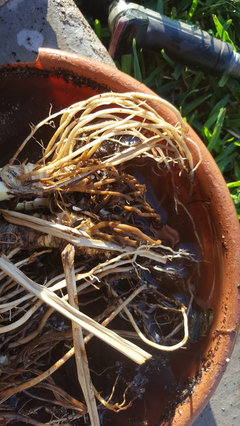
    Thanks all. She did use the powder that is supposed to be diluted. I only use it (diluted) on my outdoor plants because my indoors are always well taken care of. But she was visiting and thought it would help. I actually pulled the plant out of the pot to take a look. The soil was very, very damp. I am wondering how many times she watered it, or how much. The roots didn't look too good either. Some were super healthy, others were brown and mushy. So I am guessing root rot?? I washed everything off, cleaned the pot with bleach in case of fungus, removed the affected roots one at a time, and repotted in new clean soil. I had to use the soil on hand, which was potting soil mixed with garden soil. I know I needed a more peaty soil but I can't leave the house with my baby asleep for the night. So I had to make do. You can see in the photo below there are healthy roots and also darker brown roots that I am guessing are unhealthy. The plant is now back in my house where he belongs. And I guess I light a candle and say a prayer... I also took two smaller root bulbs and put them in a new pot, as a Hail Mary.

    House · More Info


  • 7 years ago

    I hope your good effort pays off and it recovers. We'd love to hear an update!.....if it's good, or you can cry on our shoulders!


    .


    pandoraw thanked Jay 6a Chicago
  • 7 years ago

    healthy roots and also darker brown roots that I am guessing are unhealthy.


    ==>> have faith .. you did what you could ...


    you mention she only did this 3 days ago .... seems pretty quick for roots to discolor .. i might GUESS ... that this observation is coincidental ...


    is this the first time its been repotted ... since 2013 ...


    luckily.. its a common plant .. which you can replace ... its not like you will never find another ...


    and two thumbs up... for taking care of mom ...


    its stressed ... and its going to take a few months to settle down ... i think you did some great work on it.. but now.. just water it properly ... and let it alone .. i suspect it might get a lot uglier before it starts looking better ... but just dont keep trying to keep fixing it ... i call that.. loving it to death ...


    and keep us posted ....


    ken


    pandoraw thanked ken_adrian Adrian MI cold Z5
  • 7 years ago

    My mom has been here for a month now, so I am wondering if she's been watering it a lot and not saying anything, or forgetting. She does forget things... It is the first time I have ever repotted, so maybe he needed the new soil and pot and my mom's ministrations were just coincidence. Either way, I've done all I could think of. I agree he's gonna look a lot rougher before better, and it will be tough to leave him alone :) I will let ya'll know what comes of it!

  • 7 years ago

    With the added info, the pointer has moved decidedly toward over-watering as the primary issue. Roots die/rot from the plasmolysis that is part and parcel of over-fertilizing.

    You mentioned that you used potting soil mixed with garden soil. This isn't at all likely to end well. While many of the decisions we make re how we go about tending our green pals, the most critical consideration for this plant is likely soil choice. Even though this plant naturally occurs in riparian settings, it doesn't tolerate wet feet well when grown in/under conventional container culture - like you're growing it. Those who might say different are ignoring what stark difference there is between growing in a pot vs in the ground, even if the "ground" is a bog. In short, what I'm saying is you'll very likely find your medium is far too water retentive to keep the plant happy, which will make it very difficult to impossible to keep the fungalugly root rot you observed at bay.

    Al

    pandoraw thanked tapla (mid-Michigan, USDA z5b-6a)
  • 7 years ago

    Oh dear. I am happy to redo my potting this weekend into a better medium, but what do I need to get?

  • 7 years ago

    Well others may differ but I'd suggest you get a bag of Cactus & Succulent Soil & a bag of Perlite & mix them in equal parts to repot . May I suggest if the "additional watering & powdered fertilizer applications" don't stop, it may not matter what mix it's in. Sorry to say that & good luck!

    pandoraw thanked Karen S. (7b, NYC)
  • 7 years ago

    At least one other differs. ;-) Here's why:

    Perlite is not internally porous so as far as it's relationship to media is concerned, it's much like adding a marble to the mix. Whether its a marble or a perlite particle, once you add a particle to any given volume of medium, you increase the volume of the medium w/o increasing o/a porosity or air porosity at container capacity. Since the perlite or marbles increase the volume w/o adding porosity, the o/a porosity and air porosity at container capacity decreases in direct relationship to how much perlite or how many marbles are added. So, if one starts with a bag of cacti/succulent mix they feel needs amending because its air porosity is insufficient to sustain a healthy root system, and adds an equal measure of perlite to the mix, they took a step backward insofar as porosity is concerned. It would be better to stick with the mix thought too poor to grow in, than to add the perlite, thinking it would increase porosity.

    When used in a medium, perlite's only contribution is in the fact it takes up space in the medium that might otherwise be occupied by saturated soil. It has little to no value in the fraction of medium that occupies space in the container above the max ht of the perched water table (PWT) the soil supports, in fact, it would be a detriment in that fraction of the medium because it takes up space that would otherwise be colonized by roots. The effect of perlite in the medium above the high PWT mark is the same as reducing the volume of the container by exactly the same volume as the the volume of perlite added.

    So, unless you're growing in in 90% perlite (or thereabout) and 10% cactus soil that needs amending, it does very little good. That it takes up space is like reducing pot size, so the soil returns to a state where it's holding a favorable amount of air a bit quicker, an advantage to be sure, but that means the perlite serves only as ballast, which is only important within the part of the pot that can potentially be occupied by PW, and there are other ways of using ballast that are more efficient.

    Visualize: You have a quart of coarse sand that contains 1 unit of air porosity and it supports a 3" perched water table. If you add 1 quart of perlite (fines removed) to it, you will end up with very slightly under twice the volume of "soil" with the same single unit of air porosity, which is a 50% reduction, and the same 3" of PW. Where's the gain?


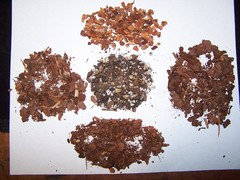
    Oh dear. I am happy to redo my potting this weekend into a better medium, but what do I need to get? If you can find a bag of pine bark of appropriate size, you can mix 1 part of your cactus mix with 1 part of perlite, and 5 parts of pine bark to make a very productive mix.


    The piles at 3, 6, and 9 0'clock are from 3 different packaging companies and are appropriate as is for use in container media. In the middle is what the soil looks like dry.

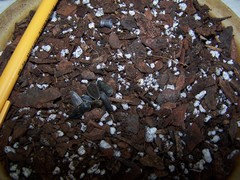
    Another look at what it looks like finished:


    Notice there is not enough fine material in the mix to fill all the spaces between the bark particles. A high % of growers do not understand that adding a small or middling size fraction of chunky material (bark/perlite) to water-retentive media does not improve aeration or drainage until/unless the volume of large particles is so much larger than the fine particles there are not enough fine particles to fill all the air space between the chunky material. Some of the poorest soils (from a structural perspective) you can grow in are those in which there is exactly enough fine material to fill all the spaces between the large particles.

    Back to your question ....... if you find the bark, get a small bale of sphagnum peat and some lime and you're good to go. If you can't find the bark, you're better off to judiciously employ some items as ballast in the bottom of the pot (no drainage layers, please) and use whatever container media you can find, than to mix an inadequate amount of perlite into a water-retentive mix and depend on it to stem the tide.

    You might find this helpful.

    Al


    pandoraw thanked tapla (mid-Michigan, USDA z5b-6a)
  • 7 years ago
    last modified: 7 years ago

    tapla, this is a bit confusing... Please correct me if I didn't understand something, but you're saying unless you add about 90% perlite to the soil, you actually doing more harm than good?

    In that case why the very first advice newcomers get in the Cacti & Succulents forum is to add at least 50% perlite, when it apparently doesn't make soil any better, if not causes more harm?

    I'm genuinely curious, this new information is clashing with what I've learned from this forum before.

    Another thing I don't quite understand is the difference between ballast and drainage layers. Ballast is good, but drainage layers increase perched water levels? Why?

    pandoraw thanked Fatimonster
  • 7 years ago
    last modified: 7 years ago

    I didn't say it doesn't have value, I said it does very little for air air porosity and air porosity at container capacity. Container capacity is the state of water retention in a container planting after the soil has been watered so the medium is 100% saturated, then allowed to drain. At the moment it stops draining, it's state is 'at container capacity'. Perlites only job is to reduce the amount of water a medium can hold, and it works fine in mixes with high %s of coarse material.

    Perlite in a bag has air porosity between the particles of perlite, but add an equal measure of peat or a peaty soil to the bag, shake it, then wet it. What happens? The finer particles completely fill the air spaces between the perlite - so where is the aeration it's supposed to add?

    Another way of looking at it is, in your mind's eye, start with a pint of peat, then start adding particles of perlite to it, one at time. Obviously, there will be more than enough peat to fill ALL air spaces between 2, 20, or 200 particles of perlite, so aeration has not increased. Even if you screen the perlite and mix it 1:1 with peat, you STILL have only the air porosity that already existed in the original volume of peat, but you have approximately doubled the volume of the medium. Simple math says you have decreased the porosity of that medium by 50%.

    Now, imagine you have a 10 x 10 square container and a soil that supports 4" of perched water. As long as you're imagining things, imagine you had a scrap piece of 2" thick foam on hand from which you cut 2 - 9.5 x 9.5" pieces. Center them on the bottom of the container and fill with a water retentive medium.

    W/o the ballast you would have 10 x 10 x 4 cu. in. of saturated soil at container capacity - 400 cu. in.. WITH the ballast, you have 39 cu. in. of saturated soil at container capacity. This is because the maximum ht of a perched water table in any given medium is a constant, regardless of container size or shape. So, the only soil capable of holding perched water in our imaginary container with ballast is the soil between the ballast and the pot wall, and only up to a 4" ht.

    Now, let's talk about the soil above the 4" PWT ht we established for the example. Because it holds no perched water, it has air between the particles, regardless of the size or even how water retentive the medium is. We already fixed the water retention issue. Let's say the remaining volume of the pot above the 4" max ht of the PWT is 1 gallon. Say it was filled with a gallon of water retentive medium, and let's call the measure of amount of air it holds 1 unit of air. So the pot would be filled and the medium in it has 1 unit of air. Now, mix that gallon of medium with a gallon of perlite and fill the pot with half of the mixture. You have just filled the pot with a gallon of medium with .5 unit of air. Is that a plus? No.

    Just for grins, let's imagine you have another block of foam that fits in the pot. It happens to displace .5 gallon. Put it on top of the ballast, and fill the remaining empty portion of the pot with with the .5 gallon of soil it will require. The additional ballast does nothing to reduce perched water, because the ballast in the bottom of the pot has taken care of that issue. It's really superfluous - does nothing but reduce the volume of the pot above the PWT that's available for root colonization. Essentially, it's the rough equal of the sum of perlite particles in the medium above the max ht of the PWT.

    For those of you whose eyes glazed over long ago and skipped to the end to see if there was something interesting or even a joke, this is what you should take away from what's above.

    * Perlite's primary job is to act as ballast - it takes up space that might otherwise be filled with water-retentive media, but it does little to increase o/a air porosity or air porosity at container capacity.

    * Perlite works best when it's used heavily in the fraction of the medium that resides at the pot bottom to the maximum ht of the PWT because it reduces the volume of medium that is capable of holding PW.

    * Since water retention is a function of adhesive and cohesive attractions, perlit's ability to reduce water retention is a result of the reduction in surface area, and therefore a reduction in media's o/a adhesive attraction.

    * Perlite in media that occupies space above maximum PWT ht does little to reduce water retention in that fraction of the medium and it reduces container volume available for root colonization.

    * Perlite can reduce the ht of a PWT, but not appreciably unless it's used at fractions above the "threshold level". The threshold level occurs at the point where a medium has just enough fine material to fill all the spaces between the medias coarse components. This type of media are some the most difficult of all to grow in because their o/a porosity and air porosity at container capacity are very low. How low depends on how fine the media's fine components are.

    * A crappy soil is a crappy soil. If you have to amend it because it lacks air porosity, don't shoot yourself in the foot by not going far enough. If you want to take advantage of well-aerated media, start with a large fraction of coarse material and only add enough fine material so you can live with the watering intervals required by well-aerated media ...... but don't be resistant to the idea there is a price to be paid for the convenience of extended intervals between waterings; this, in the form of limitations on your plant's vitality and/or growth rate and/or appearance. No one should judge how someone orders their priorities, but the negative effects of excess water in media shouldn't be denied.


    Edited to answer: I don't quite understand .... the difference between ballast and drainage layers. Ballast is good, but drainage layers increase perched water levels? Why? If this image doesn't answer your question, let me know:


    Al

  • 7 years ago

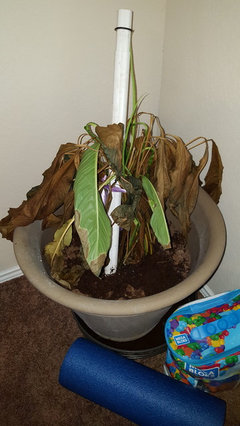
    I wanted to provide everyone with an update. After nearly a month of my Peace Lily trying to pass out of this earthly plane and my sudden efforts to save him, he hasn't kicked the bucket completely. As you can see from the photos from today, he has suffered quite a bit but seems to be holding on. I replanted him twice per my posts above, first in the only soil I had on hand and then again in the recommended soil. I have been watering only once a week and I spritzed his leaves once with water as well. I am not sure if it would help or hurt to cut off the obviously brown and dead leaves. I am mostly trying to leave him alone to recuperate. Should I remove the dead leaves?

    Landscape Ideas · More Info


  • 7 years ago

    I am sorry to say this, I think it's too late & your plant is dead.

  • 7 years ago

    The thing is, there are brand new green leaves out, so he's not completely dead. He was quite damaged but he's coming around.

  • 7 years ago

    Plus if a plant is going to die, it doesn't take a month. He would have been dead within a week if his roots were beyond help.


  • 7 years ago

    The dead leaves are not contributing anything to the plant so feel free to go ahead and cut them off.

    pandoraw thanked gardengal48 (PNW Z8/9)
  • 7 years ago

    I would leave the green, but damaged leaves until the new ones mature. As gardengal said, the brown ones can be safely cut off. It is coming back, there wouldn't be new growth if it was completely dead. It is also busy growing new roots. You wouldn't want to bother them to see though, lol.

    pandoraw thanked Sherry8aNorthAL
  • 7 years ago

    Any updates?

  • 7 years ago

    It looks like it’s time to throw it away and buy a new one. They are very inexpensive

  • 7 years ago

    If it were my situation I would discard and replace the specimen instead of looking at a very sad plant for an extended period of time.

  • 7 years ago
    last modified: 7 years ago

    I was thinking the same thing. I really couldn't bear to look at that plant with all the dead brown leaves on it for a month. [g] But - I have been known to enjoy a 'project', like seeing if I could bring an almost dead plant back to life. I would have cut all the brown off right away. And maybe put it in a smaller pot until it recovered since the root ball must be smaller than the original pot it was in. I'd love to see an update, either way.

  • 7 years ago

    I always view a declining plant as a challenge. It's difficult for me to toss a sick plant, but I have no trouble adding a healthy one that I have no use for to the compost heap.

    Al

  • 7 years ago

    My peace lily recently had parts of it die. I cut off the dead leaves and found that if I left the whole rhizome under the planting medium with no leaves the roots rotted in the soil. It looks like in the center of your brown leaves are green shoots. I'm not claiming to be an expert, but this is what I've done, I pulled out completely the dead little plants within my pot. I was left with a much smaller healthy part of the plant. I put what was left in a smaller pot with better aeration. It looks like that may help save what you have left.

    It also seems like your mom likes to water your plant when it's still moist. I'm not sure what you can do about that. I'm sorry you're going through this. It's not fun to struggle with a plant you've had for years and watch it suffer. I hope this can help. :)

  • 5 years ago

    I wonder how your plant is doing. I'm currently going through this. A plant was given to me 20 yrs ago from someone now passed. I'm heartbroken and having trouble letting it go. I hope your update can offer comfort and hope...

  • 5 years ago

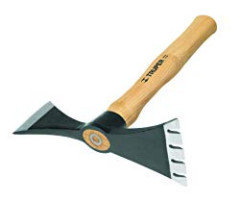
    Most commonly, peace lily in steep decline are stressed by over or under-watering (usually the former), or root congestion, which is best resolved by dividing the plant (preferred) or repotting (as opposed to potting up, which only partially and very temporarily relieves only some of the stress caused by root congestion. There is no need to stand on ceremony when dividing. I use a small (12" handle) mattock to make the divisions, and use the divisions that come from the perimeter of the root mass, which will be more robust than those in the middle.


    Very often growers conclude, because PLs are often found in situ (where they naturally occur) in riparian (river/streamside) settings, they like or prefer wet feet/soggy soil. This is not true. While the plant can readily adapt to various forms of hydroculture, they can't tolerate the stress of back and forth from wet soil to almost dry soil. The adaptation requires a physiological change in root structure. When the plant is in a riparian setting, roots will be filled with aerenchymous tissues which provide a pathway by which oxygen from above the water line moves through roots to fuel metabolic root functions. Plants grown in pots develop a parenchymous root structure which facilitates extraction of oxygen from air-filled pockets in the soil, which means the same care should be taken to provide a well-aerated medium and avoid a heavy hand on the watering can.

    PLs require regular applications of fertilizer. Foliage-Pro 9-3-6 is a solid choice with rates and frequency varying according to grower's choice of grow medium and watering habits.

    Al

  • 4 years ago

    Is your plant alive .??