Software
Houzz Logo Print
hutchae84

Help me, help this Camellia (pruning)

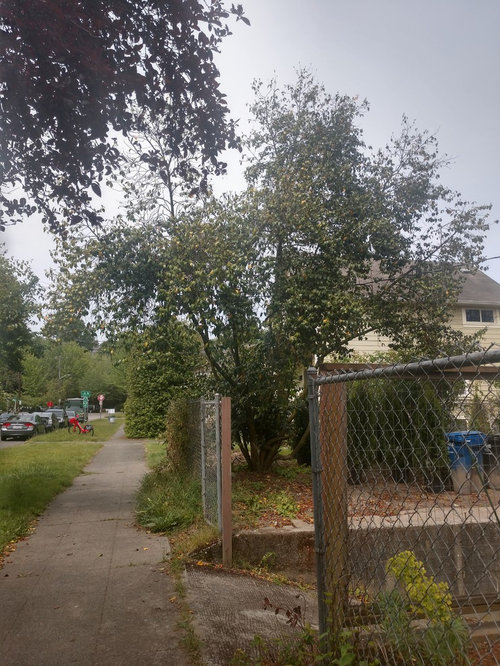
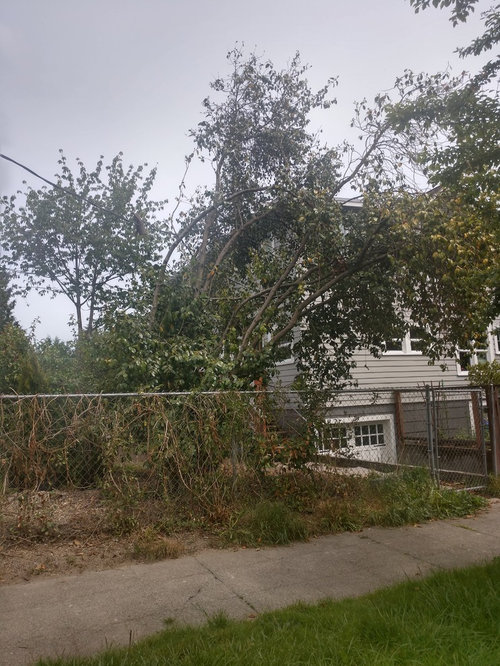
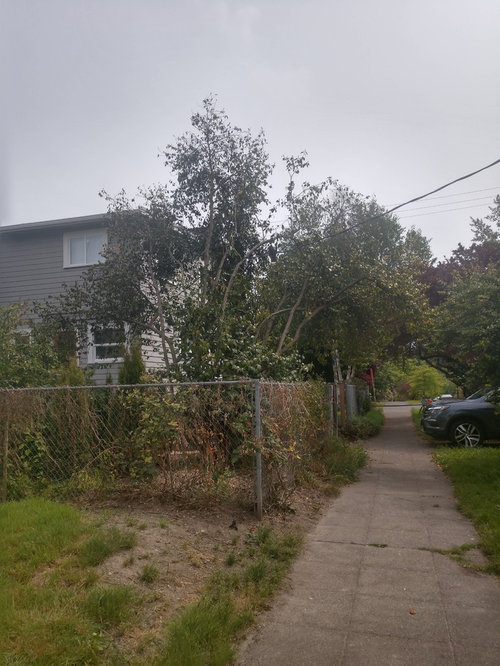
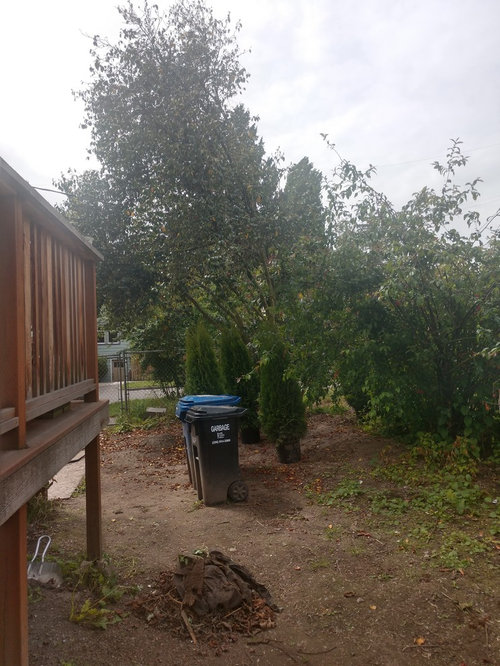
I am wondering if this very sad Camellia can be saved with some prunning and time. There was a dead Holly growing directly next to it which caused it not to grow in that direction. There was also an invasive raspberry growing up it which made a lot of its branches grow down. An aborist removed the Holly and now we are left with this. The arborist DID think it would start filling out again with time (bare side faces West).

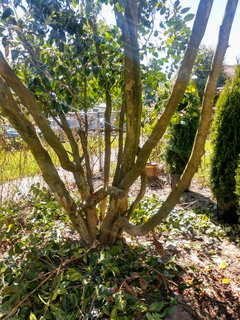
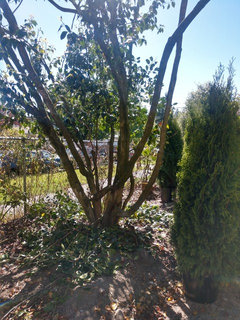
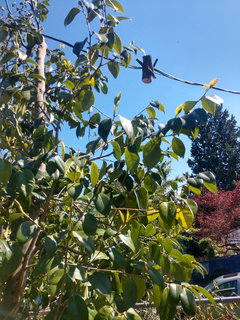
Any tips on pruning this tree? general shape? Branch cuts we should make? Here is a view on all 4 sides. I can take further pictures.

Comments (17)

  • 7 years ago
    last modified: 7 years ago

    What kind of a "look' are you aiming for at this point? Smaller and denser? Don't worry about the operation too much because you can cut a camellia at any point from the root crown to the uppermost branch trip and it will re-sprout. Tea plants (Camellia sinensis) even tolerate the constant picking that occurs on tea plantations.

  • 7 years ago

    Camellias respond very well to hard pruning and now is an ideal time to do so, so I would take it back to whatever size you feel is best for your setting. And it won't hurt to give it a dose of rhododendron or camellia fertilizer after pruning and be sure to keep it watered well during any dry spells this summer.

  • 7 years ago
    I really love the look of a fuller, upper canopy and a bare bottom part. My neighbor has one that fits this and I wish I could post a picture, I'll see if I can find an example online.
  • 7 years ago

    That is just one pruned into a tree form....also very common and easy to do. Establish where you want the canopy to begin and remove all stems/twigs from the trunk(s) below that point. These look best if the canopy has approximately the same height as the bare trunks :-) (5' tall trunk = 5' tall canopy)

  • 7 years ago
    last modified: 7 years ago

    Except in this instance much of the previously shaded specimen is now flopping over badly. So if you want to use the existing main stems to form a "tree" you are going to have to rig up something to make and keep these more vertical, at least until they stiffen up enough for the supports to be taken away.

  • 7 years ago
    Thanks I appreciate everyone's advice. I'm glad to hear I can prune away with out destroying the tree and it should bounce back. I can take a picture of the base trunks tomorrow as well as the stems that flop on the west side. The back of our house gets SO MUCH sun now that the Holly is gone so we are hoping the Camelia can eventually provide us with some shade.

    And yes the weeds! I've been trying to prune them back a little while spraying the leaves that remain. I just want to make sure they are all the way dead before I start pulling them. I have raspberry, climbing nightshade and ivy back there so if anyone has any additional tips on that, feel free to share.
  • PRO
    7 years ago

    To anyone who ALREADY has English ivy, I would recommend assessing whether it could be useful before getting rid of it. If one needs a relatively low, evergreen groundcover for a sizeable area, then ivy suits that purpose. (It grows too fast to work well for a small area, though like most plants, becomes more compliant the more it is trained.) Also, factor in if it exists in surrounding properties. If it does, it's not going to work well to have a differing concurrent groundcover and try to keep the two apart. That would be impossible without above-and below-ground physical barriers or a full time team of servants.

    As far as eradicating rasberry (if you are talking about it as a weed), I can't recall for sure, but think it is one of those plants immune or resistant to Round-Up. In those cases, herbicide containing 2,4-D (such as Weed-b-gone) in the recipe usually works. There is quite a number of plants that Round-Up alone does not kill. Mixing it in the tank with a 2,4-D herbicide, for general weed killing, will usually take of anything, though some very tough, established plants may need a subsequent hit after partial regrowth.

  • 7 years ago
    sorry I misspoke. it's not english ivy, it's bindweed or morning glory.

    I've been using round up on the raspberry so that's good to know it might not be effective, it is definitely hurting it but it's not killing it...yet.
  • 7 years ago

    Oh, raspberries are just as susceptible to RoundUp/glyphosate as are most other plants! But well established raspberries can have a large and complex root system that may require more than a single application. Most woody plants will respond in a similar manner. For faster control or knock back, you need a herbicide that is intended for woody plants, typically something with triclopyr as the actve ingredient.

  • PRO
    7 years ago

    I suppose a lot of homeowners buy prepared Round-Up, which probably most pros never do. We would mix it from concentrate. There is a schedule of strengths for a variety of plants, according to their difficulty of being killed. Some plants require a stronger shot. Others are killed so easily that one need merely pass Round-Up vapors over them, and they die. (I'm speaking figuratively, of course! No plant is that easily killed!)

  • 7 years ago
    Thanks Gardengal, I'll check out some with that ingredient! I've been applying mutiple doses since the weather has consistently hit 50 degrees and we are in the growing season. but you know how our weather is...I check the forecast for no rain, apply and then we get a surprise rain shower shortly after. I think it's working though, most of the plant is fully brown, I just don't want to trim back all the way till I know it's worked it's way into the root system.

    Yaardvark- yes I have just bought the premixed kind but I have definitely noticed the different strengths. I have the one in the white bottle now and notice it's a lot more weak than the one we had previously bought in a black bottle (for posion hemlock). I usually prefer the old fashioned way of weeding (by hand) but I know I would be fighting that battle for years.
  • PRO
    7 years ago
    last modified: 7 years ago

    Not only inflexibility in regards to strength, but the premixed name brand is much more expensive. Even if I wanted the convenience, I'm too Scotch to pay the premium. It's a much better deal to buy generic glyphosate in quarts or greater size. (And I could only tolerate a backpack sprayer ... not the kind that rips your arms out of the shoulder sockets.)

  • 7 years ago

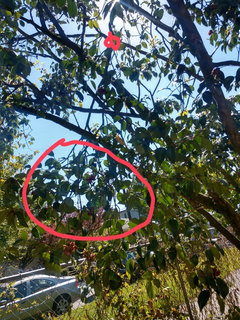
    so I started trying to tie back a little bit today and pruned the under area a bit. I will need to have my husband helpel me with the pole saw to do the upper area I think. should I be tying back the smaller branches or large ones too? I assume I should just cut off any limbs that head south versus trying to tie those? I circled in red what I mean (two circles, little one wear it comes out of branch, big one is resulting foliage).

    I also took one of the base so you can kind of see what the trunk it looking like, I know it's not necessarily vase shaped but it makes a good climbing base so I might sacrifice looks for my kids joy.

    also I looked at the side that is missing leaves and it's starting to get a some new growth and it's all upward, also notice the remainder of the Holly, they forgot a piece.

  • PRO
    7 years ago

    I would not think of Camellia as a climbing tree. That would have to be something else.

    I think you are misunderstanding my earlier directions. The red line is the cut line. And if I had to cut it lower, I would do that. (I'm not saying for you to do it, but I would cut it to the ground and grow the whole thing over if I wasn't happy with any of the trunks! Here, it looks like the bottom 3' or 4' is savable.) I'm saying that once the tree starts to go sideways, all of that must be cut off. Straight across. And the tying up is only done later in the summer as a way to collect new growth that is yet to come. You'll not be able to tie up old, misshapen growth. At the beginning of this process, there is nothing for you to tie up at all. You only will & remove. I'm saying keep the part of the plant that is correct and get rid of everything above it, and regrow the entire top. With an established root system. a large percentage of what you cut off will grow back, but it will be arranged better, thanks to uniform access to light, and what falls outside of the arrangement can be tied back into the cone shape later in the summer because it is young and pliable.

    The exercise is about creating a trunk system without limbs that deviate outside of the cone/vase shape. There is no way to get deviant trunks back into shape, outside of regrowing them. You have to cut it across straight, like my red line in the earlier picture. If you don't, shade from upper branches will mess up the sorting and arranging process, which comes about on account of uniform light, and make lower branches grow lopsided.


  • 7 years ago

    Kids will climb anything. They're not fussy about the species. OP may wish to compromise between fun for the offspring and the 'perfect' shrub trained as tree trope.

  • PRO
    7 years ago

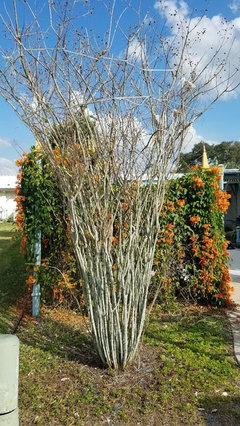
    Here, it's winter and I had just removed old ties in this crape myrtle, except for the ones at the top. The only trunks that hadn't conformed to the cone shape were a couple of new ones at the bottom, and the new growth still tied at the top.

    This tree was 6' tall with 15 trunks five years ago when I cut it to the ground. My express purpose for cutting it was to create the maximum number of trunks. (Why ... because we have to experiment to find out what happens when one does such and such.) 45 trunks came back and a couple dozen or so more trunks came along later as the tree grew. If they were at the outside of the cone, they got some light and were relatively straight (how I like them). If they were at the interior of the cone, they were all snakey and had to be fixed a good bit with tying -- which was a pain I wouldn't have bothered with, except for it being an experiment in keeping as many as possible. The top has never been cut except lightly once per winter just to even up growth and make it straight across. (It still formed a round head when new growth came out.) I was not trying to reduce its height. But now that it's reached terminal height, the top will get cut late every winter at 10' above grade.

    Even though you won't be trying to get a massive quantity of trunks as I'm doing here, the principle is basically the same ... cutting, growing, tying, tipping. In your case, though, I imagine you would want the camellia to grow as tall as it wants, so less work for you after the process of trunk creating is completed.