Software
Houzz Logo Print
webuser_321538724

what's the difference between compost and fertilizer?

7 years ago

I was thinking enough compost should act as fertilizer and I don't need to fertilize my plants as I have given them enough compost to start with. But it seems this is not the case after I realized my plants show signs of lack of nutrition. A bit google search says that compost and fertilizer are different and I am willing to accept this fact. For example, home made compost has N-P-K of 3-0.5-1.7 and the black cow manure compost got from Lowes has N-P-K of 0.5-0.5-0.5, while inorganic fertilizer can have N-P-K of say 20-20-20. So the idea I got is that fertilizer is always very high in N-P-K ratio while compost has a much smaller value. Is this really the case? Besides the N-P-K ratio difference, what else might differ for compost and fertilizer?


One confusion I have towards compost and fertilizer is that it is said compost is for soil while fertilizer is for plants, thus they are different. But don't plants get nutrition from soil? Adding compost to soil is then feeding nutrition indirectly to plants. So, to me no much difference, except that maybe plants are capable of absorbing nutrients from fertilizer faster than from compost. Is this the real difference between compost and fertilizer?


Another confusion came up to be by a link to a homemade fertilizer, which mentions making fertilizer by soaking grass clippers into water for 72 hours and then distill out the solution, which becomes fertilizer high in N. What makes it more like a fertilizer is it needs to be mixed with equal amount of water to dilute to use for plants. But grass clipper is also used for compost purpose. If a simple soak turns grass clipper into fertilizer, why isn't the whole grass clipper in compost turned into fertilizer as well?

Comments (14)

  • 7 years ago
    last modified: 7 years ago

    The numbers are, by comparable measurement, perhaps by dried weight or volume. A cup of chemical fertilizer will have more npk than a cup full of compost. Quit being an engineer and use common sense.


    What is the difference between air and compost? Do some research regarding how plants “eat”.....


    You have no way of knowing the bioavailability of what ever you are using other than hope.

  • 7 years ago
    last modified: 7 years ago

    Compost is not considered a fertilizer because the NPK cannot be verified or guaranteed (differs widely dependent on ingredients). That is a requirement to be considered a fertilzer under legal regulations, which govern all ferts. It is also a very low powered nutrient source compared to any commercial fertilizer, including most organics. It is more correctly labeled as a soil amendment, as its primary contribution to a garden is the improvement of soil structure, generally enhanced drainage and a source of OM to encourage and sustain soil biology. Any nutrienet contribution is just a bonus

    Compost - and any dry organic fertilizer - has to go through a complex process of consumption and digestion by soil biology before any nutrients are released to be taken up by plant roots. So by definition these are considered 'slow release' nutes and can take weeks to months before they become available. Commercial synthetic ferts are immediately available (unless treated to slow or control the nutrient availability over time), so quite fast acting. But all are accessed by plants in the same manner, as liquid soluble ions.

    It depends on both your current soil and the plants in question as to whether or not compost provides sufficient nutrients to forego any additional fertilization. With any reasonably fertile soil, mulching with compost in any landscape planting bed is generally more than sufficient to sustain adequate nutrient levels. For a vegetable garden or something with annual cropping, the nutrient draw typically exceeds what is available and supplemental fertilization is often required.

    John Lee thanked gardengal48 (PNW Z8/9)
  • 7 years ago

    Thanks, so you think compost can be regarded as slow release fertilizer with low unpredictable nutrient content, is it? Usually commercial fertilizer has very high content NPK value, but it usually needs to be diluted many times to apply and thus the actual content which can be used to treat plants is always quite low and the amount limited. May I say in this sense compost is a very convenient slow release fertilizer to use without the hassle of being diluted and nutrient amount counted? I think this should resolve my confusions towards the connection between compost and fertilizer, and address why grass clipper can be made a fertilizer by being soaked in water for a few days.

  • 7 years ago

    First, compost cannot be considered a fertilizer at all because it does not meet the requirements that govern what a fertilizer is. A great many garden soil amendments provide nutrients in some form or another but most are not fertilizers unless they can guarantee a certain minimum percentage of one or more of the three primary plant nutrients. To be considered a fertilizer, the nutrients in the product must be quantifiable with a guarantee of the percentages (aka, the 'guaranteed analysis' or most often, the NPK ratio)

    Not all commercial fertilzers need to be mixed with water or diluted. Many are available in granular form intended to be applied directly to the soil in that manner.

    And grass clippings soaked in water is not a fertilizer...again because it cannot meet the requirements of what a 'fertilizer' is. At best, it is similar to compost tea in that it may supply some low nutrient availability but it is not quantifiable and therefore can never be considered a fertilizer.

  • 7 years ago
    last modified: 7 years ago

    I am not concerned with what some government bureaucrat thinks of compost or any thing else concerning my gardens. Compost is a fertilizer and is a better fertilizer. because it's effective for this years crop and lasting benefit into the future.

    John Lee thanked John D Zn6a PIT Pa
  • 7 years ago

    I understand what you mean. To home gardener like me, I only care about whether my plants get proper feeding they need. Whether it is government defined fertilizer or not is really not of much concern although I understand with fixed numbers we have better control on what we input for our plants. I would like to get the characteristic of fertilizer and try to see whether I can home make them myself in the future.


    The reason behind my original post is, I need to feed my plants now but I don't know whether I should use the black cow compost at hand or go purchasing commercial organic fertilizer or home make fertilizer for my plants. So I need to be clear about compost and fertilizer, and whether home made fertilizer can be effective and helpful enough for the plants. I mainly learn homemade fertilizer from online, its basically mixture of egg shell powder, dry banana peel powder etc, and don't know whether they could act quickly and effectively enough as commercial fertilizer purchased from shop.

  • 7 years ago
    last modified: 7 years ago

    In addition to agreeing with everyting GardenGal said, let me add that the term "commercial fertilizer" often confuses gardeners. A fertilizer is simply an amendment that supplies N-P-K to your plants. "Commercial" just means that you bought it.

    Many people see the word "fertilizer" and immediately think of synthetic fertilizer like Miracle Gro. But remember, fertilizer can be synthetic or organic. Some examples of organic fertilizers are fish meal, chicken manure, and bone meal.

    While a synthetic fertilizer is balanced in the lab to provide specific N-P-K delivery, most organic amendments tend to be N or P or K by themselves. Organic fertilzer blends combine these ingredients to provide an N-P-K balance that is targeted at either general gardening or specific types of plants. Something like a 5-5-5 is good for most annuals.

    Compost is a healthy addition to most gardens. But especially if you are vegetable gardening and removing the fruits of your labor every year instead of returning them to the soil, you are going to need to put something back. And you do that by adding fertilizer. Native people did that by adding fish or seaweed to their planted seeds. I do that by working some organic fertilizer into the garden in the spring, and maybe giving very hungry vegetables a bit more at the beginning of July.

    So, fertilizer is not a dirty word for organic gardeners. To us it may be composted cow or horse manure, but if it delivers N-P-K it is fertilizer just the same.

  • 7 years ago

    John Lee

    i take by black cow compost you're talking cow manure. If it's black it's well composted.

    I can tell you that when I dug in 2 inches of mushroom compost ( manure ) and then added 2 spade fulls into the planting hole I planted my tomatoes in was too much. The plants grew 12 foot high, but still produced the same crop of tomatoes. The plants outgrew the blight/Septora Leaf Spot I've been getting.

    From looking at NPK values for manure I'd say that you get a balanced fertilizer with some micrometals. I was reading about russeting on apples and it was suggested that it's possibly a shortage of Boron in the soil. When I looked at the values for manure there was some boron in manure.

    I grow some vegetables, including heirloom beefsteak tomatoes and corn and am happy using nothing more than manure with a little compost added in. I have also grown corn in unamended clay and there is a huge difference in the results.

  • 7 years ago

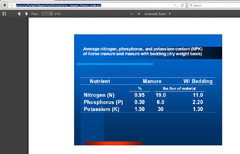
    NPK of horse manure from this link.
    N 0.95, P 0.3, K 1.5

    This may look low to you but remember you're sprinkling on fertilizer and piling on the manure. The numbers you see are sometimes a percentage of the weight of what you're using. I see occasionally how many pounds of nitrogen the is in a ton of manure, not so helpful even if you're getting a pickup truck load. It's my guess that a pickup truck of manure doesn't weigh a ton, but that's just from the feel of the truck by the way it handles. At my age it seems to be getting heavier.

    From my many years of gardening using manure I would say it's effective immediately. But I'll dig in a couple inches in early spring and maybe plant later but the nutrients are there when my plants need it. And like said earlier; you don't have to keep "side dressing" all year. And it improves the soil!

    You can find horse manure in most parts of the country. If nothing else google "horse boarding" with the name of your town in the google search. That's maybe the easiest place to get free manure as from my experience they don't spread it every spring like a farmer might. So they are usually thrilled to have someone haul it away.

    If you find more than one source and have a choice of manures. The best in my opinion is manure with hay in it as the hay soaks up the urine so there's more nitrogen, next best is manure with no bedding. I walked away this spring from a pile about 100 feet in diameter that was the worst choice, in my opinion. Manure with wood chips used for bedding. I hated to leave that site. The pile was maybe 4 feet high. I could've backed my rental pickup to the pile and used a wheel barrow and a plank to fill the front of the pickup.

    If however your looking for wood chips and can't find anyone to deliver free, then that is an excellent source for chips. It's going to compost much faster than plain wood chips.

    Speaking of compost you want the "well composted manure". I usually dig around a pile and find the oldest manure, which is the manure where they haven't added to lately. Horse manure will be brown with rollers when fresh. As it composts it turns grey and is steaming. Well composted horse manure is black. In some parts of the country where it's rolling hills the barns are built where two levels of the barn can be entered by just driving in. The animals are in the lower level and the hay is in the upper. I bring this up as many times the manure will be dumped from the upper level down a steep slope. What's important is that the old stuff is at the bottom, on the lower level.

    John Lee thanked John D Zn6a PIT Pa
  • 7 years ago

    I am not concerned with what some government bureaucrat thinks of compost or any thing else concerning my gardens. Compost is a fertilizer and is a better fertilizer. because it's effective for this years crop and lasting benefit into the future.


    Increasing the soil's CEC isn't equivalent to fertilizing no matter how angry you are.

  • 7 years ago
    last modified: 7 years ago

    I had 3 cu yards of mushroom compost delivered on May 15, this year. I started digging in that manure and the next day I planted 3 beefsteak tomatoes. A Mortgage Lifter, a Dester, and a Pink Brandywine. Where I planted the tomatoes was raw clay with maybe an inch of sod. I dug the sod in and also dug out some roots up to an inch and a half. I did this with a spade and a hatchet to cut the roots. This has been a lawn for at least 70 years that I know of.

    It's now July 7, the biggest of the 3 plants is the Mortgage Lifter, which is about 3 feet tall. I also have 10 or 11 total tomatoes with blossoms on them. I see no reason to think I won't have tomatoes by my usual first tomato date of the first week of August. I planted 25 heirloom tomatoes into that clay amended with the mushroom manure. I have never in my life used any bag of fertilizer. The last tomatoes I set out were where I had a horse manure pile over the winter, so I dug in less manure and also a lot of semi composted leaf compost. I have also never in my life added any fertilizer or compost nor any manure during the season.

    WAIT! one year I planted two crops of corn in the same year in the same soil, so in between I dug in another 2 inches of horse manure. And I have hauled manure in a plastic bag just to be totally honest here.

    You DO NOT need fertilizers. Well composted manure is effective immediately. It has an equivalent nutrient content equal to or better than that bag you're looking at in the store. Let's suppose that you fill a pickup truck with horse manure. I'd guess it weighs at least a 1000 pounds. Let's round off that 0.95 rating for nitrogen in horse manure to an even 1%. You've got 10 pounds of nitrogen in that truck.

    edit link:

    I posted a link earlier to a site that listed the NPK values for horse manure that no longer works. The actual link. The values are 0.95-0.30-1.50.

    The link is at: http://acrcd.org/Portals/0/Equine%20Fact%20Sheets/Horse_%20Keepers_Manure_Guide.pdf


  • 7 years ago

    Compost:

    Organic material is broken down by organic insects, organic bacteria and organic enzymes

    to a point organic plants can extract organic basic chemical elements and repeat the cycle.

    Chemical fertilizers:

    Organic natural compounds like organic natural gas, organic phosphate minerals, oganic sylvite & carnallite, organic ammonium chloride & sulfate are processed in organic acids, also found in nature like sulfuric and nitric acid sometimes with heat to extract organic basic chemical elements that plants can extract, and repeat.

    There is no difference. they all free up basic chemical elements from compounds plants can use.

    The only differences is how the organic compounds are broken down to the basic chemical elements.

  • 6 years ago

    Compost should be 100% organic and come from nature naturally. Fertilizer can be anything...natural or chemical with possible harmful elements in it. Nature can deal with compost but not so good with fertilizer.