Software
Houzz Logo Print
scibidr

Cavity Under Bilco Door Casting Needs Filling

7 years ago

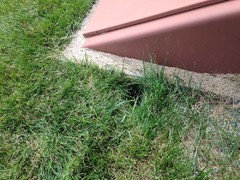
Our Bilco door stairway casting is bolted and caulked to the foundation wall. Apparently the space under the casting was not backfilled compactly. A hole has appeared in the ground beside the door. This hole “eats,” without apparent limit, whatever fill we are able to easily hand shovel. The hole is also home to various animals, serving as entry to what is a rather considerable void under the casting.


The hole funnels rain water so that even the slightest defect in the interior threshold caulking produces a geyser of water at the basement entry door. Apparently the cavity fills during rainstorms, thereby providing a reservoir with few pounds of hydrostatic pressure at the base of the entry steps. While minor improvements can be effected by improving the grading around the door, the overall layout of the land limits what might be achieved by regrading.


Regardless of regrading considerations, we would be grateful for guidance on how the cavity might be compactly filled without a major re-excavation project.

Comments (18)

  • PRO
    7 years ago

    Show overall pictures that explain what you mention.

  • 7 years ago

    Is the "casting" part of the door or the foundation to which it is attached? Bilco doors usually have a whole foundation around what is under them. The "eating" of the fill might just be animals digging it out again and again. Just some thoughts. Hard to say without a photo.

  • 7 years ago

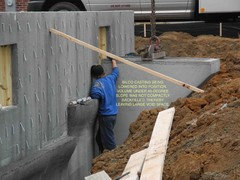
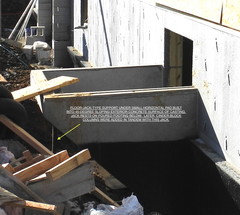
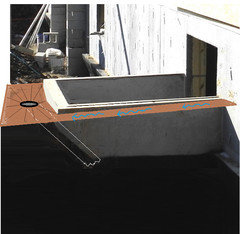
    Perhaps Bilcos were made differently in the past, but I am only familiar with what is shown on the Bilco web site and in the photos of my installation during construction (attached). As you can see, the casting is triangular in shape. I don't believe the animals are excavating as there is plenty of room for them down there! In my experience with prior houses, I have seen the effects of underground voids left by buried construction debris, improperly decommissioned septic tanks, and poorly backfilled foundation trenches. In the foundation-trench case, after "filling" the hole, the fill washed and settled deeper into the hidden void and the hole reappeared. I am certain that is what we are facing here. We only need a way to fill both hole and void once and for all without re excavating.


  • 7 years ago

    I know exactly what is being talked about, as I had this exact problem at my prior home. There is a triangular area underneath the steps that is hard to backfill completely.

    I had a pretty major wash-out appear after a few heavy rainstorms.

    I can tell you we continued to fill in the washed out area as best as we could, and it did eventually stop occurring. Fortunately I had used pavers around that area, so it wasn't a major inconvenience to lift those up and throw more dirt down what felt like an endless chasm. But that first hole was a shocker! It was big enough it would have swallowed the dog had we not seen it first. :)

  • PRO
    7 years ago
    last modified: 7 years ago

    I think there is a tendency to measure/estimate the size of the cavity by the rate and amount at which it can be filled. But you can only fill it with small spoonfuls of dirt at a time, so the problem seems to go on forever, making it seem huge. If you had direct access to the cavity, you could probably fill it once and for all, in a few minutes. The access hole is not much helpful because it is likely a circuitous route to the cavity and it is small. As I see it, the only cure is to gain access to the cavity with a hole large enough to fill it, in order to begin the process of filling it with fill dirt. I believe I would try for a process of filling it with a wet slurry of water and soil because the access hole does not have to be large. As long as there is a path, a slurry can seek the lowest level and deposit material. It is basically using the process of erosion to do positive work, except that you have to provide your own erosion by synthetic means. The process I'd be shooting for could make a muddy mess in the basement if there were any leak paths that weren't sealed, so that'd be the place to start ... by making sure no water can leak in.

    If this was my problem to wrestle with, I believe I'd start by trying to bore a hole as deep as I could with a set of clamshell post hole diggers. The hole would be in line with the slope at the bottom of the Bilco, centered with the unit. Before beginning, I'd clear any plant material, including sod, away from the Bilco ... probably at least 18" at the sides and 3' at the head. You might think of the opening to the hole that is being dug as a drain. I would grade the soil all around the Bilco sloped to drain to this hole. (At this point, we're not sure how long this will take. If a rain comes, you'd want drainage to go into the on-purpose hole rather than in any other, which should be plugged as much as possible.)

    I would try to get the hole at least 4' down, farther if possible. If by then I didn't reach the cavity, I'd add some water to the hole to soften the soil and make it as much into a slurry as possible. Using a long, heavy, pointed iron bar, I'd try to stab through the base of the hole, trying to break through to the cavity. This might take a couple days of softening the soil and working with it. If I wasn't able to break through, I try to find some kind of auger with which I could bore the hole deeper, and continue with this process until the cavity was reached.

    After accessing the cavity, I'd make a wheelbarrow load of pourable fill dirt slurry and pour it into the hole. After the water from the slurry is absorbed into the surrounding ground, it will have shrunk and need another fill, keeping up this process until it can take no more. Then, fix the grade and reestablish sod and whatever plants were around the Bilco.

    Over a period of time, it's possible that a small amount of general settling could occur from the recently added fill. But this should occur mainly around the orignal "drain" hole that was created. It would likely be mild enough that it could bed addressed by adding topsoil over the sod and letting the sod grow through it.


  • PRO
    7 years ago

    If it was my house, I'd dig down to undisturbed soil and just fix it. What are we talking, 6 ft of recently backfilled soil?

  • 7 years ago

    Thanks so much “Yardvaark” for the effort you devoted to your helpful answer. It provides some concepts for us and confirms other ideas we have had. With respect to grading, landscape prevents improving the surrounding slope. Errors on the part of the builder and/or engineer resulted in most of the house being built 12” lower than designed. These errors have also caused other problems, as you might imagine.

  • 7 years ago

    To “Revolutionary Gardens”: We hope to avoid disturbing the surroundings by re-excavation as we have invested in the area around the Bilco. Another factor is the complexity of the void space. It will complicate compacting the fill. Not only is there a floor jack, but two very rough cinder-block support columns. The house was built five years ago. Thank you for your interest.

  • 7 years ago

    Does the house have gutters? The photo makes it look as though there is a large drip line, and if so, redirecting the water via gutters and properly placed downspouts may be helpful.

  • 7 years ago

    The house has gutters and we have gone to considerable trouble to duct the downspout flow well away from the house to a nearby swale. There are no trees to contribute leaves so the gutters are most effective. The "drip line" is merely where I flattened the grass while probing the hole.


    In most other ways, the house is well above the average grade of construction. This, in fact, is likely what is saving us from basement flooding. The basement walls are made from insulated pre-cast-concrete SuperiorWall, which has proven to be excellent in every way. We are quite sure that most of the water filling the void finds its way to the french drain and is pumped away by one of our four sump pumps (two primary and two battery backups - i.e., "belt and suspenders"). We have a dry basement. During a severe rainstorm, when we experience the threshold mini geyser effect, the water enters the french drain. Right now it is dry and the pumps only deal with a bit of HVAC condensate. Nevertheless, the caulk around the Bilco opening is a weak link in the chain; we would be more at ease having the void filled.

  • 7 years ago

    I had a "sinkhole" next to my crawlspace access and I filled it with rocks/stone. I haven't had an issue since, and we've gotten an extreme amount of rain this year.

  • PRO
    7 years ago

    It wasn't clear from your original post how long this had been in place. If it's been that long, and you're confident that the majority of settling has happened, I'd look into mudjacking or pumping flowable fill in there.

  • 7 years ago

    Thank you "Revolutionary Gardens." I haven't heard of mudjacking but just checked it out on Wikipedia. Maybe a key lead? Probably an experienced mudjacking contractor would know just what to do.

  • PRO
    7 years ago
    last modified: 7 years ago

    Never used mudjacking myself, but as I understand it, regular mechanical or hydraulic jacks move the concrete slab (or whatever) back in place, and then concrete is pumped into the cavity to permanently hold it in place. As I understand it here, the concrete is already in place and the dilemma is accessing the cavity ... which would be fine to fill with concrete if it were "available." But also fine to fill with mud, as that is what's already holding up everything everywhere else.

  • PRO
    7 years ago

    @Rev, I think we're on the same general path here. Only my suggestion is more of a homemade version.

  • 6 years ago

    @Revolutionary Gardens, do you happen to know the cost of Mudjacking vs. poly level foam jacking? What would be the better solution for preventing hydrostatic water from coming into the basement from the bilco doos?

  • 3 years ago

    Old post but did anyone ever try pumping 10-20 bags of quikrete in underneath as fill for a similar situation?

Sponsored
Peabody Landscape Group
Average rating: 3.5 out of 5 stars8 Reviews
Franklin County's Reliable Landscape Design & Contracting